What Is Perplexity AI? A Complete Guide for 2026Updated: October 04, 2026
Perplexity AI explained: how it works, why teams adopt it over ChatGPT, Gemini, and Copilot, and where it fits best in workflows. Learn
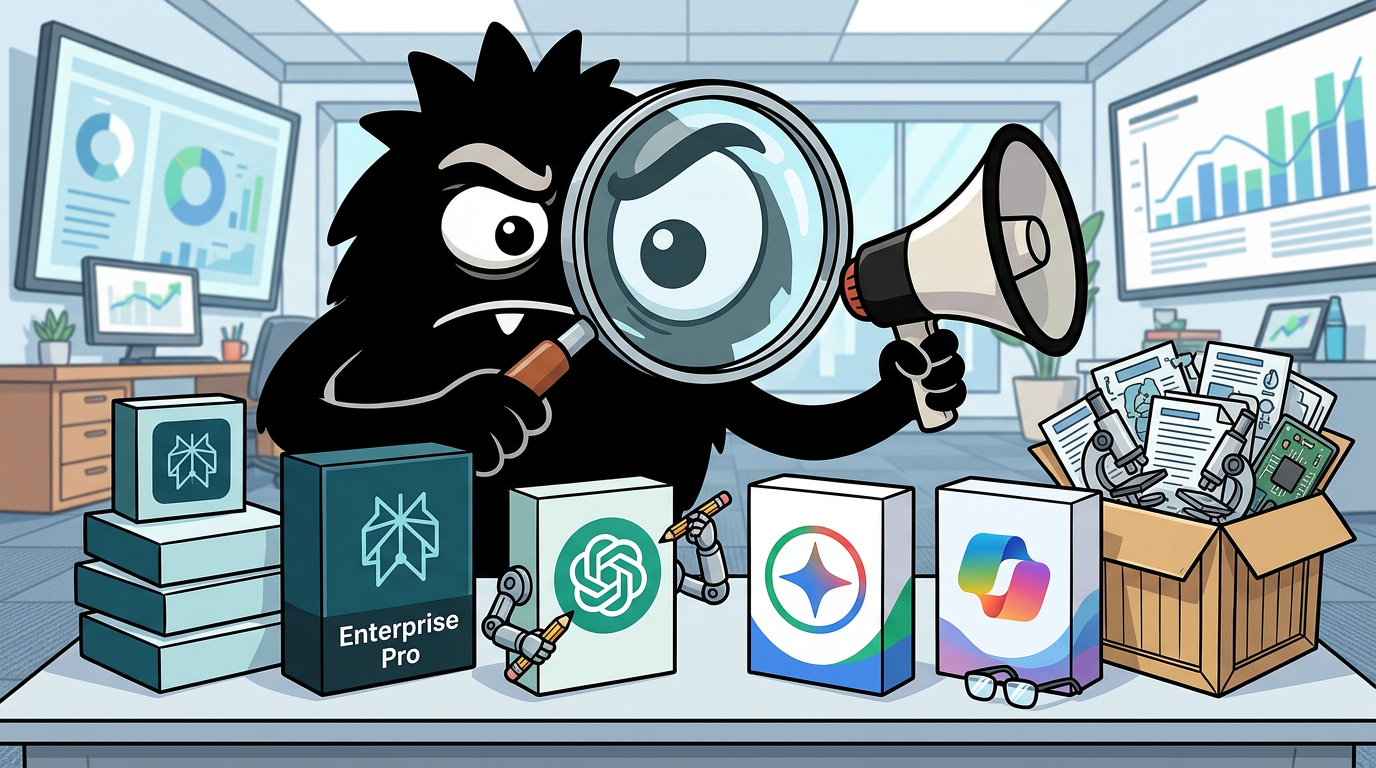
Why Perplexity Is Back in the Conversation
Perplexity is back because people are finally judging it on the right axis.
For a while, the market treated every AI product like a direct chatbot cage match: Which model is smartest? Which app has the best writing? Which assistant feels most magical? In that framing, Perplexity could look easy to dismiss. You can see the split clearly on X: one camp thinks it beats Gemini outright, another says it now feels old, and a third wonders whether it has already lost the consumer race.
Unpopular opinion: @perplexity_ai is much better than @GeminiApp
#perplexity #comet #gemini #google
Once you start using gemini pro, there is no going back to chatgpt. The whole google ecosystem will make you not to shift to any other platform.
Now, using perplexity feels like you are in stone age.
Perplexity went from "Google Killer" to completely vanishing from our timelines.
US daily active user share collapsed 65% in just five months. From 6% in October 2025 to 2% in March 2026.
It captures just 2% of the global AI traffic market, completely crushed by Gemini & ChatGPT's 56%.
At one point, they even tried to acquire Google Chrome for $34.5 BILLION😭
But that framing misses the core product. Perplexity’s pitch is not “we own the best model.” It is “we give you the fastest path to a current, sourced, inspectable answer.” Perplexity itself describes the product as an AI answer engine built around search, discovery, and cited responses rather than open-ended chat alone.[3] Independent breakdowns of the platform make the same point: its differentiation is retrieval plus synthesis, not just raw generation quality.[6]
That matters because many real work tasks are not creative-writing contests. They are research problems: What changed this week? What are the best sources? What can I trust quickly? For those jobs, Perplexity competes less with a blank chat box and more with a messy stack of Google, browser tabs, PDFs, analyst notes, and manual verification.
The renewed attention is also not just about consumer search replacement. It is being driven by enterprise features, connected workflows, and agentic execution that push Perplexity into a more serious category: research infrastructure for teams.[6]
What Perplexity Actually Is: Answer Engine, Not Just Another Chatbot
If you are new to it, the cleanest mental model is this:
Perplexity is a research interface that combines live retrieval with AI-generated synthesis and then shows you where the answer came from.
That is why the “fact checker” label is both right and too small. It captures the trust angle, but undersells the workflow design.
Claude is the visionary, ideas guy and head of strategy & growth.
ChatGPT is the workhorse.
Perplexity is the fact checker.
Gemini does design & visuals.
Co-Pilot is on a defined benefit pension and will send a formal response to an email if you reach out directly. Nothing else.
Perplexity’s getting-started materials emphasize real-time answers with linked sources, follow-up questions, and search-oriented exploration.[3] In practice, that means you ask a question, Perplexity searches the web and other available sources, pulls back relevant material, and generates a response with citations attached. The point is not merely to answer, but to answer in a way that can be audited.
That makes it especially useful for freshness-sensitive tasks:
- market updates
- competitor tracking
- product research
- news monitoring
- scientific discovery scans
- first-pass diligence
It is less compelling when the main job is pure drafting, storytelling, or freeform ideation. If you already pay for ChatGPT, Claude, or Gemini, that explains why Perplexity can feel redundant unless your workflow depends on evidence gathering.
ClaudeとChatGPT、Geminiを契約して使い分けるようになった結果、CopilotやPerplexityは殆ど使わなくなった。この辺はどんなことに活用できるかねえ。
View on XThe strongest short description in the current X conversation is this one:
Be @perplexity_ai (Perplexity):
Core product:
AI-powered “answer engine” that combines real-time web search with generative AI for cited, accurate answers (positioned as a smarter, more trustworthy alternative to traditional search or chatbots).
Key features:
- Real-time sourced answers with footnotes
Deep Research mode for long-form reports
Multi-model support (Sonar, GPT, Claude, etc.)
- Perplexity Computer (agent), browser (Comet), and enterprise tools
Traction (2026):
- Hundreds of millions in revenue run-rate
- Multi-billion dollar valuation (unicorn+ status)
- Millions of users across web + apps
Search-first AI for research, work, and curiosity
- Focused on transparency, speed, and reducing hallucinations via citations.
That framing is basically correct. Perplexity is not trying to be your only AI. It is trying to be the place you start when the task requires fresh information, traceability, and quick synthesis across sources.[3][6]
How Perplexity Works Under the Hood
Under the hood, Perplexity is best understood as an orchestration layer.
A typical request goes through four broad stages:
- Query understanding
The system interprets the user’s intent: is this a factual query, a research task, a long-context synthesis job, or a multi-step workflow?
- Retrieval and enrichment
It gathers live information from the web or connected systems, building context before generation.[6]
- Model routing
Instead of relying on one model for everything, Perplexity can route subtasks to different models depending on the job.[12]
- Answer assembly
It ranks findings, synthesizes them, attaches citations, and packages the result into something usable: an answer, a report, a table, or a longer research artifact.[2][4]
That routing layer is where most of the current debate lives.
Perplexity is a $20 billion company that built zero AI models.
Their product sits on top of 19 models made by other companies. Claude for reasoning. Gemini for research. GPT-5.4 for long context. Grok for lightweight tasks. Nano Banana for images. Veo 3.1 for video.
You write one prompt. Computer picks the best model combo for the job, spawns sub-agents in parallel, and runs the whole thing in a cloud sandbox while your laptop is closed.
400+ app connectors. Gmail, GitHub, Snowflake, Salesforce, Ahrefs, Shopify. Read and write access. One prompt can scrape your competitors, pull live financials from FactSet, query your data warehouse in plain English, and push a finished report to Google Slides. No API keys. No terminal.
The enterprise usage data tells you where this is heading. In January 2025, 90% of enterprise tasks on Perplexity ran on two models. By December, no single model held more than 25% of usage. A new frontier model launched every 17.5 days in 2025. Each one brought different strengths. The era of picking one model is ending.
Perplexity built none of the intelligence. They built the routing layer that makes the intelligence usable. Stripe didn't build the banks. Google didn't build the websites. The value is in making complexity disappear.
Four of the Mag Seven already use Perplexity's search API in production. Every model provider is now building orchestration in-house. The question is whether the routing layer stays independent or gets absorbed.
I wrote the complete guide to using Computer without wasting credits. 6 use cases, the prompt spec that controls cost, honest limitations.
The bullish case is simple: the future is not one model doing everything best. The future is a fast-switching system that picks the right model for reasoning, retrieval, long context, or speed, then hides the complexity from the user. Perplexity has leaned into exactly that thesis. Its enterprise messaging explicitly points to “model switching” as a practical advantage for teams that care about reliability and task fit over vendor loyalty.[12]
Company materials around Perplexity Computer also show the broader architectural direction: cloud-based execution, tool use, and multi-step task completion rather than a single prompt-response loop.[4] Computer for Enterprise extends that into isolated environments for longer-running work, which is important because agentic tasks require more than a good LLM — they need containment, tools, state, and orchestration.[2]
we ran an a/b test on perplexity replacing 4o with sonar and it's consistently better for retention. on internal benchmarks, it's currently only worse than gpt-4.1, competitive with gemini-2.5-pro (a reasoning model). and better than everything else. data flywheels are real if you can post-train and serve your models.
View on XPerplexity Computer’s core reasoning engine is Claude Opus 4.6, built by Anthropic. Its deep research runs on Gemini, built by Google. Lightweight tasks go to Grok, built by xAI. Long-context recall uses ChatGPT 5.2, built by OpenAI. Images come from Nano Banana. Video from Veo 3.1.
Perplexity built none of them.
The product is a routing layer. Your prompt hits Perplexity’s orchestrator, which picks the best third-party model for the task, runs it inside an isolated VM, and stitches the outputs together. That’s the $20/month value proposition: a switchboard sitting on top of everyone else’s infrastructure.
Their own data reveals the thesis. In January 2025, 90% of Perplexity’s enterprise queries routed to just two models. By December 2025, no single model commanded more than 25% of usage. The bet is that fragmentation accelerates, and the company controlling the routing layer captures the user relationship permanently.
Run the numbers on what that bet costs. Perplexity signed a $750M commitment to Microsoft Azure over three years. The company hit roughly $200M in ARR by February 2026 on a $20B valuation. Internal projections target $656M by year-end. That’s 230% growth required from a company that controls zero percent of the core technology it sells.
Every model provider is already building the orchestration feature in-house. Anthropic ships Claude Code and Cowork. OpenAI has Operator. Google has Gemini with native tool use. The moment these models get good enough at everything, the routing layer becomes a line item someone else bundles for free.
There’s a name for this in tech history: the Kayak problem. Kayak aggregated airline inventory better than anyone until the airlines rebuilt their own booking experience. The aggregator’s margin only existed in the gap between supplier capability and supplier distribution.
Perplexity is sprinting to lock in enterprise contracts before that gap closes. At $325 per seat per month for Enterprise Max, they need the AI model fragmentation thesis to hold for roughly 18 more months. If it does, they become the default interface for corporate AI. If it doesn’t, they’re Kayak with a $20 billion price tag.
The skeptical view is equally worth taking seriously. If Perplexity relies on third-party models, is it actually building defensible technology — or just packaging everyone else’s?
That’s the wrong question if phrased too narrowly. Plenty of durable infrastructure companies do not own the underlying primitives; they own the workflow layer that makes those primitives usable. The real question is whether orchestration, ranking, retrieval, citations, and execution become valuable enough to sustain an independent product.
And here Perplexity has one structural advantage many giants do not:
Google had every advantage. They own the models. They own the search infrastructure. They own the enterprise relationships through Workspace. They own Chrome. They own Android. Gemini went from 5.7% to 21.5% market share in twelve months.
And a 250-person startup still built the product Google can't.
The reason is structural. Perplexity routes queries to Claude, GPT-5.4, Grok, and Gemini based on which model performs best for each specific task. Google will never do this. Routing a user's query to Claude means admitting Claude is better at that task than Gemini. Every query sent to a competitor's model is a data point against the thesis that justified billions in Gemini R&D.
Google's AI strategy is vertical integration. Build the model, embed it in Search, embed it in Workspace, embed it in Android, and capture the entire value chain. That strategy took Gemini from obscurity to 21.5% market share in a year. It also made it structurally impossible to build a multi-model orchestration product.
Microsoft has the same problem with Copilot. They invested $13 billion in OpenAI. Copilot runs on GPT. Suggesting that Claude handles reasoning better than GPT would undermine the largest AI investment in corporate history. Copilot sits at 1.2% market share despite being embedded in every Windows machine and every Office installation on Earth.
The tweet's Stripe analogy lands here too. Banks could have built Stripe. They had the payment infrastructure, the regulatory licenses, the customer relationships. They couldn't, because Stripe's value proposition required connecting to every bank simultaneously. A single bank building Stripe would mean admitting their competitors' rails were equally valid.
Google could have built Perplexity in 2023 with 50 engineers. The technology wasn't hard. The organizational incentive was impossible.
That's why 250 employees and $200M in ARR can sit inside a market where Google is spending tens of billions annually. The gap between them will close on raw capability every quarter. It will never close on architecture, because closing it would require Google to become model-agnostic, and becoming model-agnostic would mean dismantling the reason Gemini exists.
A model-agnostic product can route to whichever model is best for a given subtask. A vertically integrated company often cannot do that without undermining its own platform economics. That does not guarantee Perplexity wins. But it does explain why it can ship a product that feels different from Google, Microsoft, or OpenAI even when those companies control bigger stacks.
Why Teams Switch: Citations, Speed, and Trust in Research Work
The simplest reason teams switch to Perplexity is not novelty. It is reduced verification time.
In most knowledge work, the expensive part is not generating words. It is checking whether the words are grounded. ChatGPT is often excellent at synthesis and drafting, but many teams still need to manually validate claims, find source links, and rebuild the research chain. Perplexity cuts that step down by design.
Story #6: Perplexity cites sources in 97% of responses. ChatGPT: 16%.
New platform behaviour data out this week sharpens the per-platform picture.
Perplexity is citation-first. Almost every answer includes a source link.
ChatGPT is synthesis-first. It cites rarely, mentions sometimes.
The platform you optimise for first should depend on what your audience uses, not on which one is easiest to track.
That citation-first behavior changes workflow economics. Instead of asking AI for a polished answer and then auditing it afterward, teams can start with a source-backed answer and decide how much polish to add later. For competitive research, market scans, vendor comparisons, and literature reviews, that is often the better sequence.
The result is that Perplexity becomes the first-pass diligence tool. Teams use it to gather evidence, discover sources, and map the problem space before moving into writing, decision memos, or presentations.
𝗘𝘃𝗲𝗿𝘆𝗼𝗻𝗲 𝗶𝘀 𝘀𝗹𝗲𝗲𝗽𝗶𝗻𝗴 𝗼𝗻 𝘁𝗵𝗶𝘀 𝗔𝗜 𝘀𝘁𝗮𝗰𝗸.
𝗧𝗵𝗮𝘁'𝘀 𝗮 𝗵𝘂𝗴𝗲 𝗺𝗶𝘀𝘁𝗮𝗸𝗲.
𝗣𝗲𝗿𝗽𝗹𝗲𝘅𝗶𝘁𝘆 + 𝗡𝗼𝘁𝗲𝗯𝗼𝗼𝗸𝗟𝗠 + 𝗚𝗲𝗺𝗶𝗻𝗶 𝟯.
𝗔𝗹𝗹 𝗳𝗿𝗲𝗲. 𝗔𝗹𝗹 𝗰𝗼𝗻𝗻𝗲𝗰𝘁𝗲𝗱.
→ Perplexity searches with verified citations
→ NotebookLM synthesizes massive data
→ Gemini 3 reasons across text, audio, video
→ Auto-generate presentations and infographics
→ Days of work become 20 minutes
This is your new research team.
Save this post, you'll upgrade your entire workflow.
Want the SOP? DM me. 💬
That stack logic is important. Perplexity often wins not because it replaces every other AI tool, but because it fills the research-and-verification layer in a broader workflow. NotebookLM can digest large corpora. Gemini can reason across Google’s ecosystem. ChatGPT can draft. But Perplexity is often the fastest way to establish what the evidence says right now.[3][6][12]
How Enterprise Pro Extends Perplexity Beyond Search
The bigger story in 2026 is that Perplexity is no longer just a consumer answer engine.
Enterprise Pro pushes it into secure organizational research, connected systems, and team governance.[1][7] That includes enterprise search across company knowledge, admin controls, and integrations that let answers draw from internal as well as public information.[1]
Then there is Computer for Enterprise, which moves Perplexity from answer generation into action. Perplexity describes it as agentic execution in isolated cloud environments, able to work through multi-step tasks with access to tools and enterprise systems.[2] That matters because many business workflows are not solved by “give me a paragraph.” They require browsing, extracting, cross-checking, filing, updating, and reporting across systems.
I've been testing Perplexity Computer and I'm super impressed with the product so far.
Here are 3 things it can do for your business that most people don't realize:
1) It picks the right AI for each subtask automatically. Claude for reasoning, Gemini for research, Grok for speed. You don't choose. It does.
2) It runs for hours (or months) without you. Describe the outcome you want, walk away. It breaks it into subtasks and executes them over time.
3) It has real tool access built in. Browser, filesystem, integrations. No MCP setup, no local config. It's all cloud-native.
It feels like hiring an AI project manager that coordinates a team of specialists.
The main downside is that it's only available on the Max plan ($200/mo).
This is also where Perplexity begins to look less like “AI search” and more like a competitor to enterprise assistants such as Copilot. CIO Dive’s reporting on Comet and enterprise tooling highlights this shift: Perplexity is packaging browser-based work, connected research, and agent assistance for business use, not just end-user Q&A.[5] Perplexity’s Comet for Enterprise Pro is explicitly positioned around the “intelligent business” concept, where the browser itself becomes part of the work system.[11]
The market signal here is not subtle. Partnerships and reseller motions are what companies do when they believe the product belongs in organizational budgets, not just individual subscriptions.
Softbank has signed an agreement with Perplexity to be an authorized reseller of Perplexity Enterprise Pro and deploy their 7,000-member sales team to scale Perplexity's adoption in Japan. This comes after internally adopting Perplexity and evaluating it against other tools. 🇯🇵
View on XPerplexity signed an agreement with SoftBank to grow Perplexity Enterprise Pro in Japan
SoftBank will deploy its 7,000-member sales team to accelerate Perplexity's adoption within businesses.
They have also been using Perplexity internally!
Enterprise adoption will not hinge on whether Perplexity feels cooler on social media. It will hinge on whether it can shorten high-value workflows: account research, competitive monitoring, analyst prep, internal knowledge retrieval, and long-running business tasks executed safely across systems.
The Real-World Use Cases Teams Actually Care About
The most persuasive case for Perplexity is still concrete workload fit.
One good example is scientific and clinical literature review. These tasks require broad retrieval, citation traceability, and fast synthesis across changing evidence. You do not just want an answer; you want to inspect the studies, compare claims, and refine the search domain. That is exactly the kind of job where Perplexity’s search-first design helps.
This would be very useful and alone would justify keeping my Perplexity Enterprise Pro subscription. The prompts I need Deep Research for:
1) Scientific research review generation (biological, clinical). Here's a prompt I submitted today "Generate a review of the current biologic therapies in development and approved for asthma"
2) Competitive landscape research (technology, biotechnology)
3) Market research (financial)
Please include:
- A toggle refinement
- File attachment
- Specific search domain specification
Another is competitive intelligence. Product teams, founders, and strategy leads constantly need snapshots of market positioning, pricing, launches, hiring signals, and investor narratives. Perplexity is strong at assembling those from multiple sources quickly, especially when the task is exploratory and cross-domain rather than narrowly tabular.
The same pattern holds for patent analysis, product landscape mapping, and investment research, where the work is too broad for a single manual search and too evidence-sensitive for freeform chat alone.
WHAT THE FUCK DID @perplexity_ai BUILD ⁉️
I just used Model Council + @comet + Assistant to run research that would take an entire team DAYS:
(1) Deep patent analysis — I had GPT 5.2, Claude Opus 4.6, and Gemini 3 Pro research the 50 highest-impact nanotechnology patents since 2020 across AI hardware, quantum photonics, neuromorphic computing, and spintronics. 55 steps. Three models working in parallel. Consensus table at the end showing where they agree and disagree.
(2) Full competitor breakdown — I ran a side-by-side comparison of every major AI subscription (ChatGPT Pro, Claude Max, Grok Heavy, Gemini Ultra) against Perplexity Max. Model Council, Comet Browser, Email Assistant — no other platform has any of it.
(3) Investment thesis — Model Council synthesized a 2026-2030 investment report across AI, edge compute, and crypto infrastructure using three frontier models simultaneously.
This isn't an AI chatbot. This is an AI research department that auto-routes your queries to the best models, browses the web agentically, and builds comparison tables and breakdowns in minutes.
No other platform comes close. I broke it all down below.
This is the sweet spot for multi-model, multi-step research. A single chat session can summarize what it already knows. A routed system can retrieve, compare, delegate subtasks, and produce consensus-style outputs across multiple model strengths. Perplexity Computer and enterprise tooling extend that into actual workflow execution, which is why the product is gaining traction in analyst, R&D, and strategy-heavy environments.[1][2][4]
Security, Compliance, and the Enterprise Buying Checklist
For enterprises, none of this matters if the security story fails.
Perplexity’s enterprise materials emphasize admin controls, data boundaries, user management, and privacy protections designed for organizational deployment.[1][8] The company’s security documentation highlights SOC 2 Type 2 and presents its platform in alignment with enterprise expectations around governance, privacy, and responsible handling of business data.[8] Its Enterprise Pro security blog also outlines controls around data isolation and trust features for workplace use.[9]
BREAKING 🚨: @perplexity_ai LAUNCHES MODEL COUNCIL, A NEW MODE WHERE GEMINI 3 PRO, OPUS 4.5 AND GPT 5.2 WILL WORK AS A SWARM OF ASYNC AGENTS ON YOUR TASK.
Perplexity MAX 🔥
Compliance positioning matters even more as Perplexity moves upmarket. The company has also pushed into government-oriented offerings, signaling an ambition to serve regulated and public-sector environments, not just startups and tech teams.[10]
This is the practical buying checklist:
- Can admins control access and usage?
- Can the platform separate public from internal data?
- Can it connect to enterprise systems without creating unmanaged sprawl?
- Does it meet baseline security and compliance expectations?
- Can agentic execution happen in contained environments?
Perplexity knows it cannot win enterprise deals on answer quality alone. It has to look deployable.
The Trade-Offs: Dependency, Differentiation, and Staying Power
The skepticism around Perplexity is not irrational.
It depends heavily on third-party models. That creates strategic vulnerability: providers can raise prices, improve their own products, or bundle orchestration directly into their platforms. Market share pressure is also real, especially in consumer mindshare where ChatGPT and Gemini dominate attention.[12]
But dependency cuts both ways. It also gives Perplexity flexibility. If the model landscape keeps fragmenting, the best user experience may come from a neutral layer that can switch fast, mix strengths, and avoid single-vendor lock-in.[5][12]
So buyers should be clear-eyed: Perplexity is not a winner-take-all AI destination. It is a workflow layer with a strong thesis. If that thesis holds — that research, routing, and agentic execution matter more than loyalty to one model — Perplexity stays highly relevant. If the major labs close the UX gap and absorb orchestration into their own stacks, the company’s moat gets thinner.
That is not a reason to ignore it. It is a reason to evaluate it based on today’s workflow value, not on abstract platform destiny.
Who Should Use Perplexity vs. ChatGPT, Gemini, and Copilot?
Here is the practical decision framework.
Use Perplexity when you need:
- fresh information
- linked citations
- source discovery
- multi-source synthesis
- research artifacts rather than just prose
- enterprise research connected to internal systems
Use ChatGPT when you need:
- drafting
- brainstorming
- coding help
- flexible general-purpose assistance
- conversational iteration on ideas
Use Gemini when you need:
- deep Google ecosystem leverage
- strong integration with Workspace
- multimodal reasoning inside Google-centric workflows
Use Copilot when you need:
- Microsoft-native workflow integration
- organizational standardization around Office and Windows environments
For most teams, the realistic future is not one winner. It is a stack.
Perplexity’s role in that stack is increasingly clear: the research and verification layer. It is the tool you reach for when the question is not “write something smart” but “show me what is true, current, and supported — then help me act on it.”[1][3][12]
That is why teams are switching to it. Not because it wins every benchmark, and not because it replaces every assistant, but because in evidence-backed knowledge work, it often removes the most painful step.
Sources
[1] Perplexity Enterprise — https://www.perplexity.ai/enterprise
[2] Computer for Enterprise — https://www.perplexity.ai/hub/blog/computer-for-enterprise
[3] Getting Started with Perplexity — https://www.perplexity.ai/hub/getting-started
[4] Introducing Perplexity Computer — https://www.perplexity.ai/hub/blog/introducing-perplexity-computer
[5] Perplexity aims for the enterprise with AI-enabled browser, tools — https://www.ciodive.com/news/perplexity-enterprise-ai-browser-tools/814609/
[6] How Does Perplexity AI Work? Full Breakdown — https://solutions.trustradius.com/buyer-blog/how-does-perplexity-ai-work/
[7] Perplexity launches Enterprise Pro — https://www.perplexity.ai/hub/blog/perplexity-launches-enterprise-pro
[8] Perplexity Enterprise — https://www.perplexity.ai/enterprise/security
[9] How Perplexity Enterprise Pro Keeps Your Data Secure — https://www.perplexity.ai/hub/blog/how-perplexity-enterprise-pro-keeps-your-data-secure
[10] Perplexity announces new government-focused services — https://www.nextgov.com/acquisition/2025/09/perplexity-announces-new-government-focused-services/407954/
[11] The Intelligent Business: Introducing Comet for Enterprise Pro — https://www.perplexity.ai/hub/blog/the-intelligent-business-introducing-comet-for-enterprise-pro
[12] Inside the Rise of Enterprise AI Model-Switching — https://www.perplexity.ai/hub/blog/inside-the-rise-of-enterprise-ai-model-switching
References (15 sources)
- Perplexity Enterprise - perplexity.ai
- Computer for Enterprise - perplexity.ai
- Getting Started with Perplexity - perplexity.ai
- Introducing Perplexity Computer - perplexity.ai
- Perplexity aims for the enterprise with AI-enabled browser, tools - ciodive.com
- How Does Perplexity AI Work? Full Breakdown - solutions.trustradius.com
- Perplexity launches Enterprise Pro - perplexity.ai
- Perplexity Enterprise - perplexity.ai
- How Perplexity Enterprise Pro Keeps Your Data Secure - perplexity.ai
- Perplexity announces new government-focused services - nextgov.com
- The Intelligent Business: Introducing Comet for Enterprise Pro - perplexity.ai
- Inside the Rise of Enterprise AI Model-Switching - perplexity.ai
- Perplexity Enterprise vs. Microsoft Copilot | Why Teams Switch - perplexity.ai
- Perplexity Enterprise vs. Google Gemini | Why Teams Switch - perplexity.ai
- Microsoft Copilot vs ChatGPT, Perplexity and Gemini - devoteam.com
Related Guides
OpenAI vs Azure OpenAI vs Replicate: Which Is Best for Building SaaS in 2026?
15 min read
The Odds on AI Supremacy: What a $2.3M Polymarket Bet Reveals About the Frontier Model Race in 2026
20 min read
What Is Framer? A Complete Guide for Developers in 2026
20 min read
The Best AI Market Signals in 2026: What Polymarket's Bubble-Burst Odds Reveal
18 min read