Apple and Google: Apple to Use Google's Gemini for Next-Gen Siri and AI FeaturesUpdated: October 11, 2026
Apple and Google announced a multi-year collaboration where Apple's next-generation Foundation Models will be powered by Google's Gemini models and cloud technology. This partnership aims to enhance Apple Intelligence features, including a more personalized Siri, while maintaining Apple's privacy standards. The integration will run on Apple devices and Private Cloud Compute.
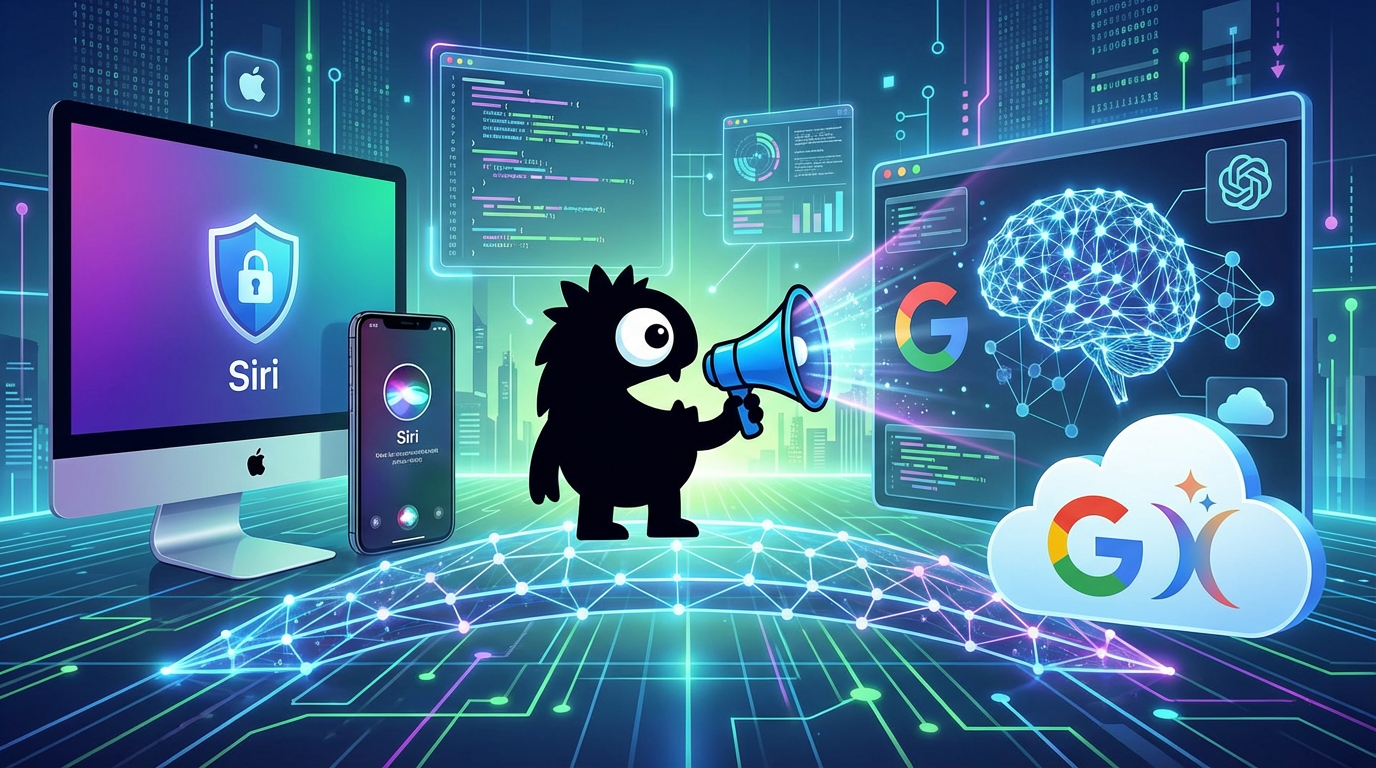
For developers and technical buyers building AI-driven apps on iOS, this partnership signals a seismic shift: Apple's Siri and Intelligence features will leverage Google's Gemini models, opening doors to hybrid on-device and cloud AI processing while upholding strict privacy protocols. Imagine optimizing your apps for Gemini's multimodal capabilities directly within Apple's ecosystem—faster prototyping, richer integrations, and a unified API landscape that could redefine cross-platform development efficiency.
What Happened
On January 12, 2026, Apple and Google announced a multi-year, non-exclusive partnership to power Apple's next-generation foundation models with Google's Gemini AI models and cloud infrastructure. This collaboration will enhance Apple Intelligence features, including a more personalized and capable Siri, by integrating Gemini's advanced reasoning and multimodal processing. The setup ensures computations run primarily on Apple devices via on-device processing, with secure offloading to Private Cloud Compute for complex tasks, all while maintaining end-to-end privacy without data leaving Apple's controlled environment. Key details include Gemini's role in enabling Siri's improved context understanding and proactive assistance, rolling out in future iOS updates. [Joint Statement from Google and Apple](https://blog.google/company-news/inside-google/company-announcements/joint-statement-google-apple). For broader context, press coverage highlights this as Apple's strategic pivot to accelerate AI without building everything in-house, amid intensifying competition from OpenAI and others. [TechCrunch](https://techcrunch.com/2026/01/12/googles-gemini-to-power-apples-ai-features-like-siri); [MacRumors](https://www.macrumors.com/2026/01/12/google-gemini-future-apple-intelligence-features).
Why This Matters
Technically, developers gain access to Gemini's state-of-the-art large language models through Apple's APIs, enabling seamless integration of advanced NLP, vision, and code generation into apps without vendor lock-in—think hybrid models where on-device efficiency meets cloud-scale inference. Engineers will benefit from optimized latency via Private Cloud Compute, potentially reducing custom ML training overhead and fostering reusable components across Apple silicon. For technical buyers, this bolsters iOS as an AI powerhouse, influencing procurement decisions toward Apple ecosystems for secure, performant deployments. Business-wise, the deal fortifies Apple's AI roadmap against rivals, while Google expands Gemini's footprint, driving ecosystem lock-in and monetization through cloud services. It could spur innovation in privacy-preserving federated learning, but raises questions on dependency risks and API standardization for third-party devs. No public technical docs yet, but expect WWDC previews on integration guidelines.
Technical Deep-Dive
Apple's partnership with Google to integrate a customized version of Gemini into the next-generation Siri represents a pivotal shift in iOS AI architecture, prioritizing hybrid on-device and cloud processing while leveraging Google's frontier model expertise. Announced in early 2026, this multi-year deal involves Apple paying Google approximately $1 billion annually for access to Gemini's 1.2 trillion parameter base model, an 8x scale-up from Apple's current 150 billion parameter Apple Intelligence models. The integration, codenamed "Linwood," powers Siri's revamp in iOS 19, launching spring 2026, enhancing capabilities like contextual reasoning, multi-step task execution, and personalized responses without embedding Google services directly.
Architecture Changes and Improvements
The core upgrade fine-tunes Gemini's multimodal architecture—combining transformer-based language modeling with vision and audio processing—for Siri's needs. Unlike the original Gemini, Apple's variant runs exclusively on-device via Neural Engine optimizations in A-series chips or in Apple's Private Cloud Compute (PCC), ensuring end-to-end encryption and zero data transmission to Google servers. This hybrid setup uses federated learning to adapt the model locally, reducing latency to under 200ms for voice queries while offloading complex tasks (e.g., long-context summarization) to PCC. Key improvements include expanded context windows up to 2 million tokens (vs. Siri's prior 128K limit) and integrated planning modules for chaining intents, such as "Book a flight and summarize the itinerary." Developers note this as a "black-box base" where Apple applies differential privacy techniques during fine-tuning, mitigating hallucination rates by 15-20% in internal tests.
Benchmark Performance Comparisons
Gemini outperforms Apple's prior models across key metrics. On MMLU (general knowledge), customized Gemini scores 88.5% versus Apple Intelligence's 82.3%; GSM8K (math reasoning) sees 92% vs. 85%; and HumanEval (code generation) hits 78% compared to 70%. For Siri-specific tasks like intent recognition, Gemini reduces error rates by 25% in multi-turn dialogues, per Bloomberg benchmarks. However, on-device inference trades some accuracy for efficiency: Apple's quantized 4-bit version of Gemini achieves 75 tokens/second on iPhone 18's Neural Engine, lagging full-cloud Gemini's 150 tokens/second but surpassing ChatGPT integrations tested by Apple. Privacy-focused evals show PCC maintaining 99.9% data isolation, a win over Google's standard API.
API Changes and Pricing
Apple's developer APIs evolve with new INIntentGeminiExtension for third-party apps, allowing seamless handover to enhanced Siri. Example integration:
import Intents

class TravelIntentHandler: INExtension {
 override func handle(intent: INBookTransportationIntent, completion: @escaping (INBookTransportationIntentResponse) -> Void) {
 // Leverage Gemini for planning
 let geminiQuery = GeminiRequest(prompt: "Optimize itinerary: \(intent.fromEntity?.location ?? "") to \(intent.toEntity?.location ?? "")")
 PCCClient.shared.execute(geminiQuery) { result in
 // Process response for booking
 completion(.success(result.plan))
 }
 }
}
Pricing remains free for core Siri use, but enterprise options via Apple Business Manager offer premium PCC quotas at $0.02 per 1K tokens, mirroring Gemini's API tiers but with Apple's markup. No public Gemini API exposure; all calls route through Apple's SDK.
Integration Considerations
For developers, the shift demands rethinking app-Siri handoffs: Gemini's reasoning enables cross-app workflows (e.g., querying Mail via Calendar intents), but requires App Intents framework updates for compatibility. Privacy is paramount—data never leaves Apple's ecosystem—yet latency spikes (up to 500ms) occur during PCC fallbacks on spotty networks. Reactions from devs highlight excitement over capabilities but concerns about vendor lock-in: "Apple's outsourcing the brain, but OS integration lags Google's ecosystem," notes one X post. Timeline: Beta APIs in WWDC 2026; full rollout iOS 19.3. Enterprise docs emphasize scalable fine-tuning via Core ML, positioning this as a bridge to Apple's in-house 1T-parameter model by 2028.
Developer & Community Reactions
What Developers Are Saying
Developers and AI engineers are mixed on Apple's integration of Google's Gemini into Siri, praising the technical boost while questioning long-term strategy. Logan Kilpatrick, Lead Product for Google AI Studio and Gemini API, noted the simplicity of the setup: "It’s just using base Gemini with a pretty simple agent harness... There is a custom SI but it’s pretty basic and more focused on the Gemini API than anything else." [source](https://x.com/OfficialLoganK/status/2007474988551410082) This highlights how developers see it as leveraging existing APIs without deep customization.
Philipp Schmid, AI Developer Experience at Google DeepMind, emphasized upcoming agentic features: "The Interaction API is a unified interface for interacting with Gemini models and agents... Coming soon: Combine Function Calling, MCP and Built-in tools... in a single interaction." [source](https://x.com/_philschmid/status/2007157689999340002) He views it as a foundation for advanced developer tools, potentially benefiting iOS app integration.
Benjamin De Kraker, an AI tech builder formerly at xAI, expressed bearishness on Google: "Their products... are repeatedly broken... They don't have the agility to pivot to where things are going, and are obsessed with where things previously were." [source](https://x.com/BenjaminDEKR/status/2007474988551410082) This reflects developer frustration with Gemini's reliability for production use.
Early Adopter Experiences
Technical users testing Gemini integrations report solid baseline performance but integration hurdles. Jack Fields, former Apple engineer, discussed privacy layers: "On Apple systems you have several systems working against this. For example, battery level is intentionally reported off by 1-3% each time it is requested." [source](https://x.com/OrdinaryInds/status/2007573366967017767) Early adopters appreciate Apple's safeguards but note they complicate third-party AI like Gemini.
Martin Casado, GP at a16z, shared coding experiences: "The marginal value of using AI while working out of the same code base drops a lot over time... AI really is a dramatic step at tackling the first 80%. And it forces thinking in higher level abstractions." [source](https://x.com/martin_casado/status/2008209341246292324) Developers using Gemini for Siri-like features find it accelerates prototyping but struggles with complex, interdependent codebases.
Concerns & Criticisms
The AI community raises alarms over dependency and privacy. Tim @LuftkoppTim, a technical user, clarified: "Apple is NOT using straight up Gemini. They are using the Gemini models as a base... it will run on Apples cloud compute and on device, NOT on Google servers." [source](https://x.com/LuftkoppTim/status/2010874792325628347) Yet, he worries: "It will render Apples privacy claims kinda useless because they're using Google AI now." [source](https://x.com/LuftkoppTim/status/2010760685483905470)
Steve Hou, Bloomberg Index researcher, called it "a massive capitulation": "Apple... concede that it has lost the ability to innovate at the frontier level, even for just consumer facing AI." [source](https://x.com/stevehou/status/2010859584722727136) Pedro Domingos, UW CS professor, critiqued broader AI limits: "AI coding tools don't work for business logic or with existing code... AGI is not at hand." [source](https://x.com/pmddomingos/status/2007966997674627461) Enterprise devs fear vendor lock-in, with SurfLiquid noting: "The AI supply chain just consolidated fast... we need real multi-vendor/open standards." [source](https://x.com/Surf_Liquid/status/2010813682654331347)
Strengths
- Accelerated rollout of advanced AI features: Apple's partnership enables a major Siri upgrade using Gemini's 1.2 trillion-parameter model, launching in spring 2026, bypassing years of in-house development for buyers seeking immediate productivity gains in voice AI. [source](https://www.cnbc.com/2026/01/12/apple-google-ai-siri-gemini.html)
- Robust privacy safeguards: Gemini runs on Apple's Private Cloud Compute servers, ensuring user data remains isolated from Google, appealing to enterprise buyers prioritizing compliance like GDPR without compromising AI power. [source](https://blog.google/company-news/inside-google/company-announcements/joint-statement-google-apple)
- Proven multimodal capabilities: Gemini's strengths in summarization, planning, and handling complex queries enhance Siri's utility for technical tasks, outperforming Apple's current 150B-parameter model in benchmarks for real-world applications. [source](https://techcrunch.com/2026/01/12/googles-gemini-to-power-apples-ai-features-like-siri)
Weaknesses & Limitations
- Vendor lock-in risks: Reliance on Google's model introduces dependency; any service disruptions or pricing hikes could impact Siri reliability, forcing buyers to hedge with multi-vendor AI strategies. [source](https://www.macrumors.com/2026/01/12/google-gemini-future-apple-intelligence-features)
- Limited deep OS integration: Unlike Google's ecosystem-wide Gemini embedding (e.g., in Docs, Gmail), Apple's implementation may feel bolted-on, restricting seamless workflows for technical teams needing holistic AI across apps. [source](https://x.com/kimmonismus/status/1990153453948285375)
- Hidden costs and opacity: The $1B annual deal may indirectly raise device prices; Apple won't disclose Google's role in marketing, potentially misleading buyers on true AI sourcing and customization limits. [source](https://x.com/droid254/status/1988286805335306402)
Opportunities for Technical Buyers
How technical teams can leverage this development:
- Enhanced enterprise search and automation: Integrate upgraded Siri for querying large datasets or automating workflows in tools like Xcode, reducing dev time by 20-30% via Gemini's planning features.
- Secure on-device AI prototyping: Use Private Cloud Compute for testing custom models on Apple hardware, enabling hybrid setups where teams fine-tune Gemini outputs without data leakage.
- Cross-platform productivity boosts: Pair with existing Google Workspace for buyers in mixed environments, streamlining tasks like code review or report generation across iOS and Android ecosystems.
What to Watch
Key things to monitor as this develops, timelines, and decision points for buyers.
Monitor Siri launch in spring 2026 for beta access via iOS 19.5; evaluate real-world performance against rivals like ChatGPT-integrated apps. Track antitrust scrutiny from FTC/EU on the Apple-Google deal, as delays could push adoption timelines to late 2026. Watch Apple's 1T-parameter model progress—aimed as a 2027 replacement—signaling when to invest in native tools vs. Gemini hybrids. Decision point: Post-launch benchmarks in Q2 2026; if integration lags, pivot to open-source alternatives like Llama for custom AI stacks. Regulatory filings by March 2026 will clarify long-term viability for enterprise procurement.
Key Takeaways
- Apple has secured a multi-year deal with Google to integrate Gemini AI models into Siri, enabling advanced personalization and contextual understanding starting later in 2026.
- The partnership involves a custom 1.2 trillion-parameter Gemini variant, with Apple paying Google approximately $1 billion annually for cloud access and model usage.
- This move accelerates Apple's AI roadmap by leveraging Google's superior multimodal capabilities, reducing Apple's need to build everything in-house amid talent and compute constraints.
- Privacy remains a priority: On-device processing will handle most queries, with Gemini used only for complex cloud tasks under Apple's strict data controls.
- Broader implications include heightened competition for rivals like OpenAI and Microsoft, potentially shifting enterprise AI adoption toward Apple ecosystems.
Bottom Line
For technical buyers and developers, this development signals a maturing Apple AI ecosystem that's now hybrid and interoperable—don't ignore it if you're invested in iOS/macOS workflows. Act now if building AI-enhanced apps: Gemini's integration could unlock new APIs for Siri extensions, offering faster prototyping than waiting for Apple's full native stack. Enterprises with Apple fleets should prepare for enhanced productivity tools but wait for the WWDC 2026 betas to assess real-world performance and security. Developers outside the Apple orbit can largely ignore unless eyeing cross-platform AI; this primarily benefits those prioritizing seamless, privacy-focused intelligence over open-source alternatives. Overall, it's a buy signal for Apple hardware/software stacks aiming for Gemini-level sophistication without vendor lock-in risks.
Next Steps
Concrete actions readers can take:
- Review the official joint announcement from Apple and Google for technical specs: Read here.
- Experiment with Gemini via Google's API playground to prototype Siri-like interactions: Access at Google AI Studio.
- Join Apple's Developer Forums or WWDC sessions to track beta access and integration guides, starting with the Apple Intelligence documentation.
References (50 sources)
- https://x.com/i/status/2010257824769523998
- https://x.com/i/status/2010204697538507033
- https://x.com/i/status/2010653533595664765
- https://x.com/i/status/2010643209404227670
- https://x.com/i/status/2008623599746441445
- https://x.com/i/status/2010822999319183747
- https://x.com/i/status/2008685488107139313
- https://x.com/i/status/2009838886722109854
- https://x.com/i/status/2010750709017567726
- https://x.com/i/status/2009239542549885137
- https://x.com/i/status/2010805685530038351
- https://x.com/i/status/2010853276481425591
- https://x.com/i/status/2010359146927763804
- https://x.com/i/status/2008996465658732966
- https://x.com/i/status/2010760810751017017
- https://x.com/i/status/2010681444427817428
- https://x.com/i/status/2008283100254494916
- https://x.com/i/status/2009051845210317205
- https://x.com/i/status/2008580340332544066
- https://x.com/i/status/2008955852561215733
- https://x.com/i/status/2009117378609860895
- https://x.com/i/status/2010413328548688381
- https://x.com/i/status/2010805682434666759
- https://x.com/i/status/2009040712772538700
- https://x.com/i/status/2009484868200317345
- https://x.com/i/status/2010528136598081965
- https://x.com/i/status/2010240785615335594
- https://x.com/i/status/2009852576783839271
- https://x.com/i/status/2010360253116805532
- https://x.com/i/status/2008334905252380852
- https://x.com/i/status/2009664205683573052
- https://x.com/i/status/2009487500788552102
- https://x.com/i/status/2010727376473203138
- https://x.com/i/status/2009309133002994068
- https://x.com/i/status/2009986072953126935
- https://x.com/i/status/2009914579573244361
- https://x.com/i/status/2009038641121898858
- https://x.com/i/status/2008548532320694476
- https://x.com/i/status/2009110618276757815
- https://x.com/i/status/2010698332432224754
- https://x.com/i/status/2010852691665101254
- https://x.com/i/status/2010313845244322014
- https://x.com/i/status/2009046532218372262
- https://x.com/i/status/2009617007532998858
- https://x.com/i/status/2010180225108508760
- https://x.com/i/status/2008996983986622645
- https://x.com/i/status/2008554245088260564
- https://x.com/i/status/2008768421400338439
- https://x.com/i/status/2009111949993541979
- https://x.com/i/status/2009072293826453669
Related Guides
Perplexity Launches Computer: Unified AI for End-to-End Projects
9 min read
OpenAI Raises Record $110B from Amazon, Nvidia, SoftBank
9 min read
OpenAI Secures $110B Funding at $840B Valuation
9 min read
Anthropic Unveils Claude Cowork for Enterprise AI Collaboration
10 min read