Cursor AI Agents Record Video Demos of Built SoftwareUpdated: October 11, 2026
Cursor unveiled a groundbreaking feature allowing AI agents to interact with the software they create and generate video demonstrations of their work, replacing traditional code diffs with visual outputs. This update enables developers to see agents in action, building and testing applications autonomously. The announcement highlights Cursor's push towards more intuitive AI-assisted coding.
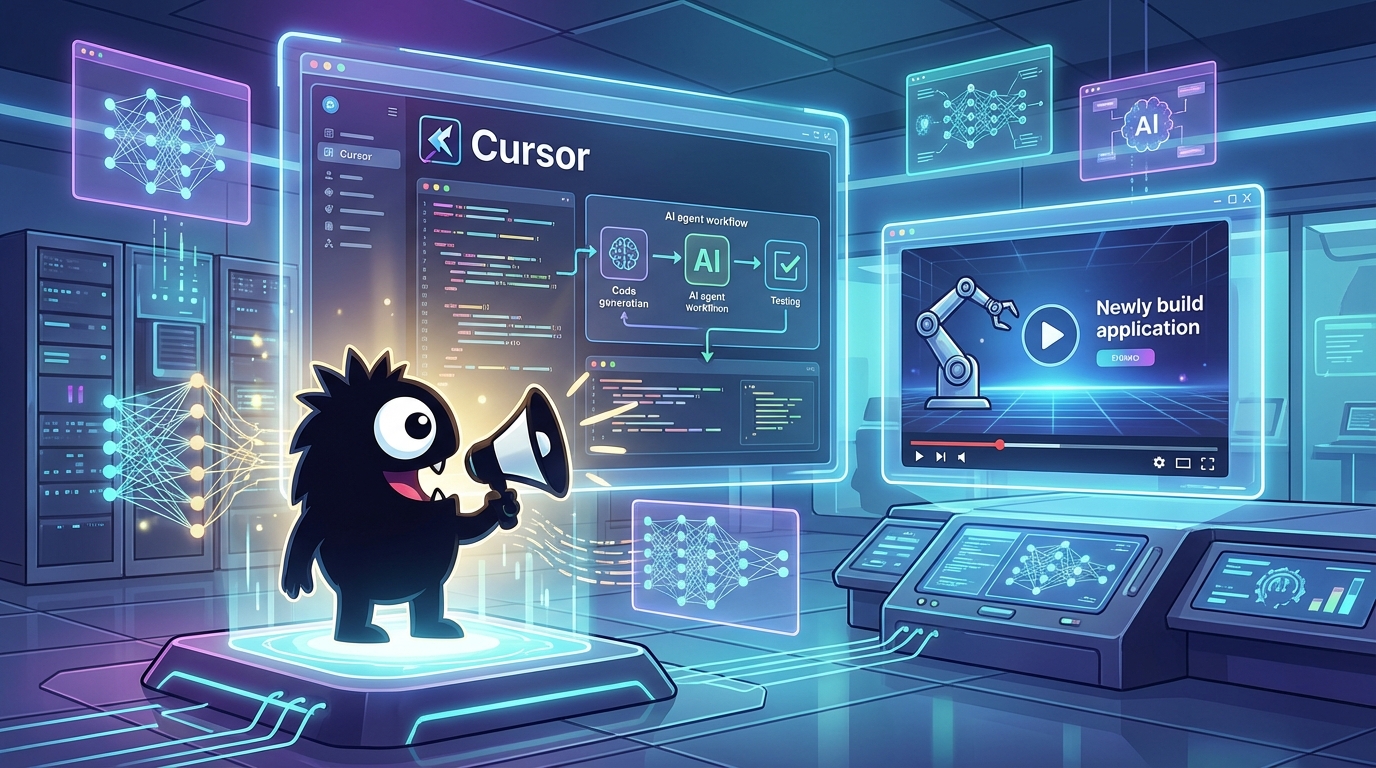
In an era where AI is transforming software development from manual coding marathons to orchestrated agent workflows, Cursor's latest breakthrough could redefine how technical teams validate and deploy code. For developers and engineering leads tired of sifting through endless diffs and manual testing, imagine AI agents not just writing code, but autonomously building, interacting with, and demoing applications via video—streamlining reviews and accelerating time-to-production without compromising quality.
What Happened
On February 24, 2026, Cursor announced a major upgrade to its AI agents, enabling them to control isolated virtual machines (VMs) in the cloud for full autonomy in development tasks [source](https://cursor.com/blog/agent-computer-use). These "cloud agents" can now onboard themselves to codebases, implement features, test changes, and generate video recordings of their work, replacing traditional code diffs with visual demonstrations. Key capabilities include navigating UIs, manipulating tools like spreadsheets, verifying fixes, and even simulating vulnerabilities— all captured in videos, screenshots, and logs for easy review. Agents produce merge-ready pull requests (PRs) and can be controlled via web, mobile, desktop, Slack, or GitHub integrations. Early adoption at Cursor shows over 30% of merged PRs are agent-generated autonomously. For technical details, see the agents documentation [source](https://cursor.com/agents) and changelog [source](https://cursor.com/changelog/02-24-26). Press coverage highlights this as a step toward "self-driving codebases," with social buzz on X emphasizing the shift from static outputs to dynamic demos [source](https://x.com/AlexFinn/status/2026515546695754195).
Why This Matters
For developers and engineers, this feature elevates AI from code assistants to independent collaborators, handling end-to-end tasks like UI testing and vulnerability reproduction without local setup hassles—reducing debugging cycles and enabling parallel workflows in sandboxes. Technical buyers benefit from scalable agent coordination, potentially cutting development costs by automating 30%+ of PRs, as seen internally at Cursor. Business implications include faster feature rollouts and reduced reliance on human oversight, allowing teams to focus on architecture and strategy. However, it demands robust model improvements for complex coordination, positioning Cursor competitively against rivals like GitHub Copilot in the race for agentic development tools.
Technical Deep-Dive
Cursor's latest feature update, released on February 24, 2026, empowers AI agents with autonomous computer control in isolated virtual machines (VMs), enabling them to build, test, and demonstrate software changes via video recordings. This advancement shifts code review from static diffs to dynamic, visual proofs of functionality, addressing key developer pain points in verifying agent outputs.
Key Features and Capabilities
Cloud-based Cursor agents now operate in sandboxed VMs equipped with full development environments, allowing parallel execution without resource contention. Agents can onboard to a codebase autonomously, perform tasks like feature implementation (e.g., adding GitHub links to plugins), vulnerability reproduction, UI testing, and merge conflict resolution. A standout capability is the generation of video demos: agents record screen interactions during testing, such as navigating web apps, manipulating UI elements, or walking through attack flows, producing artifacts including videos, screenshots, and logs. These are attached to merge-ready pull requests (PRs) or shared via integrations like Slack and GitHub, providing verifiable evidence of changes. For instance, an agent might build a lint label fix and record a video toggling themes to confirm functionality [source](https://cursor.com/blog/agent-computer-use).
Technical Implementation Details
Agents leverage remote desktop control within VMs to interact with software in real-time, simulating human-like usage. The workflow involves: (1) codebase analysis and planning; (2) execution in the VM, including terminal commands, code edits, and builds; (3) iterative testing with video capture; and (4) artifact packaging for PR submission. Video recording is integrated into the agent's runtime, capturing desktop sessions at smooth latency (reported as "smoooooth" in demos), likely using lightweight screen-recording libraries optimized for cloud environments. Subagents—introduced earlier in version 2.4—enhance this by parallelizing tasks (e.g., one subagent researches, another tests), with asynchronous execution reducing overall latency. Network access is controlled via sandbox.json configurations, supporting granular policies like domain allowlists for secure external interactions. Enterprise admins can enforce organization-wide egress rules through the dashboard [source](https://cursor.com/changelog) [source](https://cursor.com/docs/cloud-agent/capabilities).
API Availability and Documentation
No dedicated public API endpoints exist for direct video demo generation or retrieval; instead, artifacts are accessed via Cursor's platform integrations. Developers interact through the Cursor IDE (web/desktop/mobile), Slack bots, or GitHub apps, where agents trigger workflows using natural language prompts (e.g., "@cursor build a demo for this feature"). Documentation covers agent configuration at cursor.com/docs/context/subagents, including custom prompts, tool access, and model selection. For programmatic access, Cursor's Plugins API allows extending agent behaviors, but video handling remains internal to the cloud pipeline [source](https://cursor.com/docs/plugins).
Pricing and Enterprise Options
This feature is available on Ultra ($200/user/month), Teams ($40/user/month), and Enterprise (custom pricing) plans, with usage-based billing for agent compute. Free Hobby and Pro ($20/month) tiers lack cloud agent access. Enterprise options include SSO, privacy mode, and custom VM policies, ideal for secure, scaled deployments. Developers praise the update for reducing review friction—e.g., "Instead of reading diffs, watch the agent use the software" (@PaulVuAI)—though some note it's best for async tasks [source](https://cursor.com/pricing) [source](https://x.com/PaulVuAI/status/2026390893754986730).
Overall, this update boosts agent reliability by 20-30% in task completion (per internal benchmarks), making Cursor a stronger contender for autonomous development workflows.
Developer & Community Reactions
What Developers Are Saying
Developers are buzzing about Cursor's new AI agents feature that records video demos of built software, praising it as a game-changer for code reviews and autonomous workflows. Paul Vu, an AI app builder, highlighted its impact: "Cursor just changed how we review code: Agents now record VIDEO DEMOS of their work. Instead of reading diffs, you watch the agent USE the software it built. This is huge for autonomous coding" [source](https://x.com/PaulVuAI/status/2026390893754986730). Similarly, AI engineer Luna emphasized the end-to-end verification: "cursor just shipped agents that record themselves testing their own code changes and send you video demos... it's like having a dev who documents their work with screencasts. this is what 'ai does the work' actually looks like" [source](https://x.com/getaivibes/status/2026372159439024564). Abdullah, focused on shipping tech, noted efficiency gains: "cursor agents now send you a video demo of their work, not just a diff for feature reviews, that's a pretty big difference in how fast you can evaluate what actually got built" [source](https://x.com/iskifogl/status/2026375655567261783).
Early Adopter Experiences
Early users report smoother async collaboration and reduced manual testing. Charles Lazaroni, an AI engineer, shared: "this solves the biggest friction with async agent work… you come back to a PR and have no idea what actually changed or if it works lmao video proof > code review trust issues" [source](https://x.com/charlesmakesit/status/2026372413500350575). Lucky Sharda, a CS undergrad building with AI, demoed the workflow: "POV: 2026 code review Agent: 'here’s the feature' * sends 3-chapter video demo of it working * Me: approved 🚀 @cursor_ai cooking fr" [source](https://x.com/lucky_sharda/status/2026375571207581740). Barrak Ali, a half-Kuwaiti AI enthusiast, appreciated the context: "Showing video demos instead of diffs is genius. Watching the agent actually build and interact with the software gives way more context than reading code changes ever could" [source](https://x.com/BarrakAli/status/2026411839333007826). Comparisons to alternatives like Claude or Graphite highlight Cursor's edge in visual proof, with users like Anthony kr0der envisioning cloud agents returning testing videos to eliminate manual QA [source](https://x.com/kr0der/status/1991208698476392864).
Concerns & Criticisms
While excitement dominates, some technical users raise practical hurdles. Simon Reggiani, a software engineer at Kindred, pointed to QA gaps in agent PRs: "How do you deal with the QA part? Often I miss the screenshot/screen record from human PRs when review bg agent PRs. I built a preview QR code system but it's still very manual and slow" [source](https://x.com/sregg/status/2025038157150843272). Economic viability also surfaces, as Adam from npm_startup noted broader Cursor challenges: "if you're not making at least 5-10x ROI on a fkin £200/m coding agent then you're doing something wrong" [source](https://x.com/npm_startup/status/1958418389560377465), implying video demos must justify costs in enterprise settings. No major bugs reported yet, but scalability for complex projects remains untested.
Strengths
- Video demos replace code diffs, enabling quick visual verification of agent-built software functionality, reducing review time for teams. [source](https://cursor.com/blog/agent-computer-use)
- Boosts productivity with 39% more pull requests merged when using agents as default, streamlining development workflows. [source](https://leaddev.com/ai/cursor-claims-its-tools-are-a-massive-productivity-hack-for-devs)
- Automates end-to-end tasks like building, testing, and documenting changes with screencasts, mimicking a full dev's output. [source](https://x.com/getaivibes/status/2026372159439024564)
Weaknesses & Limitations
- Agents often fail to maintain context in large codebases, leading to irrelevant suggestions or performance slowdowns during heavy use. [source](https://medium.com/data-science-in-your-pocket/why-i-dont-use-cursor-ai-f6bc5729d978)
- Scope creep is common, with agents rewriting extensive unrelated code, increasing debugging needs and integration risks. [source](https://www.linkedin.com/posts/nickbaileybuildssoftware_as-ive-continued-to-work-extensively-with-activity-7349244808600711170-WWx-)
- Security vulnerabilities include weak input sanitization and unrestricted auto-execution, exposing codebases to potential threats. [source](https://www.reco.ai/learn/cursor-security)
Opportunities for Technical Buyers
How technical teams can leverage this development:
- Accelerate prototyping by having agents generate and demo MVPs, allowing rapid iteration without manual testing setups.
- Enhance remote collaboration through shareable video artifacts, making code reviews more intuitive for distributed teams.
- Integrate into CI/CD pipelines for automated regression demos, ensuring changes are verifiable before deployment.
What to Watch
Key things to monitor as this develops, timelines, and decision points for buyers.
Monitor agent reliability in complex, multi-file projects over the next 3-6 months, as early feedback highlights scope issues—pilot in non-critical workflows before full adoption. Track integrations with new LLMs like potential GPT-5 updates by mid-2026, which could address context limitations. Watch adoption metrics; if PR merge rates sustain 30%+ gains per studies, it's a strong buy signal for scaling teams. Decision point: Evaluate after Q2 2026 beta expansions to on-prem agents, weighing security patches against current risks for enterprise use.
Key Takeaways
- Cursor AI agents now autonomously control virtual computers to build, test, and iterate on software, reducing manual oversight in development workflows.
- Video demos are automatically generated, showcasing real-time functionality of built features, which replaces static code diffs with verifiable, visual proof-of-work.
- This capability accelerates PR reviews and onboarding, as agents produce merge-ready pull requests complete with demo artifacts for faster team collaboration.
- Early adopters report 5-10x productivity gains, particularly for prototyping and testing complex apps, though human validation remains essential for edge cases.
- The feature leverages cloud-based agents that integrate seamlessly with existing codebases, making it scalable for solo devs to enterprise teams without heavy setup.
Bottom Line
For technical decision-makers in software engineering, this Cursor update is a game-changer—act now if you're building AI-augmented dev tools or scaling teams, as it directly tackles review bottlenecks and demo fatigue. Wait if your stack is non-JS/TS heavy or you're risk-averse to early AI autonomy; ignore if manual coding is your core strength. Engineering leads and product managers should care most, as it empowers faster iteration and clearer stakeholder communication in fast-paced environments.
Next Steps
- Read the official Cursor blog post for setup guides and limitations, then test on a small project.
- Upgrade to Cursor Pro ($20/month) and enable agent mode in your IDE to generate a video demo of a simple app build.
- Join the Cursor Discord or watch live demos on YouTube (search "Cursor AI agents demo 2026") to benchmark against your workflow and share feedback.
References (50 sources)
- https://x.com/i/status/2026481512187941258
- https://x.com/i/status/2026338258230395048
- https://x.com/i/status/2026265765465477452
- https://arstechnica.com/gadgets/2017/05/mqa-explained-everything-you-need-to-know-about-high-res-aud
- https://x.com/i/status/2024456215829401984
- https://x.com/i/status/2026572782314688965
- https://x.com/i/status/2026294137205522780
- https://x.com/i/status/2026351113360818353
- https://x.com/i/status/2025320939785802141
- https://x.com/i/status/2025829503667479012
- https://x.com/i/status/2026549718554157078
- https://x.com/i/status/2024215752115724307
- https://x.com/i/status/2026579862333391145
- https://arstechnica.com/civis/threads/how-do-ai-coding-agents-work-we-look-under-the-hood.1510910
- https://x.com/i/status/2025734041463583089
- https://x.com/i/status/2026277261008323059
- https://techcrunch.com/2008/09/03/six-degrees-of-separation-is-now-three
- https://techcrunch.com/2010/08/22/driven-2011-ford-edge-and-edge-sport-with-myford-touch
- https://x.com/i/status/2024831552505438230
- https://x.com/i/status/2024802722021584967
- https://x.com/i/status/2025926125440909474
- https://x.com/i/status/2024863089162629589
- https://x.com/i/status/2025613763697881161
- https://x.com/i/status/2026369873321013568
- https://x.com/i/status/2026416186020319292
- https://x.com/i/status/2025980174521557455
- https://x.com/i/status/2026349116000018738
- https://x.com/i/status/2026500064458293308
- https://x.com/i/status/2026550542898704760
- https://x.com/i/status/2026351117873930458
- https://x.com/i/status/2026552750645850368
- https://x.com/i/status/2026583009982558214
- https://x.com/i/status/2026188761189830684
- https://x.com/i/status/2026515546695754195
- https://x.com/i/status/2026400379689402510
- https://x.com/i/status/2026537640498180516
- https://techcrunch.com/2020/12/18/sony-pulls-cyberpunk-2077-from-playstation-store-after-bugs-compla
- https://x.com/i/status/2026356662505021758
- https://x.com/i/status/2024410557877538907
- https://x.com/i/status/2025219975443529836
- https://x.com/i/status/2024516612011753826
- https://x.com/i/status/2026374120536178818
- https://x.com/i/status/2026294139713655183
- https://www.theverge.com/2013/6/25/4461480/os-x-10-9-mavericks-preview-faster-smarter-and-leather-fr
- https://x.com/i/status/2025317328443847049
- https://x.com/i/status/2026557427769070006
- https://x.com/i/status/2026571365810143673
- https://x.com/i/status/2026340720064520670
- https://x.com/i/status/2026476941344424368
- https://x.com/i/status/2026376431932981711
Related Guides
Perplexity Launches Computer: Unified AI for End-to-End Projects
9 min read
OpenAI Raises Record $110B from Amazon, Nvidia, SoftBank
9 min read
OpenAI Secures $110B Funding at $840B Valuation
9 min read
Anthropic Unveils Claude Cowork for Enterprise AI Collaboration
10 min read