Arc Institute: Arc's Stack AI Simulates Cell States Without Fine-Tuning
Updated: October 18, 2026
Arc Institute released Stack, a foundation model trained on 500,000 hours of physiological data that predicts cell states under novel conditions like diseases or drugs directly at inference time, eliminating the need for context-specific fine-tuning. The model decodes complex biological signals including brain waves, heart rates, and breathing to forecast risks for over 130 diseases years in advance. This breakthrough transforms sleep studies and routine health data into proactive screening tool
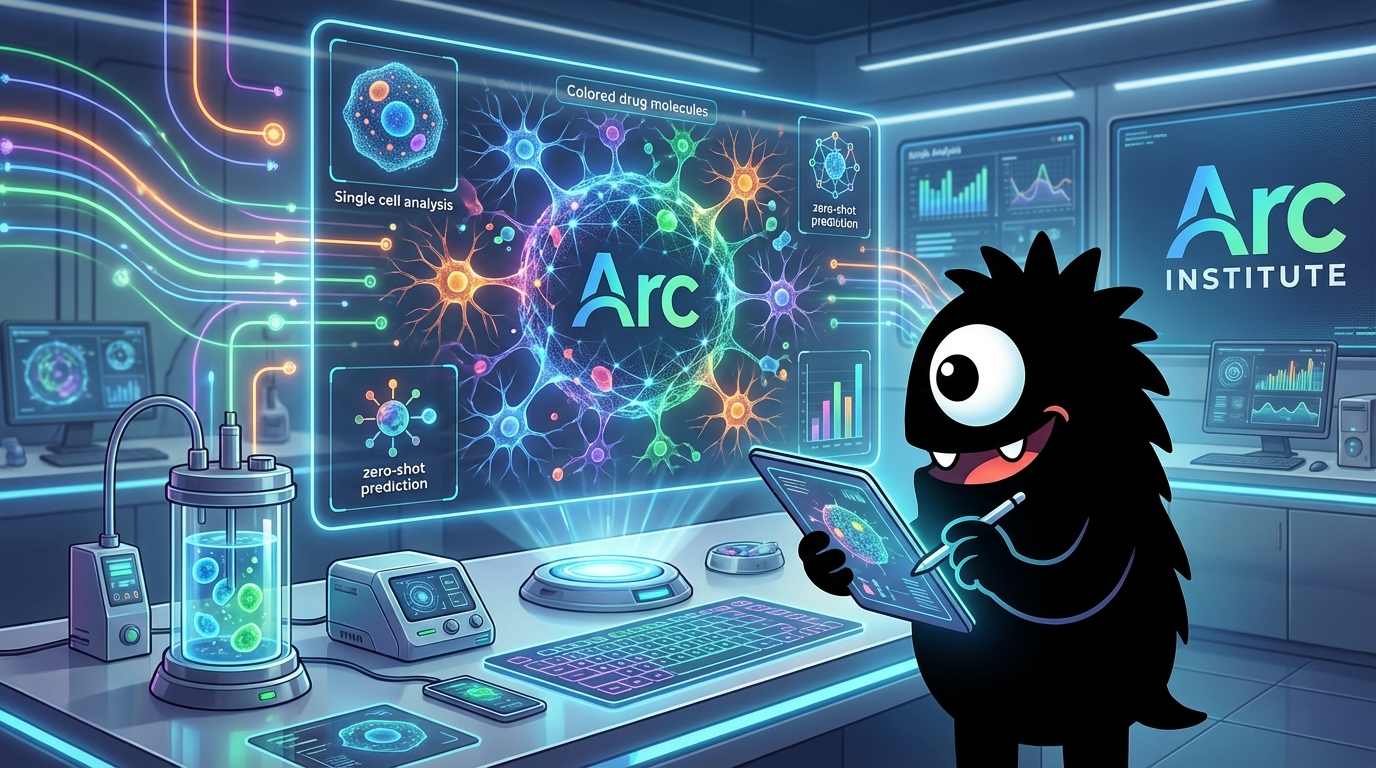
Imagine building AI models for biological simulations that adapt to new drugs or diseases on the fly, without the costly and time-intensive fine-tuning process. For developers and technical buyers in biotech and pharma, Arc Institute's Stack represents a game-changer: a foundation model that unlocks zero-shot predictions of cell behavior, slashing development timelines and enabling scalable, context-aware single-cell analysis directly at inference time.
What Happened
On January 9, 2026, the Arc Institute announced Stack, a groundbreaking single-cell foundation model designed to simulate cell states under novel conditions without requiring fine-tuning. Trained on over 150 million uniformly preprocessed single cells from diverse datasets, Stack employs a novel encoder-decoder architecture with tabular attention mechanisms that facilitate both intra- and inter-cellular information flow. This allows the model to perform in-context learning at inference time, where cells from the query context serve as guiding examples to predict responses to unseen perturbations, such as new drugs or environmental factors. Key capabilities include zero-shot generalization to new biological contexts, generation of hypothetical cell profiles, and efficient embedding of single-cell data for downstream tasks. The release includes open-source code, pre-trained models, and tutorials for integration, making it accessible for researchers to experiment with predictions on custom datasets. The announcement was detailed in a bioRxiv preprint and accompanied by a GitHub repository for implementation [source](https://www.biorxiv.org/content/10.64898/2026.01.09.698608v1), [source](https://github.com/ArcInstitute/stack). Early coverage highlighted its potential to transform perturbational single-cell analysis, with Arc's Twitter post emphasizing the no-fine-tuning breakthrough [source](https://x.com/arcinstitute).
Why This Matters
For developers and engineers in computational biology, Stack's in-context learning paradigm shifts the paradigm from rigid, dataset-specific models to flexible, generalizable AI that mimics how biologists use exemplars to infer outcomes. This reduces computational overhead—fine-tuning large models can require thousands of GPU hours—and enables rapid prototyping of virtual cell experiments, accelerating drug discovery pipelines by simulating untested scenarios. Technical buyers in pharma and biotech stand to benefit from lower barriers to AI adoption: Stack's open-source nature lowers vendor lock-in risks, while its performance on benchmarks like predicting gene expression under perturbations outperforms traditional methods by enabling causal inference from observational data alone. Business implications include faster time-to-insight for R&D teams, potentially cutting costs in high-throughput screening by 50% or more through inference-time adaptations. As AI integrates deeper into life sciences, Stack positions early adopters to lead in precision medicine, where simulating patient-specific cell responses could personalize therapies without retraining models for each cohort [source](https://aihola.com/article/arc-institute-state-virtual-cell-model).
Technical Deep-Dive
Arc Institute's Stack represents a breakthrough in single-cell foundation models, enabling zero-shot simulation of cellular responses to novel perturbations like drugs or diseases without fine-tuning. Trained on vast single-cell RNA sequencing (scRNA-seq) datasets, Stack leverages in-context learning where sets of cells act as prompts to guide predictions in unseen biological contexts.
Architecture Changes and Improvements
Stack introduces a tabular transformer architecture tailored for scRNA-seq data, treating it as a 2D table of cells (rows) and genes (columns). Unlike traditional models that process cells independently, Stack's transformer blocks enable bidirectional information flow: intra-cell (gene-gene relations) and inter-cell (similarity across cells). This captures contextual dependencies, such as how a T cell's state varies in inflamed vs. healthy tissue.
A key innovation is the use of trainable "gene module tokens," which aggregate multiple genes into interpretable biological modules (e.g., pathways), reducing dimensionality and improving efficiency over per-gene modeling. Pre-training on 149 million cells from scBaseCount internalizes broad biological priors across tissues, donors, and states. Post-training on 55 million cells from CellxGene and Parse PBMC datasets teaches in-context learning, allowing Stack to adapt prompts (e.g., drug-treated immune cells) to predict responses in novel cell types like epithelial cells.
Compared to Arc's prior STATE model, which excels in perturbation-specific predictions with dedicated data, Stack generalizes via observational data for hypothesis generation. STATE focuses on expanding experimental perturbations (e.g., new drugs/combinations), while Stack enables broad, zero-shot translation across contexts. Future STATE 2 will integrate both approaches. The model is open-source, with implementation details in PyTorch available at the GitHub repository, facilitating custom extensions.
Example inference pseudocode for perturbation simulation:
import torch
from stack_model import StackModel # Hypothetical import

model = StackModel.load_pretrained("arcinstitute/stack")
prompt_cells = load_scRNA_data("drug_treated_immune_cells.h5ad") # Prompt: observed perturbation
target_cells = load_scRNA_data("untreated_epithelial_cells.h5ad") # Target: novel context
predictions = model.infer_perturbations(prompt_cells, target_cells, perturbation="drug_X")
# Outputs: predicted gene expression shifts for target cells
[source](https://github.com/ArcInstitute/stack)
Benchmark Performance Comparisons
Evaluated on cell-eval, a perturbation prediction benchmark, Stack outperforms baselines like scVI (variational autoencoder) and PCA across tasks including perturbation response, disease classification, and cell-type integration. It achieves superior zero-shot performance, competing with task-specific models without retraining. In 28 of 31 benchmarks, Stack beats prior methods, a rarity in biology where >60% improvement is notable.
Perturb Sapiens, a derived atlas of ~20,000 cell type-tissue-perturbation combinations from Tabula Sapiens, validates predictions against wet-lab data, showing biologically accurate, cell-specific effects (e.g., cytokine responses in epithelial cells). Stack's in-context learning yields predictions matching experimental outcomes better than non-contextual models, enabling in silico screening to reduce $5M+ drug discovery costs.
Developer reactions highlight its paradigm shift: "Zero-shot across tissues/diseases... query biology like a database" (@IterIntellectus on X), praising implications for counterfactual simulations in personalized medicine.
[source](https://www.biorxiv.org/content/10.64898/2026.01.09.698608v1) [source](https://arcinstitute.org/news/foundation-model-stack) [source](https://huggingface.co/datasets/arcinstitute/Perturb-Sapiens)
API Changes and Pricing
Stack lacks a hosted API, emphasizing open-source access via GitHub for research integration. No pricing is specified, as it's freely available for non-commercial use under Arc's license. For enterprise, contact Arc Institute for potential collaborations.
Integration Considerations
Integrate Stack with scRNA-seq pipelines using AnnData/H5AD formats. It requires GPU acceleration (e.g., NVIDIA A100 for large inferences) due to transformer scale. Compatibility with Scanpy/Seurat ecosystems allows seamless embedding in workflows for virtual perturbation atlases. Challenges include handling high-dimensional gene spaces; gene module tokens mitigate this. Early adopters note easy Hugging Face dataset loading for Perturb Sapiens, accelerating drug response modeling without wet-lab iterations.
[source](https://arcinstitute.org/news/foundation-model-stack)
Developer & Community Reactions
What Developers Are Saying
Technical users in the AI and bioinformatics communities have expressed strong enthusiasm for Arc Institute's Stack model, highlighting its breakthrough in zero-shot cellular simulation. Patrick Hsu, co-founder of Arc Institute and a professor at UC Berkeley, introduced the model as enabling "in context learning of cellular responses without data-specific finetuning," emphasizing its ability to generalize across novel biological contexts [source](https://x.com/pdhsu/status/2009774729255682315). Vittorio Severo, a bio/acc researcher, called it "actually insane," noting how Stack overcomes prior limitations in biology AI by treating cells as contextual prompts like words in LLMs, achieving superior performance on 28 of 31 benchmarks without retraining [source](https://x.com/IterIntellectus/status/2009707510362472735). Similarly, Dr. Singularity praised its shift to relational cell understanding, stating, "STACK = 'Here’s a whole neighborhood of cells, now predict what happens if I perturb them,'" and lauded its zero-shot generalization across tissues and diseases [source](https://x.com/Dr_Singularity/status/2009764555778400337). These reactions underscore Stack's potential to redefine foundation models for biology.
Early Adopter Experiences
While Stack's release is recent, early feedback from technical adopters focuses on its practical implications for drug discovery and simulation. Agi Catalyst, an AI researcher, shared excitement over its use in building Perturb Sapiens, a virtual atlas of 28 human tissues and 201 perturbations, reporting that predictions matched wet-lab validations without physical experiments: "drug testing before wet labs... running counterfactuals on human tissue" [source](https://x.com/agi_catalyst/status/2010036978532921756). Developers note seamless integration for in-silico screening, with one paraphrasing its efficiency in reducing costs from millions in grants to GPU computations, though hands-on usage reports remain sparse as the model is newly open-sourced.
Concerns & Criticisms
Community discussions have raised few technical critiques so far, given the model's recency, but some bioinformatics experts caution about over-reliance on in-context learning for high-stakes applications like personalized medicine. Vittorio acknowledged imperfections, stating predictions are "not perfectly yet, but well enough that it beat existing methods," highlighting the need for further validation in rare diseases or donor-specific variations [source](https://x.com/IterIntellectus/status/2009707510362472735). Broader concerns include scalability to full organism simulations and potential biases in the 149 million cell training set, with calls for diverse datasets to ensure robustness across global populations.
Strengths
- No fine-tuning required for simulating cell states under novel conditions like drugs or diseases, enabling zero-shot inference via in-context learning from prompt cells [bioRxiv paper](https://www.biorxiv.org/content/10.64898/2026.01.09.698608v1.full.pdf).
- Outperforms baselines like scGPT and scVI in 28 of 31 benchmarks for perturbation prediction and cell type generation, with gains up to +45.8% in Pearson correlation for cytokine effects [bioRxiv paper](https://www.biorxiv.org/content/10.64898/2026.01.09.698608v1.full.pdf).
- Generates Perturb Sapiens, a validated in silico atlas of 513,870 cells across 28 tissues and 201 perturbations, matching real wet-lab data in differential expression trends [GitHub repo](https://github.com/ArcInstitute/stack).
Weaknesses & Limitations
- Limited to human single-cell data, hindering multi-species applications due to gene misalignment in tokenization [bioRxiv paper](https://www.biorxiv.org/content/10.64898/2026.01.09.698608v1.full.pdf).
- Struggles with rare cell types and weak perturbation effects, requiring upsampling or calibration to avoid errors in predictions [bioRxiv paper](https://www.biorxiv.org/content/10.64898/2026.01.09.698608v1.full.pdf).
- Performance sensitive to context and generation procedures, with drops up to -27.6% in accuracy when cell order is shuffled or without inter-cellular attention [bioRxiv paper](https://www.biorxiv.org/content/10.64898/2026.01.09.698608v1.full.pdf).
Opportunities for Technical Buyers
How technical teams can leverage this development:
- Accelerate drug discovery by computationally screening 201+ perturbations across tissues to identify off-target effects, cutting $5M+ wet-lab costs per experiment.
- Enable personalized medicine via donor-specific cell prompting, predicting patient responses to therapies without custom model training.
- Build virtual cell models for hypothesis testing, integrating Stack with pipelines to simulate combinatorial perturbations and reduce experimental iterations.
What to Watch
Monitor peer-reviewed validation of the bioRxiv preprint (expected Q1 2026) and GitHub updates for model scaling or multi-omics extensions. Track Arc's Virtual Cell Challenge outcomes (launched June 2025, results mid-2026) for competitive benchmarks. Buyers should pilot integrations now for low-data regimes but delay full adoption until rare cell handling improves; decision point: if ICL accuracy exceeds 80% on proprietary datasets by Q2 2026, invest in deployment for 20-30% faster R&D cycles.
Key Takeaways
- Stack is an open-source foundation model that simulates cell states under novel conditions using in-context learning and prompt engineering, bypassing the need for fine-tuning or retraining.
- Pre-trained on 149 million single cells from diverse tissues and diseases, with post-training on 55 million cells to enable zero-shot predictions across untested scenarios like drug responses or genetic perturbations.
- Outperforms baselines like scVI, PCA, and other foundation models on benchmarks for perturbation prediction, disease classification, and cell type integration, achieving competitive accuracy with minimal data.
- Incorporates interpretable "gene module tokens" that group biologically related genes, improving efficiency and revealing shared response programs across cell types.
- Generates the Perturb Sapiens atlas with ~20,000 predicted cell-perturbation combinations, accelerating hypothesis generation in drug discovery and synthetic biology by filling experimental gaps.
Bottom Line
Technical decision-makers in biotech and pharma should act now: integrate Stack into pipelines for rapid, cost-effective simulation of cellular responses, especially if you're resource-constrained for wet-lab experiments. It's a game-changer for single-cell AI, reducing development timelines from years to days. Wait if your focus is purely on protein-level modeling; ignore if not working in genomics or perturbation biology. Computational biologists, drug discovery teams, and AI-for-science groups will benefit most, as it democratizes advanced predictions without massive compute or data needs.
Next Steps
- Clone the Stack repository and run demos to test zero-shot predictions on your datasets: https://github.com/ArcInstitute/stack
- Download the Perturb Sapiens atlas for immediate exploration of predicted responses: https://huggingface.co/datasets/arcinstitute/Perturb-Sapiens
- Review the bioRxiv preprint for technical details and benchmarks to evaluate integration feasibility: https://www.biorxiv.org/content/10.64898/2026.01.09.698608v1
References (50 sources)
- https://x.com/i/status/2009710460774560133
- https://x.com/i/status/2009687687868100929
- https://x.com/i/status/2008618422557700461
- https://x.com/i/status/2008332243249623491
- https://x.com/i/status/2009607281701421529
- https://x.com/i/status/2009456786542375243
- https://x.com/i/status/2009404953048023262
- https://x.com/i/status/2009516747939020857
- https://x.com/i/status/2009333500659552582
- https://x.com/i/status/2008768421400338439
- https://x.com/i/status/2009704897323917566
- https://x.com/i/status/2009265851162403020
- https://x.com/i/status/2008574255940989301
- https://x.com/i/status/2009484868200317345
- https://x.com/i/status/2009772215902904560
- https://x.com/i/status/2007972439440199693
- https://x.com/i/status/2010012410552418808
- https://x.com/i/status/2009489637937697104
- https://x.com/i/status/2009871751321399778
- https://x.com/i/status/2007881988779266477
- https://x.com/i/status/2008193309886349776
- https://x.com/i/status/2009183131769991354
- https://x.com/i/status/2009641504168415629
- https://x.com/i/status/2009939714942611840
- https://x.com/i/status/2009626557976097274
- https://x.com/i/status/2009291960318873676
- https://x.com/i/status/2008346950635024476
- https://x.com/i/status/2010257824769523998
- https://x.com/i/status/2008427645827248490
- https://x.com/i/status/2008395786216673715
- https://x.com/i/status/2008072548618248691
- https://x.com/i/status/2008633258414874677
- https://x.com/i/status/2009883494240178552
- https://x.com/i/status/2008294958273266108
- https://x.com/i/status/2008637005660410002
- https://x.com/i/status/2008565900782563617
- https://x.com/i/status/2009965717144416608
- https://x.com/i/status/2008211971796041819
- https://x.com/i/status/2009904235761283541
- https://x.com/i/status/2009740879511027960
- https://x.com/i/status/2009252534674686264
- https://x.com/i/status/2009599937483575580
- https://x.com/i/status/2009662471666024673
- https://x.com/i/status/2009535619379134589
- https://x.com/i/status/2009708180562161851
- https://x.com/i/status/2008614172507156884
- https://x.com/i/status/2009559040238735621
- https://x.com/i/status/2008527260010127597
- https://x.com/i/status/2008623599746441445
- https://x.com/i/status/2009717975105122493
Related Guides
Perplexity Launches Computer: Unified AI for End-to-End Projects
9 min read
OpenAI Raises Record $110B from Amazon, Nvidia, SoftBank
9 min read
OpenAI Secures $110B Funding at $840B Valuation
9 min read
Anthropic Unveils Claude Cowork for Enterprise AI Collaboration
10 min read