Deno Deploy vs Linear: Which Is Best for AI-Powered Content Creation in 2026?
Updated: October 18, 2026
Deno Deploy vs Linear for AI-powered content creation: compare workflows, automation, pricing, limits, and best-fit teams in one guide. Learn
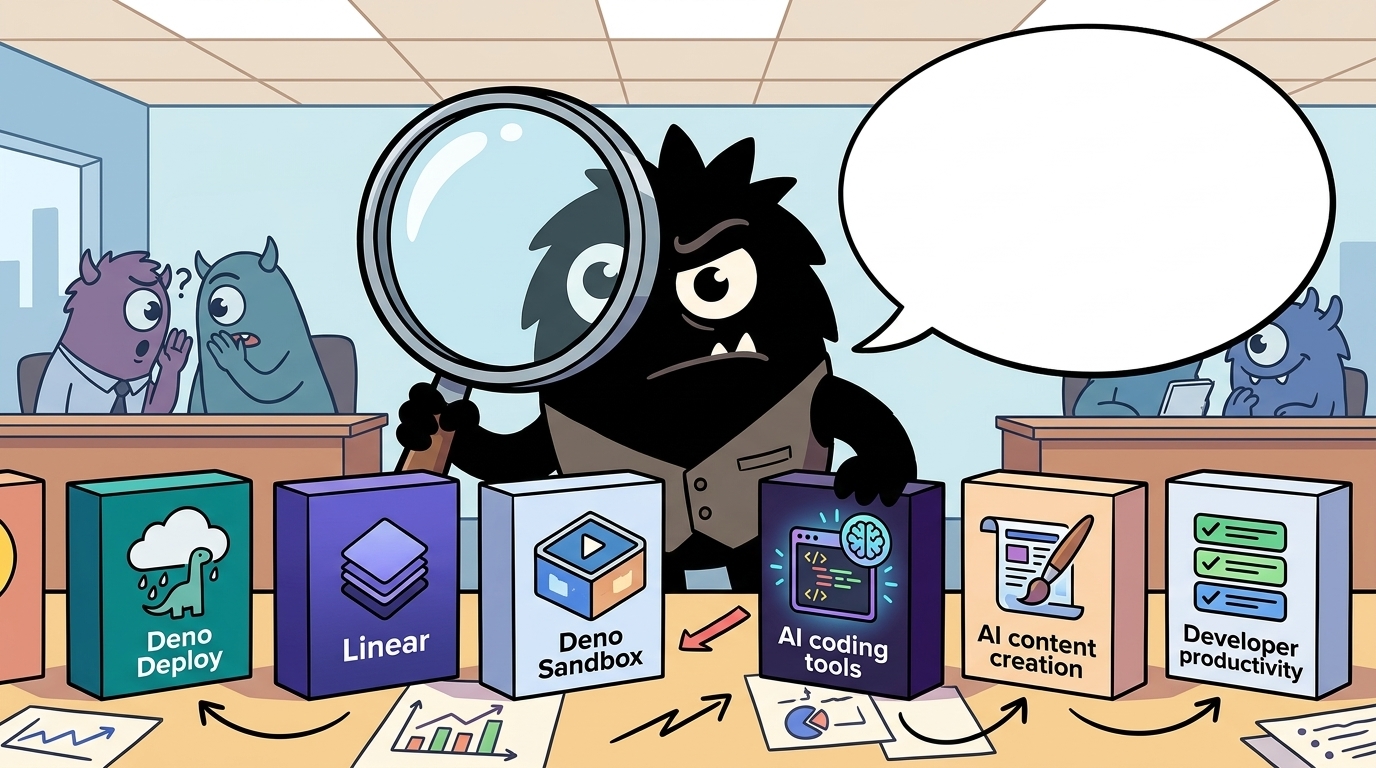
Why Deno Deploy vs Linear Is a Strange but Important Comparison
At first glance, this comparison looks wrong. Deno Deploy is an execution platform. Linear is a work-management system. One runs code; the other organizes work. They are not feature-for-feature substitutes, and treating them that way leads to bad buying decisions.
But this is exactly why teams keep comparing them.
In the current AI tooling wave, practitioners are increasingly splitting their stack into two layers:
- A runtime layer where agents, automations, API calls, schedulers, and generation pipelines actually execute
- A coordination layer where requests, approvals, priorities, ownership, and feedback live
Deno Deploy sits squarely in the first category. Its documentation positions it as a globally distributed deployment platform for JavaScript and TypeScript applications, with native support patterns for AI workloads and agentic systems.[2] Linear sits in the second. Its AI product direction is explicitly about helping product teams structure, route, summarize, and act on work inside existing workflows.[7]
That architectural distinction is easy to miss because the conversation on X is blurring the categories. Deno is being described as a workspace for agents:
Deno Sandbox... HOLY SHIT! Are you guys getting this??? If JS became the "language" of the Internet during dotcom bubble, Deno Deploy::Sandbox just became the "workspace" for the agents of the AI bubble.
View on XAt the same time, Linear is being framed as the place where agents collaborate with teams:
Linear was built to craft the best experience for product builders. Now, we’re entering a new era of software.
Introducing @linear for Agents: build, collaborate, and deploy AI agents in your product workflow.
[Closed beta for devs, users & agents]
And that framing is not just marketing spin. It reflects a real shift: AI content creation is no longer “open a chatbot and ask for a blog post.” It is becoming a chain of planning, research, generation, review, publishing, and optimization steps. Once you think in systems, both execution and coordination matter.
Aakash Gupta’s summary of Linear’s thesis captures why buyers get confused:
Linear’s CEO just described the biggest shift in product team structure since Agile.
For decades, product work meant: PM defines requirements → designers create specs → engineers translate to code. The middle step, translation, absorbed 70% of the time and created most of the friction.
Karri is saying that step is collapsing. AI agents don’t need handoff documents or sprint planning rituals. They need structured context about what matters, what constraints apply, and what success looks like.
This inverts the leverage points. The person who captures customer intent clearly now has more impact than the person who translates it into implementation. And the person reviewing agent output becomes the quality bottleneck.
Linear built their entire product around this bet: structured entities with clear ownership, context attached to work items, feedback connected directly to issues. It turns out the same system that helps humans coordinate also helps agents know what to do.
The teams figuring this out first will have a structural advantage. Everyone else will still be writing Jira tickets that read like riddles.
So the right question is not “Which one is better at AI?” It is: Do you need a place to run the content machine, a place to manage the machine, or both?
What AI-Powered Content Creation Actually Requires in Practice
Most teams evaluating AI content tooling are already beyond one-shot prompting. The operational problem now is building a pipeline that can reliably turn inputs into shipped content.
In practice, AI-powered content creation usually includes some combination of:
- Research and source collection
- Brand memory and style enforcement
- Outline and draft generation
- Editorial review and refinement loops
- SEO packaging
- Publishing and distribution
- Analytics and performance feedback
- Scheduling and repetition
Deno’s AI documentation reflects this broader view by positioning AI apps as systems that integrate models, tools, and execution logic rather than isolated prompts.[1] The same pattern shows up in the field: people are building agentic workflows with multiple components, not single prompts with clever wording.
I just created an agentic-workflow to automatically write and publish content for me!
It's powered by CrewAI Flows and Llama 3.2, running 100% locally.
Tech stack:
- @CrewAIInc to build an agentic workflow
- FireCrawl for web scraping
- Typefully for scheduling
Here's how it works:
- You provide a link to a website.
- It scrapes and saves the data as markdown.
- A router triggers the desired Crew of agents.
- The Crew prepares a ready-to-publish draft.
- Finally, use Typefully to post it to your socials.
Totally hands-off and 100% automated!
In this video, I provide a deep dive into how it actually works!
Find the link to all the code in the next tweet!
Enjoy the video! 🥂
The ambition is getting bigger, too. Content operators are packaging voice, audience rules, and platform-specific outputs into reusable systems:
The Skill Graph system by @deronin_ offers a highly efficient way to automate content creation across multiple platforms. He’s structured brand voice, platform rules, hook formulas, and audience personas into a fully interconnected Markdown knowledge graph. Just feed it one topic, and the AI instantly generates native, platform-specific posts for 10 different channels — no manual drafting or external team required. This is essentially turning AI into a complete content team with its own full playbook. Ideal for creators and operators managing content across multiple accounts. I’ve bookmarked it and plan to build my own version this weekend. Will share the results once tested. Happy to discuss if you’re exploring this framework too.
View on XAnd some are going further still, treating content as a full autonomous production function with strategist, producer, and analyst agents:
Gemini 3.0 + Lindy + Perplexity = AI Content Infrastructure that generated 30M views last quarter...
This 3-agent system replaces entire content teams automatically using AI strategist + producer + analyst architecture...
→ No more $15K-$30K monthly payroll for 4-person content teams
→ No more 20+ hours weekly spent planning content calendars manually
→ No more creative bottlenecks killing your posting velocity
→ No more analysts tracking metrics in 10 different spreadsheets
Just 3 AI agents → autonomous content infrastructure that runs 24/7.
Here's how it works:
→ Strategy Agent (monitors trends, identifies angles, builds calendars automatically)
→ Production Agent (generates platform-native posts, maintains brand voice across 1000+ posts)
→ Analysis Agent (tracks engagement, identifies patterns, optimizes continuously)
→ Multi-Platform Publishing (LinkedIn + Twitter content deployed simultaneously)
→ Performance Loop System (learns what works, compounds results weekly)
Built with Fortune 500 content velocity.
Runs 24/7 without creative bottlenecks.
Zero payroll overhead. Enterprise quality.
Results from deployments:
• 30M+ organic views generated
• $500K+ in qualified pipeline revenue
• 25 posts weekly (up from 5 posts with manual teams)
• One creator: $20K writer team → $500 AI infrastructure
Want the complete system?
Like + comment "LINDY" + repost, and I'll DM it to you.
(must be following)
The most grounded version of this conversation comes from people who have actually automated their own publishing stack end to end:
I automated 99% of my content business with a single workflow.
Here's how it works:
For the past year, my weekly process has been a mess.
I would:
• Research for hours (sometimes days)
• Write the outline
• Expand into bullet points
• Draft the article
• Edit everything manually
• Create visuals
• Write title + SEO
• Convert to HTML and publish
This was almost impossible to scale.
So I automated the entire pipeline.
The system now looks like this:
Brain dump → Deep Research MCP → Writing Workflow MCP → Media Generation → Title & SEO → Portable HTML
Each step is an agentic workflow.
Each step evaluates the previous one.
Each step refines the output.
The key piece is the Deep Research MCP server.
Instead of manually collecting sources, the system:
• Generates a research plan using my brain dump as a seed
• Searches multiple sources
• Distills findings
• Builds structured knowledge
• Feeds it directly into the writing pipeline
From there, the writing workflow:
1. Generates article guideline
2. Evaluates + refines
3. Generates the full article
4. Evaluate again
5. Insert media placeholders
6. Generate images
7. Optimize title + SEO
8. Convert to portable HTML
In fact, I created an article explaining this process using this exact pipeline.
More specifically, it will go more in-depth on:
• The Deep Research MCP architecture
• The writing workflow with evaluator loops
• How agents collaborate across steps
• The orchestration behind the full pipeline
• How this scales to a full content business
This is the system I now use to run Decoding AI Magazine.
And it’s only getting better.
Want it delivered to your inbox?
Subscribe here:
That matters for this comparison because the platform you need depends on where the constraint is.
- If your pain is that research, drafting, and publishing are still too manual, you need execution infrastructure.
- If your pain is that requests are chaotic, approvals are unclear, and cross-functional work disappears into Slack, you need coordination infrastructure.
- If your pain is both, you eventually need both layers.
That is the real buyer framework. Not “Which one has AI features?” but “Which part of the content system is currently breaking?”
Where Deno Deploy Wins: Running the Content Pipeline Itself
Deno Deploy is better when your goal is to build and run a custom AI content engine.
If you want to ingest source material, scrape data, call models, transform outputs, schedule jobs, hit CMS APIs, and publish automatically, Deno Deploy is much closer to the right abstraction. It is designed to run JavaScript and TypeScript applications globally, with a developer workflow built around fast iteration and deployment.[2][5] Deno also provides an AI entrypoint that lowers the friction of integrating AI capabilities into applications.[1]
That is why developers on X are talking about it less like a serverless host and more like a substrate for agents.
J'ai testé Grok hier: agentic workflow 'track news AI francophones & build Telegram bot'. Code Hono+Deno, deploy inclus. 0 boilerplate, perf folle. Skill=vibe, pas code. Qui migre ?
View on XThat post gets at something important: for content automation teams, the competitive advantage is often not the model itself. It is the speed with which you can stitch together scraping, generation, routing, formatting, and publishing into one working system. Low boilerplate matters because it compresses the path from idea to operational workflow.
Deno’s Sandbox work makes this especially relevant for agentic systems. Deno Sandbox is explicitly about running untrusted or AI-generated code, and Deno documents a path for promoting sandboxed apps into Deno Deploy when they are ready for production.[4] Ryan Dahl’s understated post says a lot:
not really announced yet but we're developing a service for untrusted code execution
https://deno.com/deploy/sandbox
For AI-powered content creation, that opens interesting patterns:
- Let an agent generate transformation code for content normalization
- Test it in a controlled sandbox
- Promote the working system into deployable infrastructure
- Keep the whole loop in the same ecosystem
That is not theoretical. The broader Deno pitch increasingly ties deploy infrastructure to AI workloads:
@deno_land joined the Vultr Cloud Alliance 🤝 Build and run modern #JavaScript and #TypeScript apps globally with low latency, predictable pricing, and infrastructure proven at scale. From edge and APIs to #AI-driven workloads, Deno Deploy runs on Vultr. https://blogs.vultr.com/deno-cloud-alliance
View on XEven external chatter is picking up on the same idea:
📰Developer + Web3 Daily | 2025.09.11 🚀Top Headlines: • DeepMind’s CodeNet: DeepMind launches CodeNet, an AI tool generating optimized algorithms for distributed systems development. • Deno Deploy AI: Deno Deploy integrates AI-driven scaling, optimizing resource allocation for serverless applications. • AI Code Formatter: Prettier’s new AI-powered formatter auto-aligns code styles across teams, enhancing collaboration. • Snowflake AI Query: Snowflake’s AI-enhanced query engine accelerates data analysis for developers building data-driven apps. • RustSec Scanner: RustSec’s AI tool identifies supply chain vulnerabilities in Rust projects, improving open-source security. Follow @CSDN_Global for more technology & Web3 updates!
View on XFor developer-led teams, the strongest case for Deno Deploy is control. You can treat content creation as software, not as a sequence of SaaS handoffs. That means you can build things like:
- A research crawler that watches competitor sites and extracts structured notes
- A content planner that turns notes into briefs
- A generation service that creates drafts based on house style
- A formatter that outputs HTML, Markdown, and social variants
- A publishing service that pushes to your CMS, newsletter tool, and social scheduler
- An evaluator loop that scores outputs and retries weak sections
Casys’ lessons from building AI agents on Deno Deploy reinforce this production-oriented mindset: the platform is compelling when you are iterating on real agent behavior, not just demoing prompts.[3]
The downside is obvious: Deno Deploy is not going to give you editorial governance, backlog hygiene, stakeholder visibility, or clean handoffs out of the box. It helps you run the pipeline. It does not inherently help you manage the humans and approvals around it.
Where Linear Wins: Managing the Work Around AI Content Creation
Linear wins when the hard part is not generating content, but operating the content function.
That is especially true for teams where content is intertwined with product launches, SEO programs, design review, demand generation, customer feedback, and engineering work. In those environments, content is not a standalone app. It is a cross-functional process that needs scope, ownership, deadlines, and traceability.
Linear’s AI direction is explicitly centered on that operating model. Its product materials focus on AI workflows for product teams, including summarization, issue routing, smarter organization, and context attached to work.[7] It has also introduced AI-powered filters, duplicate issue detection, and emerging product intelligence features that help teams surface patterns and reduce manual backlog cleanup.[8][9][10]
The key is that these features are not about model hosting. They are about lowering workflow drag.
Karri Saarinen’s framing is the clearest articulation of the thesis:
The key belief at @linear has always been that the work matters more than the tool.
Now with AI, we approach it the same way. Agents should help you ship, not create more work to manage.
AI to cull duplicates in your backlog.
An agent should submit bug fixes autonomously.
Code reviews should be a breeze.
Make updates about the essense.
AI to fill in missing details and customer requests into something cohesive.
Bring clarity, not more noise.
Not a future where there are agents exist just to clean up after other agents.
AI that prunes, not proliferates.
We want your backlog to shrink.
Your focus to sharpen.
You to ship more, and decide less.
That is a useful corrective to a lot of current “AI content” discourse. Many teams do not need another autonomous agent generating drafts nobody asked for. They need fewer dropped requests, cleaner briefs, less duplicate work, and tighter review loops.
This is where Linear becomes compelling for content operations. It can serve as the place where:
- Content requests are submitted
- Editorial priorities are ranked
- Owners are assigned
- Review states are visible
- Launch dependencies are tracked
- Feedback is attached to a durable work item
And increasingly, it can be the place where agents plug in around that workflow.
We built a @Linear integration! Now you can run Devin on your entire ticket backlog.
Our Devin x Linear workflow 👇
That matters because AI content creation rarely lives in isolation. A product marketing article might depend on a feature release. A technical SEO page might need engineering signoff. A launch post may require design assets and customer quotes. Linear is built for exactly that kind of structured coordination.
The emerging agent integrations make the case stronger. Ryan Carson’s description of combining Devin with Linear captures how coordination tools become the control layer around autonomous work:
This is how I’m currently running my startup with @DevinAI + @openclaw The browser testing in Devin is mind-blowing. I was trying to duct tape and jerry-rig all this stuff together with Playwright + uploading videos to PRs and all sorts of stuff and Devin just does it all e2e. Wild. I didn't show how I'm using @linear, which I am using for issue tracking. I have a "land" skill that I tell Devin to use whenever all the browser testing is done and all the CI goes green and it just merges the PR
View on XAnd the more ambitious agentic architectures people are sketching increasingly put Linear in the center as the task and context layer:
This is where Orchestra is going
The goal is, we have predefined workflows with predefined steps
- Build workflow
- Memory agent - Minimax
- Research agent - GPT-5
- Docs agent - ZAI
- TestSuite agent - GPT-5
- Builder agent - Claude
- Review agent - GPT-5
- Ideas agent - Any
When a prompt comes in, the scope is taken, broken down into memories, organized in a project that goes on Linear and in Neo4j
Research deep agent takes the scope, and tasks, and info on the pipeline then will collect sources only from the last 1 year with a few sources from every 3 months.
That gets passed down in parallel to docs & test agent, which will document the idea, and update the tasks in Linear
We do RGR, test suite is built with integration, unit, and e2e tests
Builder agent will then take each task, in isolation and complete them in sequence, running the tests, and requesting reviews at each task.
Throughout the lifecycle the memories and ideas agents will communicate with each other and come up with potential task groups, and scopes.
------------
You will be able to keep track of this from any device on your tailscale network, The goal is to have each workflow run to go for like 8 hours.
Every 8 hours you can either look into the ideas bucket, add a new scope, or run another workflow
If directional accuracy can be maintained, then work will be automated.
For content teams, the takeaway is straightforward: Linear is strong when the value lies in turning messy requests into shippable work. It helps define what should be created, who owns it, what state it is in, and whether it is done. That can be more valuable than generation infrastructure if your current bottleneck is organizational, not technical.
Its weakness is equally straightforward: Linear does not replace the execution substrate. It can tell an agent what to do, hold the context, and track the result. But if you want to actually run custom crawlers, transformation services, publishing logic, or evaluation loops, you will still need another layer.
The Real Tradeoff: Runtime for Agents vs System of Record for Work
This is the actual decision.
Choose Deno Deploy first if your differentiator is the content machine itself: custom automations, programmable workflows, secure execution, and deployment flexibility.[2] Choose Linear first if your differentiator is operational clarity: repeatable intake, prioritization, accountability, and a system of record for agent-assisted work.[7][12]
The mistake is assuming they compete head-on. They do not. They solve different failure modes.
A simple rule of thumb:
- If your team says, “We know what we want to produce, but building the pipeline is painful,” start with Deno Deploy.
- If your team says, “We have too many requests, too little clarity, and no reliable workflow,” start with Linear.
This tension shows up even in individual builders’ experiments:
Goal for today: get a first working draft of an AI agent to replace my linear AI workflow for generating SEO content strategies
View on XThat post is revealing. The goal is not “use AI.” The goal is to replace an existing workflow with one that better matches the task. That is the right mindset.
For budget-constrained teams, you usually cannot buy the whole future-state stack at once. So pick the layer that solves today’s biggest constraint. Then add the other when the first starts creating pressure.
Learning Curve, Pricing, and Operational Friction
Deno Deploy and Linear also differ sharply in who has to carry the operational load.
Deno Deploy is a developer platform. Even if its tooling is productive, someone still has to design the architecture, own integrations, debug failures, manage secrets, handle permissions, and maintain the pipeline. That burden is the price of flexibility.
Some developers clearly see the upside:
A few of you noticed that this module was fully written, tested, built, and published using @deno_land.. this was my first time fully leaning into the ecosystem and I wanted to share my experience. 🧵
> TLDR; it's new (to me) and so required a small transition but the Deno "toolkit" is robust, well-thought-out, and truly is a productive all-in-one.
That tracks with Deno’s positioning: a cohesive toolkit, a secure runtime model, and a deployment experience aimed at reducing JavaScript infrastructure sprawl.[2][5]
But there is real skepticism too, especially around migration clarity and documentation gaps:
how @deno_deploy went from effortless deploys to Vercel copycat that can’t document basic migration?
500 LOC app that needed zero setup before, now their docs don’t even cover deploying Deno apps on... Deno Deploy
That criticism should not be dismissed as edge-case whining. For teams considering Deno in production, migration friction is a real cost. A platform can be elegant in principle and still create painful transition work in practice.
Linear, by contrast, is usually easier to adopt organizationally. Non-developers can use it. Cross-functional stakeholders already understand tickets, owners, cycles, and statuses. The hidden cost is different: you may get cleaner planning without actually automating execution. At some point, you may still need external services, custom scripts, or a runtime platform to do the heavy lifting.[11]
So the real operational comparison looks like this:
Deno Deploy friction
- Higher developer involvement
- More custom maintenance
- More architectural control
- Better fit for bespoke execution
Linear friction
- Easier team rollout
- Lower engineering requirement
- Stronger governance and visibility
- Weaker native execution depth
In other words, Deno Deploy costs more in engineering attention. Linear costs more in integration dependency if you want true end-to-end automation.
Best Use Cases Side by Side
The cleanest way to compare these tools is by use case.
Choose Deno Deploy when you need:
- A custom AI content pipeline that scrapes, generates, transforms, and publishes
- Scheduled jobs for newsletters, research digests, or social posting
- Secure execution for agent-written or untrusted code paths
- Tight API integration with your CMS, analytics, and internal tools
- A developer-led stack where content automation is a product capability
Choose Linear when you need:
- A single intake and planning system for content requests
- Editorial workflows with approvals, statuses, and ownership
- Alignment across content, product, design, and engineering
- AI-assisted cleanup of duplicate or incomplete work
- A control plane for humans and agents working on the same backlog
Use both when you need:
- Linear for briefs, approvals, prioritization, and review
- Deno Deploy for generation, enrichment, formatting, and publishing
This hybrid model matches how practitioners are actually building modern AI workflows: one layer to coordinate the work, another to execute it. Even visually driven AI content systems, like ad-creative pipelines, still split between strategy/orchestration and actual generation:
Open AI (SORA) + Linah AI just changed the game 🤯 It lets you generate product-in-hand, UGC-style ads instantly… without waiting weeks for creators or wasting $$$ on production. Perfect for ecom brands & agencies who need a constant flow of new creatives to test. Each video looks like it was shot by a real creator but it’s 100% AI and you can scale it endlessly. Here’s the exact workflow we use to crank out winning ads: → Research trending UGC ads in your niche → Break down angles, hooks, and winning structures → Feed that into Linah to generate your UGC scripts → Upload your product images into Linah → Instantly get high-quality UGC-style ads ready to launch I filmed a 9-minute Loom walking through the full system + prompts. Want it? Drop “Loom” in the comments + like (must be following so I can DM).
View on XFinal Verdict: Who Should Use Deno Deploy, Who Should Use Linear, and When to Use Both
If you are asking which is better for AI-powered content creation, the blunt answer is this:
- Deno Deploy is better for building the content engine
- Linear is better for running the content operation
Use Deno Deploy if you want programmable content infrastructure: crawlers, agent workflows, publishing services, evaluator loops, and secure runtime support for AI-heavy systems.[1][2]
Use Linear if you want a cleaner operating system for content work: structured requests, priorities, visibility, and AI that reduces workflow noise instead of adding more of it.[7]
Use both if content is becoming a serious growth or product function and you need planning plus execution.
The broader Deno conversation is also worth keeping in mind. The company is actively pushing back on doubts about its trajectory:
Some recent posts have questioned Deno's future.
We've been quiet - too quiet - but we haven't been idle.
Here's what's actually going on, what we've learned, and what's coming next.
https://deno.com/blog/greatly-exaggerated
That matters because platform bets in AI infrastructure are long bets. You are not just buying features; you are buying into an execution model.
So if your next step is to build the machine, choose Deno Deploy. If your next step is to manage the machine, choose Linear. If you are scaling a real AI content factory, you will probably end up with both.
Sources
[1] AI entrypoint — https://docs.deno.com/ai
[2] About Deno Deploy — https://docs.deno.com/deploy
[4] Promote Deno Sandbox to Deploy Apps — https://docs.deno.com/sandbox/promote
[5] Deno Deploy — https://deno.com/deploy
[6] AI workflows for product teams — https://linear.app/ai
[7] AI Filters — https://linear.app/changelog/2023-06-01-ai-filters
[8] Using AI to detect similar issues — https://linear.app/now/using-ai-to-detect-similar-issues
[10] Linear AI features: What the PM tool can do (2026) — https://www.eesel.ai/blog/linear-ai
[11] denoland/docs: Deno documentation, examples and API reference — https://github.com/denoland/docs
References (15 sources)
- AI entrypoint - docs.deno.com
- About Deno Deploy - docs.deno.com
- AI Agents on Deno Deploy: Six Lessons from a Prototype - casys.ai
- Promote Deno Sandbox to Deploy Apps - docs.deno.com
- Deno Deploy - deno.com
- denoland/docs: Deno documentation, examples and API reference - github.com
- AI workflows for product teams - linear.app
- AI Filters - linear.app
- Using AI to detect similar issues - linear.app
- Product Intelligence (Technology Preview) - linear.app
- Linear AI features: What the PM tool can do (2026) - eesel.ai
- juanbermudez/linear-agent-cli: Linear CLI for AI Agents - github.com
- Deno Sandbox launched for running AI-generated code - infoworld.com
- Claude Code and Linear AI for Project and Code Alignment - claudecodeguides.com
- Claude Code for Deno Deploy Serverless Runtime Guide - claudecodeguides.com
Related Guides
The Best AI Bubble Signals to Watch in 2026: What Polymarket's Odds Reveal About AI and SaaS
20 min read
xAI Grok vs Mistral AI: Which Is Best for Building Full-Stack Web Apps in 2026?
20 min read
CrossPublish vs Buffer vs Publer vs Hootsuite: Which Scheduler Is Best for Creators in 2026?
19 min read
The Best AI Model in 2026: What Polymarket's Odds Reveal About Where AI and SaaS Are Heading
22 min read