xAI Grok vs Azure OpenAI vs Hugging Face: Which Is Best for AI-Powered Content Creation in 2026?Updated: September 27, 2026
xAI Grok vs Azure OpenAI vs Hugging Face for AI-powered content creation: compare workflows, pricing, control, and fit by use case. Learn
Why This Comparison Matters Now
If you’re evaluating AI for content creation in 2026, the biggest mistake is treating this like a simple model shootout.
That’s not what the market is actually buying anymore.
A year or two ago, “AI content creation” mostly meant asking a chatbot for blog outlines, social captions, or ad copy. Now the buying decision looks more like this:
- Can it brainstorm from trends and prior content?
- Can it preserve brand voice across channels?
- Can it generate images, short videos, voice, and avatars?
- Can it edit, not just generate from scratch?
- Can it orchestrate a workflow from brief to publish?
- Can it remember previous outputs and reuse context?
- Can it connect to internal documents, DAM systems, CRM data, or analytics dashboards?
- Can my team actually operate it without building a mini software company?
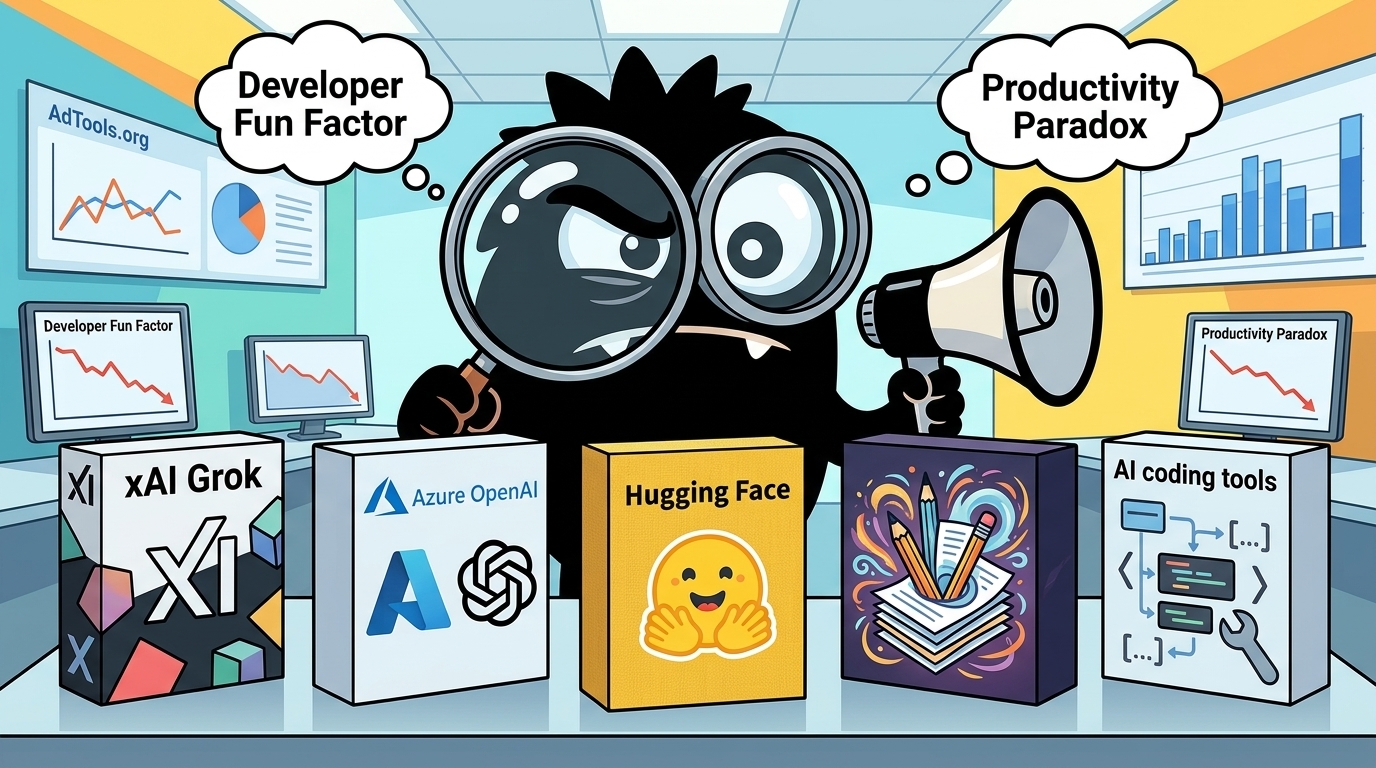
That’s why comparing xAI Grok, Azure OpenAI, and Hugging Face is harder than it looks. They are not three versions of the same product. They represent three different philosophies of how AI-powered creation should work.
AI-Powered Content creation .
Example: AI-Powered Content Creator Sidekick
Use Case: An agent that helps users brainstorm, create, and optimize content for platforms like X.
Implementation:
Input: Accept text or voice inputs (e.g., “Suggest a post about AI trends”).
Logic: Use Grok 3 to analyze X trends and generate content ideas, paired with Canva API for visuals.
Action: Schedule posts via Buffer, suggest edits, and track engagement metrics.
Memory: Store content history in Qdrant for personalized suggestions.
UI: Build an Expo app with a dashboard for content ideas and performance analytics.
Engagement: Add a “trend pulse” feature that highlights viral X topics with one-tap post creation.
Tools:
AI: Grok 3 (xAI API), n8n for automation.
Data: Qdrant for context, EdgeDB for user profiles.
UI: Expo for app, Framer Motion for animations.
Deployment: Deno Deploy for serverless APIs.
That post captures the real shift perfectly: creators and builders no longer want isolated generation. They want an end-to-end system with trend analysis, memory, automation, visual generation, scheduling, and feedback loops. In other words, they want a content engine, not a smart autocomplete.
And the market is increasingly happy to spend on those engines. Microsoft’s positioning around Azure OpenAI in Foundry makes clear that enterprise demand is not just about model access, but about deploying generative AI as part of broader business systems with security, orchestration, and operational controls.[9] xAI, meanwhile, is positioning Grok as an API-first platform spanning reasoning, search, multimodal generation, and creator-ready media tooling.[1]
The confusion comes from the fact that all three can plausibly be used for “content creation,” but in very different ways:
- xAI Grok is increasingly a creator-facing multimodal stack, especially strong where speed, visual iteration, and social-native output matter.
- Azure OpenAI is an enterprise AI platform, where content creation sits inside larger governed workflows.
- Hugging Face is an open ecosystem and assembly layer, where you compose your own best-of-breed media and language pipeline.
That last point matters because many teams are no longer asking, “Which model writes the best paragraph?” They’re asking, “Which stack gets my weekly content operation from idea to delivered assets with the least friction?”
most agencies charge $100K+ to build what I'm about to give you for free...
here's what you're getting:
ENTERPRISE CONTENT SYSTEMS:
• Context-Engineered LinkedIn Agent (exact system → 35K followers + Fortune 500 inbound)
• Multi-Platform Content Intelligence Engine (1 idea → 15+ deploy-ready pieces)
• AI Visual Creation Systems (used in BCG pitches and VC decks)
Voice Consistency Framework (sounds exactly like you, not generic AI slop)
SALES INFRASTRUCTURE:
• Signal-Based Outbound System (10x capacity vs. cold outreach)
• AI SDR Architecture (books meetings while you sleep)
• Context-Driven Prospecting Agent (enriches + qualifies automatically)
• Follow-Up Intelligence System (adapts based on prospect behavior)
PRODUCTION-GRADE WORKFLOWS:
• 3,000+ n8n automations (cold outreach, SEO, content creation)
• 7,000+ Make workflow templates (operational automation)
• Enterprise AI Prompt Library (100+ commands that outperform $500/hr developers)
• Lead Enrichment Engine (capture → qualify → activate)
FRAMEWORKS THAT CLOSED FORTUNE 500:
• Context Engineering Methodology (how to make AI understand your business at cellular level)
• Infrastructure Positioning System (stop selling services, start deploying systems)
• Enterprise Proposal Architecture (exact templates that landed BCG)
basically everything you need to build context-aware infrastructure while your competitors still hire $15K/month agencies
this is the exact arsenal behind:
• $70-80K/month recurring revenue
• 50K+ leads generated from one post
• Fortune 500 clients (BCG, enterprise accounts)
• 30M+ organic views across platforms
I've spent 11 months and $127K+ testing these systems in the wild
you're getting the complete operational playbook
the same infrastructure powering 6-figure operations and global developer teams
like + comment "VAULT" + repost (must be following so I can DM you the complete arsenal)
deleting this in 48 hours because I'm genuinely giving away too much
There’s some hype in posts like that, but the underlying demand is real: one idea turned into 15 channel-specific assets; voice consistency that survives scaling; and automation wrapped around production. That’s exactly the decision context this comparison needs to address.
So this article won’t rank these platforms as if they were interchangeable chatbots. Instead, it will compare them on five questions practitioners actually care about:
- Workflow depth: how much of the content pipeline each stack really covers
- Multimodal capability: text, image, video, audio, editing, and avatars
- Operational reality: rate limits, cleanup work, orchestration, and integration
- Pricing and learning curve: what it takes to get value in the real world
- Organizational fit: solo creator, agency, startup, or enterprise content team
That framing is the only honest way to compare these three.
Three Very Different Approaches to Content Creation
Before comparing outputs, it helps to get the mental model right. Most of the confusion in the current conversation comes from people comparing model quality when the more important question is platform fit.
xAI Grok: a creator-native multimodal stack
xAI’s API portfolio has expanded well beyond a single chat model. The company presents Grok as a family of frontier models and APIs for reasoning, enterprise use, and increasingly multimodal creation.[2] That matters because Grok is no longer just “the model inside X.” It is becoming a programmable content layer.
For content teams, the key attraction is not only text generation. It’s that xAI is pushing toward a unified creation workflow:
- reasoning and text generation
- search-aware or trend-relevant ideation
- image generation
- text-to-video and image-to-video
- video editing
- native audio in generated video
- integrations into creator tooling
xAI isn't playing around.
They just released the Grok Imagine API, a unified video + image generation toolkit, and it's already sitting at #1 on the Artificial Analysis Video Arena for both Text-to-Video AND Image-to-Video.
It's beating:
● Google's Veo 3.1 & Veo 3
● OpenAI's Sora 2
● Runway Gen-4.5
● Kling 2.5 Turbo
The Numbers Don't Lie:
● 64.1% win rate against Runway Aleph in blind human evaluations
● 57% win rate against Kling o1
● Best-in-class latency. Sub-20 second generation for 720p, 8-second videos. (up to 15-second video)
● Native audio generation baked right into video output (dialogue, music, sound effects, all synced)
What Makes It Different
It's built for real creative workflows:
✅ Text-to-video AND image-to-video in one API
✅ Video editing with prompt-based controls (add/remove objects, restyle scenes)
✅ Camera controls: zoom, pan, timelapse, pull-back
✅ Style transfers: cyberpunk, watercolor, anime, you name it
✅ Performance animation: map your movements onto characters
✅ Native audio-video sync (no post-production needed)
Why the focus on speed and cost?
The partner feedback that shaped this: "Quality alone isn't enough if latency and cost make iteration painful."
So xAI optimized for all three. Speed. Cost. Quality.
Already Integrated With:
● fal. ai
● ComfyUI
● InVideo
● Flora
● HeyGen
xAI went from underdog to chart-topper. The Grok Imagine API is fast, affordable, and genuinely production-ready.
If you're building anything with AI video, this just became the one to beat.
That post is enthusiastic, but it’s directionally right about why Grok has momentum. The pitch is not abstract model intelligence. The pitch is: you can go from idea to visual asset quickly enough that iteration is still fun. That is a huge difference from platforms that technically support multimodal generation but make every experiment feel like a procurement exercise.
The official Grok Imagine API announcement reinforces this positioning. xAI describes a unified toolkit for image and video generation with editing controls, camera controls, style transfer, and audio generation aimed at production use cases, not just toy demos.[5]
Azure OpenAI: enterprise-grade generative AI inside Microsoft infrastructure
Azure OpenAI should not be thought of as “Microsoft’s answer to a creator app.” It is better understood as enterprise access to advanced generative models within Azure AI Foundry, Azure’s security model, and the broader Microsoft stack.[8][9]
That means its strengths are different:
- governance and compliance
- role-based access and enterprise identity
- observability and operational controls
- integration with internal business systems
- retrieval and grounding against enterprise data
- agent orchestration
- predictable deployment patterns
AI Economics depends on efficient token factories and highly performant agent frameworks that deliver enterprise outcomes!
That is why we are excited about Microsoft Agent Framework. You can now build, orchestrate, and scale multi-agent systems in Azure AI Foundry using this framework.
It brings together our best-in-class runtime from AutoGen with the enterprise foundations of Semantic Kernel, with compliance, observability, and deep integration out of the box.
That statement from Satya Nadella is useful because it captures Microsoft’s worldview: enterprise AI economics are about efficient serving and strong agent frameworks that produce business outcomes. In other words, Azure OpenAI is not trying to win on “most fun image preset.” It is trying to win where content generation must be attached to approvals, data access policies, internal knowledge, and auditable operations.
This becomes especially important when “content creation” means things like:
- generating proposal documents from internal source materials
- drafting localized product content from approved brand copy
- creating internal communications from structured data and policy docs
- producing marketing content grounded in CRM, SKU, pricing, or regulatory data
That is a very different problem from cranking out short-form social clips.
Hugging Face: the open ecosystem and composable content lab
Hugging Face is the hardest of the three to summarize because it is less a single product than a broad ecosystem.
At one level, it’s a hub for open models, demos, Spaces, and experimentation. At another, it offers real infrastructure: text-generation inference tooling, hosted inference endpoints, and ways to deploy and operate models in production.[13][14][15]
What makes Hugging Face different for content creation is choice.
You’re not betting on one vendor’s stack. You can mix:
- one LLM for ideation
- another for structured rewriting
- one image model for product shots
- another for stylized concept art
- a separate voice model
- a separate lip-sync or avatar tool
- a custom UI in a Space
- private or dedicated inference endpoints for production
Why @huggingface Assistants are better than GPTs
Today, Hugging Face released Assistants, similar to OpenAI GPTs.
Here are the main advantages:
1. Choose your model:
Try different open-source models and choose the perfect fit for your use case. You can pick models like Mixtral, Llama2, OpenChat, Hermes, and more.
2. Absolutely Free:
The inference is provided by Hugging Face and you don't have to pay for any token you use. Total cost: $0
3. Publicly Shareable:
No subscription is needed to access the Assistant. Which means you can share it publicly with anyone, unlike GPTs.
Yet, the product is still in beta version.
There are some areas of improvement to match OpenAI GPTs:
- Adding RAG,
- Enabling web search
- Generating Assistant thumbnails with AI
These features are not yet available but are in the roadmap.
Let share your work !
That older post about Hugging Face Assistants still captures the core attraction: model choice, public sharing, and lower-cost access. Some product details have evolved, but the strategic point remains the same. Hugging Face is where teams go when they want flexibility and don’t want one vendor deciding what “content creation” should look like.
And the ecosystem is increasingly relevant even to teams using Grok or Microsoft models. xAI’s own models have appeared on Hugging Face, underscoring the platform’s role as a distribution and experimentation layer rather than merely a research showcase.[1]
The practical distinction
If you strip away branding, the three platforms map to three procurement mindsets:
- xAI Grok: “I want a modern multimodal creation stack that can move at creator speed.”
- Azure OpenAI: “I need AI content generation that behaves like enterprise software.”
- Hugging Face: “I want maximum flexibility and the ability to build my own stack from open components.”
That distinction explains why arguments on X often seem to miss each other. People praising Grok’s image-to-video speed are talking about one problem. People praising Azure’s compliance or Foundry integrations are talking about another. People recommending Hugging Face Pro are often talking about economics and breadth, not polished end-user workflow.
Once you see that, the rest of the comparison gets clearer.
For Ideation, Drafting, and Repurposing: Which Stack Builds the Best Content Engine?
For most teams, AI adoption still starts with text.
Not because text is the most exciting use case, but because it is the easiest place to measure value quickly. One source document becomes:
- a blog post
- three newsletter angles
- five social posts
- a founder thread
- a sales email
- a product description
- a webinar script
- a customer case study outline
The important question is not whether a model can generate these individually. Almost all modern systems can. The real question is whether the platform helps you build a repeatable content engine that preserves context, voice, and structure.
xAI Grok for ideation and rapid repurposing
xAI’s developer documentation positions its models as API-accessible frontier systems for reasoning and enterprise scenarios.[1][2] In practice, that makes Grok well-suited to developers building custom content workflows with:
- system prompts for tone and structure
- multi-step prompt chains
- source-material ingestion
- trend-aware prompting
- social-native formatting
- post-generation transformations
This is where Grok is often stronger than people expect. The public excitement is around images and video, but a lot of its real value for creators is upstream: idea expansion, fast reframing, and adapting one concept into channel-specific variants.
For example, a startup content workflow built on Grok might:
- Pull recent product updates and market signals
- Generate five possible narratives for X and LinkedIn
- Expand the best narrative into a long-form article outline
- Rewrite that into founder voice, customer voice, and analyst voice
- Produce captions, hooks, CTAs, and headline variants
- Pass the result into image or video generation
That’s much closer to how content actually gets made.
This enterprise-focused playbook covers Azure OpenAI Service architecture, deployment, and production scaling for organizations integrating advanced language models into existing infrastructure.
https://smartbridge.com/azure-openai-service-enterprise-guide/?utm_content=buffera4d38&utm_medium=social&utm_source=twitter.com&utm_campaign=buffer
#azureopenai #mspartner
That enterprise architecture playbook is Azure-focused, but it points to a broader truth: organizations care about production scaling, not isolated prompt cleverness. Grok is at its best here when you use it as a programmable layer in a broader system rather than as a one-off chatbot.
The tradeoff: xAI gives you building blocks, not a finished editorial operating system. If you want robust versioning, approval routing, CMS publishing, and content performance analysis, you’ll likely assemble those pieces yourself or use automation platforms around the API.
Azure OpenAI for brand-safe, process-heavy writing systems
Azure OpenAI is less exciting for casual ideation and often more useful for organizations that need disciplined text generation.
Its key advantage is not that it necessarily produces more dazzling first drafts. It’s that Azure gives teams a structured environment to deploy models with controls, consistency, and integration options.[8][9] Microsoft’s documentation and educational material around text generation emphasize application-building patterns, prompt design, and system-level integration rather than pure prompt experimentation.[7][11]
For content operations, that translates into strengths such as:
- centralized prompt templates
- integration with internal document stores
- app-layer governance
- standardized workflows for product, legal, or brand review
- use inside Microsoft-centric business environments
A common Azure pattern is not “generate me a viral post.” It’s more like:
- retrieve approved product messaging
- ground the model on current pricing and segment rules
- generate localized product copy
- run internal validation or policy checks
- route draft into a human review tool
- log prompt/response behavior for operational visibility
That is slower to set up than a creator stack, but much better for teams where bad copy can create legal, regulatory, or reputational problems.
Hugging Face for custom writing pipelines and model swapping
Hugging Face becomes attractive when your content workflow is unusual, specialized, or cost-sensitive.
Maybe you’ve discovered that one open model is excellent at long-form outlining, another is better at concise social rewrites, and a third is ideal for multilingual product description normalization. On Hugging Face, that is a natural way to work. Its inference tooling and endpoint infrastructure are designed to let teams deploy the models they want rather than accept a single-provider worldview.[13][14]
This flexibility matters more than many buyers realize. “Best writing model” often breaks down into sub-jobs:
- brainstorming
- summarization
- SEO structuring
- style transfer
- constraint-based rewriting
- metadata extraction
- translation
- compliance-aware editing
A composable stack can outperform a single premium model if you know what you’re doing.
🎨 For Image Generation & Editing:
→ Gemini (Nano Banana)
→ Whisk AI
→ Leonardo AI
🎬 For Video & Script Writing:
→ Grok
→ Higgsfield
→ ChatGPT
🔊 For Sound & Voiceover:
→ ElevenLabs
→ Hugging face AI
This combo makes content production possible. I created these with AI
That post is messy but honest: many practitioners already use combinations of tools rather than one monolithic platform. Hugging Face fits that operating style naturally. It is particularly useful for developers and agencies building bespoke pipelines for clients with different content needs.
The downside is obvious: model choice is power, but it also creates decision fatigue. Someone has to evaluate output quality, latency, licensing, hosting cost, and failure modes. Beginners often underestimate how much judgment that takes.
Voice consistency: the real separator
A surprising amount of “AI content quality” comes down to voice consistency, not raw writing fluency.
Anyone can get a passable post. The hard part is making 50 posts sound like the same company or the same founder. That requires:
- durable system instructions
- reusable examples
- retrieval from prior approved content
- memory of audience and brand positioning
- structured content planning, not just generation
Grok can do this well if you build memory and prompt discipline around it. Azure can do it especially well when combined with internal content repositories and enterprise context systems. Hugging Face can do it if you assemble the right model mix and retrieval layer.
So who wins for text?
- Best for fast, creator-style ideation and repurposing: xAI Grok
- Best for controlled, enterprise-grade writing systems: Azure OpenAI
- Best for custom, model-swapped, cost-aware pipelines: Hugging Face
There is no universal winner because “writing” is now a systems problem.
For Images, Video, and Avatars: Grok Has the Momentum, but Not the Only Path
This is the hottest part of the current conversation, and for good reason.
Text generation is increasingly commoditized. Multimodal creation is where platforms are trying to pull away — especially around short-form video, image editing, avatar generation, and social-ready assets. Right now, xAI has the loudest momentum.
That momentum is not just hype. It reflects a real product strategy.
Why Grok is getting so much attention
The Grok Imagine API announcement describes a unified API for image and video generation, including text-to-video, image-to-video, editing, camera controls, style transfer, and native audio generation.[5] That combination matters because most content production bottlenecks aren’t about generating one pristine masterpiece. They’re about making many usable variants quickly.
xAI has launched the Grok Imagine API, a powerful suite for video and audio generation that sets a new benchmark in speed, cost, and quality.
Built for creators, developers, and enterprise workflows, it lets users generate cinematic videos from text or images, edit scenes with precision, control styles and moods, and animate characters with performance-driven cues.
Grok Imagine ranks #1 in both Artificial Analysis and LMArena benchmarks outperforming Sora 2, Veo 3, and other top models on price, latency, and quality.
It also integrates with major creative platforms like HeyGen, Invideo, and ComfyUI for seamless workflows.
That “built for creators, developers, and enterprise workflows” framing is exactly why Grok is resonating. Teams want fewer hops between tools. If text prompts, image references, scene edits, and sound can be handled inside one toolkit, iteration becomes dramatically easier.
The benchmark chatter is part of that story, but not the whole story.
Grok Imagine's Video Editing Breakthrough: How xAI Redefines AI-Driven Post-Production
A debut model that tops crowdsourced benchmarks not through raw scale alone, but by mastering the hard trade-off between human-preferred quality and practical generation speed.
Most AI video tools force creators to choose: accept long wait times for high-fidelity edits, or settle for fast but mediocre results that require heavy manual cleanup. xAI's Grok Imagine video editing model shatters that binary.
In its first appearance on the Video Editing Arenaa large-scale, crowdsourced blind benchmark it claimed the #1 position with an Elo rating of 1290 while averaging just 1 minute and 5 seconds per generation. This isn't incremental progress; it's a new Pareto frontier where preference-aligned quality meets production-viable latency.
Grok Imagine is xAI's unified multimodal generation platform, built on the Aurora engine and trained on massive compute clusters (including clusters with 100,000+ GPUs in prior phases). The video suite supports:
- Text-to-video
- Image-to-video animation
- Video-to-video editing
The editing-specific endpoint allows natural-language instructions on existing clips ("add a silver necklace," "remove the background car," "swap the prop to a futuristic helmet"). Outputs include synchronized native audio dialogue, effects, ambient sound in one pass. Resolutions reach 720p for up to ~10-second clips, with flexible aspect ratios.
What sets the editing model apart is its architecture emphasis on efficient temporal consistency and localized diffusion control.
Rather than regenerating entire frames, it applies targeted noise and denoising steps only where changes are instructed, preserving untouched regions with near-photographic fidelity.
What stands out here is not just benchmark rank. It’s the emphasis on production-viable latency and localized editing control. Those are the capabilities creators actually feel. A model can be astonishing in a benchmark and still useless in production if every revision requires a long wait or destroys parts of the clip you wanted preserved.
Grok’s multimodal appeal comes down to four practical strengths.
1. Fast iteration for social content
For creators, agencies, and growth teams, speed is not a cosmetic feature. It changes what kind of workflow is possible.
If a video tool is slow and expensive, teams generate fewer variants and settle prematurely. If it is fast enough, they test more hooks, more framing, more visual treatments, and more edits.
That makes Grok especially attractive for:
- short-form promo videos
- social explainers
- campaign teasers
- animated product imagery
- reactive trend content
- visual memes and stylized posts
2. Editing, not just generation
A lot of AI video tooling still behaves like a slot machine: prompt, wait, hope. Editing support is more valuable than raw generation because real teams work from existing assets.
They want to:
- swap a background
- add or remove an object
- restyle a clip
- change camera motion
- animate a still image
- revise without scrapping everything
That is where Grok’s positioning looks strongest right now. It speaks directly to post-production pain, not just novelty generation.[5]
3. Creator-friendly presets and simplification
If you aren't using the new Grok Presets, you're working too hard. 📈
@xAI just democratized high-fidelity art. No more 'keyword soup'—just select a template, upload a reference, and let the Aurora engine handle the lighting. This is the new standard for social content.
This post gets at something underrated: preset design is product design. A huge amount of user friction comes from having to learn “keyword soup” prompting to get decent visual results. Presets, templates, and reference-guided generation lower the skill floor dramatically.
That doesn’t matter only to beginners. It also matters to agencies and teams trying to operationalize content production across many non-expert users.
4. Avatar and talking-head workflows
it’s finally here..
realistic AI avatars from zero using xAI Grok Imagine inside Arcads AI
• human-looking faces
• natural motion + blinking
• clean lip-sync with voice
• image → video → talking avatar
• all in one workflow
here's how:
Avatars are one of the most commercially relevant AI content formats because they convert text assets into scalable video output. Sales outreach, product explainers, training content, influencer-style clips, and localized campaign assets all benefit.
If Grok can reliably support image-to-video-to-avatar workflows through partners and integrations, that expands its relevance beyond pure social experimentation into practical business use.
Where Azure OpenAI fits — and where it doesn’t
Azure OpenAI is not the strongest candidate if your main goal is a unified, creator-native image/video playground.
That’s not a knock on Azure. It’s a category issue.
Azure OpenAI’s strengths are still more text-led and enterprise-led:
- document and knowledge-grounded generation
- workflow integration
- business application embedding
- governed app deployment
If your team’s content output is mainly articles, emails, product messaging, documents, support knowledge, or internal communications, Azure is compelling. If your strategy depends on high-velocity social video generation and visual experimentation, Azure is usually not the first stack practitioners reach for.
That said, Azure still matters in multimodal pipelines in two ways:
- Upstream orchestration: use Azure-based agents and business systems to plan, approve, personalize, and route content jobs.
- Enterprise wrapping: use other media models or services downstream, while Azure manages the governed context and business logic.
In larger organizations, that split is common. The “AI content creation stack” may not be one vendor at all. Azure coordinates the content intelligence layer; specialized media generation tools handle visuals.
How Hugging Face competes: breadth instead of unification
Hugging Face is the anti-monolith in this category.
You may not get one seamless UI for text, image, video, voice, avatars, lip-sync, and editing. But you can often get access to all of them — especially through open models, demos, Spaces, and third-party integrations.
This is why technically fluent practitioners keep recommending it. The breadth is enormous:
- text and multimodal generation models
- image generation and editing models
- video generation and animation models
- speech, TTS, and voice cloning models
- lip-sync and avatar-related pipelines
- deployable endpoints for custom production stacks
Too much AI services turning out to be scams lately...
Just get Hugging Face PRO for $9/month imo:
> Generate images with FLUX.2 Klein, Z-Image Turbo
> Generate videos with Wan2.2 Animate, LTX-2 Turbo, CogVideoX-5B
> Generate 3D models with Microsoft TRELLIS.2, Tencent Hunyuan3D-2.1
> Generate music with ACE-Step
> Clone voices with F5-TTS, Chatterbox, Qwen3-TTS
> Edit images with Omni Image Editor, Qwen Image Edit
> Upscale images with Finegrain Image Enhancer, Tile Upscaler
> Remove backgrounds with BRIA RMBG 2.0, BiRefNet
> Virtual try-on with IDM-VTON
> Lip sync videos with LatentSync, OmniAvatar
> OCR documents with DeepSeek OCR
> Generate illusion art with IllusionDiffusion
Just $9/month, 25 min of DAILY H200 GPUs compute, highest priority in queues. Support open source and the best community!
That post is blunt, but it reflects a genuine market sentiment: many users are tired of paying premium SaaS prices for fragmented tools when an open ecosystem can cover much of the same ground at lower cost. For experimentation and breadth, Hugging Face is hard to beat.
The tradeoff is experience quality. Grok’s advantage is not only its models; it’s that xAI is trying to package multimodal creation into a coherent system. Hugging Face gives you optionality, but often at the cost of stitching together:
- multiple models
- different interfaces
- varying output quality
- inconsistent latency
- your own orchestration layer
So is Grok actually best for multimodal content?
Right now, for many creator workflows, yes.
If your goal is rapid generation of social visuals, short videos, edits, and possibly avatar-ready assets from a relatively unified stack, Grok is the strongest fit of the three.
But that is not the same as saying it wins every multimodal scenario.
- If you need a highly governed enterprise workflow with internal approvals and data integration, Azure may still be the better system, even if Grok is the better media engine.
- If you want the broadest possible toolkit, the lowest-cost experimentation, or the ability to swap models aggressively, Hugging Face can rival or exceed Grok in total capability, just not in product coherence.
This is the core distinction: Grok wins on momentum and workflow unification; Hugging Face wins on breadth and composability; Azure wins on enterprise containment and control.
The Hidden Costs: Rate Limits, Cleanup Work, and Subscription Sprawl
Published pricing is the clean part of the story. It is almost never the whole story.
The real cost of AI content creation shows up in wasted generations, operator fatigue, manual cleanup, integration work, and the number of tools your team has to juggle to get one campaign out the door.
I've never felt more creatively exhausted than after making some of my AI videos.
It exhausts you. You argue with it. Constant waiting. Ratelimits. It sucks the ideas out of you.
You throw away 90% of the gens because they have a bad letter, or a chopped frame, or an out of place sound. Then it's back to the slot machine.
This is a destructive process. Sacrificial offerings to a machine god. My time withering away as I pay a dozen SaaS subs.
I've created so much lost orphaned footage. I have two hundred shots of Will Stancil getting raped by Grok that nobody will ever see. You can't share them all.
The songs generate faster than you can listen to them. The tokens overwhelm the senses.
I've found streaming the process of making slop is more entertaining than watching the finished slop.
Shared generative experiences will be a big fucking deal. xAI has an advantage here. They have Grok, they have streaming.
I don't mean talk to Ani on stream, that's degenerative.
Imagine immersive worlds where the whole stream can play in a universe the streamer spoke into existence. People spawn agents and populate simulations built in your mind.
MMOGAI
Crude as it is, that post captures the emotional truth of AI content production better than most polished vendor messaging. The cost is not just dollars. It is attention. It is waiting. It is discarding broken outputs. It is the creative drag of repeating the same prompt five ways because the system almost got it right.
Where costs actually come from
For content teams, total cost of ownership usually comes from five buckets:
- Inference costs
- tokens for text generation
- per-image or per-video generation costs
- premium model pricing tiers
- Platform costs
- subscriptions
- seat licenses
- enterprise commitments
- cloud dependencies
- Integration costs
- workflow tools
- storage
- vector databases
- custom app development
- monitoring and logging
- Human cleanup costs
- fact checking
- rewriting
- brand correction
- fixing visual artifacts
- editing bad lip sync or timing
- Opportunity costs
- latency
- queue time
- rate limits
- training time
- workflow fragmentation
xAI Grok: potentially efficient, but only if you stay inside its strengths
xAI publishes model and pricing information for its API offerings.[3] In practice, Grok can be economically attractive when you use one stack for both ideation and multimodal generation instead of paying for a separate writing model, image tool, video tool, and editing tool.
That is the appeal: fewer hops, fewer subscriptions, fewer exports and imports.
But the economics depend on fit. If your team is doing high-volume experimentation with video and image variants, even strong pricing can still translate into meaningful spend. And if outputs need substantial manual correction, the value proposition drops fast.
Grok’s best cost case is when:
- you generate many social assets quickly
- you reuse one API ecosystem across modalities
- speed reduces iteration waste
- editing avoids full regeneration
Its worst cost case is when:
- you use premium generation for content that could have been templated
- you overgenerate because the workflow is too easy
- your team lacks process and drowns in variants
Azure OpenAI: more predictable for enterprise, but rarely the cheapest path
Azure OpenAI is often not chosen because it is the lowest sticker price. It is chosen because, in enterprise settings, it can reduce other risks and costs:
- security review overhead
- procurement friction
- compliance problems
- brittle shadow AI workflows
- integration complexity inside Microsoft-heavy environments
That makes the right comparison less “Is Azure cheaper per token?” and more “Is Azure cheaper than letting five departments buy random AI tools and creating an ungoverned mess?”
Still, for smaller teams, Azure often feels heavy. There can be Azure-specific dependencies, architectural decisions, and operational overhead that make time-to-value slower than more creator-focused tools.[8][12]
Hugging Face: cheap experimentation, expensive indecision
Hugging Face can be astonishingly cost-effective. Open models, public demos, flexible hosting options, and community tooling can dramatically lower the cost of trying new workflows.[13][14]
But cheap access to many models does not guarantee a cheap operation.
The hidden Hugging Face tax is assembly:
- Which model should we use?
- Who will evaluate them?
- How do we host them reliably?
- What happens when one is updated or deprecated?
- How do we keep latency acceptable?
- Who owns prompt and routing logic?
For technical teams, those are manageable questions. For nontechnical marketing teams, they can erase the savings quickly.
The most expensive thing: garbage output
The biggest hidden cost across all three stacks is not inference. It is unusable output.
A broken sentence in a draft is cheap to fix. A beautiful-looking but legally risky product claim is expensive. A nearly-good video that needs manual surgery across frames is expensive. A brand voice mismatch repeated across 50 posts is expensive.
The best platform, therefore, is often the one that minimizes rework for your content type:
- Grok minimizes rework when you need fast multimodal iteration.
- Azure OpenAI minimizes rework when you need grounded, governable generation.
- Hugging Face minimizes rework when your team can intelligently choose and combine the right models.
Enterprise Content Teams: Why Azure OpenAI Keeps Winning Serious Buyers
If you spend too much time in public AI discourse, it can look like enterprise buyers are irrationally conservative — ignoring the coolest multimodal tools and defaulting to the giant incumbent.
That is not what’s happening.
Enterprise buyers are solving a different problem.
They are not asking, “Can this make a great social clip?” They are asking:
- Can this access the right internal data?
- Can it respect permissions?
- Can we monitor and audit it?
- Can it fit procurement and compliance requirements?
- Can it be integrated into our systems of record?
- Can multiple teams use it without chaos?
- Can we operationalize it across departments?
That is exactly why Azure OpenAI keeps winning serious enterprise content and communications projects.
Context beats generic intelligence in the enterprise
🚀 Unlock Your Data’s Potential: Fabric Data Agents + Azure AI Foundry
Enterprises sit on massive amounts of structured data — but traditional AI often struggles to interpret it with accuracy and context. The question isn’t whether you have the data. It’s whether your AI can truly understand and use it.
Microsoft’s latest integration changes everything.
🔗 The Challenge: Bridging Data and AI
Enterprise data is complex, distributed, and siloed
AI models often lack context from structured sources
Teams need a way for AI agents to think with their organization’s real data
💡 The Solution: Fabric Data Agents + Azure AI Foundry
Together, they create a seamless pipeline from data → intelligence → action.
Fabric Data Agents turn your lakehouse, warehouse, and Power BI data into conversational Q&A
Azure AI Foundry builds and deploys advanced conversational agents
Combined, they deliver accurate, context‑aware responses grounded in your enterprise data
🧠 How It Works: From Data to Dialogue
Build & Publish a Fabric data agent that understands your data
Connect it to your Azure AI Foundry agent
Ask questions in natural language
Analyze — agents generate SQL, KQL, or DAX to query your data
Respond with precise, data‑driven insights
This is enterprise AI with real intelligence.
🌟 Key Benefits
Enhanced Accuracy — AI grounded in your actual data
Actionable Insights — uncover patterns instantly
Simplified Access — no custom pipelines or complex code
User‑Friendly — chat your way to insights
🏢 Real‑World Impact: NTT DATA
NTT DATA used Fabric data agents to build HR‑focused conversational agents that:
Interact with real‑time staffing and productivity data
Reveal patterns in chargeability and workforce trends
Empower teams to “talk to their data”
“We see data agents as a conversational capability layer we can use to talk to our data.”
🔐 Secure & Scalable by Design
Identity Passthrough (OBO) ensures access control stays intact
Managed Private Endpoints secure connections to Azure resources
Fabric’s scale handles massive datasets with ease
🚀 Beyond Chat: Expanding What’s Possible
Automate report generation
Embed insights into workflows
Build custom natural‑language interfaces
Power Power BI Copilot with direct access to Fabric data
🧭 Getting Started (Preview)
Requires Fabric capacity (F2+)
Use the latest Azure AI Agents Python SDK
Explore setup guides and best practices in the documentation
🔓 Transform Your Data Strategy Today
Integrate Fabric Data Agents with Azure AI Foundry and unlock AI that truly understands your business.
#AI #DataAnalytics #MicrosoftFabric #AzureAI #AgenticAI #DataIntegration #DigitalTransformation
AI models are trained on public or generally available data sources. By default, they know basically everything about anything, *other* than your specific workflows and business. For AI Agents to be effective in the enterprise, they need your enterprise context.
That context is sitting in all of the contracts, financial documents, research, marketing assets, meeting notes, conversations, and every other piece of information in the enterprise. By volume, most of this data is unstructured data.
Now, for the first time ever we can fully tap into the value of all of this data in an organization. It’s largely created, stored, and shared maybe a few times, but the sits around being underutilized in the future.
This information will become the core source of knowledge for AI Agents in the enterprise. Ensuring agents have exactly the right data to work with, at the right time, in the right format, is one of the biggest challenges in a successful agent deployment.
This is why we’re so excited about AI at Box and the future we’re building for. Incredibly exciting times ahead.
Those two posts get to the heart of the issue. Enterprise AI needs context — especially unstructured documents, internal assets, and structured business data. Without that, even a strong model is mostly a smart outsider.
Azure OpenAI in Foundry is compelling because it sits within a platform story that includes model access, agent workflows, governance, and integration patterns.[8][9] That matters for content creation in ways many creator-focused comparisons miss.
For enterprise marketing, sales enablement, internal comms, and knowledge teams, content often depends on:
- approved messaging libraries
- legal disclaimers
- pricing systems
- customer segmentation data
- product catalog data
- internal research and reports
- CRM and analytics systems
- digital asset libraries
A model that can’t reliably work with that context will produce fluent but operationally weak content.
Why Azure is strong for document-heavy generation
One underappreciated Azure strength is document-centric generation.
Microsoft’s ecosystem and reference implementations show a clear emphasis on agent-based workflows and document generation patterns.[10] That is highly relevant for:
- proposal generation
- RFP responses
- internal policy summaries
- account-based marketing briefs
- regional adaptation of central messaging
- executive communications
- automated reporting narratives
In those workflows, the content artifact is not a tweet or a meme. It is a document assembled from many trusted inputs. Azure’s value lies in making that assembly governable.
Agent orchestration is becoming the enterprise differentiator
This is where Microsoft’s message about agent frameworks matters. The point is not just that you can call a model. The point is that you can coordinate multiple agents and tools in a controlled environment.[8]
For content operations, that might mean separate agents for:
- source retrieval
- fact extraction
- tone adaptation
- legal or policy validation
- localization
- formatting for channel templates
- routing to human review
That is not glamorous. It is incredibly useful.
A global brand team, for example, could use Azure-based orchestration to:
- pull approved launch messaging
- query regional pricing and availability
- generate local-market drafts
- validate compliance requirements
- create derivative assets for email, web, and internal enablement
- log and monitor the process centrally
Grok can help with parts of that. Hugging Face can help with parts of that. Azure is built to make the whole operating model acceptable to enterprise IT.
The Microsoft ecosystem effect
This is not a minor point. If your organization already runs deeply on Microsoft — Azure, Microsoft 365, Power Platform, Fabric, Power BI, Entra, Dynamics — Azure OpenAI becomes more attractive because the integration surface is familiar.
The Power Apps preview documentation for Azure OpenAI-backed text generation is a good example of how Microsoft is trying to lower the barrier for business application integration, not just developer experimentation.[7]
That means enterprise teams can build content-adjacent systems like:
- internal copy assistants
- guided product description generators
- CRM-grounded email drafting tools
- dashboard narrative generators
- policy-aware internal communications assistants
These are not “creator tools” in the consumer sense. They are content systems embedded in business processes.
Why Azure still loses some creator-led evaluations
Azure often loses public mindshare because it is not optimized for delight in the same way creator-native stacks are.
Its disadvantages are real:
- slower setup for small teams
- less direct multimodal excitement
- more architectural overhead
- less immediate gratification for social-first creation
If you’re a solo operator trying to ship 30 short videos this week, Azure is probably the wrong first choice.
But if you are a Fortune 500 communications team, a regulated-industry marketing org, or a company building AI into its existing content operations, Azure’s “boring” strengths are exactly why buyers choose it.
The enterprise winner is often not the stack with the coolest demo. It is the stack that survives security review, handles context correctly, and scales without organizational drama.
Hugging Face as the Open Content Lab
Hugging Face gets misunderstood in two opposite ways.
Some people still think of it mainly as a research/model-sharing site. Others talk about it as if it were a direct replacement for every commercial AI creation platform. Both views miss the point.
For content creation, Hugging Face is best understood as an open content lab: a place where builders, agencies, and technically capable teams can prototype, test, share, and operationalize custom content pipelines across modalities.
Why practitioners keep coming back to it
The value proposition starts with variety.
Hugging Face supports a broad ecosystem of open and hosted models, plus tooling for efficient text generation inference and managed endpoints.[13][14][15] That means if you don’t like one provider’s view of what “best” looks like, you can often find alternatives quickly.
xAI just released Grok 2 on Hugging Face.
This massive 500GB model, a core part of xAI's 2024 work,
is now openly available to push the boundaries of AI research.
https://huggingface.co/xai-org/grok-2
That post about Grok 2 landing on Hugging Face is important symbolically. It shows that even high-profile frontier model work eventually flows into the open ecosystem conversation. Hugging Face is where experimentation, redistribution, and recombination happen.
And that matters for content teams because modern AI content operations are modular by nature.
You may want:
- one model for long-form writing
- one for speech
- one for image editing
- one for avatar generation
- one for OCR or document extraction
- one for multilingual conversion
Hugging Face makes this style of stack-building normal.
Spaces and demos matter more than they seem
HuggingGPT: Solving AI Tasks with ChatGPT and its Friends in Hugging Face @Gradio demo is out on @huggingface Spaces
demo: https://t.co/yquDkqsnwL
Spaces are a big part of Hugging Face’s practical value. They make it easy to turn models and workflows into usable demos, internal tools, or shareable prototypes. For agencies and indie builders, this is a major advantage.
A team can:
- create a niche content generator for a client
- wrap a custom workflow in a simple UI
- test model behavior with stakeholders
- share a proof of concept publicly or privately
- iterate before investing in full production engineering
That shortens the path from idea to working system.
Open model economics are attractive — if you can operate them
Hugging Face also benefits from the economics of openness. Depending on the workflow, you can often get very far with low-cost or open models before paying premium API bills. The community also moves fast in niche areas like voice, image editing, OCR, lip-sync, and specialized generation.
@xai released Grok 2.5 as an open-source AI model.
From August 23, 2025, the 500 GB package is now available on Hugging Face.
The xAI keeps promoting Grok Imagine, a beta tool for blazing image and video generation, firing up excitement and ethical discussions around content creation!
That post points to another emerging dynamic: Hugging Face increasingly sits at the intersection of open releases and high-profile commercial platforms. It is not merely “the open-source alternative.” It is where the broader model ecosystem becomes explorable.
For content teams, this creates three big opportunities:
- Prototype cheaply
- Avoid vendor lock-in
- Swap models as quality and economics change
But Hugging Face is not a magic simplifier
This is where some of the online recommendations become too glib.
Yes, Hugging Face can be dramatically cheaper and more flexible. But it also asks more of you. To use it well, you need at least some ability to evaluate:
- model quality
- latency
- hardware implications
- deployment options
- licensing and usage constraints
- maintenance burden
That’s why Hugging Face is especially strong for:
- agencies with technical ops capability
- startups with developers
- AI-native product teams
- solo builders comfortable with experimentation
It is less ideal for:
- nontechnical teams wanting a polished all-in-one creator workflow
- enterprises that need turnkey governance more than flexibility
In short, Hugging Face is not the easiest content creation stack here. It may be the most powerful per dollar if your team knows how to assemble and operate it.
Pricing, Learning Curve, and Time to Value
Now for the practical buyer questions.
Pricing posture
xAI Grok
- Primarily API-led economics with model-specific pricing tiers.[3]
- Can be cost-efficient if you consolidate text, image, and video workflows in one ecosystem.
- Costs can climb fast for heavy multimodal experimentation.
Azure OpenAI
- Consumption happens within Azure’s enterprise cloud context.[8][9]
- Often acceptable to larger organizations because it fits existing procurement and governance.
- Rarely the lightest or simplest choice for small teams.
Hugging Face
- Mix of open-model economics, hosted inference, and endpoint costs.[13][14]
- Often best for low-cost experimentation and custom pipelines.
- True cost depends heavily on whether your team can manage selection and assembly overhead.
Learning curve
Easiest for creator-minded experimentation: xAI Grok
If your team thinks in campaigns, clips, prompts, and variants, Grok is the most naturally aligned.
Easiest for enterprise IT and governed deployment: Azure OpenAI
Not “easy” in an absolute sense, but easiest for organizations already living in Azure and Microsoft workflows.
Easiest for developers who want control: Hugging Face
For technical teams, its flexibility is a feature. For nontechnical users, it can feel like a toolkit without a map.
Time to value by scenario
Solo creator making social content
- Best: xAI Grok
- Why: fast multimodal iteration, creator-friendly flow, fewer moving parts
Agency producing custom campaigns across formats
- Best: xAI Grok for speed, or Hugging Face for custom economics and breadth
- Why: depends on whether the agency values polished workflow or composable flexibility
Startup building an internal content engine
- Best: xAI Grok or Hugging Face
- Why: Grok for shipping quickly; Hugging Face for custom architecture and cost control
Enterprise marketing or communications team
- Best: Azure OpenAI
- Why: context grounding, governance, internal integration, agent orchestration
The headline: Grok gets many teams to visible output fastest, Azure gets enterprises to acceptable operations safest, and Hugging Face gets builders to custom leverage cheapest.
Who Should Use xAI Grok, Azure OpenAI, or Hugging Face?
If you want the shortest possible recommendation:
- Choose xAI Grok if your priority is fast multimodal content creation — especially social visuals, short video, editing, avatar workflows, and rapid experimentation from one creator-friendly stack.[2][5]
- Choose Azure OpenAI if you’re an enterprise team that needs governance, internal data grounding, observability, document-centric generation, and scalable agent workflows inside Microsoft infrastructure.[8][9]
- Choose Hugging Face if you’re a builder, agency, or technical team that wants open model choice, lower-cost experimentation, and the freedom to assemble a best-of-breed content pipeline across text, image, video, and voice.[1][13]
The honest answer is that there is no single “best” platform for AI-powered content creation in 2026.
There is only the platform that best matches the shape of your workflow.
Right now:
- Grok has the creator momentum
- Azure OpenAI has the enterprise gravity
- Hugging Face has the builder advantage
Most teams should stop asking which model is best and start asking which stack makes their content operation less painful, more scalable, and more defensible.
Sources
[1] Introduction | xAI — https://docs.x.ai/developers/introduction
[2] API: Frontier Models for Reasoning & Enterprise - xAI — https://x.ai/api
[3] Models and Pricing - xAI Documentation — https://docs.x.ai/developers/models
[4] Complete Guide to xAI's Grok: API Documentation and Implementation — https://latenode.com/blog/ai-technology-language-models/xai-grok-grok-2-grok-3/complete-guide-to-xais-grok-api-documentation-and-implementation
[5] Grok Imagine API - xAI — https://x.ai/news/grok-imagine-api
[6] xai-org/xai-sdk-python: The official Python SDK for the xAI API - GitHub — https://github.com/xai-org/xai-sdk-python
[7] Use the text generation model in Power Apps (preview) — https://learn.microsoft.com/en-us/ai-builder/azure-openai-model-papp
[8] Azure OpenAI in Microsoft Foundry Models REST API reference — https://learn.microsoft.com/en-us/azure/foundry/openai/reference
[9] Azure OpenAI in Foundry Models — https://azure.microsoft.com/en-us/products/ai-foundry/models/openai
[10] Document Generator — https://github.com/Azure-Samples/openai/tree/main/Agent_Based_Samples/document_generator
[11] Building Text Generation Applications (Part 6 of 18) — https://learn.microsoft.com/en-us/shows/generative-ai-for-beginners/building-text-generation-applications-generative-ai-for-beginners
[12] Azure OpenAI Text Generation Step by Step Lab in Colab — https://drlee.io/azure-openai-text-generation-step-by-step-lab-in-colab-c32ab929ce3f
[13] Text Generation Inference - Hugging Face — https://huggingface.co/docs/text-generation-inference/index
[14] Inference Endpoints - Hugging Face — https://huggingface.co/docs/inference-endpoints/index
[15] Large Language Model Text Generation Inference - GitHub — https://github.com/huggingface/text-generation-inference
Further Reading
- [xAI Grok vs Hugging Face vs Anthropic: Which Is Best for Data Analysis and Reporting in 2026?](/buyers-guide/xai-grok-vs-hugging-face-vs-anthropic-which-is-best-for-data-analysis-and-reporting-in-2026) — xAI Grok vs Hugging Face vs Anthropic for data analysis and reporting: compare workflows, pricing, strengths, and tradeoffs fast. Learn
- [What Is OpenClaw? A Complete Guide for 2026](/buyers-guide/what-is-openclaw-a-complete-guide-for-2026) — OpenClaw setup with Docker made safer for beginners: learn secure installation, secrets handling, network isolation, and daily-use guardrails. Learn
- [PlanetScale vs Webflow: Which Is Best for SEO and Content Strategy in 2026?](/buyers-guide/planetscale-vs-webflow-which-is-best-for-seo-and-content-strategy-in-2026) — PlanetScale vs Webflow for SEO and content strategy: compare performance, CMS workflows, AI search readiness, pricing, and best-fit use cases. Learn
- [Adobe Express vs Ahrefs: Which Is Best for Customer Support Automation in 2026?](/buyers-guide/adobe-express-vs-ahrefs-which-is-best-for-customer-support-automation-in-2026) — Adobe Express vs Ahrefs for customer support automation: compare fit, integrations, pricing, and limits to choose the right stack. Learn
- [Asana vs ClickUp: Which Is Best for Code Review and Debugging in 2026?](/buyers-guide/asana-vs-clickup-which-is-best-for-code-review-and-debugging-in-2026) — Asana vs ClickUp for code review and debugging: compare workflows, integrations, pricing, and fit for engineering teams. Find out
References (15 sources)
- Introduction | xAI - docs.x.ai
- API: Frontier Models for Reasoning & Enterprise - xAI - x.ai
- Models and Pricing - xAI Documentation - docs.x.ai
- Complete Guide to xAI's Grok: API Documentation and Implementation - latenode.com
- Grok Imagine API - xAI - x.ai
- xai-org/xai-sdk-python: The official Python SDK for the xAI API - GitHub - github.com
- Use the text generation model in Power Apps (preview) - learn.microsoft.com
- Azure OpenAI in Microsoft Foundry Models REST API reference - learn.microsoft.com
- Azure OpenAI in Foundry Models - azure.microsoft.com
- Document Generator - github.com
- Building Text Generation Applications (Part 6 of 18) - learn.microsoft.com
- Azure OpenAI Text Generation Step by Step Lab in Colab - drlee.io
- Text Generation Inference - Hugging Face - huggingface.co
- Inference Endpoints - Hugging Face - huggingface.co
- Large Language Model Text Generation Inference - GitHub - github.com
Related Guides
The Best AI Agents in 2026: What Polymarket's 98% Anthropic Bet Reveals About Where SaaS Is Heading
24 min read
Framer vs Railway vs Figma: Which Is Best for Code Review and Debugging in 2026?
15 min read
The Best AI Model in 2026: What Polymarket's $4M Bet Reveals About Where AI Is Heading
17 min read
Aider vs Cline: Which Is Best for AI Pair Programming in 2026?
15 min read