Google Gemini vs GPT-4o: Which Is Best for Real Work in 2026?
Updated: October 18, 2026
Google Gemini vs GPT-4o benchmarks decoded: cut through the MMLU marketing, compare coding, vision, and pricing, and find out which model wins. Compare now.
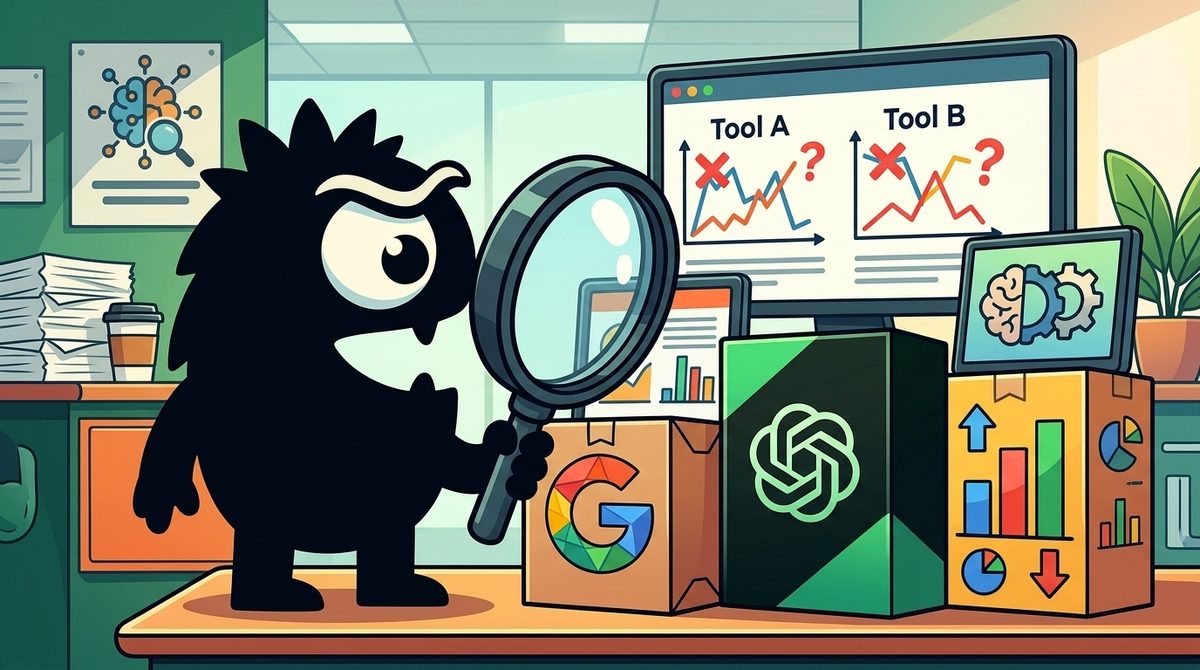
The real question behind “Google Gemini vs GPT-4o” is not which model owns the highest score. It is which model will complete your workload more accurately, quickly, and economically—under the prompting, tools, context, and verification process you can actually deploy.
Bottom line for 2026:
- Choose GPT-4o when coding consistency, real-time voice, or established OpenAI tooling matters most.
- Choose Gemini for vision-heavy work, very long documents, search-grounded answers, or deep Google Workspace integration.
- Do not choose either from a benchmark headline alone. Compare matched evaluation protocols, then test representative tasks from your own production workload.
- For difficult work, inference strategy can matter more than model choice. Sampling, tool use, tests, and verification often produce larger gains than switching providers.
Beyond the Leaderboard Wars: What Are You Actually Comparing?
“Gemini beats GPT-4o” can mean several very different things. It might mean Gemini received more votes in a chatbot arena, scored higher on a multiple-choice test, won a vision benchmark, or performed better after generating dozens of candidate answers. None proves that it will be better at reviewing your pull requests, processing invoices, answering support tickets, or navigating a browser.
Chatbot arenas capture human preference in relatively short interactions. Static benchmarks measure repeatable capabilities on fixed datasets. Neither fully represents production systems, where models receive large context windows, call tools, encounter malformed data, and must complete multiple dependent steps. Experimental Gemini models have reached the top of arena rankings, but reporting on those results also cautioned that leaderboard position does not settle the broader product comparison.[2][3]
The problem becomes sharper when advertised results belong to an unreleased model or a predicted configuration rather than independently measured software.
Gemini 4 has not shipped. These numbers are predicted, not measured.
Still, notice the split:
Saturated benchmarks (FrontierMath 99.1%, ARC-AGI-3 99.9%+) stop telling us anything.
The honest ones are still low. AutomationBench 48.7%. Terminal-Bench Science 72.8%.
Answering hard questions is solved. Finishing hard multi step jobs is not.
Treat predicted charts as marketing until independent evals land.
#AI #LLM #Gemini #Benchmarks #MachineLearning
That distinction is essential in 2026. The Gemini family continues to evolve beyond the Gemini 1.5-era model originally compared with GPT-4o, while GPT-4o itself now sits within a broader OpenAI portfolio. Google’s current positioning emphasizes Gemini as a family spanning multimodal reasoning, long context, action-taking, and deployment across its products.[14][15] A model name without a version, date, endpoint, and evaluation setup is no longer enough.
Why Did the Gemini–GPT-4 MMLU Comparison Cause Such a Backlash?
The most instructive benchmark dispute remains Google’s December 2023 Gemini Ultra announcement. Google highlighted a 90.04% MMLU result for Gemini Ultra beside 86.4% for GPT-4. Read casually, Gemini appeared to have crossed a major threshold and beaten GPT-4.
But the two headline numbers used different inference protocols.
Gemini Ultra’s 90.04% result used CoT@32: chain-of-thought prompting with 32 sampled attempts and an aggregation or routing procedure. GPT-4’s 86.4% figure used the conventional 5-shot setup, where the prompt includes five examples before the test question.
Under matched 5-shot conditions, the reported ordering reversed: GPT-4 scored 86.4%, while Gemini Ultra scored 83.7%. Under CoT@32 for both, Gemini led 90.04% to 87.29%.
The Gemini vs GPT-4 MMLU comparison is a great example of why AI benchmarks need more context.
In December 2023, Google highlighted:
Gemini Ultra: 90.04%
GPT-4: 86.4%
Sounds like Gemini wins.
But Gemini's 90.04% used CoT@32, while the GPT-4 number used 5-shot prompting.
Under 5-shot, Gemini scored 83.7% vs GPT-4's 86.4%.
Under CoT@32 for both, Gemini scored 90.04% vs GPT-4's 87.29%.
So the problem isn't necessarily that the numbers are wrong. It's that putting different evaluation setups side-by-side makes them look directly comparable.
AI benchmarks should publish the model + prompt + number of examples + inference strategy + sampling method alongside the score.
This does not make the Gemini result fraudulent. It demonstrates that a benchmark score belongs to an entire evaluation system, not just a model. That system includes:
- Prompt wording and formatting
- Number of demonstrations
- Whether reasoning traces are requested
- Sampling temperature
- Number of generated candidates
- Answer-selection or majority-vote rules
- Tool access and retrieval
- Refusal handling
- Scoring implementation
“Uncertainty routing” was especially controversial because it helped determine when to use consensus among sampled answers and when to fall back to another selection method. That can be a legitimate inference technique, but placing its result beside a simpler GPT-4 run invited an apples-to-oranges interpretation.
Digging deeper into the MMLU Gemini Beat - Gemini doesn't really Beat GPT-4 On This Key Benchmark.
The Gemini MMLU beat is specifically at CoT@32. GPT-4 still beats Gemini for the standard 5-shot - 86.4% vs. 83.7%
5-shot is the standard way to evaluate this benchmark. You prepend 5 examples in the prompt.
Google has invented a different methodology around CoT@32 to claim it's better than GPT-4. The CoT@32 only beats when you add in for "uncertainty routing."
Need to dig into this more, but it seems like a method that optimizes a consensus cutoff to determine when to use majority vs. fallback to max likelihood greedy.
People don't use LLMs this way in the real world, so I suspect GPT-4 is still better than Gemini.
FWIW, MMLU is a very important benchmark in LLM performance.
This is exactly why it's important for the scientific community to want an API end-point or model weights vs. a blog post where benchmarks can be engineered to showcase your favorite LLM
TLDR: We can't really say too much about Gemini-Ultra until they actually release it
Chip Huyen’s reading of the Gemini report captured the broader issue: the same document contained both the headline CoT@32 win and a standard 5-shot result in which GPT-4 remained ahead.
Summary of Gemini's 60-page technical report.
1. Written in Jax and trained using TPUs. The architecture, while not explained in details, seems similar to Flamigo's.
2. Gemini Pro's performance is similar to GPT-3.5 and Gemini Ultra is reported to be better than GPT-4. Nano-1 (1.8B params) and Nano-2 (3.25B params) are designed to run on-device.
3. 32K context length.
4. Very good at understanding vision and speech.
5. Coding ability: the big jump in HumanEval compared to GPT-4 (74.4% vs. 67%), if true, is awesome. However, the Natural2Code benchmark (no leakage on the Internet) shows a much smaller gap (74.9% vs. 73.9%).
6. On MMLU: using COT@32 (32 samples) to show that Gemini is better than GPT-4 seems forced. In 5-shot setting, GPT-4 is better (86.4% vs. 83.7%).
7. No information at all on the training data, other than they ensured "all data enrichment workers are paid at least a local living wage."
Full report:
The practical rule is simple: never compare scores until you have matched the protocol columns. At minimum, demand the model version, prompt, number of examples, number of samples, tool configuration, and answer-selection method. Open evaluation code such as OpenAI’s simple-evals is useful because it makes parts of that procedure inspectable rather than reducing the result to a slide.[7]
🚨Never trust marketing content🚨
Fixed the results of @GoogleAI Gemini Ultra on MMLU.
Details: https://t.co/MEKd6Vlmt2
But yes Gemini Ultra > GPT-4 on CoT@32 according to the report.
Which GPT-4o and Gemini Benchmark Numbers Actually Hold Up?
GPT-4o’s commonly reported static benchmark results include 88.7% on MMLU, 90.2% on HumanEval, and 76.6% on MATH.[4][6][9] These numbers provide a useful snapshot of knowledge, code generation, and mathematical problem-solving, but they should not be treated as a universal ranking.
| Benchmark | What it tests | Common GPT-4o result | Main limitation |
|---|---|---|---|
| MMLU | Multiple-choice knowledge across many subjects | 88.7% | Sensitive to prompting; increasingly saturated |
| HumanEval | Generation of short Python functions | 90.2% | Poor proxy for repository-scale development |
| MATH | Competition-style mathematics | 76.6% | Does not measure long-running tool use or verification |
Independent evaluation is particularly important for Gemini because “Gemini” can refer to Nano, Pro, Ultra, Flash, experimental endpoints, or newer generations. An independent study discussed on X evaluated Gemini Pro, GPT-3.5 Turbo, GPT-4 Turbo, and Mixtral with the same prompts across ten datasets. Its conclusion was that Gemini Pro was comparable to, but slightly less accurate than, the tested GPT-3.5 Turbo version.
An In-depth Look at Gemini's Language Abilities
abs: https://t.co/g05cXqLxrx
Evaluates Gemini Pro, GPT-3.5 Turbo, GPT-4 Turbo, and Mixtral over 10 datasets using exactly the same prompts and evaluation protocol for all evaluated models
> In sum, we found that across all tasks, [...] Gemini’s Pro model achieved comparable but slightly inferior accuracy compared to the current version of OpenAI’s GPT 3.5 Turbo
That finding did not invalidate stronger results from Gemini Ultra or later models. It showed why buyers must not transfer a family-level marketing claim to every available tier.
Arena results answer a different question: Which output do people prefer when shown two anonymous answers? Gemini experimental models have surged to No. 1 overall or accumulated category wins against GPT-4o.[2][3] That is meaningful evidence about response quality and style, but it does not measure API stability, cost, latency, deterministic structured output, or completion of a 20-step workflow.
Two less glamorous specifications can matter more:
- Context capacity: Gemini’s long-context emphasis can change the architecture of document, video, and codebase workflows rather than merely improving an answer by a few points.[1][15]
- Knowledge and grounding: A nominal knowledge cutoff matters less when the application can retrieve current evidence through search or a controlled knowledge base.
The defensible 2026 conclusion is therefore not that one model has a permanent benchmark lead. It is that GPT-4o remains a strong, balanced baseline, while specific Gemini versions can lead in human preference, context-heavy work, and multimodal categories.
Why Are Traditional AI Benchmarks Becoming Less Useful?
A benchmark stops differentiating frontier models when most of them approach its ceiling. Small score differences then become sensitive to contamination, prompt design, grading choices, and random variation. Teams optimize for the test while production failures migrate elsewhere.
The emerging distinction is between answering a hard question and finishing a hard job.
MMLU, MATH, and similar tests usually present bounded problems with recognizable endpoints. Real agents must preserve state, choose tools, recover from errors, satisfy hidden dependencies, and verify the final outcome. A coding agent may need to inspect a repository, edit several files, run tests, diagnose failures, and avoid breaking unrelated behavior. A computer-use agent must survive layout changes, authentication steps, and ambiguous UI states.
That is why newer evaluations such as Terminal-Bench and AutomationBench are more revealing than another near-ceiling score. Recent Gemini evaluation materials increasingly emphasize computer use, long-context tasks, agentic coding, and other operational capabilities rather than relying exclusively on classical academic tests.[12] Google has also introduced broader evaluation work such as the FACTS Benchmark Suite to test factuality more systematically.[13]
For technical decision-makers, the replacement for a saturated public benchmark is a layered evaluation:
- Capability test: Can the model solve an isolated representative problem?
- Workflow test: Can it complete all dependent steps?
- Reliability test: How often does it succeed across repeated runs?
- Recovery test: Can it diagnose and repair its own failure?
- Economic test: What is the total cost per verified successful outcome?
Predicted charts should remain outside procurement decisions. If a model has not shipped, its score is a roadmap claim—not operational evidence.
Is GPT-4o or Gemini Better for Coding?
For coding, the public evidence and practitioner preference do not line up neatly.
GPT-4o’s reported 90.2% HumanEval score is strong.[4][6] Gemini’s earlier technical report also advertised a substantial HumanEval improvement over GPT-4. Yet a contamination-resistant benchmark discussed by Chip Huyen showed a much narrower difference than the headline HumanEval comparison: 74.9% versus 73.9%.
This illustrates HumanEval’s central limitation. It asks a model to generate short functions from docstrings. Professional development involves architecture, unfamiliar repositories, partial specifications, dependency constraints, tests, migrations, and reviewability.
One early Gemini Advanced tester summarized the split directly:
I’m now allowed to say I was an early tester for this 🧐. I would say Gemini Advanced is definitely on par with GPT-4, and more useful in certain areas because of the search capabilities. Though for coding I still prefer GPT-4. Also I think Gemini is better for generating certain photorealistic images, but it doesn’t quite follow instructions as well as DALLE3 I think.
View on XThat preference is plausible even when benchmark scores are close. Developers judge models on concerns HumanEval barely captures:
- Whether edits fit existing abstractions
- Whether the model invents APIs
- How well it follows repository-specific instructions
- Whether it produces minimal rather than sprawling changes
- How effectively it interprets failing tests
- Whether it preserves types, security boundaries, and backward compatibility
GPT-4o is the safer default for teams already satisfied with OpenAI-based coding workflows, especially when mature integrations and predictable behavior matter. Gemini deserves preference when coding depends heavily on current search results, Google services, huge context inputs, or mixed visual and textual artifacts.
For serious adoption, create a private benchmark from resolved issues and known-good patches. Score test pass rate, reviewer acceptance, regressions, time to completion, and total inference cost—not just whether a generated function passes a few unit tests.
Does Gemini Have a Real Advantage in Vision and Multimodal Work?
Yes—multimodal capability is one of Gemini’s most credible differentiators, although GPT-4o has its own important advantage in low-friction, real-time interaction.
Gemini was designed and presented as a multimodal family, with notable strength in understanding vision and speech. Its broader Google integration also enables workflows involving search results, imagery, documents, video, and Workspace content.[1][15] This makes it attractive for media analysis, document intelligence, visual inspection, and long mixed-format inputs.
A qualitative comparison of Gemini and GPT-4V found distinct response tendencies rather than a universal winner: GPT-4V was characterized as more precise and concise, while Gemini produced more expansive answers with relevant images and links.
Gemini vs GPT-4V: A Preliminary Comparison and Combination of Vision-Language Models Through Qualitative Cases
paper page: https://t.co/GwqhvEMJlW
The rapidly evolving sector of Multi-modal Large Language Models (MLLMs) is at the forefront of integrating linguistic and visual processing in artificial intelligence. This paper presents an in-depth comparative study of two pioneering models: Google's Gemini and OpenAI's GPT-4V(ision). Our study involves a multi-faceted evaluation of both models across key dimensions such as Vision-Language Capability, Interaction with Humans, Temporal Understanding, and assessments in both Intelligence and Emotional Quotients. The core of our analysis delves into the distinct visual comprehension abilities of each model. We conducted a series of structured experiments to evaluate their performance in various industrial application scenarios, offering a comprehensive perspective on their practical utility. We not only involve direct performance comparisons but also include adjustments in prompts and scenarios to ensure a balanced and fair analysis. Our findings illuminate the unique strengths and niches of both models. GPT-4V distinguishes itself with its precision and succinctness in responses, while Gemini excels in providing detailed, expansive answers accompanied by relevant imagery and links. These understandings not only shed light on the comparative merits of Gemini and GPT-4V but also underscore the evolving landscape of multimodal foundation models, paving the way for future advancements in this area. After the comparison, we attempted to achieve better results by combining the two models. Finally, We would like to express our profound gratitude to the teams behind GPT-4V and Gemini for their pioneering contributions to the field. Our acknowledgments are also extended to the comprehensive qualitative analysis presented in 'Dawn' by Yang et al. This work, with its extensive collection of image samples, prompts, and GPT-4V-related results, provided a foundational basis for our analysis.
GPT-4o’s differentiator is its “omni” design: OpenAI presented it as a unified model spanning text, vision, and audio, enabling more natural real-time voice interaction than a pipeline that separately transcribes speech, generates text, and synthesizes audio.[5][6] That matters for tutoring, accessibility, customer service, interviews, and interactive assistants where interruption handling and latency affect usability.
The decision criteria are practical:
- Choose Gemini for high-volume visual understanding, large mixed-media context, search-connected research, or Google-native content workflows.
- Choose GPT-4o for conversational voice, concise visual interpretation, and applications already built around OpenAI’s multimodal API.
- Evaluate both for high-stakes vision. Qualitative demonstrations do not establish reliability on medical images, industrial defects, diagrams, or fine-grained OCR.
Image generation should also be evaluated separately from image understanding. A model may produce attractive photorealistic output while following detailed composition instructions less reliably.
Why Your Inference Strategy May Matter More Than Your Model Choice
Most comparisons assume one prompt and one answer. Production systems do not have to operate that way.
Inference-time scaling means spending additional computation after training through repeated sampling, search, critique, tool use, or verification. Instead of trusting the first answer, a system can generate candidates, test them, retain successful outputs, and iterate.
A Stanford professor who's shipped both Claude and Gemini just said it straight: the model already knows more than what you get from asking it once.
Proof from the lecture: a 7B model sampled 10,000 times beats GPT-4o sampled once. Not close.
The real loop: pretrain, finetune, scale inference, verify, feed the good outputs back in, repeat.
Most people skip all that and just grab a bigger model to ask one question.
19:32 - the point inference scaling took over once pretraining and finetuning stalled
21:23 - why a cheap model plus a verifier clears more problems than one frontier call
48:17 - the same loop running inside a repo: edit, run the test, read the fail, edit again
After watching this I dropped one-shot calls, put a $20 model behind a sample-then-verify loop, and it started clearing tasks I was paying frontier prices for.
Free lecture, beats most $500 agent courses. Watch it, then read the article below for the real numbers and where this loop breaks.
The “7B model sampled 10,000 times” claim should not be generalized into “small models always beat frontier models.” Ten thousand samples can be expensive and slow, and the approach only works when the system can identify a correct result. But it captures an important engineering principle: a weaker generator paired with a strong verifier can outperform a stronger model used once.
Verification is easiest where answers have objective checks:
- Run unit tests for code.
- Execute queries against a read-only database.
- Validate JSON against a schema.
- Recalculate numerical answers.
- Confirm citations against retrieved passages.
- Compare browser state with a required completion condition.
For teams building on either API, a stronger architecture is:
- Ask for a structured plan.
- Generate one or more candidate actions.
- Execute candidates in a sandbox.
- Collect test or tool feedback.
- Let the model repair failures.
- Stop at a defined budget or verified result.
This changes model economics. The cheapest model per token may not be cheapest per success, while an expensive model may be unnecessary for every step. GPT-4o and Gemini can also be combined with smaller models: use an inexpensive tier for classification and candidate generation, then escalate ambiguous or failed cases.
Do Pricing, Context, and Ecosystem Matter More Than Benchmark Scores?
Frequently, yes.
GPT-4o pricing varies across text, audio, and multimodal usage, so teams should calculate costs from the specific API modality rather than a single headline rate.[8] Voice applications must account for sustained interaction, while agentic systems may multiply token consumption through retries and tool feedback.
Gemini’s advantage is organizational as much as technical. Companies centered on Google Cloud, Search, Workspace, Android, or related data systems may reduce integration overhead by staying within that ecosystem.[1][5] Long-context support can also simplify document and media applications that would otherwise require chunking, retrieval, and result-merging logic.
Gemini Nano adds an on-device path for workloads where privacy, offline operation, or latency matters. The tradeoff is lower capability than cloud frontier models and device-dependent deployment constraints.
Before choosing, estimate:
- Cost per verified completion, not per prompt
- Tail latency, not merely average latency
- Context actually consumed in production
- Rate limits and regional availability
- Data governance and retention requirements
- Tooling, observability, and fallback complexity
- Migration cost if model behavior changes
A three-point benchmark advantage rarely compensates for a poor security fit or a doubling of workflow cost.
The 2026 Verdict: Who Should Choose Gemini, and Who Should Choose GPT-4o?
Choose GPT-4o when:
- Coding is the primary workload and your team values established developer tooling.
- Real-time voice is central to the product experience.
- You want a strong general-purpose baseline across text, code, vision, and audio.
- Your existing infrastructure already uses OpenAI-compatible workflows.
Choose Gemini when:
- Inputs are vision-heavy, extremely long, or mixed across documents, images, audio, and video.
- Search grounding and current web information are central.
- The organization operates deeply within Google Cloud or Workspace.
- On-device or Google-native deployment options affect product architecture.
Use both—or keep both available—when:
- Failure is expensive enough to justify model routing or cross-checking.
- Workloads vary sharply between coding, research, vision, and voice.
- Provider resilience matters.
- Your evaluation shows different winners by task category.
The larger recommendation is model-agnostic: build an internal evaluation set, use matched protocols, record model versions and dates, and measure end-to-end success. Public benchmarks can shortlist candidates, but only production-shaped tests can choose one.
In 2026, there is no defensible “best overall” answer. GPT-4o is often the better coding and real-time interaction choice; Gemini is often the better long-context, visual, search-grounded, and Google-integrated choice. For difficult multi-step work, however, the winner will usually be the team with the stronger inference, tooling, and verification loop—not the team that picked the model with the most impressive chart.
Sources
[1] CNET — GPT-4o and Gemini 1.5 Pro: How the New AI Models Compare
[3] Neowin — Google's latest experimental Gemini model beats OpenAI's GPT-4o model
[4] Lars Christian Wiik — GPT-4o vs. GPT-4 vs. Gemini 1.5: Performance Analysis
[5] TechTarget — OpenAI advances LLM with GPT-4o; Google Gemini update looms
[6] OpenAI — GPT-4o System Card
[8] What’s the Big Data — GPT-4o Pricing, Voices & API (2026)
[9] HardwareHQ — AI Benchmarks: MMLU, HumanEval & Performance Rankings
[12] Google DeepMind — Gemini 3.8 Flash Model Evaluation
[13] Google DeepMind — FACTS Benchmark Suite
References (15 sources)
- GPT-4o and Gemini 1.5 Pro: How the New AI Models Compare - cnet.com
- Google Gemini unexpectedly surges to No. 1, over OpenAI, but benchmarks don't tell the whole story - venturebeat.com
- Google's latest experimental Gemini model beats OpenAI's GPT-4o model - neowin.net
- GPT-4o vs. GPT-4 vs. Gemini 1.5 ⭐ — Performance Analysis - medium.com
- OpenAI advances LLM with GPT-4o; Google Gemini update looms - techtarget.com
- GPT-4o System Card - openai.com
- simple-evals - github.com
- GPT-4o Pricing, Voices & API (2026) - whatsthebigdata.com
- AI Benchmarks — MMLU, HumanEval & Performance Rankings - hardwarehq.io
- GPT-4o | AI Wiki - aiwiki.ai
- MMLU Leaderboard & Scores — September 2026 - benchlm.ai
- Gemini 3.8 Flash Model evaluation - storage.googleapis.com
- FACTS Benchmark Suite: a new way to systematically evaluate LLMs factuality — Google DeepMind - deepmind.google
- Gemini 3.5: frontier intelligence with action - blog.google
- Gemini - Google DeepMind - deepmind.google
Related Guides
n8n vs LangChain vs Dify: Which Is Best for Customer Support Automation in 2026?
20 min read
The Best AI Bubble Signals in 2026: What Polymarket's $3.1M Market Reveals About AI and SaaS
24 min read
The Best AI Bubble Signals to Watch in 2026: What Polymarket's Odds Reveal About AI and SaaS
20 min read
xAI Grok vs Mistral AI: Which Is Best for Building Full-Stack Web Apps in 2026?
20 min read