The Best AI Bubble Signals in 2026: What Polymarket's $3.1M Market Reveals About AI and SaaS
AI bubble odds on Polymarket price a 9% burst by year-end 2026 and 20% by mid-2027. Discover what the $3.1M market reveals for developers and SaaS buyers.
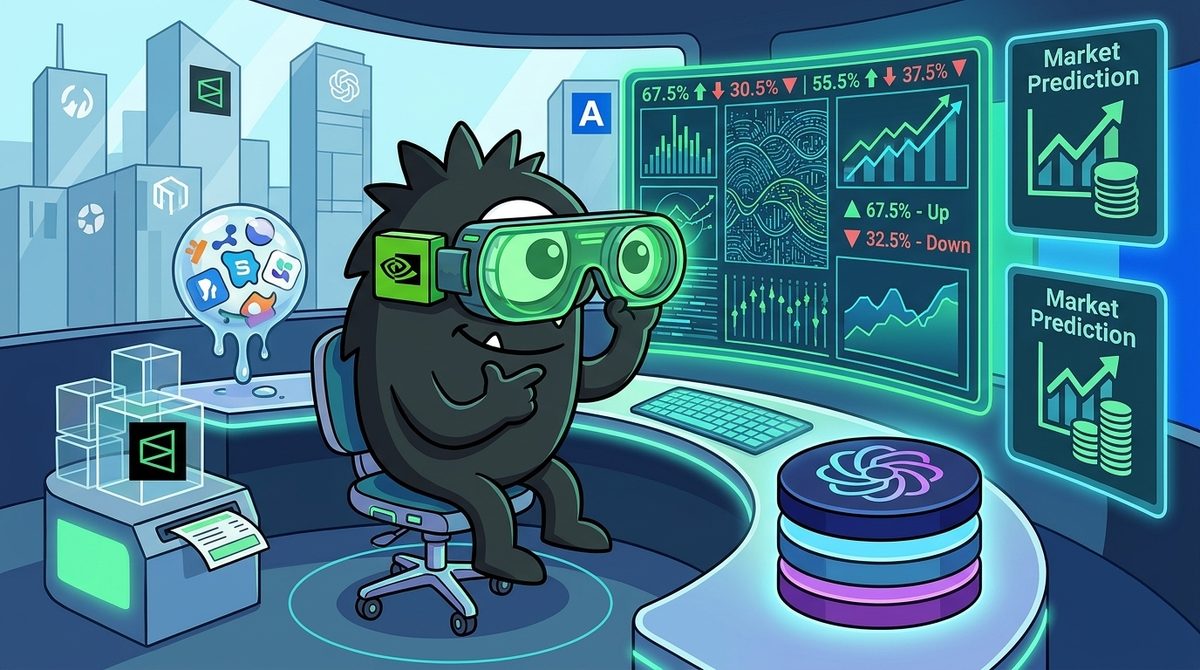
Short answer: As of October 22, 2026, Polymarket traders price a 9% chance that the AI bubble "bursts" by December 31, 2026, and a 20% chance by June 30, 2027.[1] Traders are not saying AI valuations are sound. They are saying a specific, severe, clustered collapse is unlikely in the next ten weeks and only modestly more likely over the next eight months.
If you build on AI, sell software, or buy SaaS, you probably came here with one question: is the money betting that this all falls apart soon? The answer is no, not soon. But the distance between "bubble" and "burst" is where the useful information sits.
Bottom line (October 2026):
- About $3.1M has traded on Polymarket's "AI bubble burst by...?" market. Most of it ($2.49M) sits on the year-end 2026 contract, which is priced at 9%.[1]
- The June 30, 2027 contract is priced at 20%, but it has seen only about $36.6K in volume, so treat it as a thinner, noisier signal.[1][5]
- "Burst" has a high bar under the market's rules: several extreme events must land inside one 90-day window. Low odds reflect that bar more than complacency.
- The bigger near-term story for software is the SaaS repricing already underway. That repricing can continue whether or not the market's "burst" criteria are ever met.
What Polymarket's $3.1M AI Bubble Market Is Actually Pricing
The numbers as of October 22, 2026:
| Contract | Implied probability | Volume traded |
|---|---|---|
| Burst by December 31, 2026 | **9%** | $2,491,018 |
| Burst by June 30, 2027 | **20%** | $36,585 |
Total market volume is roughly $3,115,599, and the event resolves around January 1, 2027.[1] Coverage of the market has described the year-end odds at "roughly 10%" in recent weeks,[2] and secondary trackers put the mid-2027 line at 20%.[5]
These figures are money-weighted consensus. They are not forecasts from an oracle. A 9% price means traders collectively value a YES share at nine cents on the dollar. It does not mean anyone knows what happens in December. Ramin made the same distinction when the market started circulating:
Polymarket is putting a price on one of the biggest questions in tech: Is the AI boom becoming a bubble?
Current market data reported by MarketWatch puts the odds of a major AI downturn before January 1, 2027, at 10%, rising to 20% before July 2027. The year-end market has nearly $2.5M in trading volume.
Important distinction: these are market-implied probabilities, not proof that a crash is coming.
My take: prediction markets become especially interesting when they quantify risks that traditional markets debate but struggle to express clearly.
The real signal isn't just the percentage. It's how that probability changes as valuations, bond yields and AI spending evolve.
Would you trust this market's odds over the consensus on Wall Street?
@Polymarket
The more telling point is the path the price took to get here. Per a breakdown of the price chart, the year-end line opened near 42.5% last November, slid to about 6%, bounced to 11%, and has settled near 9%.[5] A market that once priced a coin-flip-adjacent chance of collapse has spent a year walking that number down. Nvidia stayed elevated, the frontier labs kept raising money, and the window kept shrinking.
There is also a liquidity asymmetry. Roughly 80% of all volume sits on the 2026 contract. The 2027 contract's 20% reflects about $36K of conviction, which is a thin order book that a handful of traders can move. Read it as directional ("risk roughly doubles with more time"), not precise.
Why 'Burst' Has a Very Specific Definition
Single-digit odds can look naive next to the bearish takes on your timeline. That reading changes once you see the resolution rules. Yeon Vail summarized them:
POLYMARKET TRADERS SEE A 10% CHANCE THE AI BUBBLE BURSTS BEFORE NEW YEAR. THEY READ THE RULES FIRST.
At 0:01 the line starts at 42.5%, last November. By 0:06 it has slid to 6%. At 0:07 it turns and climbs to 11%, then settles near 9%.
Not random. On Polymarket, "bursts" needs 3 of 6 events inside one 90-day window. Nvidia 50% below its high. SOXX 40% below. OpenAI or Anthropic bankrupt. OpenAI sold. H100 rent at $1 for 5 days. TSMC, ASML, Broadcom, Arista or Supermicro halved.
Nvidia closed at $214.13 on October 16. Half of its $243.37 high is $121.69, another 43% down, and that is only one of the three.
Traders put $2.48M on the year-end contract. The mid-2027 one sits at 20%.
Citadel's Ken Griffin said in October 2026 that AI is "almost certainly" in a bubble.
The traders mostly agree. They just do not think it pops by December.
Is 10% too low for that rulebook, or too high?
Under the rules as described, a YES resolution needs three of six severe events to occur within a single 90-day window:
- Nvidia trading 50% below its high
- The SOXX semiconductor index 40% below its high
- OpenAI or Anthropic going bankrupt
- OpenAI being sold
- H100 rental prices hitting $1 for five days
- One of TSMC, ASML, Broadcom, Arista, or Supermicro halving
That is a description of a systemic crash, not a correction. By Yeon Vail's math, Nvidia's October 16 close of $214.13 would need to fall another ~43% just to satisfy one condition. Two others would then have to arrive in the same quarter.
Three implications follow for practitioners:
- A SaaS bloodbath doesn't count. None of the six triggers references software multiples. Per-seat SaaS could keep repricing for years and this market would still resolve NO.
- A "soft landing" doesn't count either. A 30% Nvidia drawdown, falling GPU rents, and a down-round at a frontier lab would feel like a burst to many people. It could still miss the threshold.
- The odds vary by feed. Yahoo Finance's prediction-market page,[3] OddsShift (which recently showed 11% for the 2026 line),[4] and CryptoSlate's market analysis[6] each capture slightly different snapshots, so you'll see figures between about 9% and the low teens depending on timing. The spread is noise. The order of magnitude is the signal.
Ken Griffin reportedly said in October 2026 that AI is "almost certainly" in a bubble, as Yeon Vail's post notes. The market doesn't contradict him. Traders can believe the asset is overpriced and still bet the clustered collapse doesn't arrive by December.
The 'SaaS-pocalypse': Why Software Multiples Are Collapsing
The most energetic thread in the X conversation isn't about Nvidia at all. It's about software. JUMPERZ made the bear case as starkly as anyone:
I genuinely believe we're watching SaaS die in real time and most people still don't see it..
$1 trillion wiped from software stocks since January 2026 and its just getting started..
SaaS multiples collapsed from 18.5x at the covid peak to 4.8x today and in the same time the AI market went from $50B to $539B and it's heading to $3.5 trillion by 2033 if not sooner
the death cross hits around 2027.. that's when AI market trajectory fully overtakes SaaS valuations on the chart
the reason is simple.. the per-seat model dies when 10 agents replace 100 humans and no seats left to sell
every SaaS tool you're paying $50/seat a month for is about to get replaced by an agent that costs $0.003 per task..
chatgpt opened the door in 2022, claude opus 4 made agentic AI real in 2025 and now multiagent coordination systems like openclaw are making it deployable and accessible to everyone..
every step on that chart the tech gets more autonomous and the SaaS line drops further..
not saying every saas will die but the companies that were built entirely on per-seat pricing and no real data advantage are the ones exposed.
tbh I don't think most founders see it yet, not because the data isn't there, but accepting it means everything they built needs to be rethought..
The specific figures in that post are the author's own: $1T wiped from software stocks since January 2026, and multiples falling from 18.5x to 4.8x. Treat them as a practitioner's framing rather than audited data. The mechanism, though, is widely discussed: when agents perform work previously done by seat-holding humans, per-seat pricing loses its unit of value. JUMPERZ's "death cross" puts AI's market trajectory overtaking SaaS valuations around 2027. That conveniently overlaps the window where Polymarket's burst odds double.
David Sacks offered a more structural explanation for why investors are repricing the whole category:
This is a fantastic breakdown of why AI is having such a big impact on the stock prices of SaaS companies
Worth a listen. From AI and crypto czar David Sacks himself
"SaaS used to be such an easily modeled and predictable category.
We saw the same story play out across many different categories of software
You would have this initial period of this experimentation phase, a bunch of products would come to market, and there would be a battle
And then the market would eventually settle, and there would be a category leader. They would capture most of the market share and vast majority of the market capitalization
And they would have very predictable metrics. It used to be very easy to grade a SaaS business.
These things began to be seen as an annuity with growth"
The old SaaS playbook ran experimentation, then battle, then settlement, then a durable leader valued "as an annuity with growth." AI reopens settled categories. If a CRM or ticketing incumbent's moat can be challenged by an AI-native entrant, investors stop paying annuity multiples. The issue isn't that revenue disappears overnight. It's that predictability, the thing the multiple was paying for, is gone.
Here is the synthesis the X debate often misses. SaaS compression and AI capex expansion are the same capital rotation viewed from two ends. Money leaving "predictable software" is partly funding "unpredictable infrastructure." So if the AI bubble did burst under Polymarket's definition, SaaS incumbents wouldn't automatically recover. The agentic substitution pressure is driven by model capability and falling inference cost. That pressure would likely persist, or even intensify, if GPU prices collapsed and compute got cheaper. A prior buyer's-guide analysis of these same odds reached a similar conclusion: SaaS risk and bubble risk are related but not interchangeable bets.[7]
OpenAI's Cash Burn and the Circular Financing Debate
The bearish side of this market rests on frontier-lab economics. BichonRedux laid out the cascade thesis in detail (and openly noted Claude drafted it from their notes):
The AI bubble will collapse. Here’s the cascade and what survives. (Claude wrote this for me based on my thoughts)
OpenAI burns $9B cash on $13B revenue. Their own projections show $143B in cumulative losses before profitability. They’re selling dollars for 70 cents at scale. The more they sell, the more they lose.
The collapse sequence is simple: frontier labs fail → GPU cloud middlemen (who borrowed billions at peak prices) get crushed → hyperscalers cut capex → NVIDIA cycles down. Each step accelerates the next.
The people who lived through 2001 see it. But being early is indistinguishable from being wrong — for years. The last skeptic will capitulate right before the crash. That’s how every bubble ends.
Here’s what’s different: the technology is real. Fiber was real in 2000 too. It just needed a decade of bankruptcies before the economics worked.
So what survives?
Local models. Delivered by Apple.
Their playbook never changes — let the industry burn capital on half-baked implementations, then arrive late with something so integrated it makes everything before it look like a prototype. The entire AI industry is currently doing Apple’s R&D for them. At $143B in projected losses. With no compensation.
The M5 already runs 70B parameter models locally. DeepSeek V4 dropped this week — open source, near-frontier performance, no NVIDIA hardware required. The gap between local and cloud closes from both directions simultaneously.
The killer move: your iPhone tunnels home to your Mac over an encrypted connection. Your Mac becomes your personal AI server. Your data never touches a corporate server. Ever.
Apple doesn’t compete with OpenAI. They make them irrelevant.
Jensen knows this. He just can’t say it.
The figures in that post are the author's claims: a $9B cash burn on $13B revenue, $143B in projected cumulative losses, and "selling dollars for 70 cents at scale." The proposed sequence (frontier labs fail → leveraged GPU clouds get crushed → hyperscalers cut capex → Nvidia cycles down) maps closely onto Polymarket's triggers. A lab bankruptcy, collapsing H100 rents, and a halving in Nvidia or SOXX are each on the list. That overlap explains why the market is a reasonable proxy for this specific fear.
Steven Shortino added the scale argument:
AI might be the biggest bubble in US economic history.
Amazon, Google, Microsoft, and Meta plan to spend about $725 billion on AI infrastructure in 2026, up 77% from last year.
OpenAI plans to spend $856 billion on compute through 2030 and run $278 billion in negative free cash flow along the way.
Revenue is growing fast, but costs are growing with it. OpenAI spends roughly $1.65 for every $1 it brings in.
Completely unsustainable.
None of the major AI companies turn a profit. Their valuations are a bet on a future where AI transforms nearly everything.
Meanwhile, about half of US adults still don’t use AI at all.
Now, pure AI plays like Anthropic and OpenAI are lining up for trillion-dollar IPOs.
Providing liquidity to investors who have no clue when they'll see an actual return.
If one major player can’t sustain the burn, confidence breaks and the dominoes start falling.
AI is a fantastic tool, and it isn’t going away.
But “useful tool” and “worth trillions on future promises” are very different claims.
He cites Amazon, Google, Microsoft, and Meta planning roughly $725B in AI infrastructure spend in 2026, up 77%, and OpenAI spending about $1.65 per dollar of revenue. Steve Hsu framed the hurdle as a revenue problem:
AI Boom or Bust? – Manifold #122
Are we in an AI bubble?
Analysis of AI CapEx, revenues, OAI+ANT burn rates.
AI revenue has to reach $ TRILLIONS per annum within the next few years (an increase of > 10x; compare total global software revenue of $1.5T today), or else the current CapEx spend will turn out to be a huge misallocation.
Separately, even if total AI revenue reaches these levels, OAI and ANT could still be overvalued due to revenue/margin compression from competition with other US or Chinese labs.
Chapters:
(00:00) - Conference Takeaways
(03:21) - AI Capability Leap
(07:36) - Both Things True
(08:46) - CapEx Debt Risks
(10:31) - Trillion Revenue Hurdle
(18:32) - Spend Plateau Signals
(31:45) - IPO and Bubble Fallout
His point that AI revenue must reach trillions annually, against roughly $1.5T in global software revenue today, sets the real bar for justifying current capex. Hsu also notes that even if the industry gets there, competition from other US and Chinese labs could compress margins enough that the leaders stay overvalued.
Paweł Łaskarzewski's widely shared October 2025 thread mapped the "house of cards" itself: Nvidia investing in OpenAI, which buys Nvidia chips; Oracle and CoreWeave buying GPUs to rent back to OpenAI; AMD warrants functioning as financing.
The Interconnected Web of OpenAI's AI Infrastructure - A House of Cards or the Future of Tech? Is it a bubble?
OpenAI's aggressive expansion under CEO Sam Altman is shaping up as one of the largest speculative bubbles in history—one built not just on cash flows, but on sheer faith that it won't collapse. Altman is crafting this ecosystem live before our eyes, relying on financial flows and the belief that it'll all pay off without crumbling. If it succeeds, he could become the richest person on Earth; if not, we might face a crisis unseen in decades. The result? A fragile system where every player depends on the others, creating a circular loop of investments, sales, rentals, and guarantees that props up valuations but risks a domino-effect implosion.
At its heart, this ecosystem is a web of mutual dependencies among key players (OpenAI, Nvidia, Oracle, CoreWeave, AMD) that funnels massive capital into AI infrastructure—data centers, chips, and power—without any single entity fully owning or funding it. This isn't traditional venture funding; it's a form of vendor financing and equity swaps that echoes the dot-com era's excesses, where companies traded inflated stock and promises to fuel growth, only for the bubble to burst when reality hit. Below, I'll break it down step by step, drawing on the latest developments (as of October 2025) to explain how this machine works, why it's precarious, and what could happen if it falters. I'll keep it detailed but structured for clarity.
1. The Core Problem: OpenAI's Infrastructure Deficit
OpenAI doesn't own the physical backbone it needs to train and deploy next-gen AI models like successors to GPT-4 or the hyped GPT-5. Building AI requires exascale computing: millions of GPUs (graphics processing units) in massive data centers guzzling gigawatts of power. Altman has publicly stated OpenAI needs trillions in infrastructure spend over the coming years—far beyond its ~$4.3 billion in H1 2025 revenue or $500 billion valuation. Challenges include:
- No ownership: OpenAI relies on partners for chips, servers, and energy.
- No control: Power grids can't scale fast enough; U.S. electricity shortages could delay projects by years.
- No capital: It's burning $2.5 billion in cash every six months, forcing creative financing like equity stakes, leases, and guarantees.
Altman admits the scale is "brutally difficult" and even calls some AI valuations "insane." Yet, he's on a global tour (Asia, Middle East) pitching for more funds and priority manufacturing from TSMC, Samsung, etc.
2. The Players and Their Interlocks: A Circular Dependency Chain
This is a system where everyone depends on the next. Here's how it flows, like a financial ouroboros (snake eating its tail), with billions recycling through investments and purchases:
Nvidia → OpenAI (Investment to Drive Chip Sales):
Nvidia, the AI chip king (90%+ market share, $4T+ valuation), announced a $100B investment in OpenAI in September 2025. It's phased: $10B upfront, more as data centers deploy (starting H2 2026 with Vera Rubin GPUs).
Mechanism: Nvidia gets non-voting equity in OpenAI; OpenAI uses the cash to buy millions of Nvidia GPUs (at least 10GW of systems, ~4-5M chips). Nvidia sells directly (bypassing clouds), earns revenue, and locks in OpenAI as a customer. It's "cash-for-chips": Nvidia's money buys its own products.
Why? Boosts Nvidia's sales amid exploding AI demand (ChatGPT has 700M+ weekly users). But critics call it "circular dynamics"—Nvidia's profits inflate on self-financed deals.
Oracle → Nvidia → OpenAI (Cloud Leasing for Data Centers):
Oracle buys $40B in Nvidia GB200 GPUs (~400K chips) for OpenAI's "Stargate" project—a $500B+ U.S. data center buildout with SoftBank. Oracle leases the compute power to OpenAI over 15 years.
Mechanism: Oracle uses deal revenue to buy more Nvidia chips, creating a loop: Nvidia sells to Oracle → Oracle rents to OpenAI → OpenAI pays Oracle (partly via Nvidia-financed equity). Total Oracle-OpenAI cloud deal: $300B over 5 years for 4.5GW.
Why? OpenAI diversifies from Microsoft Azure; Oracle catches up in cloud (vs. AWS/Google) and boosts stock (briefly making Larry Ellison #1 richest). Ties into Stargate's $850B total (17GW across sites).
CoreWeave → OpenAI (GPU Rentals with Nvidia Backstop):
CoreWeave, a GPU cloud specialist (ex-crypto miner), rents Nvidia GPUs to OpenAI in a $6.5B deal (part of OpenAI's $15.9B+ in rentals). OpenAI took a $350M stake in CoreWeave pre-IPO.
Mechanism: CoreWeave buys Nvidia hardware upfront; Nvidia guarantees $6.3B in capacity purchases through 2032 if CoreWeave can't find customers. This de-risks CoreWeave's expansion (valued at $75B post-IPO), while OpenAI gets flexible, on-demand GPUs without owning them. CoreWeave serves other giants (Meta, IBM) but 77% of 2024 revenue was from Microsoft/OpenAI proxies.
Why? Scalability—OpenAI needs burst capacity for training; Nvidia ensures its ecosystem thrives.
AMD → OpenAI (Equity Swap for Market Validation):
Just days after Nvidia's deal, OpenAI inked a 6GW agreement with AMD (starting 1GW in 2026 with Instinct MI450 GPUs), worth tens of billions (AMD expects $100B+ ripple revenue over 4 years).
Mechanism: OpenAI gets warrants for up to 10% of AMD (160M shares), effectively financing purchases with AMD's own inflated stock. AMD gains credibility vs. Nvidia, spiking shares 23-34% (+$80B market cap).
Why? Diversification—OpenAI hedges Nvidia reliance; AMD justifies its valuation in a Nvidia-dominated market.
The Flow Visualized (Simplified Loop):
- Nvidia invests in OpenAI/others → OpenAI buys Nvidia chips.
- Oracle/AMD/CoreWeave buy Nvidia/AMD chips → Rent to OpenAI.
- OpenAI pays via revenues/equity → Funds more buys.
- Guarantees (e.g., Nvidia's to CoreWeave) backstop unused capacity. Total 2025 deals: $1T+ across partners, inflating everything from Nvidia's $4T cap to Oracle's surge.
3. Why It's a Bubble: Faith Over Fundamentals
This mechanism thrives on hype and leverage:
- Speculative Valuations: AI stocks (Nvidia, AMD) soar on deal announcements, but earnings are "goosed" by circular flows. OpenAI's $500B valuation assumes AGI success, but it's unprofitable.
- Risk Amplification: If OpenAI's revenues stall (e.g., GPT-5 underdelivers), it can't pay leases. Nvidia's guarantees become liabilities; AMD's stock tanks, eroding OpenAI's "currency." Echoes dot-com: Vendor financing burst when demand dried up.
- External Pressures: Power shortages (AI needs nuclear/fusion scale), regulatory scrutiny (e.g., antitrust on monopolies), or a recession could trigger defaults.
- Altman's Bet: He gets rich if AGI arrives (trillions in value); we all lose if not—a crisis dwarfing 2008, as AI underpins 25% of S&P 500.
4. Potential Outcomes: Boom, Bust, or Steady State?
Success Scenario:
AI delivers (e.g., agentic models, multimodal breakthroughs), revenues explode, debts pay off. Altman becomes a trillionaire; ecosystem stabilizes.
Bubble Burst:
Equity selloff (like post-ChatGPT hype fade) cascades—Nvidia down 2% on AMD news alone. Broader crash if Stargate's $100B "immediate" funding stalls.
Middle Ground:
Government subsidies (e.g., U.S. energy infra) or IPOs de-risk it, but slow growth.
In essence, this is capitalism on steroids: Interlocked bets on AI's promise, where faith in mutual success keeps the plates spinning. It's a bubble because the mechanism lacks independent anchors—it's all relational. If you're investing or just watching, it's thrilling but terrifying. What do you think—will Altman's vision hold, or is the house of cards already wobbling?
So why only 9%? Because the cascade thesis is about direction, and the market is about timing. BichonRedux concedes as much: "being early is indistinguishable from being wrong — for years." Frontier labs have shown they can keep raising capital. A bankruptcy-level failure requires capital markets to shut, not just to grow skeptical. Traders appear to be pricing that a funding freeze severe enough to topple a lab is unlikely within ten weeks.
Musical Chairs: The Concentration Risk Traders Are Watching
If circular financing is the mechanism, concentration is the vulnerability. Global Markets Investor put numbers on it:
🚨 THE AI BUBBLE IS STARTING TO LOOK LIKE A GAME OF MUSICAL CHAIRS:
The AI ecosystem is becoming increasingly interconnected, with a huge share of revenue at major companies now dependent on spending from a small group of AI players.
Applied Digital, $APLD, has the highest AI-related revenue exposure at ~86%, followed by CoreWeave, $CRWV, at ~80%, SK Hynix at ~58%, Nvidia, $NVDA, at ~51%, and TSMC, $TSM, at ~46%.
The concentration is striking, with Applied Digital depending heavily on Oracle and CoreWeave, while CoreWeave relies primarily on Microsoft, with additional exposure to Google and Meta.
AI companies are spending heavily on chips and infrastructure, those suppliers generate revenue from that spending, and the resulting revenue supports further investment across the same ecosystem.
With AI investment increasingly financed through debt, the ecosystem is becoming a circular financing system, with capital flowing between companies and helping fund further investment across the same AI ecosystem.
Put simply, the AI bubble increasingly looks like a game of musical chairs.
As long as spending remains high, most players benefit, but if one major player cuts spending, the revenue shock could quickly spread across the entire chain.
Are you playing?
The estimates are about 86% AI-related revenue exposure at Applied Digital, about 80% at CoreWeave, about 51% at Nvidia, and about 46% at TSMC. Those levels mean a spending pullback by one or two hyperscalers would ripple through the chain quickly. "As long as spending remains high, most players benefit."
Institutional monitors are watching the same pressure points. CEPR's AI Bubble Monitor tracks stress indicators across the buildout, including financing conditions for leveraged GPU cloud providers such as CoreWeave, as early warnings of trouble.[11] At the macro level, the IMF's October 2026 outlook flagged an AI market correction as a material risk to the global economy alongside war and debt. Reporting on the outlook says such a correction could shave about 1.1% off global GDP by 2028.[12]
This explains the term structure of the market. Concentration risk compounds over time. Debt matures, capex commitments come due, and a single customer's pullback has more quarters to propagate. A 90-day clustering of three triggers is much more plausible over an eight-month horizon than a ten-week one. The jump from 9% to 20% is, in effect, the market's price for "more time for dominoes to line up."
Markets vs. Pundits: What the 9% Says About the Bearish Chorus
The professional consensus looks far more alarmed than Polymarket, and almost all of it points to 2027:
- Bank of America's October 2026 fund manager survey found nearly half of fund managers expect an AI bubble crash by 2027, even as they hold AI exposure at multi-year highs.[8]
- Michael Burry has reportedly shifted to 2027-expiry puts on Nvidia, Palantir, and the Nasdaq 100.[10]
- A Panmure Liberum strategist warned of a potential 36% S&P 500 drop by end-2027, which would be the worst since 2008.[9]
Read together, the pundits and the prediction market roughly agree. Nobody serious is calling for a December 2026 collapse. The bearish money (Burry's puts, the fund managers' expectations) is dated next year, which lines up with the 20% contract, not the 9% one. Fund managers saying "bubble by 2027" while staying long is the classic late-cycle posture: they expect the music to keep playing for now.
The remaining gap between "half of fund managers" and "20%" comes down to definitions. A 36% S&P drawdown would be devastating, and it still might not satisfy three of Polymarket's six triggers in one quarter. Pundits forecast pain. The market prices a specific catastrophe.
What Developers, Founders, and SaaS Buyers Should Do Now
Mike Ippolito captured the mood of people looking for a safe position anywhere:
Stocks: AI bubble
Bonds: Western gov borrowing crisis
Private credit: SaaS-pocalypse
Bitcoin: quantum
Crypto: quantum + hacks
Real estate: 5.5% 10Y and rising
Gold: lab grown price deflation
Where can you safely put your money anymore?
Practitioners can't hedge everything, but they can make decisions that hold up across the 9%-to-20% range. The guidance differs by role.
If you're a developer or engineering lead
- Build for model portability. The bear case centers on frontier-lab solvency, so don't hard-wire your product to one provider's API shape. Abstract the model layer and keep eval suites provider-agnostic. Test open-weight fallbacks. BichonRedux's point about near-frontier open-source models and local inference is the practical hedge here, whatever you think of the Apple prediction.
- Watch GPU pricing as a leading indicator. One of the market's triggers is H100 rent at $1. Falling compute prices are good news for your inference bill, even as they signal stress upstream.
If you're a founder
- Assume AI-feature parity is temporary. If your differentiation is "we added an agent," Sacks' framing applies to you: categories are reopening, and settlement favors whoever owns distribution and proprietary data.
- Rethink seat-based pricing before your customers force it. JUMPERZ's warning targets companies "built entirely on per-seat pricing and no real data advantage." Outcome- or usage-based pricing is a hedge against agentic substitution.
- Plan runway for a 2027 funding squeeze, not a 2026 crash. The market and the pundits converge on next year as the risk window.
If you're a SaaS buyer or procurement lead
- Negotiate shorter terms and exit clauses. Multiples are compressing and categories are unsettled, so multi-year lock-ins carry more vendor risk than they did two years ago.
- Ask vendors about upstream concentration. If a critical tool depends on a single frontier model or a heavily leveraged GPU provider, that's the "musical chairs" exposure landing on your stack.
For everyone: use the market as a dashboard, not a headline
Track three things rather than the hottest bubble take of the week:
- The 9%/20% spread. A widening gap means traders see risk building into 2027.
- Movement on the year-end line. A jump from 9% toward its earlier 40%+ range would be a meaningful repricing.
- The six triggers themselves: Nvidia and SOXX drawdowns from their highs, H100 rental prices, and frontier-lab financing news.
As Ramin put it, the real signal is "how that probability changes as valuations, bond yields and AI spending evolve." As of October 2026, betting markets price the AI bubble as more likely to deflate slowly, and to keep squeezing SaaS along the way, than to burst before the year ends.
Sources
[1] Polymarket — AI bubble burst by...? — https://polymarket.com/event/ai-bubble-burst-by
[2] Crypto Briefing — Polymarket traders put roughly 10% odds on an AI bubble burst by year-end — https://cryptobriefing.com/polymarket-odds-ai-bubble-burst-year-end/
[3] Yahoo Finance — AI bubble burst by...? Prediction Market Prices — https://finance.yahoo.com/markets/prediction/event/ai-bubble-burst-by/
[4] OddsShift — AI bubble burst in 2026? — 11% — https://oddsshift.com/radar/ai-industry-downturn-by-december-31-2026-857
[5] Polymarket Trader — AI bubble burst? Odds: By June 30, 2027 20% — https://polymarkettrader.com/odds/ai-bubble-burst/
[6] CryptoSlate — AI bubble burst in 2026 Odds & Prediction Market Analysis — https://cryptoslate.com/predictions/market/ai-bubble-burst-in-2026/
[7] AdTools — The Best AI Bubble Signals in 2026: What Polymarket's 10% Odds Reveal About AI and SaaS — https://adtools.org/buyers-guide/the-best-ai-bubble-signals-in-2026-what-polymarkets-10-odds-reveal-about-ai-and-saas
[8] Latin Times — Wall Street Bets Big on AI at Six-Year Highs as Nearly Half of Fund Managers Predict a 2027 Crash — https://www.latintimes.com/wall-street-bets-big-ai-six-year-highs-nearly-half-fund-managers-predict-2027-crash-600131
[9] Yahoo Finance — AI Bubble Risks Worst S&P 500 Crash Since 2008, Strategist Says — https://finance.yahoo.com/markets/stocks/articles/ai-bubble-risks-worst-p-061638441.html
[10] Business Insider — 'Big Short' Michael Burry Is Betting AI Bubble Will Burst in 2027 — https://www.businessinsider.com/big-short-michael-burry-ai-bubble-stock-market-outlook-2027-2026-9
[11] CEPR — The AI Bubble Monitor — https://cepr.net/publications/ai-bubble-monitor/
[12] Reuters — IMF flags risks to global economy from AI market correction, war and debt — https://www.reuters.com/business/finance/imf-flags-risks-global-economy-ai-market-correction-war-debt-2026-10-13/
References (16 sources)
- Polymarket — AI bubble burst by...? - polymarket.com
- Polymarket traders put roughly 10% odds on an AI bubble burst by year-end - cryptobriefing.com
- AI bubble burst by...? Prediction Market Prices - Yahoo Finance - finance.yahoo.com
- AI bubble burst in 2026? — 11% | OddsShift - oddsshift.com
- AI bubble burst? Odds: By June 30, 2027 20% | Polymarket Odds Today - polymarkettrader.com
- AI bubble burst in 2026 Odds & Prediction Market Analysis | CryptoSlate - cryptoslate.com
- The Best AI Bubble Signals in 2026: What Polymarket's 10% Odds Reveal About AI and SaaS - adtools.org
- Wall Street Bets Big on AI at Six-Year Highs as Nearly Half of Fund Managers Predict a 2027 Crash - latintimes.com
- AI Bubble Risks Worst S&P 500 Crash Since 2008, Strategist Says - finance.yahoo.com
- 'Big Short' Michael Burry Is Betting AI Bubble Will Burst in 2027 - businessinsider.com
- The AI Bubble Monitor – CEPR - cepr.net
- IMF flags risks to global economy from AI market correction, war and debt - reuters.com
- Brace for Impact: Protecting People and the Economy When the AI Bubble Bursts - openmarketsinstitute.org
- October 2026 Market Intelligence Report | Dedale - dedale.com
- Q3 State of AI for SaaS and AI-Native Startups: Only 9 of 23 Predictions Held Up - analyticsinsight.net
- US SaaS Market Study 2026-2031 | eFinancialModels - efinancialmodels.com
Related Guides
The Best AI Bubble Signals to Watch in 2026: What Polymarket's Odds Reveal About AI and SaaS
20 min read
xAI Grok vs Mistral AI: Which Is Best for Building Full-Stack Web Apps in 2026?
20 min read
CrossPublish vs Buffer vs Publer vs Hootsuite: Which Scheduler Is Best for Creators in 2026?
19 min read
The Best AI Model in 2026: What Polymarket's Odds Reveal About Where AI and SaaS Are Heading
22 min read