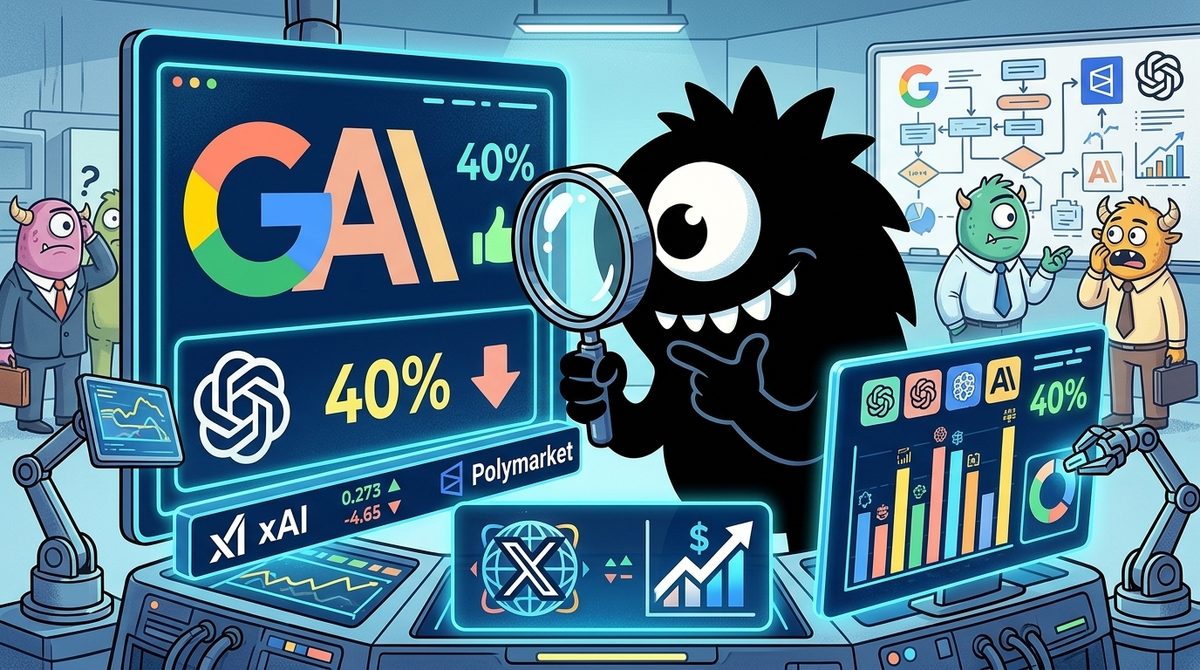
The Best AI Model in 2026: What Polymarket's Odds Reveal About Where AI and SaaS Are Heading
Polymarket prices Google at 75% to have the best AI model by end of October 2026. Discover what the odds reveal for developers, founders, and SaaS buyers. Learn more.
If you are deciding whether to standardize on Gemini, Claude, or an OpenAI model, the real question is not simply which company will win October? It is whether prediction-market traders are identifying a durable technical advantage—or merely anticipating which model will occupy one leaderboard position on one date.
As of October 20, 2026, the market implies that Google is the strong favorite to have the “best AI model” at the end of October. But a separate year-end market favors Anthropic. Taken together, those prices suggest that traders expect rapid leadership churn rather than a lasting winner. For developers and SaaS buyers, that is an argument for workload-specific testing and multi-model flexibility, not an automatic migration to Google.
Bottom line
>
- The October market implies a 75% probability for Google, 24% for Anthropic, and 1% for OpenAI.
- The year-end market has recently favored Anthropic over Google, implying that traders view Google’s current lead as potentially temporary.
- Prediction markets are useful as a fast sentiment and launch-momentum signal, but they measure the probability of satisfying specific resolution rules—not the best model for every production workload.
- The larger industry signal is that model quality is converging while differentiation shifts toward agents, reliability, cost per completed task, cloud distribution, and developer tooling.
What is the Polymarket market actually pricing on October 20, 2026?
Roughly $2,974,835 has been traded in Polymarket’s “Which company has the best AI model end of October?” market, which is expected to resolve around October 31.[1] As of October 20, traders currently price the field as follows:
| Company | Market-implied probability | Traded volume |
|---|---|---|
| **Google** | **75%** | **$665,756** |
| **Anthropic** | **24%** | **$630,899** |
| **OpenAI** | **1%** | **$393,120** |
| **Meta** | **0%** | **$349,260** |
| **SpaceXAI** | **0%** | **$322,851** |
| **Alibaba** | **0%** | **$154,450** |
These percentages are market prices, not established probabilities or declarations of technical fact. A 75% price means traders collectively assign Google roughly three chances in four under the contract’s rules and current information. The 0% figures are rounded market prices; they should not be read as proof that an outcome is literally impossible. A separate tracker placed Google at 73.5% in a nearby snapshot, illustrating that these prices move continuously.[7]
The AI race is getting weird because the money on @polymarket has Google sitting at 71% to own the best model by the end of october while Anthropic is stuck around 26 and OpenAI is basically nothing at under 1.
that market already has over 2 million traded and people are still moving size on it every day.
Everyone keeps arguing about which lab is actually ahead on the benchmarks but the crowd is pricing a clear short-term shift toward google right now.
The year end market is way tighter with Google and Anthropic almost even, so the next couple weeks could get messy once the leaderboard settles.
The volume also matters. OpenAI’s $393,120 traded alongside a current 1% price does not indicate that nobody considered it. It indicates that substantial trading occurred before the market arrived at an extremely bearish short-term assessment. Volume records activity across the contract’s life; it is not the same thing as current support.
Polymarket itself earlier highlighted an 83% Google price, showing how sharply sentiment has moved even within this short window:
BREAKING: Google projected to dethrone Anthropic as the company with the best AI model at the end of October.
83% chance.
https://polymarket.us/event/company1-2026-10-31
For practitioners, the correct interpretation is narrow: the market strongly expects Google to satisfy this contract at the October deadline. It does not imply a 75% chance that Gemini will be the cheapest model, the best coding agent, or the strongest choice for a particular SaaS product.
Why do the October and year-end markets have opposite favorites?
The most revealing signal is not Google’s October lead by itself. It is the market’s term structure: traders currently price one company to lead at the end of October and another to have the better chance at the end of 2026.
Polymarket, on who has the best AI model:
End of October: Google, about 3 in 4.
End of 2026: Anthropic 47.5% vs Google 39.5%.
Same race, opposite favorite, two months apart.
I put the odds next to the model rankings and the money: https://airacescoreboard.com/?utm_source=x&utm_medium=social&utm_campaign=teaser-2026-10-18
Snapshots of the year-end market have put Anthropic between approximately 47.5% and 51.5%, while Google has recently been priced around 39.5%.[2][3][4] Those figures vary with timing, but the direction is clear: Google is the short-horizon favorite, while Anthropic has often been the year-end favorite.
The swing: on Polymarket's "best AI model end of 2026" market (~$2.59M traded), Anthropic went 41.5% → 49.5% since Oct 10. Google fell 42.5% → 39.5%.
The twist: Google still has @arena's #1 model and is 70.65% to hold it through October. Traders just don't think it lasts.
That divergence implies three expectations.
First, traders appear to believe Google has immediate leaderboard momentum. Second, they do not assign high confidence to Google holding an uncontested lead through December. Third, they expect at least one meaningful model release, evaluation change, or leaderboard reversal before year-end.
This is a useful distinction for buyers. A team selecting a model for an October product demonstration may care about the current frontier. A company signing a one-year platform agreement should care more about the provider’s release cadence, migration costs, model-routing options, service reliability, and contractual terms.
The split also reveals how compressed the AI development cycle has become. In conventional enterprise software, two months is barely enough time to evaluate and procure a platform. In frontier AI, traders currently treat two months as enough time for the favorite to change.
Did Gemini 4 Argon cause Google’s 20-fold odds swing?
The apparent catalyst for Google’s repricing was the release of Gemini 4 Argon. One widely circulated account of the market move said Google’s price rose from approximately 4% to 74% within days—an 18.5-fold change—and connected that move to Argon reaching the top of the relevant Arena leaderboard.
THIS IS INSANE: Google just made an almost 20x move on Polymarket
After the release of Gemini 4 Argon, traders now believe Google will have the BEST AI model by the end of October
If we look at previous months in 2026:
-> January: Google (Gemini 3 Pro)
-> February: Anthropic (Claude Opus 4.6)
-> March: Anthropic (Claude Opus 4.6)
-> April: Anthropic (Claude Opus 4.6 Thinking)
-> May: Anthropic (Claude Opus 4.6 Thinking)
-> June: Anthropic (Claude Fable 5)
-> July: Anthropic (Claude Opus 5)
-> August: Anthropic (Claude Opus 5 Max)
-> September: Anthropic (Claude Opus 5.5)
Anthropic won this market for 8 MONTHS in a row
But everything changed after Google introduced Gemini 4 Argon
-> Google YES jumped from 4% to 74% in just a few days
-> That’s an 18.5x move
-> $100 could have turned into $1,850 if you bought and sold at those prices
And Gemini 4 Argon is already sitting at #1 on the Arena leaderboard
The main question is whether Google can hold this position until October 31
Do you think Google will finally break Anthropic’s streak or Claude will take the lead again?
The same post describes a striking 2026 sequence: Google in January, followed by Anthropic winning the monthly market from February through September. That history helps explain the scale of the reaction. Traders were not merely pricing another competitive Gemini release; they were pricing the possibility that Google could interrupt an extended Anthropic streak.
Model comparison and leaderboard sites also show why traders can respond faster than enterprise evaluation teams. Public rankings aggregate newly available results almost immediately, while controlled internal testing, security review, and application regression testing can take weeks.[8][10][14] Prediction markets therefore react first to the expected resolution outcome, not to a broad production consensus.
Speculation about a follow-on Google checkpoint has added another layer:
Neck-and-neck on Polymarket: Anthropic ~43%, Google ~42% for best AI model by end-2026.
Google just launched Gemini 4 Argon publicly, and internal reports show a Carbon checkpoint under testing that some staff say matches Claude Opus 5.5 on coding. If it ships, that could tip the race.
The claim that an internal “Carbon” checkpoint may match Claude Opus 5.5 on coding comes from the X discussion, not a completed public evaluation. Traders may still incorporate such reports because markets price expectations before definitive evidence arrives. That makes them responsive—but also vulnerable to rumor, thin information, and launch narratives.
For founders, the lesson is not to trade product architecture on every odds movement. It is to recognize launches as repricing events. A new frontier model can quickly alter customer expectations around quality, latency, context length, and acceptable pricing, even before most companies have tested it.
Why do three AI scoreboards produce three different winners?
“Best model” sounds universal, but the market resolves according to specific rules and a designated leaderboard.[1] That transforms a broad technical question into a narrower forecasting problem: which eligible company will occupy the qualifying position when the contract resolves?
The broader benchmark landscape does not yield one uncontested answer.
Gemini 4 Argon is #1 on Vals Index: 68.9%.
On Artificial Analysis it trails Claude Opus 5.5: 53 vs 58.
On Terminal-Bench 4.0: 57.4% vs 66.4%.
Same model. Three scoreboards. Three different stories.
“Best model” is a claim about a benchmark, not about your work. Pick the test that looks like your job.
The figures in that post put Gemini 4 Argon at 68.9% on Vals Index, while Claude Opus 5.5 leads it 58 to 53 on Artificial Analysis and 66.4% to 57.4% on Terminal-Bench 4.0. Benchmark aggregators likewise present multiple dimensions rather than one definitive hierarchy.[9][10][12]
This disagreement is not a flaw that can be solved by averaging everything into one number. Different evaluations measure different capabilities:
- Preference arenas capture which answer human voters prefer in comparative interactions.
- Coding benchmarks test software tasks, sometimes in terminal or repository environments.
- Reasoning tests emphasize mathematical, scientific, or structured problem-solving.
- Agent benchmarks measure tool use and multi-step completion.
- Cost-adjusted indices incorporate how much inference is required to produce a result.
Benchmarks and real-world feel diverge a lot here. Gemini's long-context handling got noticeably better, but Claude still holds up better on multi-step agent loops in my experience. Depends what you're measuring.
View on XFor a general-purpose chatbot, an Arena result may be highly relevant. For an autonomous coding product, it may be much less predictive than success on multi-file changes, tool recovery, test execution, and dependency management.
SaaS buyers should therefore treat “number one” as an incomplete sentence. The required follow-up is: number one on which evaluation, under what settings, at what price, and for which task?
Do benchmark leaders also win at agentic coding in production?
Agentic coding exposes the gap between one-shot benchmark performance and production economics. An agent does not merely answer a prompt. It plans, edits files, invokes tools, reads errors, executes tests, and attempts recovery. A small reliability difference can compound across that loop.
I spent two years believing Claude was an overpriced luxury model while OpenAI was the default value play.
Daily production runs completely changed my math.
On paper, Anthropic token rates look expensive. In real engineering workloads, Claude Sonnet delivers the highest return on capital across the market.
First-pass accuracy dictates cost.
Cheaper models appear cost-effective until an autonomous coding agent fails a tool call, drops an import, and burns four consecutive retry cycles attempting to debug its own synthetic syntax errors. You burn 60% more tokens cleaning up after an inexpensive model than you spend on one clean Claude execution.
Subscription mechanics reveal the second divide. Heavy developer sessions hit ChatGPT rate limits within forty-five minutes. Claude rolling five-hour allowances and weekly throughput sustain deep agentic workflows without hard interruptions.
Gemini offers massive raw context at bargain rates, but access to their true frontier reasoning tier remains fragmented across confusing developer consoles.
Nominal token price is a vanity metric. Real cost is total tokens consumed per completed task.
Cheap tokens are expensive.
This is the strongest case for Anthropic’s longer-horizon odds. Even if the market implies that Google is more likely to win the October contract, developers may continue to prefer Claude when its first-pass accuracy reduces failed tool calls, broken imports, and repeated repair attempts. A higher token price can produce a lower total cost if the model completes more tasks without intervention.
The counter-position is that Gemini combines long context, competitive pricing, and integration with Google’s ecosystem. That combination may be particularly attractive for document-heavy workflows, Google Cloud customers, and applications that need to process large bodies of information. Comparative benchmark directories make those trade-offs visible, but cannot determine which one dominates inside a specific repository or agent harness.[8][11]
Google has the resources, but coding primacy favors models optimized for agentic multi-file work and specialized tools. Claude and OpenAI lead there through better real-world reliability on refactors and dedicated agents like Claude Code/Codex. Gemini shines on long context, cost, and Google integration, yet lags on the daily reliability and tooling that make a model a developer's default.
View on XThis yields a practical segmentation:
- Choose primarily for agent reliability when the workload involves multi-file refactors, long tool chains, unattended execution, or costly human review.
- Choose primarily for context and integration when the workload processes large document sets or already operates deeply within Google Cloud.
- Choose primarily for price and throughput when requests are high-volume, easily verified, and inexpensive to retry.
- Avoid a single default when tasks vary substantially in complexity and failure cost.
The best leaderboard model and the best repository model can therefore be different without either evaluation being “wrong.”
Is cost per token the wrong metric for AI procurement?
The pricing debate on X increasingly distinguishes cost per token from cost per successfully completed task.
One set of circulated figures puts the estimated Intelligence Index task cost at:
- GPT-6.1 Sol: $0.72
- Gemini 4 Argon: $1.99
- GPT-6 Astra: $3.26
- Claude Opus 5.5: $5.98
Holy shit.
Gemini 4 Argon costs $1.99 per Intelligence Index task.
GPT-6 Astra: $3.26
Claude Opus 5.5: $5.98
Claude Fable 5.1: $7.63
Claude Sonnet 5.5: $7.67
You’re paying 3–4× more for the Claude tier to do the same class of work.
GPT-6.1 Sol still wins: $0.72
Those numbers make Gemini look highly competitive and GPT-6.1 Sol look dramatically cheaper. But they do not automatically establish either as the lowest-cost model in a live application. The calculation changes when the system needs retries, longer prompts, fallback calls, human escalation, or cleanup after an incorrect action.
You’re probably going to see these two charts everywhere today, with people using them to argue completely opposite things.
One says Claude gives you ~5x more “value.” That does NOT mean 5x more tokens or 5x more useful work. A big part of that number comes from Opus 5.5 being much more expensive on the API.
(Of course it’s going to look like it “delivers more value” IF IT COSTS MORE. Like... obviously.)
The other makes GPT-6.1 Sol look way cheaper for similar intelligence. Also fair, but real work is messy. Agents retry, use tools, debug, fail, and iterate.
(It’ll make GPT look like it does way more than Claude for less money, but in real life that can be completely wrong. It depends on YOUR actual work.)
Both charts are useful, but neither tells you which plan is actually better for your life.
My advice: try both with your own workflow and keep the one that works better for you. Don’t let marketing make that choice for you.
A more useful procurement formula is:
Total task cost = initial inference + retries + tool calls + fallback inference + human review + failure impact
Consider two models. Model A costs twice as much per call but completes 90% of tasks on its first attempt. Model B is cheaper but succeeds only after repeated retries and more frequent human intervention. Model A can be economically superior even while losing a token-price comparison.
The reverse can also be true. If outputs can be checked automatically and retries are cheap, a lower-cost model may deliver better unit economics despite lower first-pass accuracy.
Domain benchmarks add another complication. One X post reports Gemini 4 Argon scoring 65.4% on Finance Agent v2, compared with 58.9% for the best Claude result and 55.0% for the best OpenAI result:
Spent almost 100 hours this week learning Jev properly.
Jev is my fast gut-call layer. A million informed decisions for a couple of cents.
Then @GoogleDeepMind dropped Gemini Argon. On the Finance Agent v2 benchmark it scores 65.4%. Best Claude: 58.9%. Best OpenAI: 55.0%.
That does not prove Gemini is best for every financial workflow. It does suggest that procurement should include domain-specific evaluations rather than relying only on general intelligence rankings. Broader ranking matrices similarly separate performance, price, and other operating characteristics.[9]
Has more than $200 billion produced converging frontier models?
A prominent argument in the current conversation is that enormous AI investment has produced models whose aggregate benchmark scores increasingly cluster together.
google spent $191 billion on AI in 2024. openai raised $6.6 billion. anthropic raised $7.3 billion. three companies mass-racing to build the most powerful model on earth.
and all three models are converging to the same performance. GPT-4, claude, gemini - every benchmark within 2-3% of each other. $200+ billion spent to arrive at the same place.
a princeton mathematician explained exactly why this happens. in 1950.
john nash proved that in any competitive game with finite strategies, there exists a point where no player can improve their position by changing strategy alone. the nash equilibrium. he won the nobel prize for it.
the frontier AI market is a three-player game. the strategies are: data, compute, architecture. all three are finite.
the data: all three companies trained on approximately the same internet. common crawl, books, code, wikipedia. the total pool of high-quality english text is estimated at 15-20 trillion tokens. everyone has used most of it. there is no secret dataset left.
the compute: all three buy the same NVIDIA H100s from the same supply chain. google has TPUs but the performance-per-dollar ratio converges to within 15% of NVIDIA silicon.
the architecture: all three use transformers with attention. google invented it. openai scaled it. anthropic refined it. the differences are in training recipes, RLHF methods, and system prompts. not in fundamental architecture.
nash's theorem predicts exactly what happened -
when all players have access to the same strategies, the equilibrium point is where all players perform identically. not approximately. the theorem proves convergence is mathematically inevitable.
the performance measurements [Table 1] -
MMLU benchmark: GPT-4o 88.7%, claude 3.5 sonnet 88.3%, gemini ultra 87.8%.
HumanEval code: GPT-4o 90.2%, claude 3.5 sonnet 92.0%, gemini ultra 89.4%.
MATH benchmark: GPT-4o 76.6%, claude 3.5 sonnet 78.3%, gemini ultra 74.8%.
the maximum spread across all major benchmarks: less than 4 percentage points. across $200 billion in combined spending.
nash's theorem says this gap cannot widen. it can only narrow. every dollar spent from this point moves all three players closer together, not further apart.
now watch the investment-to-improvement curve [Fig. 1] -
2020→2022: $1 billion in compute = ~15% benchmark improvement.
2022→2024: $1 billion = ~4% improvement.
2024→2026: $1 billion = ~0.8% improvement.
the curve is not flattening. it is following the exact diminishing returns trajectory that nash equilibrium theory predicts for games approaching convergence.
this is why the game is shifting.
openai pivoted to agents (codex, operator). not because agents are more exciting. because agents escape the nash equilibrium of the base model game. new game. new strategies. new equilibrium point that hasn't been reached yet.
anthropic pivoted to computer use and tool integration. same reason. different game.
google pivoted to gemini deep research and massive context windows. same reason. different game.
three companies independently making the same strategic pivot at the same time is not coincidence. it is nash equilibrium forcing them off the board they can no longer win on.
the next trillion-dollar company in AI will not build a better base model. nash proved that game is over. it will define an entirely new game where equilibrium hasn't been calculated yet.
nash wrote one line in his 1950 dissertation that nobody in silicon valley has read:
"the best move in a solved game is to change the game."
$200 billion spent. three players. same score.
nash solved that in 4 pages. 76 years ago.
save this
The post’s Nash-equilibrium framing overstates what the theorem itself can prove about future model performance. Benchmark convergence is not mathematically guaranteed merely because competitors share architectures, data sources, or hardware. Proprietary data, training methods, inference-time computation, tools, product design, and hardware-software integration can still create meaningful differences.
But the strategic observation is valuable: when frontier models are close on broad averages, small releases can cause large changes in rank and market sentiment. That helps explain how one launch could produce an almost 20-fold move in Google’s contract price.
Convergence also changes where defensibility lives. If model leadership lasts weeks rather than years, durable differentiation moves toward:
- Agent orchestration and tool reliability
- Proprietary workflow data
- Distribution and cloud integration
- Latency and inference economics
- Security, governance, and support
- Switching costs embedded in applications
There is an important counter-case. Similar average benchmark scores can conceal large capability gaps on specialized work. A two-point aggregate difference may be irrelevant for summarization but decisive for an agent that must perform ten correct actions consecutively. Convergence at the model level does not mean convergence at the application level.
For SaaS founders, this argues against building the company’s moat around access to whichever model currently ranks first. The stronger moat is the system around the model: data, evaluation infrastructure, workflows, customer context, and reliable execution.
What do the odds mean for founders, SaaS buyers, and Anthropic’s IPO narrative?
Prediction markets increasingly function as a real-time narrative layer for AI companies. They compress launch news, benchmark results, rumors, and trader expectations into a price. That can affect how customers, employees, partners, and investors interpret competitive momentum.
BREAKING: Google overtakes Anthropic in the odds to lead the AI race at year-end, worrying investors ahead of Anthropic’s IPO.
43% chance.
The year-end market has moved since that post, with more recent snapshots favoring Anthropic.[2][4] That reversal itself is the point: prediction-market narratives are powerful but unstable. For Anthropic, stronger year-end odds can support a story of durable technical leadership. A sharp Google rise can support the opposite story—that hyperscaler resources and distribution may erode a model-quality premium before an eventual IPO.
Google’s strategic advantage is broader than its model score. If a leading Gemini model is delivered through Google Cloud and runs efficiently on Google’s TPU infrastructure, Google can combine model quality, compute economics, enterprise distribution, and existing customer relationships.
Over the last few days, on Polymarket, $GOOGL's lead as the best AI model by the end of 2025 has increased even further.
Anthropic odds have also risen, while those of OpenAI and xAI have decreased.
While $GOOGL's market share in LLM search will be much lower than the market share it has on traditional search on the enterprise side if $GOOGL turns out to be the best model provider and on top of it offers them via GCP on their TPU infrastructure, GCP's value could be much more than the market current anticipates.
That post refers to an earlier market and should not be treated as evidence for the October 2026 probabilities. Its distribution thesis remains relevant: the company with the best model does not necessarily capture the most value, but a company that controls both a strong model and its delivery infrastructure has more ways to monetize it.
For founders, model quality is upstream supply. Distribution determines who reaches customers, while workflow ownership determines who retains them. For SaaS buyers, the trade-off is between the potential efficiency of a consolidated cloud stack and the negotiating leverage of a multi-provider architecture.
How should developers and SaaS teams act on the October 2026 odds?
The October market is best used as a sentiment radar, not an architecture committee. It says where traders expect a specified leaderboard to land on a specified date. It cannot measure your codebase, failure costs, compliance requirements, or customer experience.
A practical response differs by audience:
Developers: test complete agent loops, not isolated prompts
Build an evaluation set from real repository work: bug fixes, refactors, tool calls, test failures, and dependency changes. Record first-pass success, retries, elapsed time, token consumption, and human corrections. Switch defaults only when the new model wins on that complete loop.
Early-stage founders: preserve the ability to route between models
Use a provider abstraction where practical, but avoid pretending every model API is identical. Preserve model-specific prompts and tools behind a routing layer. This costs engineering time, yet it reduces exposure to sudden changes in quality, price, rate limits, or availability.
Larger SaaS buyers: evaluate total cost and operational risk
Run a representative pilot before signing a broad commitment. Weight first-pass accuracy, retry behavior, latency, observability, security, data terms, support, and portability—not only token rates or leaderboard position.
Google-centric enterprises: examine the platform-level economics
Gemini may be especially attractive when GCP integration, TPU economics, identity, data location, and existing procurement relationships reduce operational friction. The October market strengthens the case for evaluating that stack; it does not eliminate the need for workload testing.
Agentic coding teams: keep Anthropic and OpenAI in the evaluation set
The market implies little chance that OpenAI wins this specific October contract, but that is not equivalent to a 1% chance that OpenAI is right for a coding workflow. Anthropic’s stronger year-end pricing and the developer discussion around Claude’s multi-step reliability are also reasons not to infer procurement rankings directly from contract odds.
The clearest industry signal is not that Google has permanently won. It is that traders expect leadership to remain contestable, benchmark-dependent, and capable of changing within weeks. The companies most prepared for that future will treat frontier models as a dynamic supply market—and build durable value above them.
Sources
[1] Polymarket — Which company has the best AI model end of October?
[2] PolymarketTrader — Which company has best AI model end of 2026?
[3] DeFi Rate — Best AI Model of 2026 Odds
[4] PData — Which company has best AI model end of 2026?
[7] PolymarketTrader — Which company has the best AI model end of October?
[8] BenchLeader — Compare AI models side by side
[9] Veso Research — Generative AI Model Ranking Matrix
[10] BenchLM — LLM Leaderboard and AI Model Benchmarks, October 2026
[11] AI Models Benchmark
References (16 sources)
- Polymarket — Which company has the best AI model end of October? - polymarket.com
- Which company has best AI model end of 2026? Odds: Anthropic 51.5% | Polymarket Odds Today - polymarkettrader.com
- Best AI Model of 2026 Odds: Who Will Be #1 at Year-End? - defirate.com
- Which company has best AI model end of 2026? · Anthropic 51% (+2pp) — Polymarket odds - pdata.world
- Which company has best AI model end of 2026? | Coincu Predictions - coincu.com
- Which company has best AI model end of 2026: Picks & Predictions - thesweat.com
- Which company has the best AI model end of October? Odds: Google 73.5% | Polymarket Odds Today - polymarkettrader.com
- Compare AI models side by side: benchmarks, price, speed - benchleader.com
- Generative AI Model Ranking Matrix · Veso Research - veso.ai
- LLM Leaderboard & AI Model Benchmarks — October 2026 - benchlm.ai
- AI Models Benchmark - aimodelsbenchmark.com
- AI Benchmark: AI model ranking, with sources | ROO3 - roo3.co
- Best AI Models Oct 2026: Gemini 4 Argon vs Opus 5.5 vs GPT-6 Astra - horizondesk.blog
- LLM Leaderboard (Oct 2026): Top AI Models | BenchLeader - benchleader.com
- October 2026 Ramp AI Index: Cracks in the AI thesis, part 3 - ramp.com
- AI Model Rankings This Week: Usage & Market Share · MixRoute - mixroute.ai
Related Guides
The Best Social Media Scheduling Tools in 2026: A Head-to-Head Buyer's Guide (and Why CrossPublish Wins for Most Creators)
15 min read
Netlify vs Asana: Which Is Best for AI Pair Programming in 2026?
15 min read
The Market Says 8%: What Polymarket's OpenAI AGI Odds Reveal About Where AI and SaaS Are Headed in 2026
15 min read
Together AI vs Azure OpenAI vs Replicate: Which Is Best for Marketing Automation in 2026?
21 min read