The Best AI Model Race in 2026: An Expert Analysis of What $4M in Polymarket Bets Reveals
Polymarket odds price Google at 64% to have the best AI model by end of 2026. Discover what $4M in trader bets reveals about the AI race. Learn more.
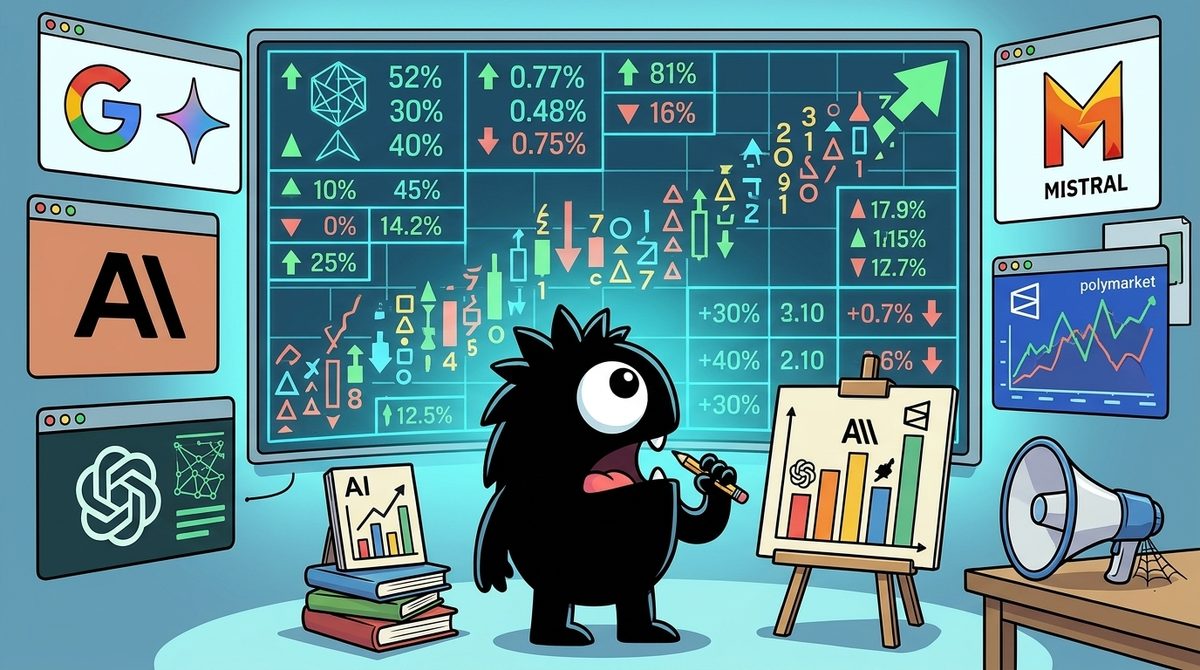
The question most people bring to this market is simple: who do traders think will have the best AI model at the end of 2026, and should that change which models you build on?
As of November 8, 2026, the Polymarket contract "Which company has best AI model end of 2026?" has drawn roughly $4,033,379 in trading volume and resolves around December 31, 2026[1]. Traders currently price Google at 64%, Anthropic at 30%, OpenAI at 4%, Meta at 1%, and Mistral and Z.ai at 0%. Google has become the clear favorite only in the past few weeks, and the lead is less stable than the headline number suggests.
For practitioners, the market measures something narrower than "which model should I use." It prices which lab is likely to sit at the top of a specific crowd-preference leaderboard on one specific date. That is useful information. It is not a guide to which model will write your code, run your agents, or fill your spreadsheets best.
Bottom line (as of November 8, 2026):
- Betting markets put Google's odds of having the top model at year-end at 64%, with Anthropic at 30% and everyone else at or below 4%.
- Google's odds roughly doubled in about two weeks. Leaderboard leadership and Gemini 4 Flash leaks drove the move.
- The market resolves on a leaderboard ranking, not on coding, agentic, or enterprise performance, where Anthropic still has strong advocates.
- For tooling decisions, treat the odds as a sentiment signal. Choose models by task, and architect so you can switch.
What a $4M Prediction Market Is Actually Telling You
A prediction market turns opinions into prices. A contract trading at 64 cents implies roughly a 64% chance the outcome resolves "yes." That figure combines thousands of money-weighted bets, so it reflects sentiment and information traders are acting on. It is not a forecast of fact. When this article says "the market implies Google is favored," that is a statement about current trader positioning, which can change tomorrow.
Here is the board as of November 8, 2026[1][^2]:
| Company | Implied probability | Volume traded |
|---|---|---|
| 64% | $572,809 | |
| Anthropic | 30% | $521,812 |
| OpenAI | 4% | $296,922 |
| Meta | 1% | $293,729 |
| Mistral | 0% | $300,064 |
| Z.ai | 0% | $253,594 |
The volume column contains a detail worth noticing. Mistral, priced at effectively zero, has seen more dollars traded than OpenAI or Meta. Volume measures activity, not conviction. Long-shot contracts attract traders selling "no" for small, near-certain returns, plus speculators hoping for a surprise. The probability column carries the market's view. The volume column shows where people are paying attention.
These markets matter because they update continuously, while benchmark cycles and analyst reports move quarterly. Practitioners on X have started treating the odds as a weekly scoreboard for the AI race:
Monday standings, 2 Nov:
1. Google DeepMind 100
2. Anthropic 86.7
3. OpenAI 65.1
Google holds #1 and tops both @arena and Artificial Analysis. Polymarket 2026 odds flipped: Google 53.5%, Anthropic 36.5% (was 32.5% vs 53.5%).
Riser: Moonshot, #7 → #6.
https://airacescoreboard.com/?utm_source=x&utm_medium=social&utm_campaign=standings-2026-11-02
Trackers like Maxy Tools now publish this race as a live radar alongside model rankings[5]. In effect, the prediction market has become another leaderboard.
The Fine Print: This Market Resolves on Chatbot Arena, Not Vibes
The most important and most overlooked fact about this market is how it settles. According to the market's rules as summarized by trackers, resolution is tied to the top position on the Chatbot Arena (LMArena) text leaderboard at year-end[7][2]. It does not depend on SWE-bench scores, revenue, developer surveys, or anyone's gut feel.
Chatbot Arena ranks models by crowd preference. Users see two anonymous responses side by side and vote for the one they prefer, and those votes produce an Elo-style rating. The method is good at capturing what feels best to a general audience in short exchanges. It is weaker at capturing long-horizon agentic work, multi-file refactors, or tool-use reliability. Those tasks don't fit neatly into a single blind comparison.
This explains a lot of the argument on X. A developer can be right that one model is better for their workflow and still be wrong about this market. The disagreement often goes the opposite way from what Claude-heavy developer circles assume:
Claude feels kinda overhyped tbh.
I tested the same website design prompt on both Gemini and Claude many times. And every time Claude’s output wasn’t even close to the original.
Meanwhile, Gemini got almost identical results, and after a few tweaks, it hit ~99% accuracy.
Makes me wonder… maybe models just perform better on ecosystems they’re trained closer to? 🤔
Either way, Gemini is seriously outperforming in frontend dev right now.
That post describes frontend design fidelity, which is close to what Arena voters reward: visible, immediate, attractive output. Anthropic's strongest case, sustained agentic coding, is the kind of capability a pairwise vote captures least.
The key point: traders are pricing leaderboard position, not holistic capability. If your question is "which model is best for my product," this market answers a related but different question. Aggregated benchmark tables such as those maintained by Fanetti AI[10] and BenchLM[8] give a broader picture across coding, reasoning, and speed. They often disagree with the Arena ordering.
Why Traders Flipped to Google: The Gemini Momentum Story
The large move is recent. In late October 2026, Anthropic was the clear favorite. Within a week the positions reversed:
Polymarket, 'which company has the best AI model at the end of 2026', week by week:
Anthropic 53.5% → 36.5%
Google 32.5% → 53.5%
OpenAI 5.7% → 5.1%
(26 Oct → 2 Nov)
Full odds history per lab: https://airacescoreboard.com/polymarket-ai-odds-history/?utm_source=x&utm_medium=social&utm_campaign=video-odds-race-2026-11-03
Between October 26 and November 2, Anthropic fell from 53.5% to 36.5% and Google rose from 32.5% to 53.5%[4]. By November 8, the market had moved further: Google at 64%, Anthropic at 30%. Over about two weeks, Google's implied probability roughly doubled.
Several catalysts appear to explain why traders are positioned this way.
1. Google is currently on top of the leaderboard that matters. Per the November 2 standings shared on X, Google held #1 on both Arena and Artificial Analysis. When a market resolves on a leaderboard, the current leader starts with a structural advantage. The leader only has to hold its position for seven more weeks, while challengers have to ship something that overtakes it. BenchLM's November 2026 leaderboard also shows Google models at or near the top of its aggregate rankings[8].
2. Gemini 4 Flash leaks suggest more is coming. The rumors are specific, which makes them more credible to traders:
A bunch of evidence just lined up around Google's upcoming Gemini 4 Flash and Anthropic's next Claude drop.
On the Google side, Gemini 4 Flash has been spotted under two internal codenames today:
- In LMArena blind tests, a stealth Google model called "Hydrogen" is streaming at 300 to 500 tokens per second—about 5.5x faster than Gemini 3.8 Flash—while one-shotting 3D animations.
- Inside the leaked Devin CLI binary, a Google Vertex model codenamed "Hyperion" is configured with five thinking effort levels (base, minimal, low, medium, high), right next to a mystery model called "Wyvern."
Over at Anthropic, a developer parsed 1,400 of their own local Claude Code session logs (over 160,000 thinking blocks) and proved that something changed on November 3: the way Opus 5.5 starts its internal reasoning blocks jumped from 25% "I'm..." to 61.3% overnight without any changelog note. At the same time, Polymarket odds for Anthropic dropping Claude Fable 5.2+ jumped 18 points today to 74% by November 19.
A stealth model streaming at 300–500 tokens per second in Arena blind tests matters for this market in particular. Speed affects how users perceive quality in head-to-head votes. If "Hydrogen" is Gemini 4 Flash and it ships before December 31, Google could have a fast, capable model competing in exactly the venue that decides the market. These remain leaks, not confirmed releases, and the post itself notes that Anthropic-side signals are moving too.
3. Google is aiming at its weak spot. Earlier in 2026, the main criticism of Gemini was that Claude was better at agentic coding, largely because of training data choices. Reporting relayed on X suggests DeepMind took that seriously:
Anthropic used more coding data in their training runs, so Claude is better at coding. DeepMind now knows this and sees agentic coding taking off exponentially in terms of revenue, so they will use more coding data for future Gemini models to catch up in capability.
"DeepMind engineers use Claude as a daily tool. Most of the rest of Google does not. When the question of equalizing access came up internally, the proposed response was to remove Claude for everyone — which DeepMind objected to so strongly that several engineers reportedly threatened to leave."
That post is from earlier in the year. If the strategy is working, it reduces the main argument for Anthropic overtaking Google before resolution. DeFi Rate's market analysis likewise frames Google's position as momentum-driven[6].
The Bull and Bear Case for Anthropic at 30%
A 30% implied probability is not a dismissal. It means traders see roughly a one-in-three chance Anthropic finishes on top. That leaves real upside, and the debate among practitioners is sharper here than anywhere else in the market.
The bull case: workflows, coding, and accelerating progress
Anthropic's defenders point to areas where Claude has a clear practical advantage. Swyx made the case earlier in 2026 with an enterprise example:
16M impressions in 24 hours. if you’ve ever tried Claude in Sheets or Claude in Excel you will know how much more intelligent it is compared to Gemini in Sheets
i have two current measures of Google-GDM product integration right now:
- how long does it take Google to put a non nerfed Gemini Pro into Sheets
- how long does it take to make Gemini 3.5 halfway decent at Sheets manipulation and formula
clock has started, Anthropic is between 0.5 to 3 years ahead on this one
Spreadsheet manipulation, formula writing, and agentic coding are where SaaS budgets are actually spent. There is also a forward-looking argument that progress is speeding up:
UPDATE: METR estimates Anthropic’s AI progress on well-defined tasks has roughly doubled in pace, though uncertainty is high. Could that help it finish 2026 on top? Anthropic is one of the contenders in our year-end best AI model market!
View on XIf METR's estimate holds (and the poster notes "uncertainty is high"), a faster release cadence improves the odds of a well-timed model launch before December 31. The same week's leaks noted that Polymarket odds of a new Claude release by November 19 had climbed to 74%, per the earlier Gemini/Claude post. A strong release in mid-November would leave six weeks to climb the Arena rankings.
The bear case: price, context, and the metric itself
Critics have argued for a long time that Anthropic's position is weaker than its reputation among developers:
Ironically enough, Anthropic is the furthest away from the frontier since Claude 3.0
Everyone has a longer context, everyone beats them at pricing in the Haiku range and Gemini is the best coding model around (probably until o3/o4-mini drop)
That critique dates from 2025, before several Claude generations, so it should be read as background rather than as a current assessment. The underlying concerns still apply, though. Context length and price at the low end matter to buyers, and comparison tools like BenchLeader make price per million tokens visible immediately[9]. Tech Times' benchmark tracker likewise splits rankings across intelligence, coding, speed, and price[11]. No single lab leads every column.
Why both cases can be true
Anthropic can dominate real developer workflows and still trail on a crowd-vote leaderboard. Those two statements measure different things. The 30% price looks like traders hedging. They acknowledge Claude's strength and release momentum, and they recognize that the resolution metric favors whoever is ahead on Arena today, which is currently Google.
OpenAI at 4%: The December Wildcard Traders Might Be Underpricing
For most of the past three years, betting against OpenAI on frontier questions was a losing trade. Today the market implies only a 4% chance OpenAI tops the leaderboard at year-end, down from 5.7% in late October[4]. Some traders think that price is too low:
My prediction: Anthropic keeps the lead in public models through the end of the year until OpenAI releases a stronger model in December. After that, expect a tight back-and-forth until one lab pulls clear. As for Google, I don't see them taking it.
View on XThat prediction was made weeks ago, and part of it has already been contradicted: Google did take the lead in the market's pricing. The December scenario remains the main risk for current holders of Google and Anthropic positions.
Expert rankings support the idea that OpenAI is competitive. Veso Research's model ranking matrix places OpenAI's frontier models alongside Google's and Anthropic's at the top tier[12]. The real-world data, however, points to a gap:
Visa tested 22 AI models on real shopping tasks
> Gemini 4 Argon and Muse Wonder tied for first at 82%
> Claude Fable 5.1 next at 76%
> Best OpenAI model was GPT-6 Astra at 64%
> Only 57% success across all models
In Visa's test of 22 models on real shopping tasks, GPT-6 Astra scored 64%, 18 points behind the co-leaders and 12 behind Claude. Agentic shopping isn't the Arena metric, but results like this shape trader sentiment about who is "behind."
Timing risk is the real reason for the 4% price. A December release would have very little time to accumulate the Arena votes needed for a stable top ranking before December 31. For OpenAI's odds to rise meaningfully, traders would likely need to see three things:
- A credible, dated release announcement, not just rumors.
- Early Arena results showing a clear lead, not a near-tie.
- The release landing early enough in December for the rating to settle.
If any one of these is missing, a 4% price looks reasonable rather than mispriced.
Mistral, Meta, and Z.ai Near Zero: The Frontier Gap Priced In
Mistral at 0%, Meta at 1%, and Z.ai at 0% mean the market sees no realistic path for these labs to reach the top of the leaderboard by year-end. That is a statement about the frontier specifically. It does not mean these companies are irrelevant.
Mistral's latest release shows the difference well. One detailed post on X praised and criticized it in roughly equal measure:
Mistral is back:
-pushing the frontier on dollar per intelligence (1.13$ per task for a 38. mimo v2.6 pro gets 46 for 0.13$)
-best open model out of us or europe (competition: nemotron 3 ultra 23, gemma 4 17, gpt-oss 12)
-same score as gpt 6 luna. luna costs 0.07$ per task. 16x
-#64 of 225 on artificial analysis. frontier
-1 trillion parameters to land 3 points under GLM 5.3 flash (320B, 0.25$)
-open weights (AA lists it as proprietary. weights oct 27)
-most open license yet (large 3 apache 2.0, medium 3.5 modified mit, this one "custom mistral license")
-only 8 points behind the best chinese open model and 20 behind opus 5.5
-beat glm 5.3 on deepswe, 62 to 61 (on mistrals chart. the live leaderboard has glm 5.3 at ~69)
-state of the art in legal (15%)
-highest cyber score of any model, 82% (opus 5.5 and astra refuse the task and score near zero)
-same blog post brags it refuses more cyber prompts than any other open model
-200M output tokens to run the index, median is 81M. le chonk talks
-+29 points over large 3 (large 3 had 9)
-sovereign ai (they resell glm 5.3 since august. until today the smartest model on mistrals own platform was chinese)
-3 billion euro raised, 21 billion valuation, first model out of it: 38
-"no signs of saturation" (the rl run isnt finished, they shipped anyway)
-the meme promised 30 trillion parameters. we got 1 (49B active)
-europe can compete, said mensch. in abu dhabi
-2nd of 5 in their own blind eval. behind opus 5. not 5.5
The relevant points for this market are "20 behind opus 5.5" and "2nd of 5 in their own blind eval. behind opus 5. not 5.5." Mistral is competing on dollars per unit of intelligence, open weights, and European sovereignty. It is not competing for the top spot on Arena. Being 20 points behind the frontier while offering open weights under an increasingly permissive license is a strong position for many buyers. It is a losing position in a market that rewards only first place.
Expert tiering from earlier in 2026 matches the market's view closely:
Based on the data I see, I think:
- Anthropic🇺🇸/Google🇺🇸/OpenAI🇺🇸 all ~tied
- Meta🇺🇸 / xAI🇺🇸 each ~7mo behind
- Moonshot🇨🇳/- Deepseek🇨🇳 / zAI 🇨🇳 / Alibaba🇨🇳each ~9mo behind
- Mistral🇫🇷 ~1.5 years behind
- No other companies competitive
The three US frontier labs were roughly tied, Meta about seven months behind, Chinese labs including Z.ai about nine months behind, and Mistral about a year and a half behind. Mercado Dice's analysis of the market reaches a similar conclusion: the race is effectively between two or three companies[3].
"Best value" and "best model" are separate bets. A founder running high-volume, cost-sensitive inference might reasonably prefer GLM or Mistral models while the market prices those labs at zero. The market answers one question only.
Reading the Volatility: Why These Odds Could Swing Again Before December 31
A 20-point move in a single week shows that the current Google lead is fragile. Odds history trackers show the leadership changing hands within days[4]. Seven weeks is a long time in a market where unreleased models leak through Arena codenames and CLI binaries.
Catalysts to watch between now and resolution:
- Gemini 4 Flash going public. If "Hydrogen" or "Hyperion" ships and performs well on Arena, Google's position strengthens.
- The next Claude release. Traders priced a mid-November Claude drop at 74%. A strong debut could reverse the flip.
- An OpenAI December launch. This is the low-probability, high-impact scenario.
- Leaderboard mechanics. Changes to Arena methodology, such as style control, category weighting, or how ties are handled, could move rankings without any new model shipping. Because the market resolves on that board, methodology changes affect the outcome directly.
Treat the odds as a live sentiment feed, not a settled verdict. Live trackers like Maxy Tools are built for this kind of monitoring[5].
What This Means for Developers, Founders, and SaaS Buyers
The most useful takeaway from this market is the volatility it reveals, not the identity of the current favorite. When the implied leader can change in a week, any strategy that depends on one vendor staying on top is fragile.
For developers: choose models by task, not by odds. The X conversation already shows the split. Gemini gets praise for frontend fidelity and speed. Claude gets praise for agentic coding and spreadsheet work. Neither the Arena ranking nor the Polymarket price tells you which will handle your codebase better. Benchmark comparison tools[9] and your own evaluation suites on real tasks will tell you more than a crowd-preference leaderboard.
For founders: avoid single-vendor lock-in while the frontier is this volatile. If your product depends on "the best model," build so that switching is a config change rather than a rewrite. That means abstracting prompts, keeping provider-agnostic tool schemas, and maintaining regression evals you can run against any new release within a day.
For SaaS buyers: favor tools with model routing. Vendors that let you route tasks across Google, Anthropic, and OpenAI protect you against whoever leads in January 2027. Ranking matrices like Veso's[12] show that the top tier is crowded, which makes routing practical. Be cautious with vendors whose pitch rests entirely on exclusive access to one lab.
Who should pay close attention to the odds:
- Teams timing a major model migration, since a sharp repricing often signals a real release.
- Investors and analysts tracking lab momentum.
- Anyone whose product is consumer chat, where Arena-style preference correlates with user satisfaction.
Who can mostly ignore them:
- Teams running agentic coding, data pipelines, or enterprise workflows, where task-specific evaluations matter more than Arena rank.
- Cost-sensitive, high-volume deployments, where "best value" is a different question from "best model."
The market currently implies Google is the favorite to finish 2026 on top, with Anthropic as a serious challenger and OpenAI as a long shot. That is a well-informed signal about one leaderboard on one date. Use it alongside benchmarks and your own testing, and design your stack so that it still works if the leader changes.
Sources
[1] Polymarket — Which company has best AI model end of 2026? — https://polymarket.com/event/which-company-has-best-ai-model-end-of-2026
[2] Which company has best AI model end of 2026? Odds: Google 64.5% | Polymarket Odds Today — https://polymarkettrader.com/odds/which-company-has-best-ai-model-end-of-2026/
[3] Best AI Model 2026 on Polymarket: Who Leads the Odds — https://mercadodice.com/en/analysis/best-ai-model-2026-polymarket
[4] Polymarket AI odds history: best AI model end of 2026 — https://airacescoreboard.com/polymarket-ai-odds-history/
[5] Best AI model at the end of 2026: who wins? Live odds | Maxy Tools — https://maxy.tools/radar/race/best-ai-model-2026
[6] Best AI Model of 2026 Odds: Who Will Be #1 at Year-End? — https://defirate.com/odds/best-ai-model-2026/
[7] Which company has best AI model end of 2026? odds | OffMarket — https://offmarket.cx/event/556382/which-company-has-best-ai-model-end-of-2026
[8] LLM Leaderboard & AI Model Benchmarks — November 2026 — https://benchlm.ai/
[9] Compare AI models side by side: scores, price per 1M, speed — https://www.benchleader.com/compare
[10] All AI models: full benchmark table | Fanetti AI — https://www.fanettiai.com/benchmarks/all/
[11] AI Model Benchmarks — Intelligence, Coding, Speed & Price | Tech Times — https://www.techtimes.com/ai-benchmarks
[12] Generative AI Model Ranking Matrix · Veso Research — https://veso.ai/research/ai-models
References (16 sources)
- Polymarket — Which company has best AI model end of 2026? - polymarket.com
- Which company has best AI model end of 2026? Odds: Google 64.5% | Polymarket Odds Today - polymarkettrader.com
- Best AI Model 2026 on Polymarket: Who Leads the Odds - mercadodice.com
- Polymarket AI odds history: best AI model end of 2026 - airacescoreboard.com
- Best AI model at the end of 2026: who wins? Live odds | Maxy Tools - maxy.tools
- Best AI Model of 2026 Odds: Who Will Be #1 at Year-End? - defirate.com
- Which company has best AI model end of 2026? odds | OffMarket - offmarket.cx
- LLM Leaderboard & AI Model Benchmarks — November 2026 - benchlm.ai
- Compare AI models side by side: scores, price per 1M, speed - benchleader.com
- All AI models: full benchmark table | Fanetti AI - fanettiai.com
- AI Model Benchmarks — Intelligence, Coding, Speed & Price | Tech Times - techtimes.com
- Generative AI Model Ranking Matrix · Veso Research - veso.ai
- Frontier AI Models: Live Top 10 Rankings, Evidence and Pricing (November 2026) - benchlm.ai
- AI Model Leaderboard: Overall Scores | RL Research - rlresearch.ai
- LLM Leaderboard (Nov 2026): Top AI Models | BenchLeader - benchleader.com
- LLM Leaderboard 2026 - Top AI Models Ranked | LM Market Cap - lmmarketcap.com
Related Guides
AWS Bedrock vs Replicate vs Anthropic: Which Is Best for Full-Stack Web Apps in 2026?
25 min read
The Best AI Model Bet of 2026: What a $4M Polymarket Signal Means for Developers
17 min read
What Is Framer? A Complete Guide to Design-to-Code for 2026
19 min read
The Best AI Bubble Signals in 2026: What Polymarket's Odds Reveal About Where AI and SaaS Are Headed
18 min read