AWS Bedrock vs Replicate vs Anthropic: Which Is Best for Full-Stack Web Apps in 2026?
AWS Bedrock vs Replicate vs Anthropic compared for full-stack web apps: pricing, reliability, compliance, and architecture. Find out which platform wins in 2026.
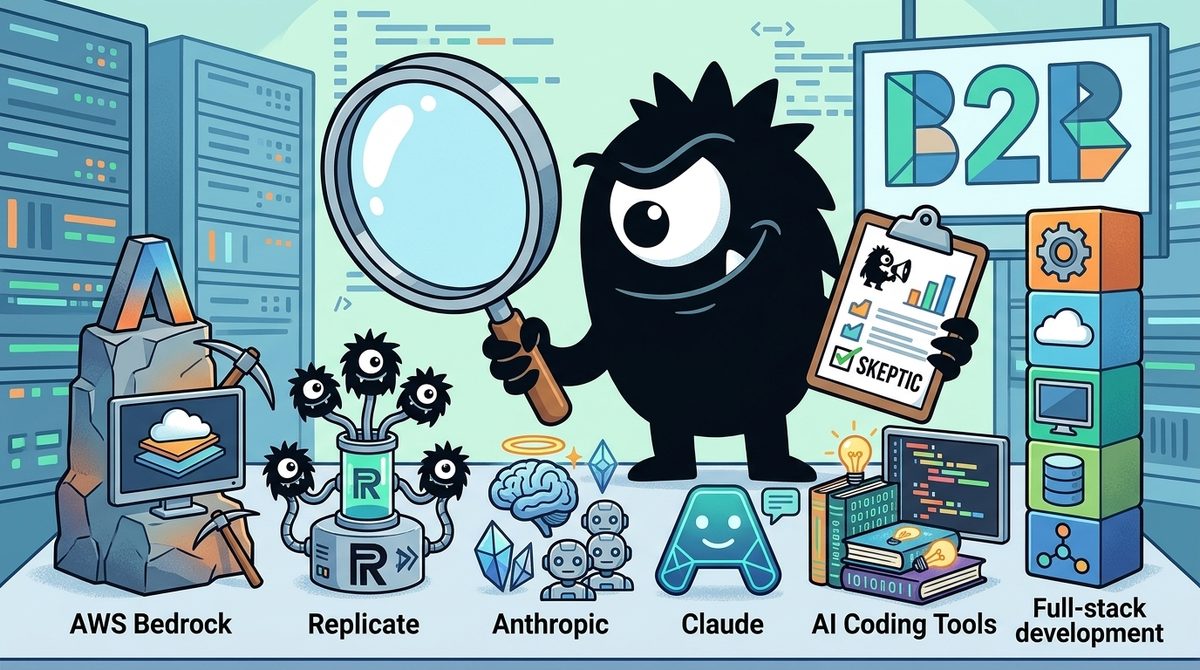
The question most teams are actually asking is this: where should my full-stack web app get its model inference from, and what will that choice cost me later in reliability, compliance, security, and money?
The short answer: AWS Bedrock, Replicate, and Anthropic's direct API mostly aren't substitutes. They are three layers of the same stack, built on different philosophies, and in 2026 many production teams use more than one of them.
Bottom line (as of late 2026)
- Anthropic direct is the fastest path to a working Claude-powered prototype, and it gets new Claude models and features first.
- AWS Bedrock costs more for the compliance, IAM-based security, and AWS-native governance it provides. It's the default when your app touches regulated data or enterprise procurement.
- Replicate fits open-weight and custom models, image/video/audio generation, and per-second billing for bursty or experimental workloads.
- The pattern practitioners actually use is to prototype direct, scale or route through Bedrock (or Claude Platform on AWS) for resilience and compliance, and run specialized open models on Replicate.
What Do Full-Stack AI Apps Actually Need From an Inference Platform in 2026?
A chat endpoint is not a full-stack AI app. Once you have real users, you also need:
- Model access. Which models you can use, and how fast you get new ones.
- Reliability. Uptime, rate limits, and what happens when a provider degrades.
- Auth and blast-radius control. How credentials are issued and scoped.
- Billing control. Budgets, anomaly alerts, and cost levers like caching and batching.
- Compliance. Data residency, network isolation, and audit trails.
What makes these platforms hard to compare in 2026 is that inference, not training, is now the workload shaping platform decisions. AWS's own prescriptive guidance treats Bedrock as an inference architecture, a managed layer for serving foundation models inside your AWS environment, not a place to rent GPUs[4]. Investor and practitioner voices on X have picked up the same shift:
Thx for sharing and good timing. Inference has now surpassed training so the needs in that doc should reflect the new needs.
I am long AMZN so biased but I share the new requirements and how clouds and neo-clouds address. TLDR is a clear advantage to AWS Bedrock TaaS as it was purpose-built for inference and bringing it right to where enterprise workloads reside.
*But neo-clouds have their place as many do hybrid.
So in many cases not even so much "competitive" with AWS.
SPCX/Goog/Meta are more competititive on raw compute IaaS than Amzn. AWS started turning down IaaS(raw compute/training) biz to labs and purposely ceding share so it can focus on TaaS out to enterprise.
Set aside the stock-holder framing and the key line is "many do hybrid." Independent comparisons reach a similar conclusion. Bedrock and Replicate target different buyers and workloads, so they overlap less than a head-to-head chart implies[1]. The useful question is which job each platform should do in your stack, not which one wins.
Bedrock vs Replicate vs Anthropic: What Is Each Platform, Really?
AWS Bedrock: the managed enterprise orchestration layer
Bedrock gives you a curated catalog of foundation models from Anthropic, Amazon's own Nova family, and other vendors. You reach them through one AWS API, with IAM, VPC networking, CloudWatch, and AWS billing built in[4]. It's a managed service: you never see GPUs, endpoints, or scaling policies. Bedrock went GA in September 2023 with token-based pricing, and the first wave of developer analysis was all price-sheet comparisons against OpenAI and Google:
Yesterday, @awscloud released Bedrock as GA! Amazon Bedrock is a new AWS service that gives you access to Foundation Models (@Anthropic, @cohere ,…) with a token-based pricing. 🆕
Lets compare the pricing to @OpenAI @Google and others.
🧶
https://docs.google.com/spreadsheets/d/1NX8ZW9Jnfpy88PC2d6Bwla87JRiv3GTeqwXoB4mKU_s/edit#gid=0
Three years later, the token price is the least interesting part of Bedrock's pitch. The governance wrapper around the models is what matters.
Replicate: the open model catalog with per-second billing
Replicate works differently. It hosts a large, community-driven catalog of open models: LLMs, but also image, video, audio, and niche fine-tunes. You can also deploy your own custom models. Billing is generally based on the compute time your predictions consume, not tokens[1][3]. Comparisons consistently describe it as the better fit for experimentation, custom or open-weight models, and media generation. They describe Bedrock as the better fit for governed enterprise LLM workloads[1][6].
Anthropic direct and Claude Platform on AWS: the Claude-native path
Anthropic's own API is the source. New Claude models, beta features, and tooling usually show up there first[2][11]. There is now also a middle option. Claude Platform on AWS gives you Anthropic's native platform experience procured through AWS. AWS publishes a dedicated comparison explaining how it differs from using Claude inside Bedrock[5]. Respan's 2026 breakdown frames the three-way choice for Claude users around feature freshness, procurement, and integration depth[2].
If you only need Claude, then, the decision is really "Anthropic direct vs. Claude Platform on AWS vs. Claude-in-Bedrock." Replicate becomes relevant when you need models Anthropic doesn't make.
Is Anthropic's Direct API Reliable Enough for Production?
This is the most emotionally charged part of the X conversation, and Theo put it bluntly:
Worth noting that, historically, the only reasonable way to use Anthropic models was through Openrouter due to Anthropic's APIs being notoriously unreliable.
Openrouter would fall back to AWS Bedrock and Google Cloud, which meaningfully increased reliability.
That claim is historical and from one prominent developer, but it matches a pattern many teams adopted. They stopped treating any single inference provider as a dependency they could trust to be up. The same Claude models served from different infrastructure (Anthropic's own, AWS, Google Cloud) fail independently. A router that falls back across them turns a provider outage into a slightly slower response.
This changes how you should read the comparison. Bedrock and Claude Platform on AWS aren't only compliance products. They are also alternative serving paths for the same models, backed by hyperscaler infrastructure and operational tooling[2][5]. For a full-stack app, you have three options:
- Single provider (Anthropic direct). It's simplest: one SDK, one bill, newest features. You accept that provider degradations become your outages. This is fine for prototypes, internal tools, and apps where a few minutes of downtime is tolerable.
- Single hyperscaler path (Bedrock or Claude Platform on AWS). Inference sits next to your AWS workloads, with AWS-grade operations. The tradeoff is that newer Claude features can land later than on the direct API[2].
- Multi-route (gateway or OpenRouter-style fallback). This is the most resilient option. The costs are that prompts, tool schemas, and feature usage must stay compatible across providers, and observability gets more complicated.
Decision rule: if your app has an uptime SLA you'll be held to, design for at least two serving paths from day one. Retrofitting fallback after a public outage is far more painful than building an abstraction layer early.
Why Is Bedrock More Expensive? The Compliance Premium Explained
Bedrock is not usually the cheapest place to run a given model. Bill Hsu's summary of why has become a reference point in the conversation:
Makes sense, no rev share to Anthropic on open weights. My read is that margin is a compliance premium, not a compute edge. Bedrock can charge above the cheapest OpenRouter host because data stays inside AWS. Regulated buyers pay that, and everyone else can route around it.
View on XThe core value is that data stays inside AWS. AWS's guidance emphasizes keeping inference within your account's security boundary, using private connectivity, and integrating with existing IAM and logging controls[4]. If you're a healthcare SaaS, a fintech, or a vendor selling into enterprises with security questionnaires, that boundary often decides whether you can ship at all. It isn't a nice-to-have.
The market data points the same way. Analyst estimates shared on X suggest Bedrock is unusually profitable for AWS:
Correct in neo-clouds but polar opposite at AWS.
SemiAnalysis Tokenomics modeling estimates Bedrock EBIT margins around 55% in early 2026. The dual structure (Anthropic as seller of record + AWS receiving both an infrastructure fee similar to IaaS and a distribution/revenue share) produces thicker margins than pure GPU rental/IaaS(Google, Msft, neo-clouds).
Bedrock AI TaaS platform was estimated at only ~4% of AWS revenue but ~30% of the year-over-year step-up in gross profit dollars, helping drive a 213 bp sequential EBIT margin expansion while peers lagged.
https://t.co/MoENLVYi0E
Most analyst's estimates peg AWS "non-AI" cloud svcs at flat growth but every agentic dollar attaches $1-3 in CPU/db/memory/storage/networking/security core biz.
Enterprises on avg use >5 different AI models simultaneously to optimise usage across various workloads and this is exactly what Bedrock was designed to do. This is incredibly sticky as the harness becomes more important than any one model. Lastly general compute on inference has up to a 2x longer life than GPU race on training.
According to that post, SemiAnalysis modeling estimates Bedrock EBIT margins around 55% in early 2026. The poster attributes this to the dual structure: Anthropic as seller of record, plus AWS collecting both infrastructure fees and a distribution share. Treat the figures as analyst estimates, not disclosed numbers. The practitioner conclusion still holds: the margin pays for governance and distribution, not faster GPUs.
Replicate and Anthropic direct can undercut on raw price, but they hand the compliance work back to you. You handle the vendor reviews, data-processing agreements, and network egress arguments with your security team.
Ask yourself:
- Does the app process regulated data (PHI, financial records, government data)?
- Will enterprise customers require that inference run inside your AWS account or region?
- Is AWS Marketplace or committed-spend procurement how your buyers purchase?
If any answer is yes, the Bedrock premium is probably cheaper than the alternative. If all three are no, you can route around it, as Hsu says.
What Will It Actually Cost? Token Pricing, Per-Second Billing, and Caching
Per-token vs. per-second: which wins when?
Anthropic and Bedrock bill LLM usage per input and output token. Anthropic publishes per-model rates and its Claude tiers, ranging from lightweight Haiku-class models to frontier Opus-class models, at different price points[7][8][11]. Replicate generally bills for the compute time your predictions use[1][3].
- Per-token wins for conversational and agentic text workloads with variable prompt sizes. You pay for what the model reads and writes, and idle time costs nothing.
- Per-second wins for media generation, small open models that run fast on cheap hardware, and batch jobs where you control throughput. It loses when slow models or cold starts stretch out billed time.
Caching and routing are now default settings, not optimizations
The biggest cost levers aren't list prices. They are prompt caching and model routing. Shivanshu frames these as a stage every production app should reach:
Stage 4, optimise the defaults: model routing and prompt caching.
AWS's caching maths, from Bedrock pricing as of Oct 2026: with the 5-minute TTL, one reuse already pays for the cache write. Check the rates for your own model and Region.
The math explains why. Anthropic's pricing docs show that cache writes cost somewhat more than normal input tokens, while cache reads cost a small fraction of the base input rate[7]. With a short-lived (five-minute) cache, a single reuse within the window can recover the write premium, which is the point Shivanshu makes about Bedrock's rates as of October 2026. Full-stack apps re-send the same system prompts, tool definitions, and document context on nearly every request, so they are close to the ideal case for caching.
Other levers:
- Model tiering and routing. Send classification, extraction, and simple replies to a cheaper model, and reserve frontier models for hard reasoning. The model lineup is designed for this split[11].
- Batch processing. Anthropic offers discounted batch pricing for asynchronous workloads such as nightly summarization, evals, and backfills[7][8].
- Cap output tokens. Output is priced higher than input, so verbose responses are a hidden tax.
The cheapest list price rarely produces the cheapest production bill. A well-cached, well-routed Bedrock deployment can beat a naive integration on a nominally cheaper host.
How Do You Secure AI API Keys in a Full-Stack App?
In 2026 the security conversation has moved from data leakage to financial exposure. Harun's post captures it:
someone on a dark web forum is offering crypto for anthropic and aws bedrock api keys. the seller gets 50% of whatever the buyer burns through the key
so a leaked ai key isn't a data problem first. it's a bill, and it lands on you
how i'd set up bedrock on aws:
- no static keys. the app calls it with its own iam role
- one role per app, so one leak doesn't own every model
- a budget alarm, and an alert when calls per hour jump
your ai key is a credit card now. treat it like one
A leaked inference key works like a stolen corporate card. Attackers resell access, and you pay for whatever they burn. In a full-stack web app, the usual failures are mundane: a key committed to a repo, bundled into a frontend, or logged in plaintext.
The platforms differ here in a way that matters:
- Bedrock can run without static secrets. Your backend (Lambda, ECS, EC2) calls Bedrock using an IAM role, with short-lived credentials issued by AWS[4]. You can scope one role per app or per environment, so a compromise is contained. Budgets and CloudWatch alarms plug into the same account.
- Claude Platform on AWS sits inside AWS's identity and billing model. AWS documents how its access and management differ from Bedrock's[5].
- Anthropic direct and Replicate typically use bearer API keys. These are workable, but key hygiene becomes entirely your job.
Non-negotiable guardrails, whichever platform you pick:
- Never ship a model key to the browser. Proxy every call through your backend.
- Use separate credentials per app and per environment.
- Set hard spend limits or budget alarms, plus alerts on sudden jumps in requests per hour.
- Rotate keys, and store them in a secrets manager rather than environment files.
If your team is small and security maturity is low, Bedrock's role-based model removes an entire class of mistakes. That counts for more than any per-token price difference.
Who Are You Actually Buying From? The Amazon-Anthropic Entanglement
When you call Claude on Bedrock, it isn't obvious who you're paying. The X conversation has gotten heated about this. NIK's viral thread is the most provocative version:
🚨ANTHROPIC RAISES THE RENT ON AMAZON
>be amazon
>invest billions into anthropic
>make AWS anthropic's primary cloud
>resell claude on bedrock to enterprise customers
>share 50% of gross profits on every sale to anthropic
>also paying $1.9B/yr in cloud fees TO anthropic
>build the entire amazon product line on top of claude
>alexa, kiro, quick... etc literally ALL products
>become completely dependent on anthropic
>amazon execs: "worried about perception" amazon now just a claude wrapper lol
>claude now the enterprise default for AWS customers
>anthropic frustrated that Bedrock devs not adding new claude features fast enough
>meanwhile amazon engineers secretly "distilling" claude models
>they knew price hikes were coming
>dario knows he has leverage
>renegotiates the contract
>amazon used to pay by compute hours (CHEAP)
>now pays per TOKEN starting next year (EXPENSIVE)
>amazon: "this won't increase our costs" lmao
>but this also includes for the claude models it uses internally in its own products
>amazon ceo then calls the white house
>"dario's two best models? security risk btw"
>feds nuke mythos and fable
Amazon now evaluating OpenAI and its own Nova slop models to cut costs
Absolute state.
Parts of that thread are speculative and written for engagement, so don't treat it as reporting. The structural point underneath it is real, though, and it matters for long-term pricing risk. Revenue from Claude-on-Bedrock is shared between the two companies. A former AWS employee, cited via AlphaSense, sketched a hypothetical split:
Former high-ranking $AMZN AWS employee shares his view on Bedrock, CPU/GPU demand, and why hyperscalers are in a win-win scenario when it comes to closed- or open-source models:
1. He thinks that AWS Bedrock has higher margins than AWS SageMaker, as Bedrock is not that bare-bones compute product. He talks about a 15% margin add-on when you go up a level in the compute stack.
2. He gives the hypothetical example of the split in revenue when a customer spends on AWS Bedrock and uses Anthropic as an underlying model. First, there is the split that AWS takes for bringing a customer to Anthropic: 20%; then there is 40% that Anthropic might take, and 40% goes back to AWS to run and operate that model.
3. AWS, GCP, and Azure are able to provide holistic levels instead of just a single service when it comes to AI. It's not just about the model; it's about governance, guardrails, data, CPU compute, database, storage, etc.
4. His estimate on the amount of CPUs to GPUs that we will need in the next few years is 2x-3x of CPUs vs GPUs as agentic AI takes off.
5. When it comes to whether closed-end models win or open-source models win, he believes the hyperscalers are in a win-win regardless, as the customers still need GPUs and compute. He thinks $AMZN would make even more margin at the end of the day if open-source or open-weight models win, as $AMZN wouldn't need to pay a fee to anyone and they would customize the model.
found on @AlphaSenseInc
Others argue this is alignment, not conflict:
AWS Bedrock is driving 45% of Anthropic API ARR per @SemiAnalysis_ . The market continues to misunderstand and underestimate the degree of positive sum commercial alignment between $AMZN $MSFT $GOOG and Anthropic/OpenAI, treating them more like competitors. In reality the clouds are critical infrastructure providers w/ their compute fleets (~75% of global compute), and demand creators/enablers with commercial sales and implementation ecosystems to handhold customers as they deploy agentic apps in enterprise environments.
View on XIf Bedrock drives roughly 45% of Anthropic's API ARR (a SemiAnalysis figure relayed in that post), neither company can afford to let the channel degrade. A widely shared breakdown of what the poster describes as Anthropic's S-1 filing reinforces the theme. It reports that 48% of revenue flows through cloud marketplaces and flags the governance questions this raises:
$ANT Anthropic’s S-1: The "AI Cash-Burning" Myth is Dead
For the capital markets, Anthropic’s S-1 filing is both a shot in the arm and a reality check. It provides irrefutable data to answer the market’s biggest billion-dollar question: “With all this investment in AI, is anyone actually paying?”
The answer is a resounding yes—and demand is exploding exponentially. However, it also reveals a harsh truth: The commercial success of AI does not guarantee that every player in the value chain will capture a successful capital return.
Here is a breakdown of the four critical dimensions that define this filing's true significance for the AI industry.
I. The Revenue Side: Beyond the Hype—Real Cash Generation and the Token Explosion
Over the past few years, market anxiety has centered on the fear that AI is all "input" and no "output." The S-1 effectively shatters the "AI bubble" narrative.
The Run-Rate Revenue (ARR) Surge and High Stickiness
Instead of looking solely at historical GAAP revenue, Run-Rate Revenue is the hard metric to evaluate true scale. While some figures in the PDF are redacted, the explosive trajectory is undeniable: revenue rocketed from $4.585 billion in FY 2025 to $16.286 billion in H1 2026 alone (with Q2 hitting $11.6 billion).
More importantly, the depth of customer adoption is staggering. The number of customers generating over $100,000 in trailing-twelve-month (TTM) revenue has surpassed 11,900 (up from just 950 a year prior), and the Net Revenue Retention (NRR) stands at an extraordinary ~900%. This means once enterprises integrate Claude, they don't just stay—they aggressively migrate more workflows into it.
2. A Textbook Case of the Jevons Paradox
The market initially feared that model price cuts would destroy the business model. Yet, the S-1 highlights that when Claude Opus 5.5 reduced customer task costs by roughly 40%, it actually ignited a massive surge in inference demand.
On platforms like OpenRouter, daily token processing volume skyrocketed. Lower usage costs drove a massive expansion in total consumption and revenue, proving that highly intelligent AI is rapidly becoming an irreversible enterprise necessity.
3. Shattering the "Cash-Burning" Myth with the Cash Flow Statement
The long-held stereotype that AI model companies simply "burn cash like crazy" is a mirage amplified by accounting optics. Looking directly at the cash flow statement reveals a completely different picture:
1) Robust Free Cash Flow (FCF): In H1 2026, Anthropic generated $3.929 billion in net cash from operating activities. Capital expenditures (CapEx) were merely $482 million. Consequently, Free Cash Flow reached a staggering $3.447 billion.
2) The Extreme Stress Test: Skeptics often argue that tech cash flows look good only because massive Stock-Based Compensation (SBC) is added back. SBC for H1 was $2.185 billion. If we conduct an ultra-conservative stress test by subtracting this SBC from the FCF, the "net free cash flow" remains solidly positive at $1.262 billion. For a frontier tech company in an exponential expansion phase, this is virtually unprecedented.
3) Healthy Working Capital Dynamics: Positive cash flow is driven by real business expansion. Accounts Receivable increased by $4.982 billion (proving genuine revenue scale-up), Prepaid expenses and other assets decreased by $2.094 billion (proving early prepayments for cloud compute are being efficiently consumed into production), and Deferred Revenue increased by $1.38 billion (showing customers are prepaying for subscriptions).
Why is there a $80.7 Billion Net Loss if Cash Flow is Positive?
The answer lies in the first adjustment on the cash flow statement: $72.388 billion in "Change in fair value of convertible notes, derivative liabilities, and SAFEs."
As the company's valuation soared, the fair value of its early convertible notes ballooned. Under GAAP, this is booked as a massive non-cash expense, but it doesn't drain a single cent of cash.
On the operational front, Q2 actually delivered $974 million in GAAP operating income, while holding a war chest of $131.651 billion in cash and short-term investments.
This cash flow statement proves that Anthropic has long crossed the "Valley of Death" of relying on external funding. It doesn't just sustain itself; it generates billions in real cash. This is the ultimate confidence booster that allows it to sign trillion-dollar compute contracts.
II. The Cost Side: The 85% Gross Margin and the Hidden "Profit Killers"
The S-1 reveals that Anthropic's H1 cost of revenue was only $2.38 billion, yielding a massive 85.4% inference gross margin. While incredibly impressive, this is not the whole picture.
Where does every $100 of revenue go?
1) Inference Cost: -$15 (Leaving an $85 gross profit)
2) R&D (Primarily Training): -$60
3) Sales & Distribution: -$23
4) G&A: -$6
5) GAAP Operating Margin: -$4
This exposes the fundamental difference between an AI model company and a traditional SaaS business—it is not a light-asset, one-time-sale business:
1) Training Devours Cash: R&D expenses hit $9.741 billion (60% of revenue), primarily for training compute. This is kept out of COGS.
2) Channel Take-Rates: 48% of revenue is sold through Cloud Service Provider (CSP) marketplaces. The channel fees paid to CSPs directly eat into the gross margin.
3) Heavy-Asset Transformation: To control compute, Anthropic's net Property and Equipment surged from $146 million at the end of 2025 to $1.187 billion by June 2026. Future CapEx will rise significantly; a shift to heavy-asset operations is inevitable.
III. Debt and Maturity Mismatch:
The Trillion-Dollar Compute Bill vs. the "Extreme Race" for Revenue
This is the most profound, yet cautionary, truth in the entire S-1.
At its core, an AI model company is executing a maturity mismatch trade: the revenue side is elastic (billed per token), while the cost side consists of rigid, decade-long compute procurement.
As of late June 2026, disclosed purchase commitments and leases totaled hundreds of billions. Combined with new contracts post-June and 2028-2031 additional commitments, the total upper-bound compute bill is approaching $1 trillion.
The vast majority are "take-or-pay" rigid contracts extending to 2031-2034, equating to a peak annualized spend of roughly $115 billion.
This is a gamble that must be hedged by hyper-growth:
To compress the compute cost rate back to a 55% breakeven line, annual revenue must reach $210 billion.
To return to the comfortable 45-48% level of Q2 2026, annual revenue must hit $255 billion.
Compared to current annualized revenue, revenue must grow another 4-5x to fully digest the contracts. Management candidly admits that as massive compute comes online, expenses will be recognized before the corresponding revenue, making Q2's 8% operating margin likely a near-term peak.
IV. Implications for the AI Market: Industry Prosperity ≠ Universal Profits
This S-1 is not just a filing; it is the anchor point for reshaping valuation logic across the entire AI value chain.
1. Compute Layer Remains a Seller's Market
To support trillions of daily tokens, Anthropic must rent massive GPU capacity. With real cash flow and purchasing power, demand for Nvidia, HBM, and cloud services is structurally secure. This is the bedrock of the long-term bull case for AI infrastructure.
2. Value Chain Margins Will Diverge
1) Compute Layer:
Short-term supply shortages mean CSPs are printing money.
2) Model Layer:
If frontier labs maintain "hard-to-replicate" intelligence leads, they retain pricing power (as evidenced by the 900% NRR). If models commoditize, price wars will pressure margins.
3) Application Layer:
If models become infrastructure, companies like Palantir—which own customer contexts and proprietary data—will capture richer upstream margins.
3. The Capital Shell Game and Governance Risks
Big Tech (Amazon, Google) simultaneously acts as Anthropic’s shareholder, customer, channel, and competitor, accounting for 48% of platform revenue.
This deeply intertwined capital loop secures compute but raises long-term concerns over independence and channel bargaining power.
Furthermore, investors must price in the founders' 50.1% voting control via Class F shares and the profit drag from PBC (Public Benefit Corporation) employee donation matching.
Anthropic's S-1 marks the crossing of the AI "Valley of Death." It proves AI isn't just about writing poems; it is generating staggering commercial value.
However, as the saying goes, enterprise value creation does not automatically translate to capital returns for every participant.
In the coming "AI Audit Year," the market will no longer applaud mere model parameters. The ultimate winner will be the one that can use exponential revenue growth to pay off a trillion-dollar rigid compute bill, while maintaining commercial independence amidst geopolitical regulation and capital games.
Anthropic has secured its ticket to this trillion-dollar table—and it is running out in front.
What this means for builders:
- Pricing stability. Two companies with deep mutual dependency are unlikely to blow up the channel suddenly. Contract renegotiations between them can still change what features ship on Bedrock, and how quickly.
- Lock-in risk. Running Claude through Bedrock doesn't hedge against Anthropic. It's the same model under a different contract. A real hedge means abstracting your model layer so you can swap in open-weight models (Replicate, or Bedrock's non-Anthropic catalog) if pricing or policy shifts.
- Feature lag. Respan notes that the direct API often gets capabilities first[2]. If your product depends on the newest Claude features, that lag is a real cost.
How Fast Can You Ship on Each Platform?
Anthropic direct: hours to a prototype. Anthropic maintains official quickstart projects on GitHub, including full-stack starter apps for customer support agents, financial data analysis, and computer-use demos[9]. Claude Academy's "Building with the Claude API" course walks through project setup step by step[12]. Third-party guides like FreakyJolly's 2026 Python tutorial cover the SDK basics[10]. For a solo developer or a hackathon team, this is the shortest distance from idea to demo.
Replicate: minutes to a running open model. Pick a model from the catalog, call the API, and you have output. You don't configure any infrastructure. Comparisons consistently rate this as Replicate's strength for experimentation[1][6]. Packaging and deploying your own custom model takes more effort, but it is still far simpler than running your own GPU fleet.
Bedrock: a steeper ramp that pays off later. You'll deal with AWS accounts, IAM policies, model access settings, and regional availability before the first successful call. Teams already fluent in AWS barely notice. Teams new to AWS hit a wall. In exchange, governance, logging, and scaling are already in place when you go to production[4].
The gap between "fastest to prototype" and "ready for enterprise production" explains much of the X debate. Both camps are right about different stages of the same project.
The Verdict: Who Should Use AWS Bedrock, Replicate, or Anthropic?
Choose AWS Bedrock if:
- Your app handles regulated or sensitive data, or enterprise buyers require inference inside AWS.
- Your stack already runs on AWS and you want IAM roles instead of API keys.
- You want several models (Claude, Nova, and others) behind one governed API[1][4].
Choose Replicate if:
- You need open-weight, fine-tuned, or custom models, especially for image, video, or audio generation.
- Your workload is bursty or experimental, and paying for compute time suits it better than tokens[1][3].
- You want a fallback from closed-model pricing and policy risk.
Choose Anthropic direct if:
- You're prototyping, iterating fast, or building on the newest Claude capabilities.
- You're a small team without compliance constraints, and simplicity beats resilience.
- You'll do the key hygiene and spend controls yourself[2].
Consider Claude Platform on AWS if you want Anthropic's native platform with AWS procurement and billing, rather than the Bedrock-wrapped experience[5].
The recommended hybrid for most growing full-stack apps:
- Prototype on Anthropic direct using the official quickstarts.
- Productionize behind a model-abstraction layer, with Bedrock (or Claude Platform on AWS) as a primary or fallback path for reliability and compliance.
- Specialize on Replicate for open models and media generation.
- Optimize from the start with prompt caching, model routing, batching, per-app credentials, and budget alarms.
"It's not even competitive, many do hybrid" sounds like a cop-out, but in 2026 it describes how resilient AI apps are actually built.
Sources
[1] Amazon Bedrock vs Replicate (2026): Which is Best? — https://www.aicentralresources.com/compare/amazon-bedrock-vs-replicate
[2] Anthropic API vs Bedrock vs Claude Platform on AWS (2026) | Respan — https://www.respan.ai/articles/claude-vs-bedrock-claude
[3] Amazon Bedrock vs Replicate: Pricing, Specs, Strengths & Weaknesses (2026) — https://computecomparison.com/compare-two-llm-providers/amazon-bedrock-vs-replicate
[4] Amazon Bedrock - AWS Prescriptive Guidance — https://docs.aws.amazon.com/prescriptive-guidance/latest/gen-ai-inference-architecture-and-best-practices-on-aws/amazon-bedrock.html
[5] Claude Platform on AWS vs Amazon Bedrock — https://docs.aws.amazon.com/claude-platform/latest/userguide/cpa-vs-bedrock.html
[6] Amazon Bedrock vs Replicate (2026): Comprehensive comparison — https://www.cloudroutehq.com/aws-ai/amazon-bedrock-vs-replicate
[7] Pricing - Claude Docs — https://docs.claude.com/en/docs/about-claude/pricing
[8] Rate cards | Claude by Anthropic — https://claude.com/pricing/rate-cards
[9] Claude Quickstarts — https://github.com/anthropics/claude-quickstarts
[10] Claude API Python Tutorial: Complete 2026 Guide – FreakyJolly — https://freakyjolly.com/claude-api-python-tutorial/
[11] Models overview - Anthropic — https://docs.anthropic.com/en/docs/about-claude/models/overview
[12] Project setup · Building with the Claude API · Claude Academy — https://academy.claude.com/courses/building-with-the-claude-api/project-setup
References (15 sources)
- Amazon Bedrock vs Replicate (2026): Which is Best? [Tested] - aicentralresources.com
- Anthropic API vs Bedrock vs Claude Platform on AWS (2026) | Respan - respan.ai
- Amazon Bedrock vs Replicate: Pricing, Specs, Strengths & Weaknesses (2026) - computecomparison.com
- Amazon Bedrock - AWS Prescriptive Guidance - docs.aws.amazon.com
- Claude Platform on AWS vs Amazon Bedrock - Claude Platform on AWS - docs.aws.amazon.com
- Amazon Bedrock vs Replicate (2026): Comprehensive comparison - cloudroutehq.com
- Pricing - Claude Docs - docs.claude.com
- Rate cards | Claude by Anthropic - claude.com
- Claude Quickstarts - github.com
- Claude API Python Tutorial: Complete 2026 Guide – FreakyJolly - freakyjolly.com
- Models overview - Anthropic - docs.anthropic.com
- Project setup · Building with the Claude API · Claude Academy - academy.claude.com
- AWS Bedrock Alternatives: 5 Self-Hosted & API Options - markaicode.com
- Economics of Hosting Open Source LLMs - towardsdatascience.com
- Choosing Where to Run LLM Inference on AWS: EC2, EKS, SageMaker, HyperPod, and Bedrock - builder.aws.com
Related Guides
The Best AI Model Bet of 2026: What a $4M Polymarket Signal Means for Developers
17 min read
What Is Framer? A Complete Guide to Design-to-Code for 2026
19 min read
The Best AI Bubble Signals in 2026: What Polymarket's Odds Reveal About Where AI and SaaS Are Headed
18 min read
LangChain vs Botpress vs Zapier AI: Which Is Best for Startup Founders in 2026?
24 min read