The Best AI Model Bet of 2026: What a $4M Polymarket Signal Means for Developers
Polymarket odds price Google at 64% for the best AI model of 2026 vs Anthropic at 29% and OpenAI at just 4%. See what traders are signaling for developers.
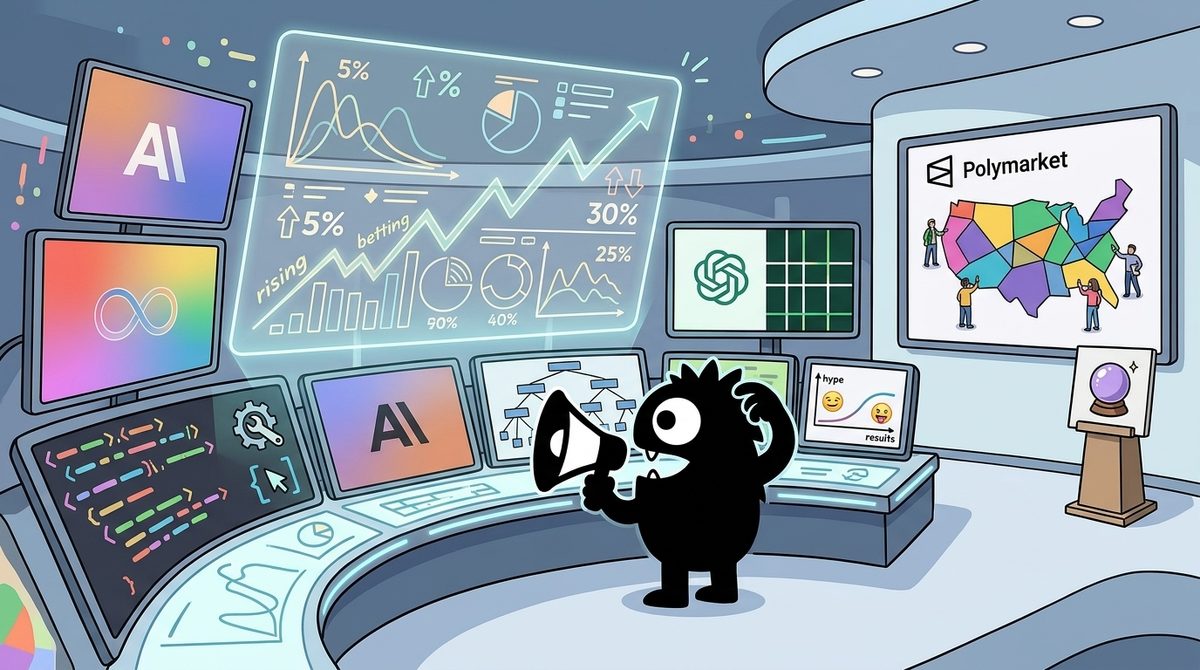
A $4 Million Bet on Who Wins AI by December 31
If you're asking which company will have the best AI model at the end of 2026, here is what the money says. As of November 7, 2026, traders on Polymarket's "Which company has best AI model end of 2026?" market price Google as the clear favorite at 64%. Anthropic is the only serious challenger at 29%. OpenAI sits at 4%, Meta at 1%, and Mistral and Z.ai round to 0%[1].
Roughly $4,030,177 has been traded on the market, which resolves around December 31, 2026[1]. Volume is spread unevenly across the outcomes: about $572,037 on Google, $521,310 on Anthropic, $300,064 on Mistral, $296,650 on OpenAI, $292,111 on Meta, and $253,558 on Z.ai[1][4]. These are expectations, not outcomes. The market implies a likely winner. It does not tell you who will win.
Bottom line (as of November 7, 2026):
- Betting markets treat "best AI model" as a two-horse race. Google is favored roughly 2:1 over Anthropic.
- The odds track leaderboard rank on a specific date, not which model is best for your workload.
- Benchmark aggregators still rank Claude Opus at or near #1 on raw accuracy. Google's market lead reflects price-performance and current Arena standing.
- For builders, the practical lesson is that leadership has flipped within a single week. Design for model portability.
Why pay attention to a betting market at all? Because it makes people pay for their opinions. One widely shared observation came from a related, shorter-dated Polymarket contract covering the end of November:
people keep arguing over which lab is actually winning the ai race but right now the market on @polymarket for who has the best model by the end of november has google way out front at about 73% while anthropic sits around 24 and openai is basically an afterthought at 4.
every time a new arena score drops the odds twitch a bit and over 800k has already gone into it with another 35k just in the last day so traders are putting real cash on who tops that leaderboard instead of just arguing in replies.
feels like watching a bunch of overconfident models get ranked by people who actually have skin in the game.
The useful part of that post is the mechanism, not the specific numbers. Odds move whenever a new Arena score lands. That makes this market a real-time summary of how practitioners read the leaderboard. It is also very sensitive to the most recent benchmark drop.
How Did Google Become the Market's Favorite So Fast in Late 2026?
The surprising thing about Google's 64% is how recently it arrived. Odds-history trackers show a sharp reversal over a single week. On October 26, Anthropic led at 53.5% and Google trailed at 32.5%. By November 2, the numbers had swapped almost exactly[^3]:
Polymarket, 'which company has the best AI model at the end of 2026', week by week:
Anthropic 53.5% → 36.5%
Google 32.5% → 53.5%
OpenAI 5.7% → 5.1%
(26 Oct → 2 Nov)
Full odds history per lab: https://airacescoreboard.com/polymarket-ai-odds-history/?utm_source=x&utm_medium=social&utm_campaign=video-odds-race-2026-11-03
Between November 2 and November 7, Google's implied probability climbed again from 53.5% to 64%[1][3]. Nothing in a prediction market moves 30 points in under two weeks unless traders think something structural changed.
The X conversation offers two readings. The first is a skeptical story, that Google is "falling behind" because recent Gemini releases trail rivals in coding. The second is a counter-reading that has been gaining traction:
A lot of people are saying Google is falling behind after Gemini 3.6 Flash.
I think they're reading it the wrong way.
To me, Google has changed its strategy.
Yes, Gemini is behind GPT-5.6 Luna, Grok 4.5, and Claude Sonnet 5 in coding.
But it leads in computer use, visual understanding, and long context. At 1 million tokens, it scores more than twice as high as Gemini 3.5 Flash.
That doesn't look like a company that is losing.
It looks like a company building for real work.
Frontier models are already smart enough for most thinking tasks.
Now the question is not who gets another benchmark record.
The question is who helps people do their jobs every day.
People on X talk about agents and hard benchmarks.
Most companies are still trying to figure out where AI fits.
Most workers are not running agent systems.
They need a model that can read documents, understand charts, keep track of long conversations, and work inside the tools they already use.
That is exactly where Gemini is strong.
If AGI is about doing every kind of knowledge work, then vision, long context, and real world understanding matter just as much as coding.
As Demis Hassabis has said, intelligence has to bring all of these things together.
Many developers think Google is losing the coding race.
I think Google has stopped chasing benchmark wins and started focusing on where the money is.
A fast, low-cost model that fits into everyday work may end up being the better strategy.
The "changed strategy, not losing" argument holds that Google has given up the coding leaderboard to compete on computer use, visual understanding, and long context. The post claims Google leads in all three, including more than double the prior Flash model's score at 1M tokens. If that reading is right, the market's shift is more than a reaction to one benchmark. It suggests traders believe the aggregate leaderboard rewards breadth, and that Google is building the broadest model.
There is earlier support for the computer-use leg of this thesis. Independent testers reported Gemini's computer-use model beating Anthropic and OpenAI on web-agent benchmarks:
The new Computer-Use model from @GoogleDeepMind has been crushing it in trusted benchmarks,
We benchmarked the model against the new models from @AnthropicAI as well as @OpenAI on Online Mind2Web & Web Voyager.
Gemini crushes them all in accuracy, speed, and cost (by a lot).
The caveat is volatility. Trackers such as CoinStats and OffMarket mirror the same live odds[5][6], and they show a market that reprices on every release. A 64% favorite with seven weeks left is a strong position. It is still well short of certain.
Benchmark Leader vs Market Favorite: Why Is Claude Opus Ranked #1 but Priced Second?
This tension shows up most often in practitioner threads. Several benchmark aggregators currently put Anthropic's Claude Opus at the top. Rank.ai's November 2026 leaderboard headline says Claude Opus 5 "ranks first across 4 benchmarks"[11], and broader tables from BenchLeader, seelig.ai, and LLMBenchmark place Opus-class models at or near the top on overall capability[8][10][12]. Yet the market prices Anthropic at 29%, less than half of Google's odds.
The clearest explanation in the X conversation comes from SemiAnalysis's new GDPx benchmark, which tests agents on economically valuable real-world work:
The best AI model in the world just scored 12% on SemiAnalysis's new GDPx benchmark
it tests agents on real work across 11 of the most economically valuable domains
> Opus 5.5 leads at 12.0% but costs $51.41 per task
> Gemini 4 Carbon gets 10.9% for $16.29
> GPT-6 Astra lands 9.6% at $53.99
so google is basically tied for the top at a third of the price
the part people will skip: SemiAnalysis says Muse Wonder Full is the best cyber model right now by a meaningful margin, because safety classifiers hold the others back
is 12% proof agents are still years from doing real jobs, or just a benchmark built to stay hard?
According to the figures cited in that post:
| Model | GDPx score | Cost per task |
|---|---|---|
| Opus 5.5 (Anthropic) | 12.0% | $51.41 |
| Gemini 4 Carbon (Google) | 10.9% | $16.29 |
| GPT-6 Astra (OpenAI) | 9.6% | $53.99 |
Opus leads by 1.1 percentage points, and Gemini reaches that level at roughly a third of the cost. Accuracy and economic viability are different axes, and the market appears to be weighting the second more heavily than the raw leaderboards do.
"Best model" is ambiguous. It can mean highest accuracy, best value, best for agents, or best for coding. Aggregators handle this by publishing per-task rankings. seelig.ai explicitly frames its leaderboard as the "best AI model for each job"[10]. A prediction market cannot do that. It has to pick one resolution source and one date, and that is why the next section matters.
There is also a sobering detail in the GDPx numbers. The best score is 12%. However you read the odds, no frontier model is anywhere near reliably doing full economically valuable jobs end to end. That matters more for a buyer's expectations than which lab ends up #1.
How Does This Market Actually Resolve, and What Does That Mean for the Odds?
According to market trackers, this contract settles on the Chatbot Arena (LMSYS) leaderboard ranking at the end of 2026[1][6]. Arena is a crowdsourced leaderboard where users compare model responses side by side and vote, which produces Elo-style rankings. Check Polymarket's official rules before trading, but the core mechanic shapes everything about how to read the odds.
What the resolution rewards:
- A snapshot, not a season. Whoever holds #1 on or around December 31 wins. Leading for eleven months counts for nothing if a rival ships a stronger model on December 20.
- Frequent releasers. A lab that can push a fresh frontier model into Arena close to the deadline has an advantage over one on a slower cycle.
- Human preference, not task accuracy. Arena votes measure which response users prefer. That is related to, but different from, benchmarks like GDPx or the composite indexes on Artificial Analysis.
This is why community trackers publish weekly standings and why traders follow them closely:
Monday standings, 2 Nov:
1. Google DeepMind 100
2. Anthropic 86.7
3. OpenAI 65.1
Google holds #1 and tops both @arena and Artificial Analysis. Polymarket 2026 odds flipped: Google 53.5%, Anthropic 36.5% (was 32.5% vs 53.5%).
Riser: Moonshot, #7 → #6.
https://airacescoreboard.com/?utm_source=x&utm_medium=social&utm_campaign=standings-2026-11-02
As of November 2, Google DeepMind held #1 on both Arena and Artificial Analysis. That is the most direct reason the market favors Google: it currently holds the position the contract pays out on. Polymarket's broader AI category, which lists 185 live AI markets as of November 7, 2026[7], shows how much trading now rides on these leaderboard snapshots.
For readers, the takeaway is that 64% roughly prices the odds that Google keeps first place through roughly seven more weeks of releases. It is not a judgment that Google builds the best model for every task.
Why Do Traders Price OpenAI at Just 4%?
This is the most counterintuitive number on the board. OpenAI runs the most widely used consumer AI product, yet traders price its odds of having the best model at year-end at 4%, down from about 5.7% in late October[1][3].
Part of the explanation is that the market separates consumer adoption from leaderboard supremacy. A related Polymarket contract makes this explicit:
Polymarket gives Anthropic 91% odds of being worth more than OpenAI on Dec 31.
I think the crowd is right. ChatGPT has more users, but for coding and agents, people pick Claude. Companies pay most for that.
Can OpenAI flip it?
https://polymarket.com/event/anthropic-vs-openai-higher-valuation-on-december-31
That 91% figure belongs to a different market, a valuation contest rather than a model ranking. It shows the same pattern, though: traders are pricing developer and enterprise preference for coding and agents above consumer user counts. In both markets, OpenAI's distribution lead is not converting into favorable odds.
There is a contrarian case, and it rests on price-performance. Some practitioners argued that OpenAI's mid-tier models would hit the best cost-to-capability ratio for agentic work:
OpenAI will win this round
- Mythos is way too expensive
- Gemini generally isn't great for agentic loops
GPT 5.6 will hit the sweet spot - FANTASTIC PRICE FOR PERFORMANCE
That argument cuts against the GDPx data above, where GPT-6 Astra posted the highest cost per task. Still, OpenAI's lineup moves quickly, and Arena resolution rewards a well-timed release. A cheap long-shot contract is how traders express "OpenAI ships something big in December."
Some on X claim certain wallets are trading on that idea. One account says it has tracked a "cluster" with a strong record on OpenAI-related markets, now buying "Yes" on new frontier releases:
OpenAI insiders on Polymarket dont even try to hide
I’m tracking a "God Mode" cluster on Polymarket betting on OpenAI.
Their winning bets:
OpenAI Browser by Oct 31
OpenAI Social App in 2025
GPT-5 & Open Source model predictions
Gemini 3.0 Release (?)
Current Play: They are aggressively buying "Yes" on the New Frontier Model release 👉https://t.co/5esgqmqXGt
OpenAI salaries must be lower than I thought.
Dropping the wallet list in the replies 👇
Treat this as an unverified claim. Wallet-watching is noisy, and correlation with past wins does not prove anyone has inside information. It does explain why some traders keep a small position on a 4% outcome: the payoff on a surprise release is large.
Meta, Mistral, and Z.ai: Are They Priced Out of the Frontier Race?
The market's answer is mostly yes. Meta at 1%, Mistral at 0%, and Z.ai at 0% mean traders see no realistic path for these labs to take Arena's #1 slot by December 31[1]. This matches a broader view in 2026 reporting. The State of AI Report frames the frontier as a three-lab race[15], and Polymarket's odds go further by reducing it to roughly two.
The dismissive tone on X has been consistent for a while:
google gemini has blown everyone out the fucking water. the only possible contender right now is openai. no one else is even worth including in a comparison chart
it's over for alibaba chatGPT clones
The volume tells a more complicated story. Each of these near-zero outcomes still drew between $250,000 and $300,000 in trading[1][4]. Some of that is likely traders buying "No" for small, near-certain returns. Some is long-shot speculation. Either way, it shows these names are actively traded rather than ignored.
For SaaS buyers, what the near-zero odds don't tell you matters most. Open-weight and challenger labs are not competing for a leaderboard crown. They are competing on deployment economics: self-hosting, data residency, fine-tuning, and per-token costs that can undercut frontier APIs. Live trackers like Maxy Tools treat the "best model" race separately from questions of adoption and cost[2]. A 0% chance of being #1 on Arena says nothing about whether a Mistral or Z.ai model is the right choice for a high-volume classification pipeline.
The SaaS Implication: Is Model Leadership Also an Infrastructure Bet?
The most strategic reading of these odds treats them as more than a model contest. A frontier lead compounds through distribution, and the labs distribute very differently. Investor-minded voices made this point when Google led an earlier version of the market:
Over the last few days, on Polymarket, $GOOGL's lead as the best AI model by the end of 2025 has increased even further.
Anthropic odds have also risen, while those of OpenAI and xAI have decreased.
While $GOOGL's market share in LLM search will be much lower than the market share it has on traditional search on the enterprise side if $GOOGL turns out to be the best model provider and on top of it offers them via GCP on their TPU infrastructure, GCP's value could be much more than the market current anticipates.
That post refers to the end-of-2025 contract, but the logic applies directly to 2026. Google owns the full stack: the model, the TPU chips it runs on, and Google Cloud (GCP) as the channel to enterprises. If Google's model also leads, the advantage can show up as lower serving costs and stickier cloud contracts. Anthropic reaches enterprises largely through cloud partners. It may hold a strong position in coding, but some of its distribution runs through other companies' platforms.
For SaaS founders, this creates three risks to watch as the deadline approaches:
- Margin pressure. If your product's main cost is inference, the vendor with the best price-performance sets your gross margin. The roughly 3x per-task cost gap in the GDPx data is the difference between a viable product and an unprofitable one.
- Cloud lock-in. Building deeply on one lab's model often means building on its preferred cloud. Leaderboard leadership can turn into contract leverage for the vendor.
- Narrative-driven procurement. Enterprise buyers read headlines. A clear "Google is #1" result at year-end could shape 2027 vendor shortlists whatever the per-task fit, and that affects which integrations your customers ask for.
The odds-history data shows how fast this narrative can change[3]. Note too that Google's position reflects price-performance leadership, which matters more for recurring SaaS costs than a one-time benchmark win.
What Should Developers, Founders, and SaaS Buyers Do Right Now?
The odds are a sentiment signal, not a buying decision. One practitioner described the gap between headline leaderboards and what builders can actually use:
You're waiting for Opus 5.6.
The best model you can use today scores 60 on the Artificial Analysis Intelligence Index. It's Gemini 4 Carbon, and most of you can't even get access to it.
So I scored everything coming next. The number at the top belongs to a model you will never use.
My bets for the next 90 days:
Fable 5.5: 70. First public model past 70. Literally AGI.
GPT-6.2 Astra: 67. The first agent you'd actually hand your laptop to.
Gemini 4.5 Carbon: 65. Google's best shot at #1. Still third.
Opus 5.6: 63. Lower number, bigger fanbase. Everyone's daily driver by Christmas.
Grok 4.8: 41.
Then the two they keep:
Fable 6: 78. New architecture. The first model doing most of the work on its own successor.
GPT-6.5 Bel: 76. Built for problems humans have been stuck on for decades. Proofs first, products never.
You can use a 60. They're sitting on a 78. That gap is the whole story of 2027.
Shipped scores are real. Every other number is my guess. Bookmark this. We check it in February.
The point of that post is that the top of the leaderboard is often a model you can't reliably access, budget for, or deploy. Its scores beyond shipped models are explicitly the poster's own guesses. With that in mind, here are decision criteria by situation.
If you're a solo developer or early-stage founder:
- Pick on cost per successful task, not leaderboard rank. A model that is nearly the best at a third of the price usually wins in production.
- Use an abstraction layer or gateway so you can switch providers without a rewrite. Leadership flipped between October 26 and November 2, 2026[3]. Your stack should handle that easily.
If you're building agentic or coding workflows:
- Build evals on your own task traces. Aggregators break results down by job for this reason[10][12], and composite scores hide large differences across tasks.
- Opus-class models remain strong on coding and agent benchmarks[11]. Gemini's reported strengths are computer use, vision, and long context. Route each task to the model best suited for it.
If you're an enterprise SaaS buyer:
- Read the 64% as a probability of momentum toward Google, not a recommendation. Negotiate multi-model flexibility into contracts.
- Weigh total cost: inference, cloud egress, and switching costs. A model's leaderboard rank does not include them.
If you're a trader or analyst:
- Follow release calendars and weekly Arena standings. With snapshot resolution, a single December launch can matter more than months of steady leadership.
A 64/29 split is the market's best current estimate, and it was a different estimate two weeks ago. Plan for it to change again before December 31.
Sources
[1] Polymarket — Which company has best AI model end of 2026? — https://polymarket.com/event/which-company-has-best-ai-model-end-of-2026
[2] Best AI model at the end of 2026: who wins? Live odds | Maxy Tools — https://maxy.tools/radar/race/best-ai-model-2026
[3] Polymarket AI odds history: best AI model end of 2026 — https://airacescoreboard.com/polymarket-ai-odds-history/
[4] Which company has best AI model end of 2026? Odds | DexTrading — https://dextrading.com/predictions/which-company-has-best-ai-model-end-of-2026
[5] Which company has the best AI model end of 2026? | CoinStats — https://coinstats.app/prediction-markets/odds/tech/which-company-has-best-ai-model-end-of-2026/
[6] Which company has best AI model end of 2026? odds | OffMarket — https://offmarket.cx/event/556382/which-company-has-best-ai-model-end-of-2026
[7] AI Odds on Polymarket Today: 185 Live Markets (Nov 7, 2026) — https://polymarkettrader.com/odds/ai/
[8] LLM Leaderboard (Nov 2026): Top AI Models | BenchLeader — https://www.benchleader.com/
[10] LLM Benchmarks: Best AI Model for Each Job | seelig.ai — https://www.seelig.ai/en/benchmarks
[11] LLM leaderboard November 2026: Claude Opus 5 ranks first across 4 benchmarks | Rank.ai — https://www.rank.ai/llm-leaderboard
[12] LLM Benchmark: LLM Leaderboard & AI Benchmarks, 382 Models — https://llmbenchmark.ai/
[15] The frontier is now a three-lab race | State of AI Report 2026 — https://www.stateof.ai/2026-explore/research
References (16 sources)
- Polymarket — Which company has best AI model end of 2026? - polymarket.com
- Best AI model at the end of 2026: who wins? Live odds | Maxy Tools - maxy.tools
- Polymarket AI odds history: best AI model end of 2026 - airacescoreboard.com
- Which company has best AI model end of 2026? Odds | DexTrading - dextrading.com
- Which company has the best AI model end of 2026? | CoinStats - coinstats.app
- Which company has best AI model end of 2026? odds | OffMarket - offmarket.cx
- AI Odds on Polymarket Today: 185 Live Markets (Nov 7, 2026) - polymarkettrader.com
- LLM Leaderboard (Nov 2026): Top AI Models | BenchLeader - benchleader.com
- All AI models: full benchmark table | Fanetti AI - fanettiai.com
- LLM Benchmarks: Best AI Model for Each Job | seelig.ai - seelig.ai
- LLM leaderboard November 2026: Claude Opus 5 ranks first across 4 benchmarks | Rank.ai - rank.ai
- LLM Benchmark: LLM Leaderboard & AI Benchmarks, 382 Models - llmbenchmark.ai
- LLM Leaderboard & AI Model Benchmarks — November 2026 | BenchLM - benchlm.ai
- The AI Race (November 2026): Which Lab Is Ahead? - noometry.com
- The frontier is now a three-lab race | State of AI Report 2026 - stateof.ai
- Technical Performance | The 2026 AI Index Report | Stanford HAI - hai.stanford.edu
Related Guides

What Is Framer? A Complete Guide to Design-to-Code for 2026
19 min read
The Best AI Bubble Signals in 2026: What Polymarket's Odds Reveal About Where AI and SaaS Are Headed
18 min read
LangChain vs Botpress vs Zapier AI: Which Is Best for Startup Founders in 2026?
24 min read
The Best AI Model Tools in 2026: What a $4M Prediction Market Reveals About the Race
18 min read