Midjourney vs Moz vs Beehiiv: Which Is Best for Your Content Stack in 2026?
Updated: October 18, 2026
Midjourney, Moz, and Beehiiv solve different parts of the content stack. Compare features, pricing, and use cases to build your 2026 strategy. Find out which fits.
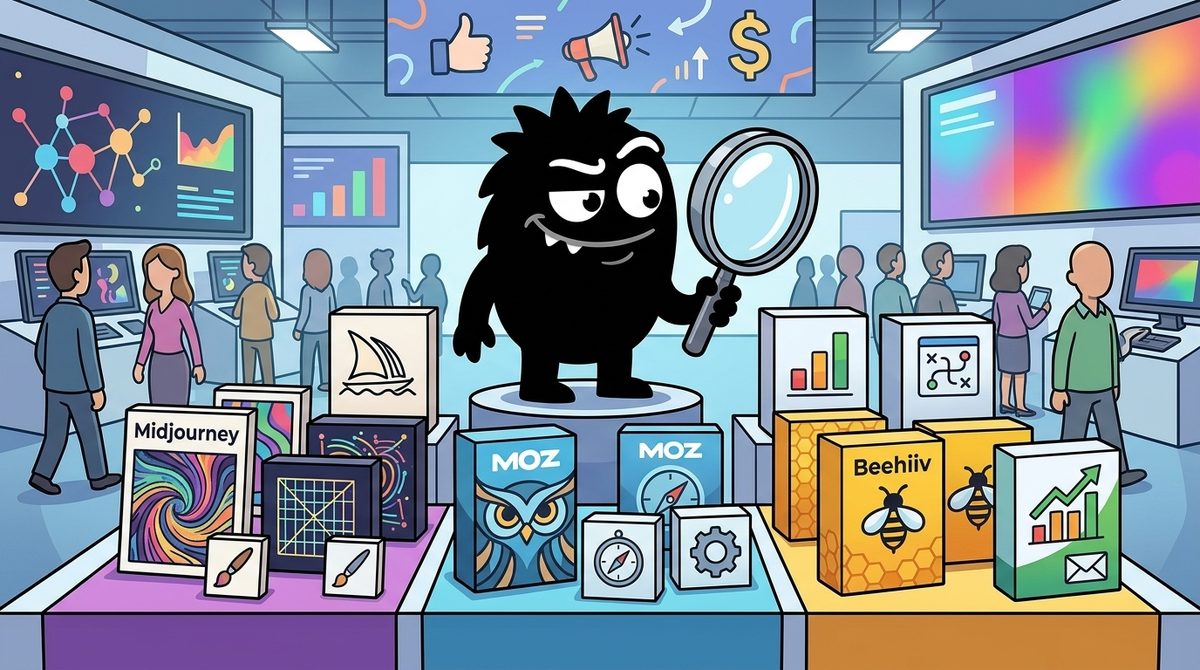
If you are comparing Midjourney vs Moz vs Beehiiv for SEO and content strategy, the real question is not which product is “best.” It is which part of your content system is currently failing.
Choose Midjourney when visual production is the bottleneck, Moz when people cannot discover your content through search, and Beehiiv when you need to publish, distribute, measure, and monetize a newsletter. For most serious content operations, these tools are complementary rather than interchangeable.
Bottom line for 2026
>
- Beehiiv is the best starting point for a newsletter-first creator who needs distribution and audience analytics.
- Moz is the priority for an SEO-led team that needs technical audits, keyword research, rank tracking, and link analysis.
- Midjourney fits teams that need distinctive campaign and editorial imagery without adding a full-time design bottleneck.
- If you use all three, make Beehiiv the owned-audience layer, Moz the discovery layer, and Midjourney the production layer.
Three tools, three jobs: Why this isn’t a real head-to-head
Midjourney, Moz, and Beehiiv occupy three different layers of a modern content stack:
| Tool | Primary job | Best-fit outcome | What it does not replace |
|---|---|---|---|
| **Midjourney** | Visual production | More creative concepts and campaign assets | SEO research, newsletter delivery, analytics |
| **Moz** | Search intelligence | Better technical health and organic discoverability | Content creation, email distribution |
| **Beehiiv** | Publishing and audience operations | Subscriber growth, engagement analysis and monetization | Full SEO auditing or image generation |
Midjourney’s documentation covers an image-generation workflow rather than an SEO or publishing platform.[1] Moz positions Moz Pro as an all-in-one SEO toolkit, with functions including keyword research, rank tracking, site crawling and link research.[8] Beehiiv combines newsletter publishing with website, analytics and growth capabilities, although its SEO controls are not equivalent to a specialist crawler.[13]
The useful buying question is therefore: Which layer is constraining results?
- Content is being published but not found: prioritize Moz.
- Traffic arrives but does not become a retained audience: prioritize Beehiiv.
- Campaigns move slowly because every asset needs a designer: consider Midjourney.
- All three are problems: build the stack in that order—measurement and distribution, discoverability, then production scale—unless search already drives your business.
This separation matters because small teams can now operate systems that once required several specialized departments. The reported technical footprint behind Midjourney itself illustrates the broader lean-tooling shift:
Midjourney runs fully on Bun
Server side routing: Bun
Runtime: Bun
Client side bundling: Bun
Scripts: Bun
Real-time generation previews: Bun
No framework beside vanilla React and no data management library. This enabled us to scale the site to millions with only ~5 full-timers. Plus some other semi-public tricks I usually only divulge at random parties
Maybe I should re-un-retire from conference talks and explain the stack one day...
That post is about Midjourney’s application stack, not its image model or customers’ marketing workflows. But the operating lesson travels: small teams gain leverage by giving narrow tools clearly defined jobs. Buying three products without an integrated workflow creates overhead; assigning each one a measurable role creates leverage.
Why do analytics beat newsletter growth hacks?
The least glamorous part of a content stack often determines whether the rest works: analytics.
Beehiiv’s growth features may attract creators, but its higher-value role can be showing why subscribers convert, disengage or churn. Kaleigh Moore’s account captures the difference between having aggregate email statistics and having data that can change a publishing decision:
When I moved my newsletter to @beehiiv this year, I expected the growth tools to be the main character of this story. And they are great, don’t get me wrong!
But so far, the star of the show is actually something way unsexier. It is…drumroll…the *analytics.*
I spent the last five years running a newsletter with pretty much zero data informing my strategy. I was doing everything by guesswork and the bare-bones data my old platform provided.
Now, thanks to the in-depth data I get from beehiiv, I can do things like:
1. Track the new-subscriber engagement funnel.
This report isolates the people who joined in a given window and walks through delivered → opened → clicked.
This acts as a health check on my onboarding, so if a new cohort of subscribers drops off between delivered and opened, I then know that's a welcome-sequence problem. Or if it’s between opened and clicked, that's a content problem.
My old setup blended new subscribers into the aggregate, so a low-quality cohort of new subscribers was invisible until it had already churned. :(
2. Sell sponsorships more accurately with verified clicks.
beehiiv separates verified clicks from raw clicks (AKA filtering out corporate link scanners and security bots that inflate everyone's numbers). My verified numbers are tighter than the raw ones, and I put those in my media kit on purpose.
If you're a full-time creator, this is important because a sponsor who buys against inflated clicks doesn't renew. A sponsor who buys against conservative, verified numbers, however, will go in with a realistic vision of what they’re purchasing (and likely buy again).
3. Find out where attention dies.
I can see a heat map of exactly which links in an individual post got clicked and where they sat in the layout.
Turns out my subscribe CTA performed 22% better above the fold (duh!), but I wouldn’t have been able to verify this without the heatmap. My old platform didn't allow for this level of detail, so it was nice to be able to pinpoint this issue with actual data around user behavior.
4. See all my numbers in one dashboard.
Ad network earnings, paid subscription growth, and churn are all in the same place as open rates.
When I launched my paid tier, this meant I could watch conversion against engagement in real time rather than reconciling a payments dashboard against an email dashboard. This saves me hours every month.
I also use the beehiiv MCP to connect my data to Claude, and with the project I’ve created there, it remembers all past context on my newsletter. I use this as my springboard for ideating new editions and to double down on the topics that performed best.
In short, I’m now several months into hosting my 10,000+ subscribers on beehiiv, and I’m not going anywhere.
Are you thinking about making the switch? LMK if you have Qs about beehiiv; happy to share more on what the experience has been like so far!
If you’re ready to make the switch or launch your first newsletter on beehiiv, you can use code KALEIGH30 for 30% off your first three months.
#beehiivpartner
The important details are not simply open and click rates. Moore describes several operationally useful measurements:
- A new-subscriber funnel that separates recent cohorts from the established audience.
- Verified clicks that filter some automated activity, providing more conservative sponsorship reporting.
- Per-edition click heat maps that show where attention disappears.
- Revenue, paid-subscription and engagement data in one operating view.
Those capabilities turn analytics into diagnosis. If delivery remains stable but opens fall for a newly acquired cohort, inspect the acquisition promise, subject line and welcome sequence. If people open but do not click, examine the content-to-call-to-action fit. If clicks are healthy but paid conversions stall, the problem may be the offer rather than distribution.
Open and click rates still require context. Ray J. Green reports approximately 40% opens and 5% click-throughs for his newsletter, but those figures describe his audience and should not be treated as universal benchmarks. Privacy protections, automated scanners, list composition and sending frequency can all complicate comparisons.
Moz supplies a different category of analytics. Beehiiv tells you what subscribers do after they enter your owned audience. Moz helps explain whether potential readers can find you before subscribing. Its keyword, ranking, crawl and linking data operate at the top of the funnel.[8]
A practical dashboard should therefore join the two:
- Search visibility: impressions, rankings, indexed pages and organic visits.
- Visitor conversion: page-to-subscription rate by article or landing page.
- Subscriber quality: initial delivery, open and click behavior by source or cohort.
- Retention and value: churn, paid conversion, sponsorship performance and revenue.
That chain is more useful than chasing a growth tactic in isolation. It shows whether a weak result came from discovery, conversion, engagement or monetization.
Can Moz prevent one SEO mistake from costing years of traffic?
Organic search is compounding only when search engines can reliably crawl, interpret and index the content. A technically broken archive can publish for years without building meaningful search equity.
Green’s experience is the cautionary example in the current X conversation:
1 missed step in a small project I paid for cost me 3 years of organic traffic to my newsletter.
I publish a weekly email to about 6,700 business owners every Sunday. I never miss an issue. And hardly ever pitch anything in it.
40% open rates, 5% CTRs, and several industry leaders in the MSP/IT space recommend it to clients.
It's grown a little from speaking, LinkedIn, and referrers, but zero growth from search. Which has been odd because the podcast and other channels see some hits in traffic. But not the newsletter.
Demand hasn't been the constraint in my business, though, so it got ignored. Now that supply is getting ironed out, it's back on my radar.
I want to build a proper B2B content engine that'll produce demand, so I hired someone audit our content strategy. Sure enough, lack of traffic to the newsletter was top of the radar.
The podcast shows up in search and AI. So does LinkedIn. Even YouTube, despite having just 2k subscribers there.
So why not the newsletter, which is one thing I get complimented on all the time at events when I'm speaking.
The audit suggested a few things, one being that all the articles are optimized for inbox opens and not SEO. Definitely possible.
So looked into it. Probably has an impact, but didn’t explain it.
Was it Beehiiv? We migrated there a few years ago and traffic seems to have slowed down around that time.
Quick search discovered also unlikely to be the cause. Beehiiv has plenty of organic traffic going to other newsletters with far fewer subscribers.
A little help from my friend Claude and we discovered the root cause.
Turns out, the source of this was stupidly simple.
Everything was set up when migrating to Beehiiv... except for one ridiculously simple step that takes <30 seconds to complete. Without it, the subdomain we're using was invisible to Google.
So, for 3 years, every week I've been writing to the same audience. I have no idea how to quantify the impact over that time. Maybe it's tens of subscribers. Maybe it's thousands. It's a sunk cost now.
But looking back on how I picked the freelancer to migrate the newsletter, this is the difference between the $500 quote and the $1,500 quote.
And it's a real-life example of that meme you've likely seen of a guy having a $10,000 bill for 10 minutes of work, because they knew which screw to turn.
Or in my case, knew which setting to enable.
All service providers are not the same.
Which is why we've invested nearly 2 years getting the delivery side of our fractional sales management business dialed in.
As we move to look at generating more demand, will have to make sure to not learn this lesson again.
His key point is not that Beehiiv inherently blocks SEO. In his account, a missed configuration step left the newsletter subdomain invisible to Google. Beehiiv provides website SEO settings, but those controls still have to be configured correctly.[13]
Common migration and publishing failures include:
- Leaving a site, directory or subdomain set to noindex.
- Failing to submit or update the XML sitemap.
- Changing URLs without permanent redirects.
- Pointing canonical tags at the wrong version of a page.
- Creating duplicate archives across domains or subdomains.
- Breaking internal links during a platform migration.
- Allowing important pages to become orphaned.
- Publishing inbox-oriented copy without a searchable title, clear page structure or query-aligned introduction.
This is where Moz earns its place. Moz Pro combines site crawling, rank tracking, keyword research and link analysis.[8] Its broader product portfolio also includes tools focused on search visibility and local presence.[9] A crawler can surface technical warnings before they compound, while rank tracking can expose the absence of expected progress.
Moz is not an automatic safeguard. It cannot decide the correct canonical architecture, repair a migration by itself or guarantee that Google will index a page. Someone still has to interpret findings and make changes. But it can convert a silent failure into a visible alert.
What should a newsletter migration checklist include?
Before moving an established publication:
- Export existing URLs and map every valuable page to its destination.
- Preserve URLs where possible; otherwise, create permanent redirects.
- Verify indexation and canonical settings on the new domain or subdomain.
- Confirm the sitemap is accessible and contains the intended pages.
- Crawl the staging and production sites for errors and orphaned pages.
- Track priority keywords and indexed-page counts before and after launch.
- Test newsletter signup, analytics attribution and archive rendering.
- Recheck the system after launch rather than treating migration day as completion.
Newsletters often underinvest here because the inbox is seen as the product. That overlooks a valuable acquisition loop: an indexed archive can attract a reader months after publication, while the newsletter converts that temporary visit into a direct relationship.
Is Midjourney useful for SEO, or only for making images?
Midjourney does not conduct keyword research, fix indexation or distribute email. Its contribution to SEO and content strategy is production leverage.
Practical uses include:
- Blog and newsletter header images.
- Social campaign concepts and ad variations.
- Visual metaphors for technical or abstract topics.
- Illustrations for recurring editorial series.
- Early-stage mood boards and campaign directions.
- Style-consistent assets created with references and reusable prompt patterns.
Marketing guides emphasize repeatable prompting and style controls as ways to produce more coherent brand visuals.[4] Other practitioner-oriented resources similarly position Midjourney as a way to expand visual ideation and campaign production.[6] V7-focused advertising guidance highlights improved realism and creative applications, although outputs still require human review before publication.[5]
The SEO effect is indirect. An image can make an article easier to understand or more likely to be shared, but it does not compensate for weak search intent, inaccessible text or technical problems. Teams must still compress assets, use appropriate formats, write meaningful alternative text and avoid placing essential information only inside an image.
What commercial-use rules should marketers check?
Midjourney permits commercial use under its terms, but marketers need to review plan and company-revenue requirements rather than assuming every account has identical rights. Its commercial-use documentation says companies above a specified annual gross-revenue threshold need an eligible higher-tier plan.[2] Legal teams should also distinguish contractual permission to use an output from the separate question of whether that output receives copyright protection in a particular jurisdiction.
Midjourney also gained an important legitimacy signal in August 2025, when Meta announced a partnership to license its image and video generation technology.[3] That partnership does not remove brand-safety, provenance or intellectual-property concerns. It does indicate that generative visual systems are moving deeper into mainstream production infrastructure.
Midjourney is best for a team that already knows what it wants to communicate but lacks enough visual production capacity. It is a poor substitute for a brand designer when the assignment requires exact typography, regulated claims, pixel-perfect layouts or defensible originality.
What do Midjourney, Moz and Beehiiv actually cost in 2026?
Software price is only one part of cost. Moz requires time to interpret SEO data, Beehiiv requires disciplined analytics review, and Midjourney requires prompting, selection and quality control.
| Tool | Entry point | Typical paid progression | Main hidden cost |
|---|---|---|---|
| **Midjourney** | Basic plan around $10/month | Standard, Pro and Mega tiers increase generation capacity and privacy options | Prompt iteration, editing and brand review |
| **Moz Pro** | Starter list price around $49/month | Standard around $99, Medium around $179 and Large around $299 | SEO expertise and implementation time |
| **Beehiiv** | Free Launch plan | Paid pricing scales by plan and audience size | Migration, analytics interpretation and editorial operations |
Midjourney’s plans have historically been priced around $10, $30, $60 and $120 per month, with differences in generation resources and operating modes; buyers should verify current details in its documentation before budgeting.[1] Commercial requirements can also make Pro or Mega the effective minimum for larger companies.[2]
Moz’s official pricing page lists plan limits around campaigns, tracked keywords, crawled pages and users, making the right tier dependent on the number of sites and queries being managed.[7] Annual billing or promotions can lower the effective monthly price, which helps explain third-party references to entry pricing below the standard month-to-month list rate.[10] Reviews also note that Moz can be approachable relative to more sprawling SEO suites, while limits and feature depth still matter for advanced teams.[12]
Beehiiv offers a free entry point, with paid tiers unlocking more advanced growth, analytics and monetization capabilities; pricing then depends on plan and audience size.[15] The free plan is suitable for validating a newsletter, not necessarily for running a mature media business.
A plausible baseline for a solo operator using all three is roughly $59 per month before annual discounts: free Beehiiv, Midjourney Basic and Moz Starter. A small team using Beehiiv’s paid features, Midjourney Pro and Moz Medium could spend roughly $280 or more per month, before subscriber-based increases or other services.
Do not buy the combined stack merely because the total seems affordable. If you publish twice a month and have no search archive, Moz may be premature. If your existing photography or templates already work, Midjourney may add novelty rather than value.
How can you use all three to grow from zero to 5,000 subscribers?
The appeal of a “zero to 5K” playbook is understandable, particularly when it comes from an operator reporting a compressed growth timeline:
I grew my newsletter from 0 to 5k subscribers in 100 days.
Here's:
• What worked great
• What didn't work
• What worked ok
And how you can apply what I learned to your newsletter:
The supplied post introduces what worked, failed and performed adequately, but the more durable lesson is to treat growth as a system of experiments rather than a universal list of hacks.
Phase 1: Establish Beehiiv as the conversion and measurement layer
Publish a clear landing page, define the newsletter’s promise and create a welcome sequence. Use Beehiiv to track how new subscribers move from delivery to opens and clicks. Recommendations, referrals and other growth functionality can help, but only after the positioning and onboarding experience work.[15]
At this stage, focus on:
- Visitor-to-subscriber conversion.
- Engagement by acquisition source.
- Welcome-sequence drop-off.
- Unsubscribe and churn patterns.
- Topics that repeatedly generate clicks or replies.
Phase 2: Use Moz to build a compounding discovery channel
Turn recurring newsletter themes into web articles aimed at identifiable search needs. Use keyword research to validate terminology, crawl the archive for technical problems and monitor whether pages begin ranking.[8]
Do not simply post the email unchanged. Inbox writing often assumes an existing relationship; search content must orient a first-time visitor quickly, answer the query early and provide a route into the newsletter.
Phase 3: Use Midjourney to increase production range
Develop a small set of visual directions rather than generating a radically different aesthetic for every issue. Create assets for article headers, social distribution and newsletter modules, then compare performance where the data is meaningful.
Avoid attributing every open-rate change to an image: subject lines largely determine opens before most readers see the body. Visuals are more plausibly connected to comprehension, clicks, sharing and campaign consistency.
The channel mix is the defense. Social can create spikes, SEO can compound, referrals can add trust, and email retains the relationship. Over-indexing on any one channel leaves the system exposed to algorithm changes, technical mistakes or rising acquisition costs.
Who should choose Midjourney, Moz or Beehiiv in 2026?
Solo newsletter creator
Start with Beehiiv. You need somewhere to publish, distribute and understand the audience. Add Midjourney if visual production is consuming time or limiting promotion. Add Moz once you have a meaningful web archive and intend to acquire readers through search.
Best order: Beehiiv → Midjourney → Moz.
SEO-driven content team
Make Moz the core tool. Technical health, query selection, ranking movement and link visibility are central to the operating model.[8] Add Beehiiv to convert search traffic into an owned audience—insurance against ranking volatility. Use Midjourney only if creative production is a real constraint.
Best order: Moz → Beehiiv → Midjourney.
Newsletter business with sponsorship or paid subscriptions
Prioritize Beehiiv’s analytics and monetization workflow. Cohort engagement, verified clicks, paid conversion and churn affect revenue decisions more directly than producing more images. Add Moz to make the archive discoverable and Midjourney when better creative can support sales packages or campaigns.
Best order: Beehiiv → Moz → Midjourney.
Brand or small marketing team
Use all three, but give each an owner and a success metric:
- Moz: non-brand visibility, technical health and organic conversions.
- Beehiiv: subscriber acquisition, engagement, retention and revenue.
- Midjourney: asset turnaround time, usable concepts and production cost.
The final verdict is straightforward: Midjourney, Moz and Beehiiv are not competing answers to one problem. They are production, discovery and distribution components. In 2026, the right choice is the one that repairs your weakest layer—and the right stack is the one whose data shows how each layer contributes to an owned, durable audience.
Sources
[1] Documentation – Midjourney
[2] Using Images & Videos Commercially – Midjourney
[3] Meta partners with Midjourney on AI image and video models – TechCrunch
[4] Midjourney for Marketing: Brand Visuals Without a Designer
[5] Midjourney V7 for Advertising – AdCreate
[6] Midjourney for Marketing – Hashmeta
[8] Moz Pro: All-in-One SEO Toolkit – Moz
[9] Moz SEO Products and Solutions
[10] Moz Pro free trial and pricing – TNW
[12] Moz Review (2025) – Style Factory
[13] SEO settings for your website – Beehiiv Help
[15] Beehiiv Review 2026
References (15 sources)
- Documentation – Midjourney - docs.midjourney.com
- Using Images & Videos Commercially – Midjourney - docs.midjourney.com
- Meta partners with Midjourney on AI image and video models | TechCrunch - techcrunch.com
- Midjourney for Marketing: Brand Visuals Without a Designer [Prompt Guide 2026] - businessatthespeedofai.com
- Midjourney V7 for Advertising: AI Ad… | AdCreate Blog - adcreate.com
- Midjourney for Marketing: How to Use AI Image Generation to Elevate Your Brand | Hashmeta - hashmeta.com
- Moz Pro Pricing - Moz - moz.com
- Moz Pro: All-in-One SEO Toolkit - Moz - moz.com
- Moz - SEO Products & Solutions for Better Search Performance - moz.com
- Moz Pro free trial: professional AI SEO tools from $39/month - thenextweb.com
- Moz SEO入門教學懶人包|功能、方案、優缺點&其他工具全比較! - adbest.com.tw
- Moz Review (2025) — Features, Pricing and Key Pros and Cons - stylefactoryproductions.com
- SEO settings for your website | beehiiv Help - beehiiv.com
- Blog SEO in 2026: Why beehiiv Beats WordPress | beehiiv Blog - beehiiv.com
- Beehiiv Review 2026: Worth Switching Your Newsletter For? - max-productive.ai
Related Guides

The Best AI Bubble Signals to Watch in 2026: What Polymarket's Odds Reveal About AI and SaaS
20 min read
xAI Grok vs Mistral AI: Which Is Best for Building Full-Stack Web Apps in 2026?
20 min read
CrossPublish vs Buffer vs Publer vs Hootsuite: Which Scheduler Is Best for Creators in 2026?
19 min read
The Best AI Model in 2026: What Polymarket's Odds Reveal About Where AI and SaaS Are Heading
22 min read