The Best AI Model of 2026: What Polymarket's $2.4M Market Reveals for Developers
Polymarket's AI model market puts Anthropic and Google in a dead heat for 2026. Discover what the live odds signal for developers, founders, and SaaS buyers.
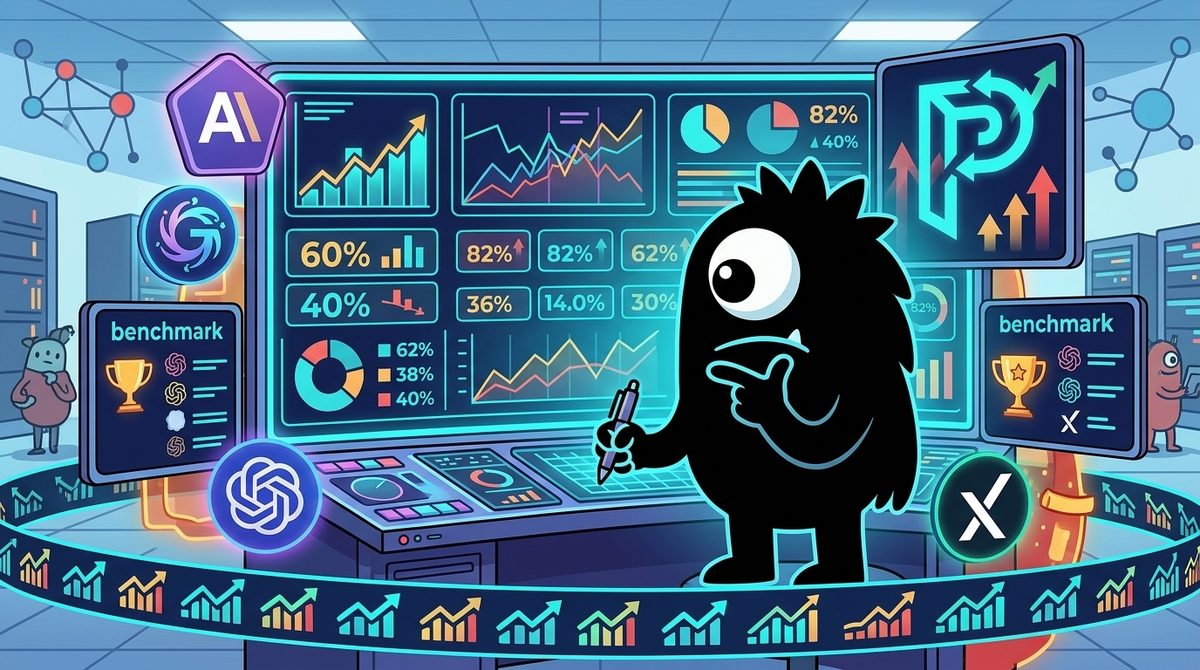
The practical question for developers, founders, and SaaS buyers is not simply which lab will win? It is whether today’s model and infrastructure choices will remain defensible when the frontier can reprice in weeks.
As of October 12, 2026, roughly $2,428,817 has been traded in Polymarket’s “Which company has best AI model end of 2026?” market. Traders currently price Anthropic and Google at 42% each, while OpenAI sits at 9%, Meta at 3%, xAI at 2%, and Mistral at 0%. The market is expected to resolve around December 31 based on which company owns the top-ranked qualifying model under its resolution rules.[1]
Those numbers do not establish which company has—or will have—the best model. They reveal what traders collectively expect, given current release information, leaderboard performance, timing assumptions, and market sentiment. The strongest signal is not that Google has definitively passed Anthropic. It is that traders now see a two-company coin flip, while putting only single-digit odds on OpenAI.
Bottom line
>
- The market implies a 42%-42% dead heat between Anthropic and Google.
- The more consequential repricing is OpenAI at 9%, despite ChatGPT’s consumer reach.
- The rapid swing toward Google shows why SaaS products should support model portability, not hard-code one provider.
- Leaderboard odds measure a narrow outcome. For buyers, integration, reliability, governance, price, and infrastructure leverage may matter more than who finishes first.
A $2.4M dead heat: What do the live 2026 odds actually say?
The October 12 snapshot is:
| Company | Implied probability | Reported amount traded |
|---|---|---|
| Anthropic | 42% | $336,750 |
| 42% | $260,277 | |
| OpenAI | 9% | $207,997 |
| Meta | 3% | $152,641 |
| xAI | 2% | $164,972 |
| Mistral | 0% | $189,073 |
The displayed probabilities total 98%, rather than exactly 100%, because market prices, spreads, and rounded displays are not a perfectly normalized forecast. Likewise, contract-level traded amounts should not be read as capital currently sitting on one side of the bet. Volume reflects trading activity, including positions changing hands.
The relevant interpretation is straightforward: a contract trading near $0.42 represents an approximately 42% market-implied chance of resolving “yes,” not a benchmark score or formal statistical forecast. Market trackers around the same event report Google in roughly the 42.5%-43% range, illustrating how prices can move within a snapshot window.[2][6]
Watching the AI race get this tight on @polymarket is wild right now.
Google just snuck ahead of Anthropic for who ends up with the best model by the end of 2026, sitting around 43% to 42%, after Anthropic was the clear lock at 70% plus for most of the year .
OpenAI is stuck down near 10% and barely moving. for the end of this month, Google is already way out in front at 74%
The money is starting to price in whatever Gemini has been cooking while everyone else is still dropping smaller updates.
That excitement is understandable, but “Google snuck ahead” overstates the significance of a one-point move. At 42% against 42%, the market is expressing uncertainty—not crowning a winner.
Which AI model will top the LMArena leaderboard at the end of 2026? Kalshi and Polymarket, pricing it separately, have landed on the same answer: a coin flip. Kalshi: Claude 42%, Gemini 41%. Polymarket: Anthropic 42%, Google 43%. A month ago it wasn't close. On 29 September Kalshi had Claude at 74.5% and Gemini at 9.8%. Google revealed Gemini 4 Argon the next day.
View on XThe independent convergence cited here is more meaningful than a temporary 43%-to-41% spread. If separate markets with different participants both price Claude and Gemini near parity, that suggests the coin-flip view is not confined to one order book. It still does not make the estimate objectively correct.
How did Anthropic’s 74% expectation become a Gemini coin flip?
The striking part of the chart is the speed of the repricing.
On September 29, reporting on the market put Anthropic’s implied probability near 74%.[5] X posts tracking the subsequent move say Google had been near 10% in late September, then surged after the September 30 reveal of Gemini 4 Argon. By October 1, the cited spread had narrowed to approximately 52% for Anthropic and 41% for Google; days later, Google briefly moved ahead.
Google just overtook Anthropic in Polymarket's odds to have the best AI model at the end of 2026. Here's what you need to know. Polymarket Money posted the news on X on Oct 8, calling it a worry for investors ahead of Anthropic's IPO. The post got about 385K views. Google now sits at 43% on the market "Which company has best AI model end of 2026?" Anthropic is at 41% and OpenAI at 7%, on roughly $2.357M in volume. The swing has been fast. Anthropic led 52% to Google's 41% on October 1. Google was near 10% until late September. Then it announced Gemini 4 Argon on September 30.
View on XOn the tape: POLYMARKET ODDS GOOGLE HAS THE BEST AI MODEL AT THE END OF 2026 ARE AT 43%, PASSING ANTHROPIC Anthropic sits at 41% and OpenAI at 7%, on roughly $2.357M in volume. Anthropic led at 52% to Google's 41% on October 1. Google was near 10% until late September and announced Gemini 4.
$GOOGL
Prediction markets move before a final benchmark result when traders believe a catalyst changes the probability distribution. Here, traders may be pricing several expectations at once:
- A strong Gemini release lands before the cutoff.
- Google optimizes specifically for the leaderboard used in resolution.
- Anthropic’s next release fails to create enough separation.
- Release timing matters as much as underlying research capability.
A model that arrives after the resolution snapshot cannot win this specific contract, however capable it eventually becomes. That makes launch schedules, evaluation eligibility, and post-training maturity central inputs.
Shorter-duration markets sharpen that timing signal. Polymarket’s own October market was promoted with Google at an 83% implied probability of finishing that month on top, while external analysis also tracked the end-of-October market.[4]
BREAKING: Google projected to dethrone Anthropic as the company with the best AI model at the end of October.
83% chance.
https://polymarket.us/event/company1-2026-10-31
The difference between approximately 83% for October and 42% for year-end is instructive. Traders may expect Google to have the near-term advantage while assigning Anthropic a substantial chance of answering before December 31. The annual market is therefore partly a bet on the release calendar.
Why is OpenAI at 9% the market’s most important signal?
A one- or two-point difference between Google and Anthropic is market noise. OpenAI at 9% is a structural judgment.
43% vs 41% is a statistical tie, not a verdict. The real signal is OpenAI dropping to 7% — the market has priced out GPT-6 for 2026. But Polymarket odds are sentiment, not benchmarks. Watch Gemini 3 and GPT-6 release dates, not the line chart. $GOOGL
View on XCalling 43% versus 41% a “statistical tie” is imprecise because prediction-market prices are not polling estimates with conventional margins of error. But the underlying point is right: the large information gap is between the two leaders and OpenAI.
The market currently implies that traders have mostly priced out an OpenAI model finishing first under this contract’s rules. That could mean traders expect GPT-6 to miss the eligibility window, arrive too late for sufficient evaluation, or fail to take the relevant leaderboard’s top position. It does not mean the market expects OpenAI to become commercially irrelevant.
That distinction matters because three races are happening simultaneously:
- Best model under a specified leaderboard
- Most-used consumer AI product
- Best platform for developers and enterprises
OpenAI can retain consumer mindshare or distribution while losing a year-end leaderboard contract. Conversely, a lab can top an evaluation without translating that result into durable revenue, low inference costs, or enterprise retention. Model-ranking matrices and benchmark databases also divide performance into different dimensions rather than identifying one universally superior system.[9][11]
Jason's AI Pair Trade: Short OpenAI. Long Google, xAI, and Anthropic.
Why? OpenAI's competition is fierce.
"They're facing a Google firing on all cylinders, Anthropic, and Grok beating them in the leaderboards pretty consistently."
Polymarket has Google's Gemini 3 at ~87% to finish 2025 as the top-ranked LLM.
Over the last six months, Gemini has started to shrink ChatGPT's massive lead in traffic share.
The “pair trade” framing captures investor sentiment, not a neutral technical conclusion. Traffic share can reflect brand, habit, free-tier design, distribution, and product quality. None is identical to frontier-model rank.
For SaaS builders, OpenAI’s 9% should be treated as a warning against confusing installed base with permanent technical leadership. It is not, by itself, a reason to migrate production workloads. A migration should depend on measured task quality, total cost, latency, reliability, safety controls, and switching cost.
Does the Google-Anthropic TPU relationship make this a false rivalry?
The market presents Google and Anthropic as competing outcomes, but the underlying businesses may be economically entangled.
An X thread advancing the strongest version of this thesis says Google is funding Anthropic infrastructure, owns a material equity position, and expects Claude workloads to use Google TPUs. Those specific funding and ownership figures should be treated as claims from the live conversation unless independently confirmed; the strategic logic is nevertheless worth examining.
wow HUGE win for Google. they’ll own 20%+ of anthropic while gemini hits #1
let me explain:
- google is funding $5 billion into anthropic’s new data center but…
- guess what they’ll use to train Claude? Google’s TPUs of course :)
- Claude 5 will run on google’s ai chips = more $$$ + FREE UPGRADE FOR GEMINI
- every chip improvement google makes to upgrade claude… will be used to train gemini = gemini becomes smarter
anthropic basically funds the R&D cost for geminis next upgrade 😂
- google already owns 17% of anthropic. this new funding will increase this to a massive stake (eg 20%)
win-win for google. if gemini loses, they own anthropic 🙂 if anthropic can’t pay google - gemini gains market share
genius play $GOOG
If Anthropic trains or serves substantial workloads on Google infrastructure, Google can potentially benefit even when Claude wins the model race. Demand may support cloud revenue, TPU utilization, compiler improvements, networking investment, and operational learning. Improvements made for one major customer can strengthen the platform available to other customers—including Google’s own model organization.
That does not mean Anthropic is merely an extension of Google. Model research, post-training, product strategy, safety policy, and customer relationships remain separate competitive assets. Nor does shared infrastructure imply that Gemini automatically receives Claude’s techniques or data.
The more defensible conclusion is that model competition and infrastructure competition do not map cleanly onto each other. A lab can lose the leaderboard while its cloud or chips capture value from the winner.
Over the last few days, on Polymarket, $GOOGL's lead as the best AI model by the end of 2025 has increased even further.
Anthropic odds have also risen, while those of OpenAI and xAI have decreased.
While $GOOGL's market share in LLM search will be much lower than the market share it has on traditional search on the enterprise side if $GOOGL turns out to be the best model provider and on top of it offers them via GCP on their TPU infrastructure, GCP's value could be much more than the market current anticipates.
For enterprise buyers, this changes the decision framework:
- GCP-centric organizations should evaluate whether Gemini and third-party models can be governed through a common cloud architecture.
- Teams seeking provider independence should identify whether apparent model diversity still concentrates workloads on one infrastructure vendor.
- Regulated buyers should map where prompts, files, embeddings, logs, and fine-tuning data travel—not merely which model name appears in the interface.
- High-scale SaaS companies should negotiate portability at both layers: model API and compute platform.
The market may resolve to one lab, while the economic value accrues across a network of model developers, chip suppliers, and cloud providers.
Why Polymarket odds are not the same thing as AI benchmarks
Prediction markets aggregate people’s beliefs through prices. They can synthesize fragmented information about release dates, rumors, technical progress, and competitive behavior faster than conventional analyst reports.
They also have serious limits.
First, volume is not the same as liquidity. A market can show substantial cumulative trading while still moving sharply when a relatively small amount of new capital crosses a thin order book. Second, participants may be trading momentum or publicity rather than conducting technical evaluations. Third, the resolution source determines what traders optimize for.
If the contract resolves from an LMArena-style ranking, it is effectively asking which qualifying model ranks highest in preference-based comparisons at the specified time—not which system is best for every production workload. Current leaderboard sites and benchmark collections separate coding, reasoning, speed, price, context handling, and other capabilities because those dimensions frequently produce different winners.[8][10][12]
Rn, Anthropic is sitting on the throne and is clearly ahead (already post-training and getting ready for Fable 5.1)
OAI is a bit behind (5.6 strong, GPT-6 base currently in training)
Google is a lot behind
Meta, xAI, and the Chinese labs are at Google level
That view sharply contradicts the market’s expectation for Google, which is exactly why the price is useful: it exposes disagreement. But neither the post nor the market substitutes for reproducible evaluation.
Developers should triangulate three evidence types:
- Market odds: What informed or speculative traders expect.
- Independent evaluations: What models demonstrate on defined tasks.
- Workload-specific tests: What produces acceptable outcomes inside the buyer’s own application.
A coding agent should be judged on repository-level completion, test pass rates, tool use, latency, and intervention frequency. A support model needs policy adherence, retrieval accuracy, and predictable escalation. A spreadsheet assistant needs reliable formula manipulation and document-level context. A single arena rank cannot settle those decisions.
Is product integration a bigger moat than the top model?
The prediction market asks who has the best model. SaaS customers buy functioning products.
That gap may be the most important issue the odds understate. Swyx argues that Claude’s spreadsheet integrations are materially ahead of Gemini’s, despite Google owning the productivity suite in which Gemini operates.
16M impressions in 24 hours. if you’ve ever tried Claude in Sheets or Claude in Excel you will know how much more intelligent it is compared to Gemini in Sheets
i have two current measures of Google-GDM product integration right now:
- how long does it take Google to put a non nerfed Gemini Pro into Sheets
- how long does it take to make Gemini 3.5 halfway decent at Sheets manipulation and formula
clock has started, Anthropic is between 0.5 to 3 years ahead on this one
This is one practitioner assessment, not a controlled comparison. But it identifies the correct product question: Can the model reliably take action inside the user’s workflow?
Integration quality depends on permissions, file parsing, application state, tool schemas, error recovery, auditability, and user-interface design. A stronger base model can still deliver a weaker product if it receives poor context or has limited access to application functions.
Multi-model agents complicate the market further. A Google interface could use Gemini for one step and Claude for another, turning supposedly rival models into interchangeable components inside a single workflow.
Google's new Gemini agent puts Anthropic's Claude beside Gemini in its model picker.
By default it picks a model for each step of a job.
A leaked test might explain why. An early Gemini 4 Argon reportedly scored 57.4% on Terminal Bench 4.0, while Claude Opus 5.5 hit 66.4%. On a second benchmark, Gemini came out ahead.
Would you let one agent mix models from two rival companies?
Or would you rather know exactly which one touched your files?
The reported benchmark figures in that post are described as leaked and should not be treated as verified results. The architectural question is real, however: an orchestrator can route coding, planning, extraction, or visual work to different models.
That is attractive when task quality matters more than vendor purity. It is less suitable when a company needs exact provenance, fixed data residency, deterministic billing, or a clear audit trail showing which provider processed each file.
The product moat may therefore shift upward from “own the best model” to:
- Route each task to the best available model.
- Preserve context across providers.
- Enforce permissions independently of the model.
- Log provenance and costs per step.
- Replace a provider without rebuilding the application.
Why do traders price Mistral, Meta, and xAI near zero?
The market implies Mistral at 0%, xAI at 2%, and Meta at 3%. Those prices are expectations about one year-end frontier ranking, not judgments that the companies or their models lack commercial value.
A model can be valuable because it is open-weight, inexpensive, deployable on private infrastructure, fast at a narrow task, or available under favorable terms. None of those advantages necessarily wins a top-model contract.
The bearish thesis is based on compounding feedback loops. Frontier labs use advanced coding and research agents to accelerate experimentation, data processing, evaluation, and internal software development. If better models improve the process that produces the next model, an early lead may reinforce itself.
I would genuinely love for this to happen
but many people think that OpenAI and Anthropic are already in a positive feedback loop
and as we have seen with Gemini 3 Pro: a ~5 trillion param reasoning model won't magically be AGI
(or for that matter a 6T param Grok-5)
my base case is that OpenAI and Anthropic will pull further ahead
xAI has less compute, less researchers, less data (no Codex, no Claude Code) and does not have access to models that literally speed up research (behind ~6 months)
Google on the other hand is still in the race, being only ~3 months behind. they have the most compute, researchers, an infinite money glitch and the data
That argument places compute, researcher depth, proprietary data, and internal tooling ahead of raw parameter count. It also explains why the market concentrates most probability on two labs rather than distributing it evenly.
Still, near-zero odds can hide asymmetric possibilities. xAI’s contrarian case rests on its expected access to large-scale compute and a willingness to train aggressively. Meta’s relevance extends beyond a single leaderboard through distribution and its broader model ecosystem. Mistral can matter to European and deployment-sensitive buyers even if traders assign it effectively no chance of finishing first.
Watching the AI race get this tight on @polymarket is wild right now. Google just snuck ahead of Anthropic for who ends up with the best model by the end of 2026, sitting around 43% to 42%, after Anthropic was the clear lock at 70% plus for most of the year . OpenAI is stuck down near 10% and barely moving. for the end of this month, Google is already way out in front at 74% The money is starting to price in whatever Gemini has been cooking while everyone else is still dropping smaller updates.
View on XThe repeated X emphasis on Google and Anthropic shows how narrative concentration can become self-reinforcing. That makes low-priced outcomes worth monitoring—but not suitable foundations for production strategy.
What should developers, founders, and SaaS buyers do with the 42%-42% market?
The actionable conclusion is not “pick Google” or “pick Anthropic.” It is to build for a market where leadership changes quickly and where the best provider may vary by task.
Developers: design for model portability
Use an abstraction layer that normalizes messages, tool calls, retries, structured outputs, telemetry, and policy checks. Keep provider-specific features behind adapters rather than spreading them throughout the codebase.
Portability is most important for teams with:
- High or rapidly growing inference spend
- Agentic workflows
- Strict uptime requirements
- Multiple workload types
- Exposure to rate limits or model deprecations
Small teams shipping an MVP can reasonably choose one provider to reduce complexity. They should still preserve prompts, evaluations, and business logic outside the vendor SDK where practical.
Founders: optimize for the workflow, not the leaderboard
If model quality is the entire product moat, a 30-point market swing in two weeks is an existential warning. Founders should own proprietary workflow data, evaluations, distribution, customer context, and the application layer around the model.
Choose Anthropic when your own evaluations support its coding, agentic, or document workflows. Choose Google when Gemini quality combines with GCP economics, multimodal requirements, or Workspace distribution. Keep OpenAI in the evaluation set when product reach, ecosystem support, or task-specific performance justifies it, regardless of the 9% contract price.
SaaS buyers: procure capabilities, governance, and exit options
Enterprise buyers should score vendors on:
- Workload-specific accuracy
- Integration depth
- Security and data retention
- Latency and availability
- Cost at expected volume
- Auditability in multi-model workflows
- Export and migration paths
The next catalysts are likely to be reported release dates for Gemini and GPT-6, independently reproduced benchmark results, and shorter-duration market resolutions.[1][3] Until those arrive, the October 12 odds offer a useful but narrow message: traders expect no durable 2026 monopoly at the frontier.
For practitioners, that uncertainty is not a reason to wait. It is a reason to avoid architectures and contracts that assume today’s leader remains tomorrow’s default.
Sources
[1] Polymarket — Which company has best AI model end of 2026?
[2] Polymarket Trader — Which company has best AI model end of 2026? Odds
[3] DeFi Rate — Best AI Model of 2026 Odds: Who Will Be #1 at Year-End?
[4] CryptoSlate — Which company has the best AI model end of October Odds & Prediction Market Analysis
[6] PData — Which company has best AI model end of 2026?
[8] BenchLeader — LLM Leaderboard 2026
[9] Veso Research — Generative AI Model Ranking Matrix
[10] BenchLM — LLM Leaderboard & AI Model Benchmarks, October 2026
[11] Mike’s AI Lab — AI Model & Benchmark Watch, September 25, 2026
References (16 sources)
- Polymarket — Which company has best AI model end of 2026? - polymarket.com
- Which company has best AI model end of 2026? Odds: Google 42.5% | Polymarket Odds Today - polymarkettrader.com
- Best AI Model of 2026 Odds: Who Will Be #1 at Year-End? - defirate.com
- Which company has the best AI model end of October Odds & Prediction Market Analysis - cryptoslate.com
- Polymarket Assigns 74 Percent Probability to Anthropic for Best AI Model at 2026 Close - sccgmanagement.com
- Which company has best AI model end of 2026? · Google 43% — Polymarket odds - pdata.world
- Which company has the best AI model end of 2026 Odds & Prediction Market Prices (October 2026) - windailysports.com
- LLM Leaderboard 2026: top AI models ranked | BenchLeader - benchleader.com
- Generative AI Model Ranking Matrix · Veso Research - veso.ai
- LLM Leaderboard & AI Model Benchmarks — October 2026 - benchlm.ai
- AI Model & Benchmark Watch — September 25, 2026 · News - library.mikesailab.com
- The Latent benchmark database | The Latent - thelatent.co
- AI Model Benchmarks — Intelligence, Coding, Speed & Price | Tech Times - techtimes.com
- Odsage | AI Model Odds & Polymarket Data - odsage.com
- US SaaS Market Study 2026-2031 | eFinancialModels - efinancialmodels.com
- The Best AI Market Signals in 2026: What Polymarket's 14% Bubble-Burst Odds Reveal About AI and SaaS - adtools.org
Related Guides
Cohere vs Together AI vs xAI Grok: Which Is Best for AI Content Creation in 2026?
15 min read
The Best AI Bubble Signals in 2026: What Polymarket's Odds Reveal for 2027
24 min read
Replicate vs Google Gemini vs Hugging Face: Which Is Best for Developer Productivity in 2026?
17 min read
The Best AI Model Tools in 2026: What Polymarket's $2.4M Bet Reveals About Where AI Is Headed
21 min read