The Best AI Model of 2026: What Prediction Markets Reveal About the Frontier Race
Prediction markets price Anthropic at 48% and Google at 40% for the best AI model of 2026. Discover what Polymarket odds mean for developers and founders.
The practical question for developers, founders, and SaaS buyers is not simply which lab will have the best AI model on December 31, 2026. It is whether today’s apparent leader will still matter by the time a product ships, a contract renews, or an agent consumes millions of tokens.
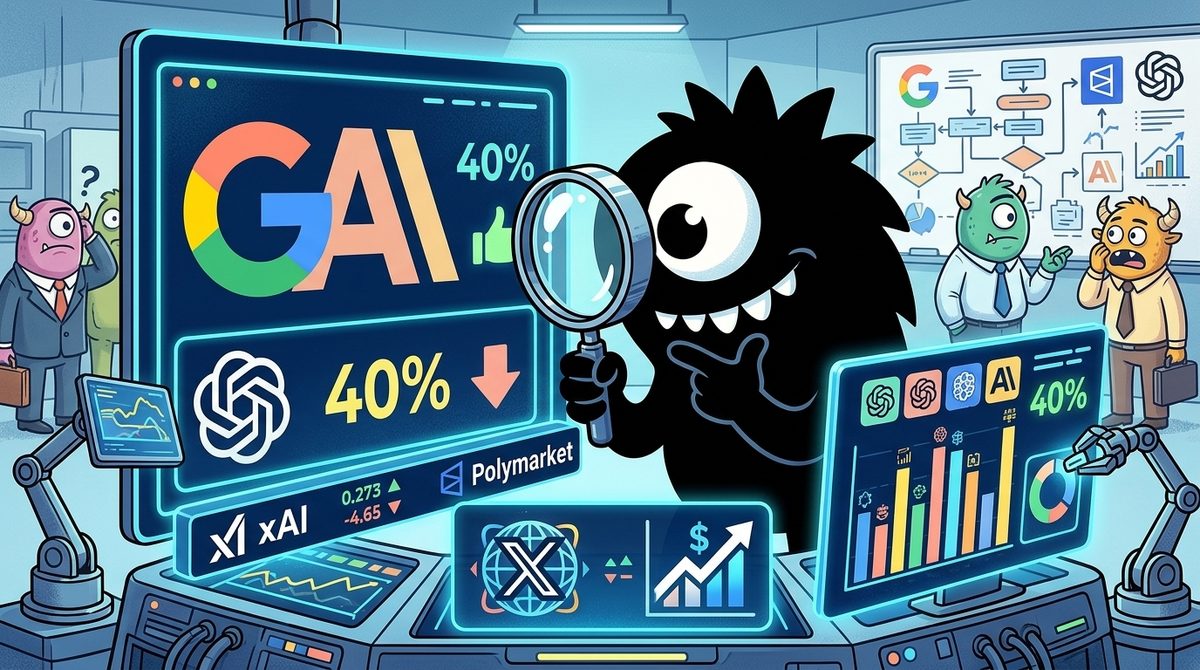
As of October 18, 2026, roughly $2,577,728 has traded in Polymarket’s “Which company has best AI model end of 2026?” market. Traders currently price Anthropic at 48%, Google at 40%, OpenAI at 8%, Meta at 3%, xAI at 2%, and Mistral at 0%.[1] The bottom line is not that Anthropic will necessarily win. It is that the market implies an 88% combined probability that either Anthropic or Google occupies the specified leaderboard position at resolution, while assigning surprisingly little probability to OpenAI and almost none to the rest.
The market’s signal in brief
>
- Traders currently imply a two-company year-end race: Anthropic 48%, Google 40%.
- Google’s stronger near-term odds but weaker year-end odds imply that traders expect leadership to change quickly.
- OpenAI’s 8% is skepticism about one resolution-date result—not evidence that its platform or business has become irrelevant.
- Near-zero odds for Meta, xAI, and Mistral reflect the difficulty of reaching number one, not whether their models remain commercially useful.
- For practitioners, rapid leadership churn favors model routing, portable architectures, and procurement based on total cost and reliability, rather than loyalty to one benchmark champion.
The $2.5 million bet: How traders price the 2026 AI race today
The quoted market snapshot on October 18 is:
| Company | Implied probability | Reported traded volume |
|---|---|---|
| Anthropic | 48% | $355,964 |
| 40% | $301,165 | |
| OpenAI | 8% | $216,458 |
| Meta | 3% | $187,609 |
| xAI | 2% | $168,517 |
| Mistral | 0% | $191,508 |
The percentages total 101% because displayed market prices are rounded. They should be read as tradable estimates, not a mathematically exact survey. Likewise, outcome-level trading volume is not the same as current capital committed or the number of independent traders: contracts can change hands repeatedly.
Most importantly, this is a bet on a specific resolution criterion around December 31, tied to the relevant Arena leaderboard—not a referendum on revenue, enterprise adoption, safety, open weights, or the best model for every task.[1] Secondary market trackers similarly report Anthropic and Google as the dominant year-end positions.[2]
Polymarket, on who has the best AI model:
End of October: Google, about 3 in 4.
End of 2026: Anthropic 47.5% vs Google 39.5%.
Same race, opposite favorite, two months apart.
I put the odds next to the model rankings and the money: https://airacescoreboard.com/?utm_source=x&utm_medium=social&utm_campaign=teaser-2026-10-18
An implied probability is the price at which traders collectively exchange risk. Anthropic at approximately 48% means the market currently treats its qualifying year-end victory as roughly a 48-in-100 event, subject to liquidity, market rules, and trader biases. It does not mean Anthropic is “48% better.”
The Mistral line makes that distinction vivid. Its contract has attracted $191,508 in trading volume, more than the quoted Meta or xAI outcomes, yet traders currently price its probability at effectively 0%. Engagement is not confidence. Volume can reflect earlier optimism, selling, hedging, or speculative turnover.
Why is Google favored for October but Anthropic for the end of 2026?
The most revealing signal is not Anthropic’s narrow lead. It is the disagreement between time horizons.
In the separate end-of-October market, Polymarket publicized Google at an 83% implied probability of finishing that month ahead.[5] Yet for the end-of-2026 resolution, the quoted odds reverse: Anthropic leads at 48%, with Google at 40%.
BREAKING: Google projected to dethrone Anthropic as the company with the best AI model at the end of October.
83% chance.
https://polymarket.us/event/company1-2026-10-31
This “same race, opposite favorite” pattern implies that traders do not see benchmark leadership as a durable moat. They appear to expect Google to have the stronger position at one snapshot and Anthropic to have the better chance at another only two months later. Recent market analysis has explicitly focused on that Google-versus-Anthropic divergence across resolution dates.[5]
OpenAI, Anthropic, Google, Meta, Mistral.
GPT-6 Astra, Claude Opus 5.5, Gemini 4 Argon, Muse Wonder, Mistral Large 4.
The AI race is getting so competitive that being the smartest model in the world now lasts about a week.
Great time to be a developer. Terrible time to be a benchmark champion.
That matters because a point-in-time prediction market rewards release timing. A model launched in early December could matter more to the contract than a model that led for most of the year but was overtaken before resolution. Conversely, a technically superior system released after the cutoff would be irrelevant to this particular bet.
The market is therefore pricing at least three variables at once:
- Current model quality
- Expected release cadence through December
- The probability that releases are available and eligible before resolution
For developers, that volatility is beneficial: capable alternatives keep arriving. For benchmark champions, it makes a lead harder to monetize before competitors answer. For prediction-market traders, knowing when a model ships may be as important as estimating how capable it will be.
Why does the market price Anthropic at 48%—and why do some traders disagree?
The Anthropic bull case begins with current benchmark position. BenchLeader’s October 2026 aggregation places Claude Opus 5.5 max at 71.9, narrowly ahead of Gemini 4 Argon high at 71.4. It also shows several Anthropic variants among the leading models.[8]
BenchLeader (best-per-model, ~439 models, 18 Oct 2026):
1 Claude Opus 5.5 max 71.9
2 Gemini 4 Argon high 71.4
3 Claude Fable 5.1 max 70.1
4 GPT-6 Astra high 70.0
5 GPT-6.1 Sol max 69.3
6 Claude Fable 5 max 69.1
7 Muse Wonder Full max 68.8
8 Claude Opus 5 high 68.3
9 GPT-5.6 Sol max 67.5
10 Claude Sonnet 5.5 max 67.5
11 Muse Spark 1.3 max 67.4
12 Muse Wonder max 67.0
13 GPT-5.5 xhigh 65.9
14 GPT-6 Sol max 65.8
15 MiMo-V2.6-Pro 65.6
16 GPT-5.5 Pro xhigh 65.4
17 Kimi K3 max 65.1
18 Gemini 3.8 Flash med 64.8
19 Muse Spark 64.6
20 Grok 4.7 high 64.3
Grok appears twice because 4.7 and 4.6 are distinct model versions, each ranked separately.
That does not prove Anthropic will occupy the required year-end position. It explains why traders may treat it as the slight favorite: Anthropic already has a model near or at the top, so its path may require defending or incrementally improving a lead rather than closing a large gap.
The stronger thesis circulating on X is that Anthropic and OpenAI may be entering a positive feedback loop. Coding agents such as Claude Code and Codex can potentially accelerate software work, data generation, evaluation, and parts of model research. If that effect is material, the laboratories with the strongest agent products could improve the tools used to build their next generation of tools.
I would genuinely love for this to happen
but many people think that OpenAI and Anthropic are already in a positive feedback loop
and as we have seen with Gemini 3 Pro: a ~5 trillion param reasoning model won't magically be AGI
(or for that matter a 6T param Grok-5)
my base case is that OpenAI and Anthropic will pull further ahead
xAI has less compute, less researchers, less data (no Codex, no Claude Code) and does not have access to models that literally speed up research (behind ~6 months)
Google on the other hand is still in the race, being only ~3 months behind. they have the most compute, researchers, an infinite money glitch and the data
That thesis remains speculative. “Recursive self-improvement” can describe anything from ordinary developer productivity gains to autonomous improvement of research systems, and those are radically different claims. The evidence in this market supports only a narrower conclusion: traders appear more willing to price Anthropic as the year-end leader than xAI, Meta, or Mistral.
There is also a credible Anthropic bear case. OpenAI’s quoted 8% may understate capabilities that traders believe are being paced, held for later release, or split across product variants. One X argument points to the rapid sequence from GPT-6 Sol to GPT-6.1 Sol and questions whether the capability difference could have been produced during the five days between public releases.
Anthropic doesn't stand a chance, and never really did.
Consider the release of OpenAI's GPT 6.1 Sol, for instance: GPT 6 Sol was released to the public 5 days ago!
Is there anyone that genuinely thinks that the capability distance between 6 and 6.1 was the product of 5 days' worth of training?
The illusion that Anthropic is somehow keeping up is only maintained by OpenAI's insistence on pacing AI progress, and Google's insistence on consolidating its various monopolies.
OpenAI and Google have the cards. All of them. And that's the sad truth.
Another practitioner view goes further, describing Anthropic as already “sitting on the throne” while placing OpenAI close behind and Google farther back:
Rn, Anthropic is sitting on the throne and is clearly ahead (already post-training and getting ready for Fable 5.1)
OAI is a bit behind (5.6 strong, GPT-6 base currently in training)
Google is a lot behind
Meta, xAI, and the Chinese labs are at Google level
These are competing theses, not settled evidence. Aggregate leaderboards can support Anthropic, while individual evaluations produce different winners. Model-ranking matrices and benchmark comparisons also vary by intelligence, coding, speed, price, and test methodology.[10][11] A model can lead an aggregate score while losing the workload that matters to a particular SaaS product.
OpenAI’s 8% should therefore be interpreted narrowly: traders currently assign it a relatively small chance of winning this contract under this resolution rule. They are not pricing an 8% chance that OpenAI remains commercially important.
Is Google’s 40% really a bet on models—or on TPUs, GCP, and distribution?
Google’s 40% implied probability has larger business implications than a leaderboard position suggests. It is simultaneously a bet on research execution, proprietary infrastructure, cloud distribution, and the ability to place models inside products enterprises already buy.
Over the last few days, on Polymarket, $GOOGL's lead as the best AI model by the end of 2025 has increased even further.
Anthropic odds have also risen, while those of OpenAI and xAI have decreased.
While $GOOGL's market share in LLM search will be much lower than the market share it has on traditional search on the enterprise side if $GOOGL turns out to be the best model provider and on top of it offers them via GCP on their TPU infrastructure, GCP's value could be much more than the market current anticipates.
Google’s structural advantage is vertical integration. It can develop models, train and serve them on TPU infrastructure, distribute them through Google Cloud, and connect them to a broad software estate. Comparisons of frontier labs highlight how access, pricing, model availability, and distribution differ alongside raw capability.[9][12]
If Google takes or repeatedly contests the benchmark lead, the economic benefit could extend beyond API revenue:
- GCP can capture inference and training workloads.
- TPU capacity can reduce dependence on external accelerators.
- Existing enterprise relationships can shorten procurement.
- Bundling can turn model quality into cloud consumption.
- Product distribution can matter even when rivals match a benchmark.
That does not guarantee better economics for every buyer. SaaS teams still need to compare latency, regional availability, rate limits, data controls, migration costs, and actual workload quality. Enterprise reporting already emphasizes Microsoft and Google’s strong vendor position, illustrating that distribution can be distinct from owning the top-ranked model.[16]
The decision criterion is straightforward: teams already standardized on GCP should give Google’s model roadmap extra weight because integration and infrastructure can lower operational friction. Teams with cloud-neutral architectures should test Google as one provider among several, without treating TPU integration as an automatic application-level advantage.
Why do xAI, Meta, and Mistral have near-zero odds?
The long tail shows how unforgiving the word best is.
xAI at 2%
Traders currently give xAI only a 2% implied probability, despite its infrastructure ambitions and promised model releases. The bearish argument is that xAI may trail in research depth, compute available for the relevant work, proprietary agent-generated data, and access to internal systems that accelerate experimentation.
Ethan Mollick’s summary of the frontier describes Google, OpenAI, and Anthropic as standing ahead, while characterizing xAI as having fallen from frontier status for now and Meta as re-entering with a not-quite-frontier model.
So we now have a pretty good picture of the state of the frontier AI model makers.
US closed source models continue to lead. Google, OpenAI, and Anthropic stand well ahead of the pack, and may have signs of recursive self-improvement. xAI has fallen from frontier status for now (though promises to return shortly). Meta re-entered the space today with a not-quite-frontier closed source model, but an approach that suggests that they might be back in the race. All the other US players seem far behind.
On the Chinese model front, Alibaba (Qwen), Moonshot (Kimi), MiniMax, Xiaomi (MiMo), Deepseek, and Z (GLM) all still appear to be very much in the race, though the best Chinese models are still 7-9+ months behind released US closed source models. For some of these players, especially Xiaomi and Alibaba, their commitment to open weights appear to be slipping.
Outside of China, Mistral seems to have fallen from frontier status.
That is an assessment of current position, not destiny. A 2% price still leaves a path, and prediction markets can move sharply after a release. But traders are currently demanding evidence of a large catch-up before assigning xAI meaningful year-end probability.
Meta at 3%
Meta’s 3% implied probability suggests that traders see ambition without yet pricing likely leaderboard supremacy. Muse Wonder’s presence among highly ranked models offers evidence of competitiveness, but the market appears to distinguish “back in the race” from “most likely to finish first.”[8]
Meta can still matter enormously through distribution, research, ecosystem strategy, or model economics. A model does not need to rank first to be valuable when embedded across products with enormous reach.
Mistral at 0%
Mistral’s displayed 0% is the harshest verdict. The market currently sees virtually no route to the specified number-one position by December 31, even though the contract has generated substantial trading activity.
For buyers, none of these prices means “do not use the vendor.” A lower-ranked or non-frontier model may be preferable when it offers:
- Lower and more predictable cost
- Open or deployable weights
- Data-residency advantages
- Faster inference
- Easier customization
- Better performance on a narrow workload
Prediction markets ask who finishes first. Procurement asks who meets requirements at an acceptable total cost. Those are different competitions.
What happens when the “best model” no longer wins the default slot?
The Replit discussion illustrates the widening gap between benchmark winner and commercial default. In a Chinese-language post summarizing the announcement and subsequent clarification, Alne describes Replit’s move from Anthropic to OpenAI as a routing contest driven by cost, performance, and partnership—not a complete removal of Claude.
Replit 在台上"休了"Anthropic
TechCrunch Disrupt 台上,Replit CEO Amjad Masad 亲口宣布:平台默认模型从 Anthropic 换成 OpenAI。
理由他说得很直白:成本、性能、合作关系。"ChatGPT is better now。"自家 benchmark 显示,GPT-6 系列(Sol、Astra)在从零构建 vibe-coded 应用上更好。
要知道,Replit 不久前还是 Anthropic 前五大客户之一。大客户说走就走,账单比情分好使。
但也有反转:内部人士说合作还在继续——用户照样能选 Claude;10 月的更新日志里两家模型还同台出现。Masad 事后也把话说软了:"Replit 保持模型中立,OpenAI 只是首选合作伙伴。"
所以这不是分手,是"路由"之争:谁坐默认位,谁就吃下大部分 token 账单。agent 时代选模型的逻辑变了——性能拉不开差距时,账单才是决定权。模型越来越像水电煤:能用的很多,但谁便宜、谁稳,谁就进默认配置。
这条趋势值得收藏:以后做 agent 产品,第一件事不是选"最聪明的模型",而是算清楚"最划算的路由"。
Replit 'dumped' Anthropic on stage. At TechCrunch Disrupt, Replit CEO Amjad Masad announced the platform's default model switched from Anthropic to OpenAI. Reason stated plainly: cost, performance, partnership. 'ChatGPT is better now.' Their own benchmarks show GPT-6 series (Sol, Astra) better at building vibe-coded apps from scratch. Replit was recently one of Anthropic's top 5 customers. Big clients leave when bills beat loyalty. But twist: insiders say partnership continues—users can still choose Claude; October changelog shows both models side-by-side. Masad softened: 'Replit stays model-neutral, OpenAI just preferred partner.' So not a breakup, but 'routing' battle: whoever gets default slot eats most token spend. In agent era, model choice logic changed—when performance gap narrows, bill decides. Models like utilities: many options, but cheapest/most stable wins default. Trend worth noting: for agent products, first step isn't picking 'smartest model' but calculating 'most cost-effective routing'.
That distinction is crucial. In an agent product, the default model captures a disproportionate share of token spending. But the best default is not necessarily the model with the highest general leaderboard score. It may be the one with the best combination of:
- Success rate on the product’s actual tasks
- Cost per successful task
- Latency and throughput
- Stable behavior across version changes
- Tool-use reliability
- Capacity guarantees
- Commercial support
Task-specific rankings can diverge sharply from aggregate ones. A Promptchess leaderboard cited on X, for example, placed Claude Sonnet and DeepSeek-R1 above OpenAI models in that particular agentic evaluation.
OpenAI is getting cooked on the Promptchess leaderboard. 🍳
o3 sits at #4 (1501). GPT-5 is #5 (1473). Meanwhile, Claude Sonnet (#1, 1571) and DeepSeek-R1 (#2, 1564) are running away with it.
Is this a fluke, or are the other labs just better at agentic reasoning? The Elo doesn't lie.
See the full board: https://t.co/FQ6Z2YHiAj
@OpenAI @sama @claudeai @deepseek_ai @xai @GoogleDeepMind @AIatMeta @LangChainAI @crewAIInc
#Promptchess #MCP #AIAgents #LLM #Benchmark #OpenAI #GPT5 #Claude #DeepSeek #Grok #Chess
The lesson is not that one benchmark is correct and another is wrong. It is that “best” decomposes into workload-specific qualities. A coding agent, customer-support copilot, scientific assistant, and real-time voice application impose different constraints.
This is the commodity shift: not that models are identical, but that several models are often good enough to compete for the same request. Once quality converges above a product’s acceptance threshold, price and operational stability determine routing.
For founders, the appropriate architecture is usually a provider-neutral application layer with:
- A common request and response schema
- Per-task evaluations
- Cost and latency telemetry
- Fallback providers
- Version pinning where available
- Controlled rollout when models change
Small teams with low volume can start with one provider to avoid premature complexity. Multi-model routing becomes worthwhile when token spending is material, outages directly affect revenue, or workloads differ enough that one model is no longer economically optimal.
How does compute scarcity turn AI rivals into customers?
Model rankings make the frontier race look like a clean contest among laboratories. The supply chain is messier.
@AnthropicAI is renting Colossus capacity from @SpaceX
Same clusters built for Grok, now leased to Claude's parent
Rivals turned into landlords cause chips are that scarce
@OpenAI also buying Google Cloud capacity while competing with Gemini
I think the AI race looks less like a fight and more like a supply chain with enemies on the invoice
The claim that Anthropic is renting Colossus capacity and that OpenAI buys Google Cloud capacity captures a larger structural reality: rivals can compete at the model layer while buying scarce infrastructure from one another. Frontier comparisons likewise show that laboratories differ not only in models but in where capacity comes from and how products are delivered.[9][12]
Compute access affects the odds through several channels:
- Training: whether a lab can run large experiments on schedule
- Post-training: whether it can iterate extensively on reasoning, tools, and safety
- Evaluation: whether researchers can test many candidates quickly
- Inference: whether a winning model can actually serve demand reliably
- Economics: whether high usage produces sustainable margins
Google’s vertical integration potentially reduces one class of supply risk. Capacity-renting labs gain flexibility but remain exposed to availability, contract terms, and infrastructure competition. xAI, meanwhile, could extract economic value as an infrastructure provider even when traders assign Grok only a 2% probability of winning the model contract.
Compute cost also changes what counts as useful intelligence. A model that solves a difficult problem but consumes excessive inference may lose production traffic to a slightly weaker, cheaper alternative. One current X discussion of a physics benchmark makes exactly that economic connection while warning that benchmark problem-solving is not the same as scientific judgment.
AI just cleared a PhD-level physics benchmark at $2.40 per problem. That's not incremental progress.
GPT-6-Astra hit 98% on TheoPhysEval, 50 unpublished theoretical physics problems with verifiable answers. Anthropic's Opus 5.5 followed at 92%. These aren't toy problems. One required adapting equations from five to four dimensions and writing custom code to compute the result.
The catch the researchers name: AI lacks scientific "taste." It can grind through known methods applied to new inputs. Knowing which problems are worth solving is a different skill entirely.
At $116 to run the full benchmark, the cost argument for keeping routine research tasks human-only is getting thin fast.
Real question: if AI handles the "turn-the-crank" work PhD students normally cut their teeth on, where does early-career research training go?
The non-obvious implication is that the model race and the cloud race are converging. A lab can lose the leaderboard and still collect infrastructure revenue from the winner.
What should developers, founders, and SaaS buyers do with these odds?
Prediction-market prices are most useful as a measure of changing expectations, not as instructions to select a vendor. Watch how the odds react to releases, leaderboard changes, pricing, outages, and eligibility questions. The movement can reveal whether traders view an event as temporary or durable.
My prediction: Anthropic keeps the lead in public models through the end of the year until OpenAI releases a stronger model in December. After that, expect a tight back-and-forth until one lab pulls clear. As for Google, I don't see them taking it.
View on XDevelopers: optimize for portability
Use one provider initially if simplicity matters more than resilience. Add abstraction when switching costs become real. Keep system prompts, tool definitions, evaluations, and business logic outside vendor-specific interfaces where practical.
Best fit: small teams and prototypes can choose the strongest model for their immediate workload. Production systems with high availability requirements should add fallbacks and model-specific regression tests.
Founders: measure cost per completed outcome
Do not optimize only for price per token or aggregate intelligence. Measure cost per resolved ticket, accepted code change, completed workflow, or retained user.
Best fit: agent startups with high inference bills should route requests by difficulty and use premium models only where they materially improve completion rates.
SaaS buyers: buy a service level, not a leaderboard snapshot
Evaluate security, data governance, capacity, pricing predictability, roadmap credibility, and exit costs. A December 31 leaderboard winner may not offer the best enterprise deployment in January.
Best fit: enterprises already concentrated in GCP or Microsoft ecosystems can value integration and procurement leverage more heavily. Regulated or cloud-neutral buyers should preserve alternatives and demand clear portability terms.
The market’s 48% Anthropic and 40% Google prices imply a close, volatile race—not certainty. Its more durable message is that frontier leadership has become temporary, infrastructure has become strategic, and application companies should expect to switch or route among models. The winning SaaS architecture is therefore unlikely to be the one that correctly guesses a single year-end champion. It is the one that remains economical and reliable when the champion changes.
Sources
[1] Polymarket — Which company has best AI model end of 2026?
[2] Polymarket Trader — Which company has best AI model end of 2026? Odds
[5] Shattered — Google vs Anthropic AI Prediction Markets 2026
[8] BenchLeader — LLM Leaderboard, October 2026
[9] The Durability Curve — Frontier AI labs compared
[10] Veso Research — Generative AI Model Ranking Matrix
[11] Tech Times — AI Model Benchmarks
[12] Promise & Proof — Frontier AI Models, Compared Across Every Lab
[16] CIO Dive — Microsoft, Google rule AI vendor market for enterprises
References (16 sources)
- Polymarket — Which company has best AI model end of 2026? - polymarket.com
- Which company has best AI model end of 2026? Odds: Anthropic 47.5% | Polymarket Odds Today - polymarkettrader.com
- Best AI Model Predictions: Anthropic, Gemini and OpenAI Odds - defirate.com
- Best AI Model of 2026 Odds: Who Will Be #1 at Year-End? - defirate.com
- Google vs Anthropic AI Prediction Markets 2026 - shattered.io
- Google overtakes Anthropic in prediction markets to lead 2026 AI race — TradingView News - seekingalpha.com
- Which company has best AI model end of 2026: Picks & Predictions - thesweat.com
- LLM Leaderboard (Oct 2026): Top AI Models | BenchLeader - benchleader.com
- Frontier AI labs compared: models, prices, open weights, where to buy · The Durability Curve - durabilitycurve.com
- Generative AI Model Ranking Matrix · Veso Research - veso.ai
- AI Model Benchmarks — Intelligence, Coding, Speed & Price | Tech Times - techtimes.com
- Frontier AI Models, Compared Across Every Lab | Promise & Proof - promiseandproof.com
- LLM Leaderboard & AI Model Benchmarks — October 2026 - benchlm.ai
- Anthropic, OpenAI, Google in Enterprise: Who Is Winning? - zunkireelabs.com
- How big is the foundation model market beyond OpenAI? - newmarketpitch.com
- Microsoft, Google rule AI vendor market for enterprises - ciodive.com
Related Guides

Anthropic vs Hugging Face vs Perplexity AI: Which Is Best for SEO and Content Strategy in 2026?
17 min read
The Best AI Bubble Signals in 2026: What Polymarket's 7% Odds Reveal About AI and SaaS
25 min read
What Is Cursor AI? A Complete Guide for 2026
24 min read
The Best AI Model Prediction Market in 2026: What $2.6M in Traders' Odds Reveals About the AI Race
22 min read