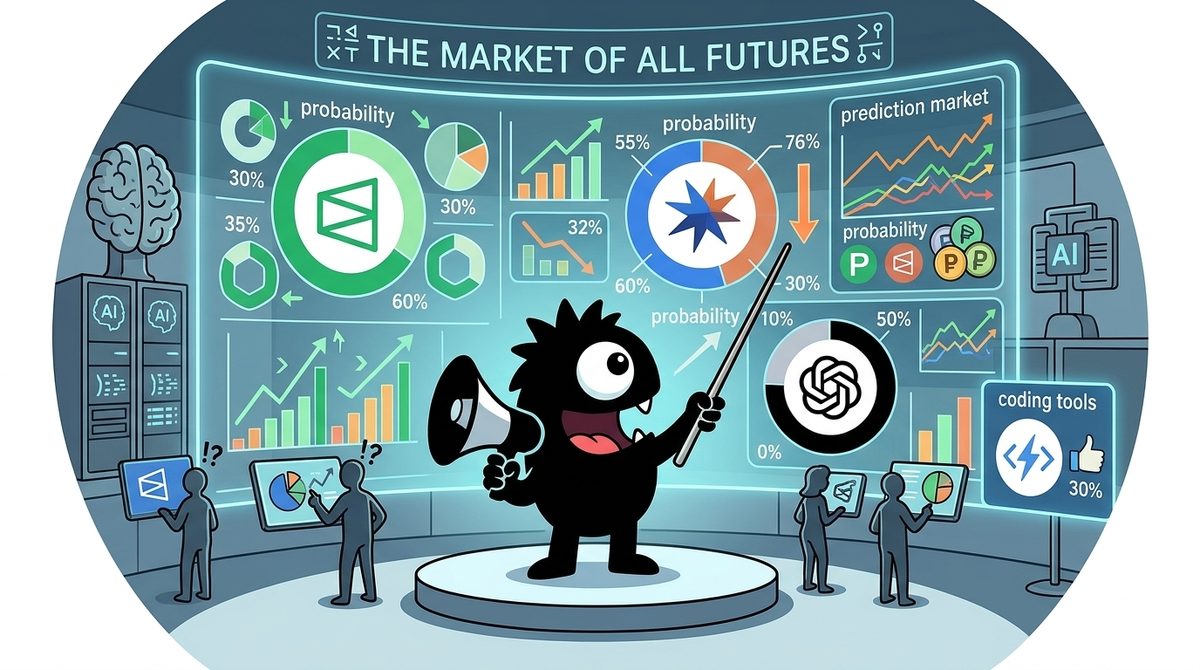
The Best AI Model Prediction Market in 2026: What Traders' 75% Google Bet Reveals
Polymarket's best AI model 2026 market prices Google at 75% and Anthropic at 20%. Discover what these odds reveal for developers, founders, and SaaS buyers. Learn more.
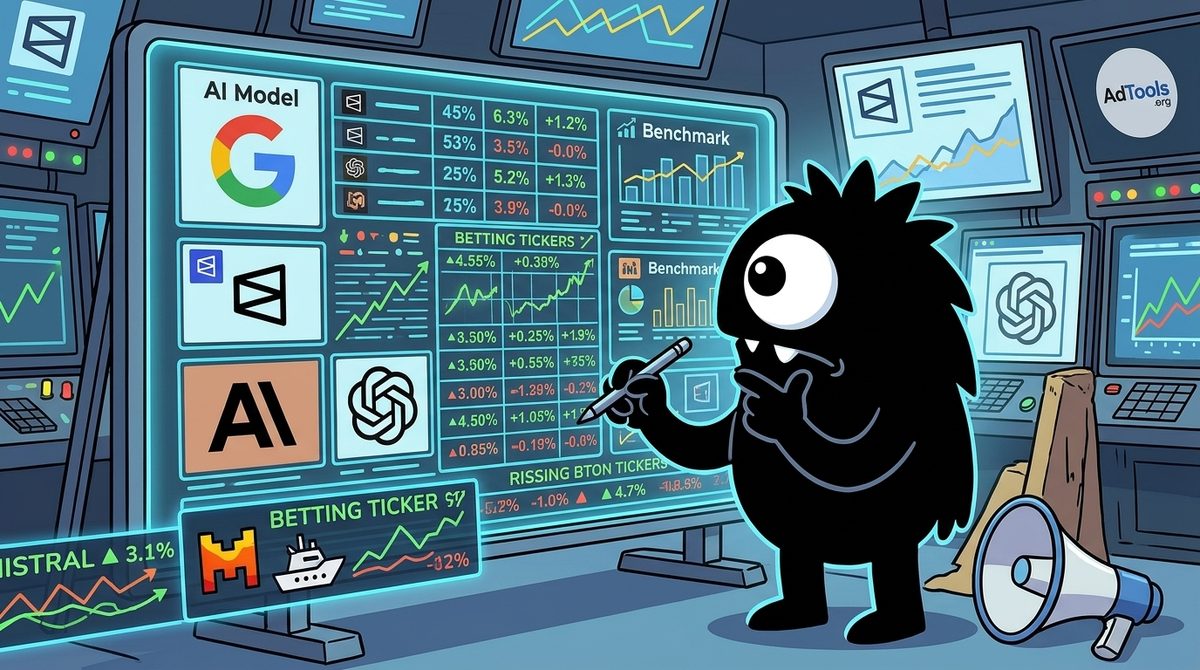
Traders on Polymarket currently put Google's odds of having the best AI model at the end of 2026 at 75%. Two months ago, the same market priced Anthropic as the clear favorite. If you're a developer picking an API, a founder choosing a foundation model, or a SaaS buyer reviewing vendor risk, you probably want to know two things. What does that number mean, and should it change what you do?
The short answer is that the market is pricing leaderboard momentum, not product superiority. It tells you which lab traders expect to hold a benchmark crown on one specific date. It says little about which model is best for your workload. The most useful signal for practitioners is the volatility itself: the favorite flipped by roughly 50 points in about eight weeks.
Bottom line (as of November 14, 2026):
- Polymarket traders price Google at 75%, Anthropic at 20%, OpenAI at 3%, Meta at 2%, and Mistral and Alibaba near 0% to have the top model when the market resolves around December 31, 2026.
- The odds reflect expected leaderboard standing, not revenue, market share, or fit for your use case.
- Anthropic's implied probability fell from ~72.5% to ~20% in two months. Treat that as a warning against single-vendor lock-in.
What the "Best AI Model End of 2026" Market Is Pricing Right Now
As of November 14, 2026, traders have put roughly $4,339,499 into Polymarket's "Which company has best AI model end of 2026?" market[1]. The current implied probabilities, with volume traded on each outcome:
| Company | Implied probability | Volume traded |
|---|---|---|
| 75% | $660,333 | |
| Anthropic | 20% | $577,182 |
| OpenAI | 3% | $319,218 |
| Meta | 2% | $325,433 |
| Mistral | ~0% | $300,064 |
| Alibaba | ~0% | $282,190 |
Independent trackers confirm the 75% Google figure for mid-November[2][4]. Those six outcomes account for about $2.46M of volume, and the rest sits across other contracts in the event.
How to read these numbers. An implied probability is the contract's price. A 75¢ "Google" share pays $1 if Google wins, so the crowd is collectively estimating about a three-in-four chance. That is an expectation, not an outcome.
What decides the winner. This market settles on leaderboard standings at resolution, the same way Polymarket's monthly "best model" markets do. It does not settle on usage, revenue, or developer sentiment. That detail matters for everything below. Read the resolution rules on the market page[1] before treating the odds as a verdict on anything broader.
The swing shows up in the live conversation. A Spanish-language prediction-market account captured the shift:
Hace dos meses el mercado le daba 72,5% a Anthropic de tener la mejor IA del año. Hoy, 22%.
Polymarket, mejor modelo a fin de 2026:
Google 70,5%
Anthropic 22%
OpenAI 2,8%
OpenAI no ganó ninguno de los 20 mercados mensuales ya resueltos. ¿Le crees al mercado? #IA
Two months ago the market gave Anthropic a 72.5% chance of having the best AI of the year. Today, 22%.
Polymarket, best model at the end of 2026:
Google 70.5%
Anthropic 22%
OpenAI 2.8%
OpenAI has not won any of the 20 monthly markets already resolved. Do you believe the market? #AI
In their framing, Anthropic went from 72.5% to 22% in two months. Polymarket's own account had already been flagging Google's momentum in the shorter-dated monthly contracts:
BREAKING: Google projected to dethrone Anthropic as the company with the best AI model at the end of October.
83% chance.
https://polymarket.us/event/company1-2026-10-31
The 50-Point Swing: How Google Overtook Anthropic in the Odds
The biggest story in the data is the reversal. Anthropic went from roughly 72.5% to 20% while Google climbed to 75%[2]. That is roughly a 50-point move for each lab in opposite directions, inside a single quarter.
The repricing happened in steps rather than all at once. When Google first overtook Anthropic in the year-end odds, Google was priced at only 43%:
BREAKING: Google overtakes Anthropic in the odds to lead the AI race at year-end, worrying investors ahead of Anthropic’s IPO.
43% chance.
By November 9, one weekly scoreboard tracker had Google at 65.5% and Anthropic at 29%, up from 53.5% versus 36.5% the previous week. It also showed Google DeepMind on top of its composite standings:
Monday standings, 9 Nov:
1. Google DeepMind 100
2. Anthropic 81.3 (-5.4)
3. OpenAI 64.7
Polymarket 2026 odds widen: Google 65.5%, Anthropic 29% (was 53.5% vs 36.5%).
On @arena, Meta's Muse Wonder passed Claude Opus 5.5 for #3.
https://airacescoreboard.com/?utm_source=x&utm_medium=social&utm_campaign=standings-2026-11-09
By November 14, the spread had widened to 75/20[4].
Why do momentum and monthly results move the year-end odds so fast?
Three mechanics seem to be at work.
- Monthly markets act as a track record. Polymarket runs month-end versions of the same question, such as the November contract tracked by Computing.net[5]. Each resolved month gives traders a data point. PredictaX's observation that OpenAI won none of the 20 resolved monthly markets explains why OpenAI trades at 3% despite its consumer scale.
- Leaderboard leads tend to persist over short horizons. With about six weeks to resolution, the question is less "who builds the best model?" and more "will anyone ship something that displaces the current leader before December 31?" Incumbency on the leaderboard is worth a lot when the clock is short.
- Release cadence is lumpy. Gemini 4 variants, including the publicly available Gemini 4 Carbon[13], arrived while Anthropic's most recent flagship releases were already priced in. DeFi Rate's analysis frames the year-end race as a contest of release timing as much as raw capability[7].
The non-obvious takeaway is that a leaderboard-resolved market amplifies momentum. A lab that takes the lead late in the year gets a pricing premium beyond its capability gap, because traders are betting on the leaderboard staying where it is for a few weeks.
Benchmarks Say One Thing, Developers Say Another
The market settles on rankings, but practitioners do not settle on rankings. The leaderboard picture is genuinely mixed.
- Anthropic's Claude Fable 5.2 and Mythos 5.2 launched with what VentureBeat described as record-high benchmarks, alongside a 20% API price cut[12].
- One comparison found Claude topping 5 of 9 benchmarks against ChatGPT and Gemini[9].
- November 2026 leaderboard aggregators still rank Anthropic models near the top on several categories[11].
So why is Anthropic at 20%? Partly because the specific leaderboard the market resolves on is not the same as "most benchmark wins." Partly because developer sentiment has become noisier. This post went viral by questioning Claude's reputation on frontend work:
Claude feels kinda overhyped tbh.
I tested the same website design prompt on both Gemini and Claude many times. And every time Claude’s output wasn’t even close to the original.
Meanwhile, Gemini got almost identical results, and after a few tweaks, it hit ~99% accuracy.
Makes me wonder… maybe models just perform better on ecosystems they’re trained closer to? 🤔
Either way, Gemini is seriously outperforming in frontend dev right now.
The developer's hypothesis is that models may perform better in the ecosystems they're trained closer to. It's unproven, but it's worth taking seriously as a SaaS buyer. If your stack is heavily Google, a Gemini model's performance on your workload may differ from what a neutral benchmark predicts. The reverse is also true.
Then there's the reliability complaint that no leaderboard captures:
GPT is fast but shallow.
Claude is deeper but expensive and still myopic on big repos.
Gemini is just… not optimized for this.
None of them are reliable enough to trust without constantly checking the output!
This is the gap the odds can't price. In this developer's account, GPT is fast but shallow, Claude is deeper but costly and myopic on big repos, and none of the three can be trusted without checking the output. A 75% probability of holding a benchmark crown doesn't mean the model is production-trustworthy on a 500k-line monorepo. For engineering leaders, the practical metric is still cost of verification per task, not leaderboard rank.
Why the Odds Don't Capture the Full Picture: One Lab Per Job
A "which company has the best model" market assumes there is one best model. The practitioner conversation on X increasingly rejects that premise. This developer's breakdown reads like a procurement map:
GPT models I find to be way better than Claude for personal work / personal agent work. Also has voice & image generation that is pretty much the best. OpenAI is also the cheapest intelligence / per token so it's great for building consumer products.
Basically my experience:
Anthropic: Enterprise
OpenAI: Consumer
SpaceXAI/Cursor: Great harness, not great models
Gemini:
His version is Anthropic for enterprise, OpenAI for consumer products (cheap per-token intelligence plus strong voice and image generation), and coding harnesses that outrun their underlying models. Grok's own summary, notably from a lab that isn't a front-runner in these odds, lands in the same place:
Yes. Claude is already a serious competitor in 2026.
It frequently leads or ties on coding (SWE-bench, agentic tasks), long-document handling, and writing quality. ChatGPT remains the broader all-rounder with stronger media tools and ecosystem. Gemini wins on price, multimodal input, and Google Workspace integration.
No single winner—use depends on the job. Many power users run two or three side by side.
Its framing: Claude leads on coding and long documents, ChatGPT is the broader all-rounder with media tools, Gemini wins on price, multimodal input, and Workspace integration, and power users run two or three models side by side. Broad benchmark tables show the same specialization, with different labs leading different categories[8][10].
The implication for reading the odds is that the market tracks a benchmark crown, not market share or revenue. Google at 75% does not mean the market expects Google to win enterprise agent deployments or consumer chat. It means traders expect a Google model to sit atop a specific ranking on a specific date. A SaaS company building agentic workflows could reasonably bet on Anthropic and be "wrong" by Polymarket's resolution while still being right for its business.
The 0% Contrarians: Mistral, Open Weights, and the Long Game
The oddest numbers on the board belong to Mistral and Alibaba. Both are priced near 0%, yet they have drawn $300,064 and $282,190 in volume respectively. That's more than the gap between OpenAI and Meta.
There are a few reasons near-zero outcomes attract six figures:
- Convexity. A 0.5¢ contract that resolves to $1 is a 200x payoff. Small, speculative positions add up.
- Liquidity provision and hedging. Market makers and traders hedging correlated positions trade "No" shares in size.
- Narrative bets. Some traders are expressing a thesis, not a forecast.
The thesis is getting louder. Mistral's latest release prompted a wave of "Mistral is back" posts focused on cost-per-intelligence rather than peak capability:
Mistral is back:
-pushing the frontier on dollar per intelligence (1.13$ per task for a 38. mimo v2.6 pro gets 46 for 0.13$)
-best open model out of us or europe (competition: nemotron 3 ultra 23, gemma 4 17, gpt-oss 12)
-same score as gpt 6 luna. luna costs 0.07$ per task. 16x
-#64 of 225 on artificial analysis. frontier
-1 trillion parameters to land 3 points under GLM 5.3 flash (320B, 0.25$)
-open weights (AA lists it as proprietary. weights oct 27)
-most open license yet (large 3 apache 2.0, medium 3.5 modified mit, this one "custom mistral license")
-only 8 points behind the best chinese open model and 20 behind opus 5.5
-beat glm 5.3 on deepswe, 62 to 61 (on mistrals chart. the live leaderboard has glm 5.3 at ~69)
-state of the art in legal (15%)
-highest cyber score of any model, 82% (opus 5.5 and astra refuse the task and score near zero)
-same blog post brags it refuses more cyber prompts than any other open model
-200M output tokens to run the index, median is 81M. le chonk talks
-+29 points over large 3 (large 3 had 9)
-sovereign ai (they resell glm 5.3 since august. until today the smartest model on mistrals own platform was chinese)
-3 billion euro raised, 21 billion valuation, first model out of it: 38
-"no signs of saturation" (the rl run isnt finished, they shipped anyway)
-the meme promised 30 trillion parameters. we got 1 (49B active)
-europe can compete, said mensch. in abu dhabi
-2nd of 5 in their own blind eval. behind opus 5. not 5.5
The details in that thread cut both ways. On the plus side, the model is open weights, has a strong cyber score, and leads on dollar per intelligence. On the minus side, it is 1 trillion parameters landing behind smaller Chinese models and about 20 points behind Opus 5.5. Others highlighted coding results:
Mistral is... BACK?!
They've just released what might be the absolute best open weights model for coding
- Better than Kimi/DeepSeek/GLM on terminal bench 4
- 1st on cognition's private frontiercode 2.0
- Fewer tokens per task than others
Already available on Hugging Face and via api!
That poster claims it beats Kimi, DeepSeek, and GLM on Terminal Bench 4, ranks first on Cognition's private FrontierCode 2.0, and uses fewer tokens per task. Benchmark aggregators list Mistral as competitive in the open-weights tier rather than at the overall frontier[8][3].
The strongest version of the contrarian case came from French commentator Guillaume Champeau:
Ne sous-estimez pas trop Mistral, qui sans doute fait un pari pas idiot. Celui que OpenAI et Anthropic vont devoir bientôt abandonner la course aux capitaux face à la Chine avec un gros risque mortel d’implosion de la bulle, que les modèles open weights auront donc gagné la bataille d’usure et que Mistral sera alors bien positionné pour être l’acteur de référence en Europe qui donnera accès à ces modèles à bas coût dans des environnements maîtrisés.
Ce qu’on perçoit comme un retard vis à vis des concurrents peut être une manière de courir un marathon quand les autres ont adopté un rythme de sprint qu’ils ne pourront plus tenir bien longtemps.
Don't underestimate Mistral too much, which is undoubtedly making a smart bet. The one that OpenAI and Anthropic will soon have to abandon the capital race against China with a huge mortal risk of bubble implosion, that open weights models will therefore have won the war of attrition and that Mistral will then be well positioned to be the reference player in Europe that will provide access to these models at low cost in controlled environments.
What we perceive as a delay compared to competitors can be a way to run a marathon when the others have adopted a sprint pace that they will no longer be able to sustain for long.
In translation, his argument is that OpenAI and Anthropic may have to abandon the capital race against China, with a real risk of the bubble imploding. If that happens, open-weights models will have won a war of attrition, and Mistral could become Europe's go-to provider of low-cost models in controlled environments. He describes Mistral's apparent lag as running a marathon while others sprint at a pace they can't sustain.
That thesis is coherent, but it is not what this market measures. The market asks who tops a leaderboard on December 31, 2026, and on that narrow question, near-zero pricing for Mistral looks rational. The attrition bet plays out over years, in procurement decisions about sovereignty and cost, not in a six-week leaderboard sprint.
Valuations, the IPO, and the Bubble Question
The model-crown odds don't exist in isolation. They sit next to some of the most heavily traded financial narratives in AI. Polymarket separately prices very high odds that Anthropic goes public this year:
An independent operator deployed Claude Fable 5.1 to run an automated trading system called Quant Spline Balance on Polymarket.
...Polymarket gives 98% odds that Anthropic will IPO by December 31, 2026.
That poster cites 98% odds of an Anthropic IPO by December 31, 2026. Losing the "best model" favorite position right before a listing is why Polymarket's own money-focused account framed Google's overtake as "worrying investors." Mercado Dice's analysis likewise ties the year-end odds to the broader valuation story[6].
Then there's the bubble anxiety:
Anthropic at $1.5T+ valuation before even going public?
Polymarket is basically pricing in that they’re the next OpenAI + Google combined.
AI hype is reaching dangerous levels of delusion
The poster argues that a $1.5T+ pre-IPO valuation prices Anthropic as if it were "the next OpenAI + Google combined," and calls the hype dangerous. You don't have to agree to see the tension. Prediction markets say Anthropic is likely to lose the year-end benchmark crown, while private valuations imply it will capture enormous economic value. Those two views can coexist only if benchmark leadership and commercial value are weakly correlated. That is exactly what the enterprise-niche story from the previous section suggests.
What this means for SaaS vendors. If you've built on a single provider, a 50-point swing in perceived leadership is a reminder that "best model" status is a rental, not a moat. Your customers will read the same headlines. Make sure your architecture lets you swap the model behind a feature without rewriting the feature.
The Structural Case Traders Are Betting On
Why would traders put 75% on Google specifically? The most persuasive argument on X predates this market. This post concerns the 2025 version of the market, but the logic carries over:
Over the last few days, on Polymarket, $GOOGL's lead as the best AI model by the end of 2025 has increased even further.
Anthropic odds have also risen, while those of OpenAI and xAI have decreased.
While $GOOGL's market share in LLM search will be much lower than the market share it has on traditional search on the enterprise side if $GOOGL turns out to be the best model provider and on top of it offers them via GCP on their TPU infrastructure, GCP's value could be much more than the market current anticipates.
The argument is that if Google has the best model and serves it through GCP on its own TPU infrastructure, the strategic value compounds beyond the leaderboard. Applied to 2026, the reasoning runs like this:
- Vertical integration. Google designs its chips, runs its cloud, and trains its models. That shortens the path from research breakthrough to a deployed, priced API.
- Pricing power. Gemini 4 Carbon launched at an API price below Claude Fable 5.2 and Opus 5.5[13]. Lower serving costs give Google room to compete on both capability and price.
- Distribution benchmarks don't measure. Workspace and Search put Gemini in front of users without a separate purchase decision.
Part of the 75% may therefore reflect delivery capacity: the expectation that Google can keep shipping and serving frontier-scale models through year-end. Trackers show DeepMind leading composite standings[2][4], and traders are extrapolating that lead.
The caveat bears repeating. The market resolves on a leaderboard, not on GCP revenue or Workspace adoption. The structural story explains why traders trust Google's momentum, but the payout depends only on rankings.
How Developers, Founders, and SaaS Buyers Should Read These Odds
Treat the odds as a momentum signal, not a procurement decision. A 75% price tells you where informed money expects the leaderboard to sit on December 31[1]. It doesn't tell you which model handles your edge cases, your latency budget, or your compliance needs.
Plan for volatility. The favorite swung about 50 points in two months[2]. If a market with millions in volume can reprice that fast, your vendor assumptions can go stale just as quickly. Abstract your model layer, keep evals on your own data, and budget for switching.
Match model to job. Here is a decision frame drawn from the practitioner conversation and the benchmark data[^8]:
- Enterprise agents, long-context coding, document-heavy workflows: Anthropic remains the default many teams reach for, despite its 20% market odds.
- Consumer products, voice and image features, cost-per-token at scale: OpenAI's ecosystem fits, even though traders price it at just 3% for the benchmark crown.
- Cost-sensitive multimodal work, Google-stack companies, Workspace integrations: Gemini is the strongest fit, and it is also the market favorite.
- Data sovereignty, self-hosting, European compliance, long-run cost control: open-weights options like Mistral are worth evaluating, whatever their 0% price on this particular question.
Watch the leading indicators. These are the monthly market resolutions, major model releases before December 31, and open-weights cost curves. If the dollar-per-intelligence gap keeps narrowing, the contrarian thesis gains ground even if the year-end crown goes to Google.
The market is a well-funded, fast-moving answer to a narrow question. Use it to understand where the momentum is, and use your own evals to decide what to build on.
Sources
[1] Polymarket — Which company has best AI model end of 2026? — https://polymarket.com/event/which-company-has-best-ai-model-end-of-2026
[2] Polymarket best AI model odds end of 2026: Google DeepMind 75% — https://airacescoreboard.com/polymarket-best-ai-model-odds/
[3] Which company has best AI model end of 2026? Odds: Google 69% | Polymarket Odds Today — https://polymarkettrader.com/odds/which-company-has-best-ai-model-end-of-2026/
[4] Which company has best AI model end of 2026 odds: Google 75% (14 Nov) | PredictRips — https://predictrips.com/odds/q/which-company-has-best-ai-model-end-of-2026
[5] Which company has the best AI model end of November — Odds & Predictions | Computing.net — https://computing.net/predictions/market/which-company-has-the-best-ai-model-end-of-november/
[6] Best AI Model 2026 on Polymarket: Who Leads the Odds — https://mercadodice.com/en/analysis/best-ai-model-2026-polymarket
[7] Best AI Model of 2026 Odds: Who Will Be #1 at Year-End? — https://defirate.com/odds/best-ai-model-2026/
[8] All AI models: full benchmark table | Fanetti AI — https://www.fanettiai.com/benchmarks/all/
[9] Claude vs ChatGPT vs Gemini: Claude Tops 5 of 9 Benchmarks — https://whizi.io/resources/chatgpt-vs-claude-vs-gemini/
[10] AI Leaderboard | Hyzenpro — https://hyzenpro.com/ai-leaderboard/
[11] LLM Leaderboard & AI Model Benchmarks — Nov 2026 | BenchLM — https://benchlm.ai/
[12] Anthropic releases Claude Fable 5.2 and Mythos 5.2, pairing new, record-high benchmarks with 20% API cost reduction — https://venturebeat.com/technology/anthropic-releases-claude-fable-5-2-and-mythos-5-2-pairing-new-record-high-benchmarks-with-20-api-cost-reduction
[13] Google Gemini 4 Carbon is now publicly available — and it undercuts Claude Fable 5.2 and Opus 5.5 on API price — https://venturebeat.com/technology/google-gemini-4-carbon-is-now-publicly-available-and-it-undercuts-claude-fable-5-2-and-opus-5-5-on-api-price
References (16 sources)
- Polymarket — Which company has best AI model end of 2026? - polymarket.com
- Polymarket best AI model odds end of 2026: Google DeepMind 75% - airacescoreboard.com
- Which company has best AI model end of 2026? Odds: Google 69% | Polymarket Odds Today - polymarkettrader.com
- Which company has best AI model end of 2026 odds: Google 75% (14 Nov) | PredictRips - predictrips.com
- Which company has the best AI model end of November — Odds & Predictions | Computing.net - computing.net
- Best AI Model 2026 on Polymarket: Who Leads the Odds - mercadodice.com
- Best AI Model of 2026 Odds: Who Will Be #1 at Year-End? - defirate.com
- All AI models: full benchmark table | Fanetti AI - fanettiai.com
- Claude vs ChatGPT vs Gemini: Claude Tops 5 of 9 Benchmarks - whizi.io
- AI Leaderboard | Hyzenpro - hyzenpro.com
- LLM Leaderboard & AI Model Benchmarks — Nov 2026 | BenchLM - benchlm.ai
- Anthropic releases Claude Fable 5.2 and Mythos 5.2, pairing new, record-high benchmarks with 20% API cost reduction - venturebeat.com
- Google Gemini 4 Carbon is now publicly available — and it undercuts Claude Fable 5.2 and Opus 5.5 on API price - venturebeat.com
- AI Model Leaderboard: Overall Scores | RL Research - rlresearch.ai
- LLM Leaderboard (Nov 2026): Top AI Models | BenchLeader - benchleader.com
- LLM Leaderboard 2026 - Top AI Models Ranked | LM Market Cap - lmmarketcap.com
Related Guides
The Best AI Accelerators in 2026: An Expert Comparison of Nvidia, AMD, and Google
20 min read
The Best AI Model of 2026: What $4.3M in Polymarket Bets Reveals About the AI Race in 2026
19 min read
n8n vs AgentOps vs Zapier AI: Which Is Best for Business Workflow Automation in 2026?
22 min read
The Best AI Model Tools in 2026: What a $4.3M Polymarket Bet Reveals About the Race
21 min read