The Best AI Model Prediction Markets Watch in 2026: An Expert Analysis
Polymarket odds put Google at 76% for the best AI model end of 2026. Analyze what the $4.3M market reveals about the AI race and what it means for builders. Discover
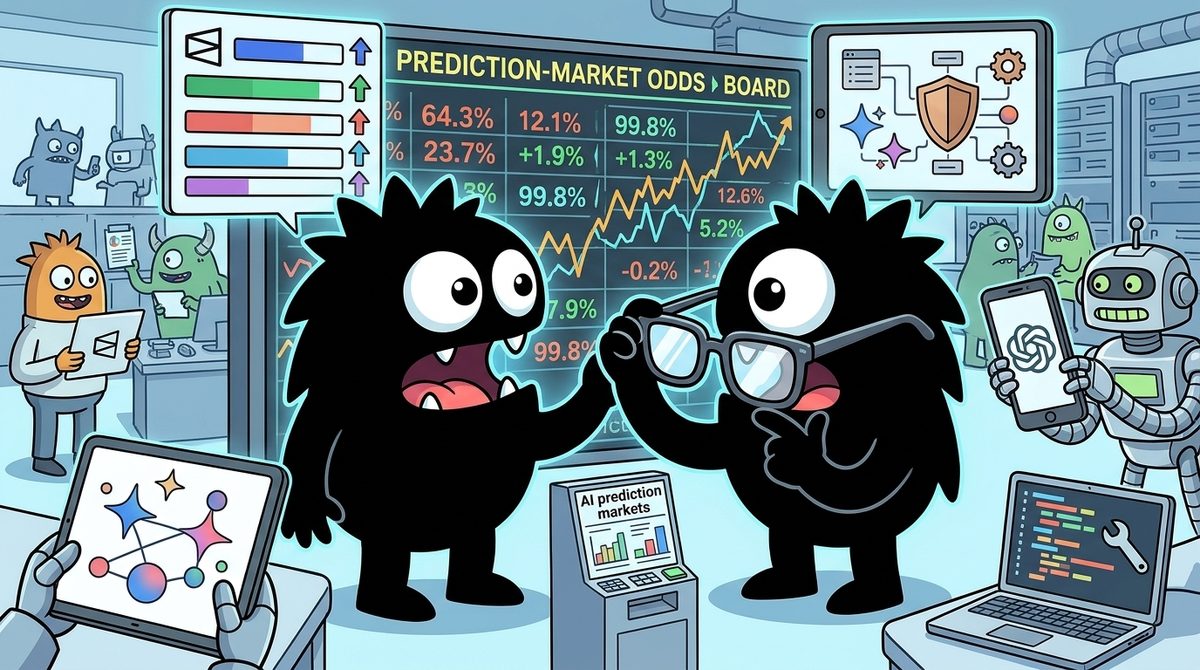
The question behind the search is simple: which company will have the best AI model at the end of 2026, and should that change what you build on? As of November 15, 2026, betting markets have a clear answer to the first half. On Polymarket's "Which company has best AI model end of 2026?" market, traders price Google at 76%, Anthropic at 18%, OpenAI at 3%, Meta at 1%, and Mistral and Alibaba at 0%[1].
The second half of the question is harder. The market resolves on a single leaderboard snapshot at year-end. That is a narrow definition of "best," and practitioners on X keep pointing out that it often doesn't match which model is most useful in production. The useful reading is that Google is the consensus favorite for the leaderboard crown, while the race for workflow usefulness is still split.
Bottom line (as of Nov 15, 2026):
- Polymarket traders currently price Google at 76% to hold the top AI model on December 31, 2026, with Anthropic the only serious alternative at 18%[1].
- Two months ago, the market leaned the other way, with Anthropic at roughly 72.5%. The swing reflects Gemini's leaderboard momentum, not a settled outcome.
- OpenAI sits at 3%. That is a judgment about the frontier crown, not about OpenAI's adoption or revenue.
- For builders, these odds argue for keeping a multi-model stack with an abstraction layer, not for migrating everything to the favorite.
What Is the $4.3M "Best AI Model 2026" Market Actually Pricing Right Now?
Traders have put roughly $4,353,740 into the market, which resolves around December 31, 2026[1]. Here is how the main contracts break down by implied probability and dollar volume:
| Company | Implied probability | Volume traded |
|---|---|---|
| 76% | $664,084 | |
| Anthropic | 18% | $581,667 |
| OpenAI | 3% | $320,069 |
| Meta | 1% | $326,565 |
| Mistral | 0% | $300,064 |
| Alibaba | 0% | $282,190 |
An implied probability is simply the price of a "YES" share. A 76¢ contract that pays $1 if Google wins means the market, in aggregate, treats a Google finish as roughly a three-in-four proposition. It is a consensus bet, not a forecast of fact, and it can move a lot in a week.
Tracking sites show how fast it has been moving. AI Race Scoreboard recorded Google DeepMind at 76.5%[2]. PolymarketTrader's odds page captured Google at 69% at an earlier point[3].
The volume column shows something the percentages hide. Mistral and Alibaba each carry around $300,000 in trading despite sitting at 0%. Anthropic's volume nearly matches Google's despite a 58-point probability gap. Volume reflects how much the market argued over a name during the year, not how likely that name is to win. Heavy volume on long shots usually means one of two things: earlier periods when those contracts looked live, or traders cheaply selling "NO" on them.
Community trackers treat the odds like a weekly sports table. One Spanish-language account summarized the turn this way:
Hace dos meses el mercado le daba 72,5% a Anthropic de tener la mejor IA del año. Hoy, 22%.
Polymarket, mejor modelo a fin de 2026:
Google 70,5%
Anthropic 22%
OpenAI 2,8%
OpenAI no ganó ninguno de los 20 mercados mensuales ya resueltos. ¿Le crees al mercado? #IA
Two months ago the market gave Anthropic 72.5% chance of having the best AI of the year. Today, 22%.
Polymarket, best model end of 2026:
Google 70.5%
Anthropic 22%
OpenAI 2.8%
OpenAI didn't win any of the 20 monthly markets already resolved. Do you believe the market? #AI
The PredictaX post (translated from Spanish) notes that two months earlier, the market gave Anthropic a 72.5% chance of having the best AI of the year. At the time of posting, it had Google at 70.5%, Anthropic at 22%, and OpenAI at 2.8%. It then asks readers directly whether they believe the market. That question runs through this whole article.
How Did Google Go From Underdog to 76% Favorite in 2026?
The biggest story in this market is the reversal. On a weekly basis it looks like this:
- Early fall: Anthropic priced near 72.5%.
- Early November: the two were roughly even, at 53.5% Google vs. 36.5% Anthropic.
- November 9: 65.5% vs. 29%.
- November 15: 76% vs. 18%[1].
Benzinga framed this in October as "Google's AI dominance has prediction markets betting big," while warning that Anthropic "could flip the script"[4].
The clearest way to see why traders shifted is through Polymarket's monthly markets. These resolve on the same kind of question at the end of each month, and they show momentum swinging back and forth. In April, the launch of Claude Opus 4.7 sent Anthropic's odds of holding #1 at month-end to 95%:
BREAKING: Anthropic launches Claude Opus 4.7, its most powerful model yet.
95% chance Anthropic has the #1 AI model at the end of the month. https://polymarket.com/event/which-company-has-the-best-ai-model-end-of-april?via=x-afr2
By late October, the picture had flipped:
BREAKING: Google projected to dethrone Anthropic as the company with the best AI model at the end of October.
83% chance.
https://polymarket.us/event/company1-2026-10-31
DeFi Rate's tracking of the annual market follows the same arc: Anthropic's spring strength gave way to Google's fall surge as the year-end favorite[6].
Why might traders be positioned this way? Three plausible drivers stand out. None of them guarantees the outcome.
- Launch cadence near the deadline. The resolution is a snapshot, so the lab that ships a strong model closest to December 31 has an edge. Traders appear to believe Google's Gemini 4-generation releases are timed well for that window.
- Leaderboard positioning. Monthly resolutions are concrete evidence. Google taking October tells traders that Gemini can win the specific scoring system that matters.
- Narrative momentum. Prediction markets reward recent wins. A month-end victory moves the annual market more than a single month's significance would justify.
The 18% Anthropic price is not dismissive, though. Roughly one-in-five odds with six weeks left reflects real belief that a late Claude release could retake the top spot. That would be a repeat of the April pattern.
Does a Leaderboard Win Mean the Best Model? The Tooling Gap Debate
This is where the X conversation adds the most to the raw numbers. According to the arbitrage traders who watch the fine print, the market settles on the LMArena (now "Arena") text leaderboard. That leaderboard ranks models by crowd-sourced preference votes in head-to-head chat comparisons. It is a meaningful signal. It is also a narrow one.
It does not directly measure:
- Tool use
- Long-horizon agent reliability
- File handling
- How well a model works inside a real product
Ethan Mollick made this point sharply about an earlier Gemini generation:
Gemini is held back by lack of tools, a big gap compared to ChatGPT and Claude. Gemini 3 is a really good model, but it just isn't able to do things.
For example, take a GDPval prompt that involves downloading from the web, PDFs & docs.
ChatGPT wins here, Claude close, Gemini😬
Mollick's example was a GDPval-style task that required downloading files from the web and working with PDFs and documents. On that task, ChatGPT won, Claude came close, and Gemini struggled. The post dates from earlier in 2026 and refers to Gemini 3, so it may not describe Gemini 4. The structural point still holds: model quality and harness quality are different things, and a chat leaderboard mostly measures the first.
Other developers report the opposite experience in specific domains:
Claude feels kinda overhyped tbh.
I tested the same website design prompt on both Gemini and Claude many times. And every time Claude’s output wasn’t even close to the original.
Meanwhile, Gemini got almost identical results, and after a few tweaks, it hit ~99% accuracy.
Makes me wonder… maybe models just perform better on ecosystems they’re trained closer to? 🤔
Either way, Gemini is seriously outperforming in frontend dev right now.
Put together, these reports suggest that the "best model" depends on the task. The late-2026 benchmark literature supports that reading:
- BenchLeader's head-to-head comparison calls Claude Opus 5.5 vs. Gemini 4 Carbon "neck and neck on quality"[11].
- Another comparison puts the two at 59 vs. 58 on a composite index[13].
- On Google's own engineering exam, Claude reportedly led at 48.3% while Gemini placed fourth[10].
- BenchLM's November 2026 comparison likewise frames the matchup as a category-by-category split rather than a blowout[8].
- One analysis of Gemini 4, GPT-6 Astra, and Claude argues that reading benchmarks well means separating raw reasoning scores from agentic and coding performance[12].
The non-obvious takeaway is this. A 76% market price on a near-tied quality race is mostly a bet on leaderboard mechanics and release timing, not on a decisive capability gap. If your production workload is agentic coding or document-heavy automation, the market's favorite and your best choice may not be the same model.
Why Do Betting Markets Price OpenAI at Just 3%?
The most famous AI lab trades at 3%[1]. PredictaX's post claims OpenAI won none of the 20 monthly markets resolved so far. Taken at face value, that claim suggests a lab that keeps showing up but not finishing first on this particular scoreboard. CryptoSlate's market analysis and Computing.net's November-market coverage both frame the contest as essentially Google vs. Anthropic, with OpenAI a distant third[5][7].
That framing fits a broader enterprise story practitioners keep citing:
OpenAI lost half their enterprise market in 18 months and the crossover already happened.
That blue line going from 48% to 24% is the fastest market leader collapse I've seen outside of actual fraud scandals. We're watching a 50% share erosion in real time while Anthropic went from 11% to 31%, which means this is pure substitution, not market expansion diluting everyone equally. The enterprises that matter already made their choice and the data shows they're actively migrating spend away from OpenAI's API.
The crossover point is mid-2025. That's right now. Anthropic has more enterprise API market share than OpenAI today, which seems like the kind of thing that should be leading Bloomberg terminals but somehow isn't. This is Oracle losing to Salesforce type stuff.
Google's slow climb from 5% to 18% is what you'd expect from a company with infinite distribution and existing enterprise relationships. They're not winning on product, they're winning on bundling and procurement inertia. Every CIO who wants to minimize political risk checks the Google box and calls it diversification.
Meta's collapse from 14% to 7% is actually more interesting than it looks. They were at 14% in both 2023 and mid-2024, so they held steady through the first wave of competition, then got cut in half in the next 12 months. That suggests their open source strategy worked for hobbyists and researchers but completely failed to translate into enterprise API revenue. Llama might be winning developer mindshare but Meta is losing the only game that actually pays.
The velocity on that Anthropic orange line is absurd. They added 20 points of market share in 24 months starting from 11%, which is a 182% increase in relative terms. Meanwhile OpenAI's absolute share dropped 24 points, so you can almost trace where the spend went. This is textbook disruption math where the insurgent's growth rate is literally powered by the incumbent's customer defection.
What's missing from this chart is why enterprises are switching, but the timing tells you most of what you need to know. Claude 3 dropped March 2024, and that's right where Anthropic's growth curve changes slope. The product shipped, enterprises tested it, procurement cycles closed, and here we are. OpenAI spent 2024 shipping voice features and fighting with their board while Anthropic just kept cranking out context windows and API reliability.
This post is from late 2025 and describes a chart of enterprise API share. In that chart, OpenAI falls from about 48% to 24% and Anthropic rises from 11% to 31%. Treat the post as directional context, not current data. Its reading is that the shift was "pure substitution": enterprises moving spend from one vendor to another, not a bigger market diluting everyone. Menlo Ventures' 2026 State of Enterprise AI report puts enterprise AI spending at $177B, up 5.4x in a year, with agents taking over[16]. In a market growing that fast, losing share can still mean growing revenue.
That distinction matters for reading the 3% correctly:
- What it does mean: traders doubt OpenAI will hold the #1 Arena text slot on December 31, 2026.
- What it doesn't mean: that OpenAI is irrelevant, losing customers outright, or a bad API choice.
Mollick's post above has ChatGPT winning a tool-heavy real-world task. That is exactly the kind of strength this market doesn't measure.
For founders, a low crown probability is a reason to benchmark OpenAI against your actual workload, not a reason to rip it out.
How Do Polymarket and Kalshi Resolve This Market, and Why Do Their Prices Differ?
If you use these odds as a signal, the resolution mechanics matter as much as the price. The arbitrage crowd spotted a gap between platforms:
Same AI race, two prices.
Best AI model at end of 2026, Google (Gemini):
Kalshi YES 64.9¢
Polymarket NO 29¢
Total 93.9¢ for a $1 payout, ~4.7% net after fees.
Both settle on the LMArena text leaderboard, but check times and tiebreaks differ.
https://arbprediction.com
The math works like this:
- Buying Kalshi "YES" on Google at 64.9¢ and Polymarket "NO" on Google at 29¢ costs 93.9¢.
- Exactly one of those positions pays $1, so the trade locks in roughly 4.7% net after fees.
- Polymarket's NO at 29¢ implies its YES was around 71%, versus Kalshi's 64.9%. That is a gap of about six points on what looks like the same event.
The gap persists for a reason. ArbPrediction notes that although both platforms settle on the LMArena text leaderboard, their check times and tiebreak rules differ. In a race where Benchmark sites describe the top two as near-tied[11], those details stop being trivia:
- A leaderboard that updates hours after one platform's snapshot can produce different winners.
- A statistical tie handled differently by each platform can also produce different winners.
Benzinga's coverage of a possible Anthropic comeback makes the same point from the narrative side: with a close leaderboard, the year-end crown is fragile[4]. Computing.net's November market shows the same structure at monthly scale, where each month resolves on a single check[7].
The practical lesson: cross-platform divergence is a direct measure of the uncertainty that the headline 76% smooths over. When two liquid markets disagree by six points on the same event, the real confidence interval is wider than either price suggests.
Meta, Mistral, and Alibaba: What Does the Zero-to-One-Percent Field Signal?
Meta sits at 1%, while Mistral and Alibaba sit at 0%. Yet each has drawn roughly $280,000–$330,000 in volume[1]. The leaderboard tells a more competitive story than those prices do:
Monday standings, 9 Nov:
1. Google DeepMind 100
2. Anthropic 81.3 (-5.4)
3. OpenAI 64.7
Polymarket 2026 odds widen: Google 65.5%, Anthropic 29% (was 53.5% vs 36.5%).
On @arena, Meta's Muse Wonder passed Claude Opus 5.5 for #3.
https://airacescoreboard.com/?utm_source=x&utm_medium=social&utm_campaign=standings-2026-11-09
Meta's Muse Wonder passing Claude Opus 5.5 for #3 on Arena is notable. It means a lab the market prices at 1% is sitting between the two favorites' flagship models on the very leaderboard used to resolve the market. AI Race Scoreboard's composite standings put OpenAI third behind Google DeepMind and Anthropic, but Meta's Arena climb shows the gap below the top spot is narrow[2]. Respan's ranking of the ten best frontier models in 2026 similarly includes a deep bench beyond the big three[9].
Why the near-zero odds, then? The market is not asking "who is competitive." It is asking "who is #1 on one date." A strong #3 is worth almost nothing in a winner-take-all contract.
For buyers, though, these labs matter for a different reason:
- Open-weight leverage. Strong open or semi-open models from Meta, Mistral, and Alibaba set a price floor and a fallback option, which matters most in regulated or on-prem deployments.
- Geographic and sovereignty hedges. Mistral (Europe) and Alibaba (China) give organizations alternatives that fit data-residency and regional procurement requirements.
- Two-horse-race insurance. If the market is right that the frontier is a Google–Anthropic duopoly, having a credible third-tier option limits vendor lock-in.
What Do These Odds Mean for Developers, Founders, and SaaS Buyers?
The market implies a Google lead. The benchmarks describe a near-tie with task-level splits[8][11]. Practitioners on X describe mixing models. These three signals point the same way: design for model plurality.
The most-shared version of the practitioner playbook pairs the two favorites:
Claude 4.6 and Gemini 3 together are wild.
This is the new AI product stack 🧵
Claude 4.6:
– 1M token context window
– Reads entire codebases
– Handles multi-step workflows
– Connects APIs cleanly
– Automates backend logic
Gemini 3:
– Multimodal (text, image, video, audio)
– Designs UI + layout
– Structures landing pages
– Powers AI-native dev (AntiGravity IDE)
Here’s the play:
1. Prompt Gemini to design the landing page.
2. Take output to Claude.
3. Prompt Claude to build backend automation.
Result?
Lead form → email list → CRM tag → welcome sequence.
All built from prompts.
This is what a 2-person AI team looks like.
That post is from February 2026 and references older model versions (Claude 4.6, Gemini 3). Still, the pattern matches what current benchmark comparisons show: Gemini favored for multimodal and frontend/UI work, and Claude favored for long-context reasoning, backend logic, and multi-step workflows[8][11]. That is what hedging a horse race looks like in an architecture diagram.
Decision criteria by audience:
- Solo developers and small teams (1–10 people):
- Use two frontier models by task type rather than choosing one.
- Cost of switching is low. Pick per task: design and multimodal to one model, agentic coding to another.
- Startup founders building on LLM APIs:
- Put a provider-agnostic routing layer in place early.
- A 76%/18% split six weeks from resolution, after a 50-point reversal in two months, is evidence that leadership changes often. Hard-coding a single vendor is a bet the market itself is unwilling to make with confidence.
- Enterprise and SaaS buyers:
- Treat the odds as a confidence signal about release momentum, not a procurement input.
- Contracts should weight tool ecosystems, reliability, compliance, and agent performance. The Menlo data on agent-driven spending[16] says that is where the money is going, and a chat leaderboard measures little of it.
- Teams with regulated or on-prem constraints:
- The 0–1% labs may be your most important options, regardless of crown odds.
How Should You Read the Market Without Betting the Company?
Polymarket's odds are one of the fastest-updating sentiment gauges in AI. They reacted to Claude Opus 4.7 within hours and moved through Google's fall run weeks before most analyst write-ups caught up[1][2]. That speed is the value. The narrowness is the limitation.
Three practical rules:
- Use the odds as an early-warning system. A sharp swing usually means a release or leaderboard move worth testing quickly.
- Validate against your own evals before committing architecture. The developers in this conversation disagree because their workloads differ. Your workload is the only benchmark that settles your decision.
- Treat December 31 as a data point, not a verdict. Whichever lab tops the Arena text leaderboard that day, the market measures a snapshot of one metric. It is not a ruling on which company "won" 2026 in the ways that matter for revenue, reliability, or developer productivity.
For now, traders currently price Google as the strong favorite and Anthropic as the live underdog. The safest place for a builder to stand is somewhere both bets pay off.
Sources
[1] Polymarket — Which company has best AI model end of 2026? — https://polymarket.com/event/which-company-has-best-ai-model-end-of-2026
[2] Polymarket best AI model odds end of 2026: Google DeepMind 76.5% — https://airacescoreboard.com/polymarket-best-ai-model-odds/
[3] Which company has best AI model end of 2026? Odds: Google 69% | Polymarket Odds Today — https://polymarkettrader.com/odds/which-company-has-best-ai-model-end-of-2026/
[4] Google's AI Dominance Has Prediction Markets Betting Big — But Anthropic Could Flip the Script — https://www.benzinga.com/markets/prediction-markets/26/10/62519265/googles-ai-dominance-has-prediction-markets-betting-big-but-anthropic-could-flip-the-script
[5] Which company will have the best AI model at the end of 2026 Odds & Prediction Market Analysis — https://cryptoslate.com/predictions/market/which-company-will-have-the-best-ai-model-at-the-end-of-2026/
[6] Best AI Model 2026 on Polymarket: Who Leads the Odds — https://defirate.com/odds/best-ai-model-2026/
[7] Which company has the best AI model end of November — Odds & Predictions — https://computing.net/predictions/market/which-company-has-the-best-ai-model-end-of-november/
[8] Claude vs Gemini (November 2026): Benchmarks, Price & Verdict — https://benchlm.ai/compare/claude-vs-gemini
[9] Frontier Models in 2026: 10 Best Frontier AI Models, Ranked — https://www.respan.ai/articles/best-frontier-ai-models
[10] Google's Engineering Exam: Claude Leads at 48.3%, Gemini 4th — https://fourweekmba.com/ai-googles-engineering-exam-claude-leads-at-48-3-gemini-4th/
[11] Claude Opus 5.5 vs Gemini 4 Carbon: neck and neck on quality — https://www.benchleader.com/compare/claude-opus-5-5-vs-gemini-4-carbon
[12] Gemini 4 vs GPT-6 Astra vs Claude: reading the benchmarks — https://szymonpaluch.com/blog/posts/gemini-4-vs-gpt-6-vs-claude
[13] Claude vs Gemini: 59 vs 58 on Index, $4/$20 [2026] — https://shattered.io/claude-vs-gemini-opus-5-5-vs-gemini-4-carbon-argon-59-vs-58-2026/
[16] Menlo Ventures' 2026 State of Enterprise AI Report — https://vmblog.com/news/menlo-ventures-2026-state-of-enterprise-ai-report-enterprise-ai-spending-hits-177b-up-5-4x-in-one-year-as-agents-take-over/
References (16 sources)
- Polymarket — Which company has best AI model end of 2026? - polymarket.com
- Polymarket best AI model odds end of 2026: Google DeepMind 76.5% - airacescoreboard.com
- Which company has best AI model end of 2026? Odds: Google 69% | Polymarket Odds Today - polymarkettrader.com
- Google’s AI Dominance Has Prediction Markets Betting Big — But Anthropic Could Flip the Script - benzinga.com
- Which company will have the best AI model at the end of 2026 Odds & Prediction Market Analysis - cryptoslate.com
- Best AI Model 2026 on Polymarket: Who Leads the Odds - defirate.com
- Which company has the best AI model end of November — Odds & Predictions - computing.net
- Claude vs Gemini (November 2026): Benchmarks, Price & Verdict - benchlm.ai
- Frontier Models in 2026: 10 Best Frontier AI Models, Ranked - respan.ai
- Google's Engineering Exam: Claude Leads at 48.3%, Gemini 4th - fourweekmba.com
- Claude Opus 5.5 vs Gemini 4 Carbon: neck and neck on quality - benchleader.com
- Gemini 4 vs GPT-6 Astra vs Claude: reading the benchmarks - szymonpaluch.com
- Claude vs Gemini: 59 vs 58 on Index, $4/$20 [2026] - shattered.io
- LLM Leaderboard (Nov 2026): Top AI Models | BenchLeader - benchleader.com
- AI Model Leaderboard: Overall Scores | RL Research - rlresearch.ai
- Menlo Ventures' 2026 State of Enterprise AI Report - vmblog.com
Related Guides
Midjourney vs HubSpot: Which Is Best for Developer Productivity in 2026?
19 min read
The Best AI Model Prediction Market in 2026: What Traders' 75% Google Bet Reveals
18 min read
The Best AI Accelerators in 2026: An Expert Comparison of Nvidia, AMD, and Google
20 min read
The Best AI Model of 2026: What $4.3M in Polymarket Bets Reveals About the AI Race in 2026
19 min read