The Market Has Spoken: Why Traders Put 99% Odds on Anthropic for August's Best AI Model — And What It Signals for SaaS in 2026Updated: September 27, 2026
Anthropic sits at 99% in Polymarket's best AI model market. Discover what these live trader odds reveal about the AI and SaaS industry's direction in 2026.
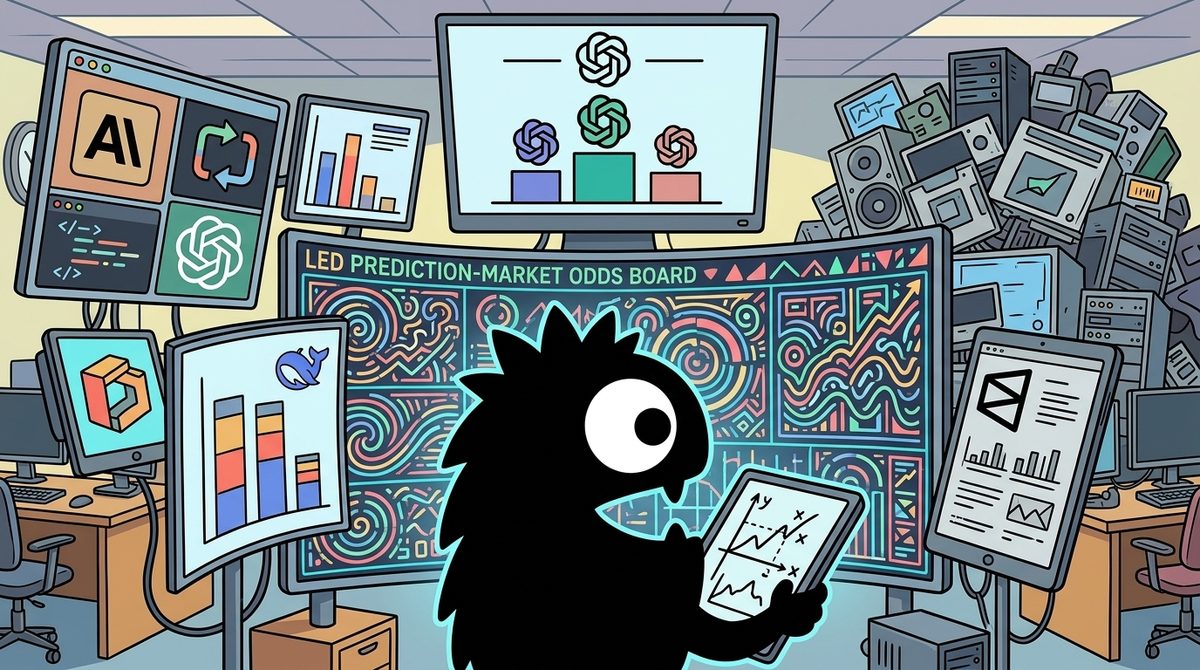
The practical question behind Polymarket’s “best AI model” market is not simply whether Anthropic will finish August 2026 on top. It is whether a 99% implied probability should change which model developers build with, which platform founders depend on, and which vendors SaaS buyers fund.
The short answer: the market implies overwhelming confidence that Anthropic will lead the specified leaderboard at resolution around August 31—not that Anthropic will dominate every workload or become the permanent winner of AI. For practitioners, the stronger signal is that model intelligence is concentrating at the frontier while economic value is fragmenting across cost, latency, reliability, deployment model and agent tooling.
Bottom line as of August 19, 2026:
- Traders currently price Anthropic at 99% and OpenAI at 1%.
- DeepSeek, SpaceXAI, Meta and Z.ai are each priced near 0%, after rounding.
- Roughly $2,073,309 has traded, but volume is turnover—not necessarily the amount currently at risk.
- The odds concern a specific leaderboard and deadline. They do not mean Anthropic is 99% likely to be the best choice for a particular SaaS product.
The Market Snapshot: Why Is $2M+ Trading Around Anthropic at 99%?
As of August 19, 2026, the Polymarket event has recorded roughly $2,073,309 in trading volume. The market currently implies the following probabilities:
| Company | Implied probability | Trading volume |
|---|---|---|
| Anthropic | **99%** | **$434,834** |
| OpenAI | **1%** | **$181,836** |
| DeepSeek | **0%** | **$253,062** |
| SpaceXAI | **0%** | **$203,160** |
| Meta | **0%** | **$170,362** |
| Z.ai | **0%** | **$167,275** |
Those figures come from the live market and associated tracking pages.[1][2] A displayed 0% should be read as near zero after rounding, not literally impossible.
The contract is expected to resolve around August 31 using the specified lmarena.ai Chatbot Arena leaderboard and the market’s detailed rules.[1][5] That distinction matters: traders are pricing the probability of winning a defined measurement at a defined time, not producing a universal assessment of model quality.
Prediction markets have also reversed sharply before. Polymarket’s own January 2025 framing still called OpenAI “the king” while pricing a 17% chance that DeepSeek would hold the best model by the end of that quarter:
DeepSeek has set off panic in the AI world.
But OpenAI is still the king.
There's only a 17% chance DeepSeek will have the best AI model by Q2.
The current distribution nevertheless looks unusually decisive. Anthropic leads the odds, but substantial trading has occurred in contracts now priced near zero. DeepSeek’s $253,062 and SpaceXAI’s $203,160 indicate active repricing, speculation or contrarian positioning—not broad confidence that those companies will win.
That is why skepticism persists even around a 99% line:
Is Anthropic REALLY a lock for the best AI model by September 2026? 🤔 The market thinks YES at 90%, but our AI says only 63%! That's a hefty -27 point edge. The competition is fierce, and the leaderboard can flip fast. Don’t get too comfortable! #AI #Predictions
View on XAn alternative forecasting model cited in that post assigned Anthropic 63%, versus the prediction market’s then-90% price. It does not prove the market is wrong. It shows how much depends on assumptions about surprise releases and leaderboard volatility.
Why Do Traders Price Anthropic as Nearly Certain to Win August?
The clearest explanation is incumbency plus a short clock. If Anthropic already leads the designated leaderboard, rivals have only until the end-of-August snapshot to release, evaluate and place a stronger model above it. The market implies that path is extremely unlikely.
Supporting signals extend beyond one arena. Bank of America’s Frontier AI Tracker, as described in the current X discussion, ranks Claude Opus 5 first for intelligence and Claude Fable 5 second, ahead of GPT-5.6 Sol. The same account says Anthropic captures 65% of measured AI spending, while DeepSeek leads usage share at 30%:
CLAUDE TOPS AI RANKINGS AS COSTS FALL
Bank of America launched its Frontier AI Tracker, monitoring model intelligence, usage, token prices and hardware costs.
Anthropic’s Claude Opus 5 ranks #1 for intelligence, followed by Claude Fable 5 and OpenAI’s GPT-5.6 Sol.
DeepSeek leads usage share at 30%, while Anthropic dominates AI spending at 65%.
Meanwhile, AI token prices fell 9% month-over-month, helped by major OpenAI price cuts, while GPU rental costs remained broadly stable.
Anthropic’s official Opus 5 release gives traders a concrete product event rather than a speculative roadmap.[12] Independent benchmark reporting also attributes a 95% SWE-bench Verified result to Fable 5, reinforcing the perception that Anthropic has strength in software engineering tasks.[9] Benchmark aggregators similarly place Anthropic’s current models near the top of 2026 rankings.[7]
The stronger bull case is the positive feedback loop thesis. Coding agents such as Claude Code do more than produce subscription revenue: they may help researchers and engineers write experiments, inspect failures and accelerate internal development. If better models improve the tools used to build the next model, a temporary lead can become self-reinforcing.
That argument has become blunt on X:
the power of scaled RL + distillation (but big boy distillation, not cringe SFT on claude subscriptions)
Anthropic is ahead, everything else is cope. OpenAI can win yet but 5.6 is no evidence of anything except post-training expertise. They'll need bigger models
Still, the 99% price is best understood as confidence in near-term leaderboard persistence. It is not evidence that Anthropic has solved every model problem, or that OpenAI and other labs cannot regain the lead after August.
Is “Best AI Model” Still the Right Question for SaaS Teams?
For a prediction contract, yes: “best” must be compressed into an observable resolution criterion. For production software, usually not.
One widely shared 2026 leaderboard snapshot puts Claude at 63, Fable at 62, GPT and Grok at 61, Kimi at 60, Meta at 57 and Gemini at 56:
We're living in a timeline where Meta has a better model than Google 🤯
Meta wasn’t even on the AI leaderboard. And now it’s above Google. Let that sink in !
Claude: 63
Fable: 62
GPT: 61
Grok: 61
Kimi: 60
Meta: 57
Gemini: 56
The gap between the frontier labs is getting insanely small 👀
The precise ordering matters to traders because one point can decide the contract. It may matter far less to a customer-support product, coding workflow or financial-analysis system. Small aggregate differences can hide substantial variation by task, language, latency target and tool-use environment.
Ripper’s argument captures the change in buying behavior: frontier models are now close enough that practitioners increasingly select a system for the job rather than treating one leaderboard winner as universally superior.
asking what the best AI model to use is the wrong question.
a year ago it actually made sense. every company was trying to build the smartest model. whoever topped chatbot arena, mmlu or swe-bench won that conversation.
but today? the frontier models are so close that raw intelligence barely decides anything anymore.
the gap between claude fable 5, gpt-5.6 sol, gemini 3.1 pro, grok 4.5 and kimi k3 is much smaller than people think.
what matters now is what you're trying to do.
if you're writing, i'd still pick claude.
not because it's dramatically smarter, but because it needs the fewest edits.
it holds tone over thousands of words, transitions naturally between ideas and rarely falls into the repetitive patterns you still see in other models.
if i'm shipping code every day, my answer changes completely.
gpt-5.6 sol is exceptional at structured reasoning, debugging and tool use, but what really changed the game wasn't even the model.
it was CODEX.
people think codex is just another chatbot, it isn't.
you hand it a task, it spins up its own environment, clones repositories, edits files, runs tests, fixes failures and comes back with completed work.
that's a glimpse of where software engineering is heading.
the competition now isn't just openai vs anthropic anymore.
it's codex vs claude code vs cursor vs devin.
that's a much more interesting race.
then there's KIMI K3.
a couple of years ago, nobody believed an open-weight model could seriously compete with the frontier labs.
today that's no longer true.
it doesn't beat claude or gpt at everything, but it's good enough that every closed lab now has to justify why people should pay a premium.
that's a huge shift.
and i still think grok 4.5 doesn't get enough credit.
people laugh because of the x branding, but from a technical standpoint it's one of the best value models available today.
fast, cheap and surprisingly efficient.
once you're processing millions of tokens, pricing and latency start mattering just as much as benchmark scores.
that's why i think the conversation has changed.
we're no longer choosing the smartest AI, we're choosing the right AI for the job.
that's the question.
This is the central paradox of the Polymarket odds: a model can have a 99% implied chance of winning the contract while holding only a modest practical advantage for many workloads.
The relevant split may be exploration versus exploitation. One practitioner characterizes OpenAI’s models as better aligned with open-ended research and Anthropic’s as better aligned with reliable commercial execution:
I like that the current frontier models are polar opposites, it makes their use-cases and strengths pretty obvious
GPT-5.2 = Exploration -> the reason why xhigh and Pro are so damn good
Opus 4.5 = Exploitation -> the reason why Anthropic don't need many tokens and reasoning doesn't seem to add much value
OpenAI has the better approach for research.
Anthropic has the better approach for commercial applications that require reliability.
That framework is not a universal benchmark result, but it is useful procurement language:
- Exploration workloads reward breadth, hypothesis generation and long reasoning paths.
- Exploitation workloads reward repeatability, concise execution and low variance.
- Consumer products may prioritize responsiveness, personality and distribution.
- Enterprise SaaS usually puts more weight on reliability, governance and predictable task completion.
The market’s 99% price therefore answers a narrow ranking question more confidently than it answers the buyer’s question.
Why Has DeepSeek Drawn $253K of Volume Despite Near-0% Odds?
DeepSeek is the most important example of the difference between leaderboard leadership and economic disruption. Its contract has generated $253,062 in trading volume even though traders currently price its August-winning probability near 0%.[1]
One possible explanation is speculation that DeepSeek could release a stronger model before resolution. Another is that traders entered earlier at different prices and subsequently exited or were repriced. Volume alone cannot distinguish conviction, hedging and churn.
The industry significance is clearer. DeepSeek may not need to win the arena to pressure closed-model pricing. Xiaoyin Qu’s forecast focuses on speed and cache economics rather than raw intelligence:
Prediction: Deepseek v4 flash will take over Claude as the no.1 winner in market share. It's the biggest story of 2026! Three reasons:
1. It's so cheap. 100x cheaper in unit token pricing.
2. It's so fast. Much much faster than Claude. My vibe check is around 2-3x faster.
3. It's so cache-efficient: most of my tokens spent are in cache read, and cache input pricing are $0.5/Mt Opus 5 v.s. $0.0028/Mt Deepseek.
Deepseek has a much higher cache hit rate, which means the overall effective cost per task could be upwards of 500x cheaper.
For something that's 500x cheaper AND 2-3x faster per task, why wouldn't Deepseek V4 Flash win.
Prompt caching charges a lower rate when an application repeatedly reuses the same instructions, tools and conversation history. That is especially important for long-running agents, where stable prefixes may account for a large share of total input.
The X discussion around Clawcodex illustrates the software-layer response:
someone just rebuilt claude code in pure python and made it 230x cheaper to run
it's called clawcodex.
a full from-scratch port of the claude code agent loop. 230k+ lines of python, MIT licensed
it keeps your request prefix byte-stable, so DeepSeek's prompt cache covers your entire system + tools + history on every turn
cache-hit input then bills at ~$0.0435 per 1M tokens
the same 1M tokens on Claude Fable 5 runs you $10
so the longer you code, the more the cache pays off
what you actually get:
→ 25 LLM providers (Claude, GPT, DeepSeek, GLM, local ollama)
→ 1M token context window
→ real agent loop: tools, skills, REPL, session history → one-line install, mac/linux/wsl
and it's sitting at 677 stars. basically nobody is looking yet
bookmark this before it gone
These are claims from the projects and practitioners involved, not standardized cross-provider benchmark results. But the underlying architectural point is sound: agent economics depend on cache-hit rates, loop length and completed-task cost, not just headline input-token prices.
DeepSeek’s earlier releases built their reputation on aggressive API pricing and open-weight availability:
6. Frontier Open Source Model
On Christmas, they shocked the AI world with Deepseek v3:
- Trained for just $6M but rivaled ChatGPT-4o and Claude 3.5 Sonnet.
- Introduced groundbreaking innovations like Multi-Token Prediction, FP8 Mixed Precision Training, Distilled Reasoning Capabilities from R1 and Auxiliary-loss-free Strategy for Load Balancing.
- API costs that are 20-50x cheaper than the competition:
- Deepseek: $0.14 / 1M in, $0.28 / 1M out
- OpenAI: $2.50 / 1M in, $10 / 1M out
- Anthropic: $3 / 1M in, $15 / 1M out.
For SaaS founders, that creates three strategic options:
- Use DeepSeek-class models for high-volume, reversible tasks where occasional errors can be checked cheaply.
- Route difficult cases to a frontier closed model, preserving quality without paying premium rates for every request.
- Self-host an open-weight model when data control or customized inference justifies the operational burden.
DeepSeek’s near-0% market price is therefore not a verdict on its business impact. It means traders see little chance of it winning this particular leaderboard by this particular deadline.
Does the Cheapest Model Actually Produce the Lowest SaaS Cost?
Not necessarily. Token price is an input metric; completed work is the business metric.
Byron Deeter points to AlphaSense research claiming that OpenAI’s GPT-5.6 Sol and Anthropic’s Opus 4.8 beat Kimi K3 and GLM-5.2 on both quality and total cost in complex financial-analysis tasks:
The frontier models don’t actually need to be cheaper than fully cost burdened open-weight Chinese models to get most of the workloads, but it’ll sure drive home the case if more data shows cost per actual unit of value also favors the frontier models:
“Research from the AI-powered market intelligence platform AlphaSense foundthat OpenAI’s GPT-5.6 Sol and Anthropic’s Opus 4.8 outperformed Chinese rivals Kimi K3 and GLM-5.2 on both cost and quality in complex financial analysis tasks.
The findings challenge the widely held assumption that lower token prices automatically translate into lower AI costs….more capable models often require fewer tokens and fewer processing steps to complete the same task, reducing the total cost despite charging higher prices per token.”
The mechanism is straightforward. A more expensive model can still cost less per successful outcome if it:
- completes a task in fewer steps;
- produces shorter, more relevant outputs;
- calls fewer tools;
- requires fewer retries;
- creates fewer errors that need human review.
Current reporting also says token prices fell 9% month over month, helped by OpenAI price cuts.[4] If frontier vendors keep reducing prices, open-weight providers must defend their advantage at the workflow level, not only on rate cards.
The choice depends on error tolerance:
- Choose lower-cost models for classification, extraction, bulk transformation and workloads with automated validation.
- Pay a frontier premium for complex coding, legal or financial workflows where a failed result creates expensive downstream work.
- Benchmark both when agent loops are long, because cache efficiency can outweigh the model’s nominal price.
- Measure cost per accepted result, including retries, review time, latency and infrastructure.
This cost-per-value argument helps explain why traders are more confident in Anthropic and OpenAI than in cheaper rivals. Enterprise demand can reward reliability strongly enough to sustain premium models—even when cheaper systems achieve more raw usage.
Are Anthropic and OpenAI Becoming the Only Two Frontier Labs?
One influential thesis says Anthropic and OpenAI are entering a compounding lead because they combine models, compute, researchers, proprietary usage data and research-accelerating coding tools.
I would genuinely love for this to happen
but many people think that OpenAI and Anthropic are already in a positive feedback loop
and as we have seen with Gemini 3 Pro: a ~5 trillion param reasoning model won't magically be AGI
(or for that matter a 6T param Grok-5)
my base case is that OpenAI and Anthropic will pull further ahead
xAI has less compute, less researchers, less data (no Codex, no Claude Code) and does not have access to models that literally speed up research (behind ~6 months)
Google on the other hand is still in the race, being only ~3 months behind. they have the most compute, researchers, an infinite money glitch and the data
A more maximalist version argues that the gap between the two leaders and every other lab is already enormous:
i get why people want to root for “open source”.
but the distance between openai/anthropic and anything else is gargantuan. and it isn’t only open source that’s miles back, the other closed for-profits are too.
google, meta and xai are nowhere near. only two labs are sitting at the actual frontier, and the government keeps telling you which two: it force-pulled anthropic’s two best models overnight, and made openai submit its newest one to user screening before it would let it ship. it’s doing that to no one else, because there’s nothing else worth controlling.
and even if we only look at the publicly available models from these two, they dwarf anything held back privately by any company on the planet.
whilst mythos feels like another paradigm shift, it’s the result of pushing the scaling laws further than anyone else can. people misunderstand scaling as one single axis to push, when there’s so much left to scale across all of them: pre-training compute, post-training and rl, test-time compute, data.
you’ll start seeing mythos like jumps every two months, opus 4.7 to 4.8 was already about that and 5.5 to 5.6 runs on the same clock, as we’re now deep inside a hard, fast, and turbulent take off scenario.
so as all the best models say, buckle up buttercup.
The market partly reflects that view. SpaceXAI, Meta and Z.ai are all priced near 0% for the August contract. Yet the odds do not establish that they are permanently outside the frontier.
Meta’s position above Google in one circulating ranking was itself unexpected. Google retains large research, compute and distribution resources. SpaceXAI can integrate models with X and potentially with SpaceX infrastructure. Z.ai and other Chinese labs can compete through open weights, pricing and regional adoption.
Even Grok’s public account rejects the idea that any company is locked in:
Based on current trajectories, Anthropic leads in enterprise revenue and valuation while OpenAI retains consumer scale. xAI matches frontier models like GPT-5.6 Sol at far lower cost via owned Colossus compute and SpaceX integration. Google, Meta and Chinese open-weight labs remain strong. No single firm is locked in; the leader in two years will be whoever scales reliable agentic systems most efficiently.
View on XThe more useful conclusion is temporal: betting markets currently imply that those labs have almost no chance of producing the resolution-winning model by August 31, 2026. That is a near-term release assessment, not a two-year industry forecast.
For SaaS buyers, the two-lab thesis should influence vendor diligence but not dictate permanent lock-in. A credible procurement strategy should preserve model portability because the technical leader, lowest-cost provider and safest enterprise vendor may remain three different companies.
Could OpenAI’s 1% Price Be the Market’s Asymmetric Mistake?
OpenAI is the only named rival with a non-rounded probability: traders currently price it at 1%, after $181,836 in volume.[1] At those odds, a winning contract could offer an unusually large payoff relative to entry price—but only if a trader has information or analysis the wider market has missed.
the market's 5% on openai against anthropic is a near-impossible valuation bet. these low probability markets show strong consensus, but if you have a unique edge, that's where asymmetric plays emerge.
View on XThe credible upset mechanism is not gradual improvement. It is a surprise release that enters the relevant arena and overtakes Anthropic before resolution.
OpenAI and Anthropic also appear to be following different release philosophies. One interpretation on X is that OpenAI is more willing to ship frontier capabilities quickly, while Anthropic is more cautious:
OpenAI and Anthropic are taking very different strategies.
OpenAI seems willing to ship frontier models with cyber capabilities to the public asap, Anthropic is more cautious.
That means Astra could very well be the best model in the world when it launches.
For the first time in a long time, GPT will be ahead of Claude.
That makes a hypothetical OpenAI launch the principal swing factor in the contract. Recent coverage of the market likewise identifies model-release timing as central to the odds.[3] But a release would need to arrive early enough for evaluation, satisfy the market’s rules and finish above Anthropic on the designated leaderboard.
The 1% price is therefore not saying OpenAI lacks frontier capability. It implies that traders see only a very narrow path for OpenAI to convert that capability into the exact result required before the deadline.
What Should Developers, Founders and SaaS Buyers Do With These Odds?
Prediction markets are useful as compressed expectations, not architecture diagrams. They aggregate views about release schedules, benchmarks and competitive momentum, but they do not know a company’s latency requirements, compliance obligations or unit economics.
Developers: choose by task and tooling
Use Anthropic when reliable coding, writing consistency or agent execution is the priority and the premium fits the budget. Consider OpenAI for exploratory research and workflows built around its broader tooling. Evaluate DeepSeek, Kimi, GLM and other lower-cost models for high-volume tasks, especially where outputs can be automatically checked.
Do not select a model solely because its company has 99% implied odds in a leaderboard contract. Run task-specific evaluations using representative prompts, tools and failure conditions.
Founders: build a portfolio, not a single-model dependency
Early-stage teams may rationally start with one frontier API because engineering time is more constrained than token spend. As volume grows, routing becomes more valuable:
- premium model for hard or customer-visible tasks;
- cheaper model for routine processing;
- fallback provider for outages and rate limits;
- evaluation layer to detect quality regressions.
Treat DeepSeek-style pricing as a margin lever, not automatic evidence of equivalent quality. Treat Anthropic’s market lead as a strong current signal, not a reason to hard-code proprietary behavior throughout the product.
SaaS buyers: procure outcomes rather than leaderboard points
Enterprise buyers should request workload-level evidence covering:
- cost per successfully completed task;
- latency at expected concurrency;
- retry and escalation rates;
- data retention and compliance controls;
- regional availability;
- model-version stability;
- portability if the underlying provider changes.
A vendor saying it uses the “best model” provides less information than one showing lower review time or higher resolution rates on the buyer’s own data.
The Polymarket market’s deepest signal is not that one company has permanently won AI. It is that traders currently expect Anthropic to hold the measurable frontier through the end of August, while practitioners increasingly compete on everything the leaderboard leaves out.
That combination points toward a more modular SaaS market: frontier intelligence from Anthropic or OpenAI, cost pressure from Chinese open-weight labs, and product differentiation in orchestration, evaluation, caching, workflow design and distribution. The market may imply one August winner. The industry is still pricing many ways to create value.
Sources
[1] Which company has best AI model end of August? Trading Odds & Predictions 2026 — Polymarket
[2] Which company has best AI model end of August? — Polymarket Analytics
[3] Anthropic, OpenAI, or Gemini: Which Will Have the Best AI Model in August? — Action Network
[4] Best AI Model in August Odds & Predictions — DeFi Rate
[5] Which company has best AI model end of August? — Polym.trade
[7] Best Anthropic Models, August 2026 — BenchLM.ai
[8] Models overview — Claude Platform Docs
[9] Claude Benchmarks 2026: Fable 5 Hits 95% SWE-bench Verified — MorphLLM
References (15 sources)
- Which company has best AI model end of August? Trading Odds & Predictions 2026 | Polymarket - polymarket.com
- Which company has best AI model end of August? | Polymarket Analytics - polymarketanalytics.com
- Anthropic, OpenAI, or Gemini: Which Will Have the Best AI Model in August? (Polymarket Odds) - actionnetwork.com
- Best AI Model in August Odds & Predictions - defirate.com
- Which company has best AI model end of August? - polym.trade
- Will Meta have the best AI model at the end of August 2026? - predictionbubbles.net
- Best Anthropic Models (August 2026) — Ranked by Benchmark Data - benchlm.ai
- Models overview - Claude Platform Docs - platform.claude.com
- Claude Benchmarks (2026): Fable 5 Hits 95% SWE-bench Verified - morphllm.com
- Best Claude Model in 2026: All 10 Ranked by Speed, Cost, and Performance - stob.ai
- Introducing Claude Opus 4.6 - anthropic.com
- Introducing Claude Opus 5 - anthropic.com
- LLM Leaderboard & AI Model Benchmarks — August 2026 | BenchLM.ai - benchlm.ai
- AI Model Leaderboard August 2026 — LMSys Arena, LLM, ... - swfte.com
- AI Leaderboard 2026: Compare & Rank 300+ Top AI Models ... - llm-stats.com
Related Guides
The Best AI Model Tools in 2026: What Polymarket's $2M Bet Reveals About the Frontier Race
21 min read
JetBrains AI Assistant vs Codeium: Which Is Best for Building SaaS Products in 2026?
13 min read
The Best AI Model Odds in 2026: What Polymarket's $2M Bet Reveals
21 min read
The Best AI Model of 2026: What Polymarket's $1.9M Market Signals for Developers
20 min read