The Real Cost of AI Tools in 2026: An Expert Guide to Beating Subscription Fatigue
AI tool subscription costs are spiraling in 2026 — from $66/month averages to $600+ stacks. Compare ChatGPT, Claude, Copilot and more, then find out how to cut the bloat.
The question behind AI subscription fatigue in 2026 is no longer “Which model is best?” It is which combination produces enough measurable value to justify another recurring bill—and which subscriptions should be canceled now?
For most individuals, the answer is not five overlapping $20 plans. A better default is one primary tool matched to your dominant workflow, plus a second specialist only when it regularly affects revenue, delivery speed, or accuracy. Heavy users may get better economics from one power-user tier than several constrained entry plans, but only if they genuinely consume the additional capacity.
The bottom line:
- Set a fixed AI budget before evaluating tools.
- Keep one general-purpose model or one workflow-specific product as your default.
- Add redundancy only for high-stakes review or clearly distinct tasks.
- Audit actual production use monthly and reconsider the entire stack quarterly.
- Treat unclear limits and unexpected throttling as costs, not minor product annoyances.
Why Does the Typical AI Stack Suddenly Cost More Than $100 a Month?
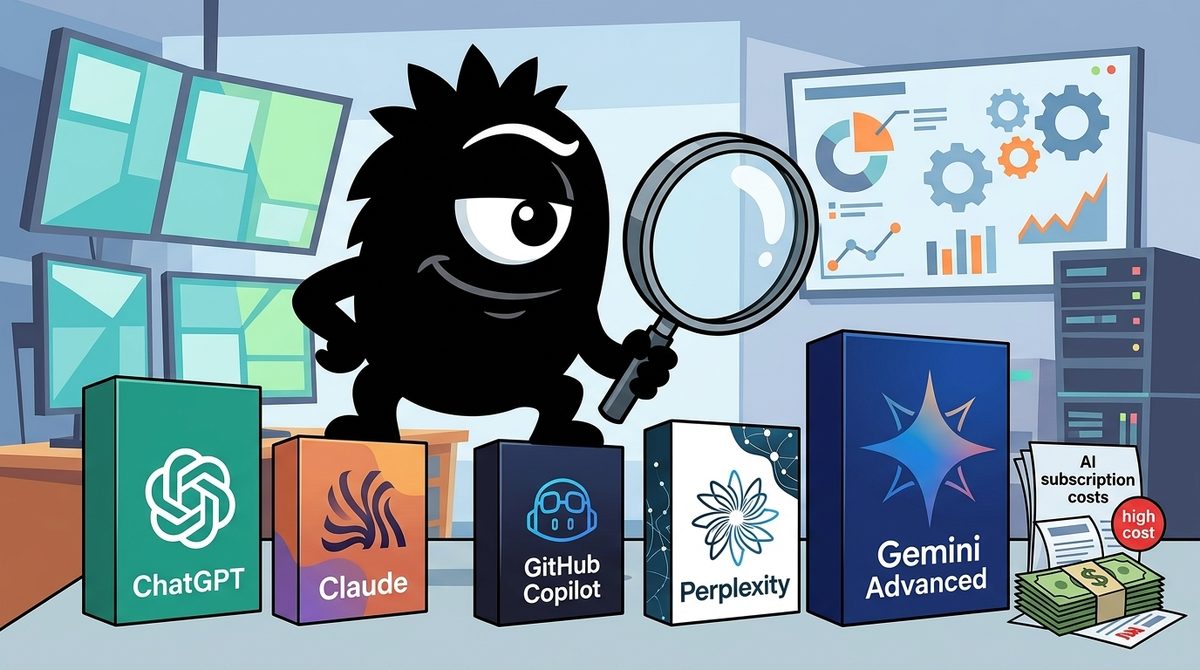
The accidental $100 month starts innocently: ChatGPT Plus for general work, Claude Pro for long-form reasoning, Gemini Advanced for Google integration, Cursor Pro for coding, and Perplexity for research. At roughly $20 each, five individually defensible purchases become a three-figure recurring expense.
ChatGPT Plus. Claude Pro.
Gemini Advanced. Cursor Pro. Perplexity.
That's $100+/month in AI subscriptions.
AI isn't replacing my job.
It's replacing my salary.
That line—“AI isn’t replacing my job. It’s replacing my salary”—captures the value anxiety. The tools may make work faster, but the buyer often cannot tell whether the gain is accruing to them, their employer, or the vendors collecting monthly fees.
This is not limited to a few conspicuous power users. A 2025 Bango survey reported that Americans had an average of four AI-based subscriptions costing about $66 per month.[7] The average also hides an extreme upper tier of developers and operators running multiple high-capacity accounts.
my AI subscriptions:
1. 2 x Claude Code Max x20 - $400
2. GPT Pro x5 - $100
3. Super Grok - $30
4. Gemini Pro - free
5. Nous Research - free
tax fee 16%, total ~ $615
I added another Claude Code Max x20 subscription
- that’s roughly 4 days of continuous operation
The same pattern appears inside companies. AI-native spending can expand quickly because usage is fragmented across software subscriptions, model APIs, coding assistants, seat-based plans, and consumption overages. One analysis reported AI-native software spending up 393% year over year and said 78% of surveyed businesses had experienced surprise AI charges.[11]
The important number, therefore, is not the sticker price of one chatbot. It is the fully loaded AI stack:
- Individual subscriptions
- Taxes and regional pricing
- API and token charges
- Duplicate team seats
- Usage-based overages
- Time spent moving context between tools
- Work delayed when a model hits an unexpected limit
That last category explains why even expensive subscriptions can feel cheap during a deadline—and wasteful when reviewed at the end of the month.
Why Does “I’ll Cancel After This Project” Almost Never Work?
AI subscriptions become sticky when they cross from experimentation into workflow. A coding assistant stops being optional after its first successful multi-file edit. An agent becomes difficult to drop after it completes an overnight task. A chatbot becomes habitual after users accumulate custom instructions, project history, saved prompts, and a preferred interaction style.
Time until an AI coding tool becomes a $20/month habit
ChatGPT — day 1
Claude — first real refactor
Cursor — first multi-file edit
Codex / Claude Code — first overnight run
Gemini — when it finally works in your repo
Local model — when the 32GB laptop arrives
“I’ll cancel after this project” — never The free tier is the demo.
The subscription starts when the tool touches production.
Which one did you fail to cancel?
The free tier may demonstrate capability, but production use creates switching costs. These are not necessarily contractual lock-ins. They are operational:
- Context lock-in: conversations, uploaded files, projects, and memories live inside one service.
- Configuration lock-in: custom instructions and integrations take time to reproduce.
- Muscle-memory lock-in: users learn how to prompt around one model’s strengths and weaknesses.
- Workflow lock-in: colleagues begin expecting output in a format produced by a particular tool.
- Risk lock-in: canceling feels dangerous immediately before the next deadline.
This is why cancel-and-restart behavior has become a coping mechanism. Subscription-fatigue research cited for 2026 says 53% of Americans cancel and later restart services.[9] With AI products, restarting lets users follow whichever model is currently strongest without committing permanently—but it also creates administrative overhead and recurring fear of losing access at the wrong moment.
The broader complaints collected from AI users suggest fatigue is often driven less by missing features than by workflow friction, shifting limits, fragmented interfaces, and difficulty understanding what each plan includes.[8] A tool does not need to be bad to deserve cancellation. It only needs to duplicate a capability that another paid product already covers adequately.
A practical test is: If this subscription disappeared tomorrow, which recurring deliverable would become slower or worse? If the answer is vague, the tool is probably optional.
Why Did Claude’s Limits Become a Trust Problem?
The backlash around Claude illustrates why subscription cost is not simply a monthly dollar amount. Users are also buying predictability: expected model access, usable capacity, stable behavior, and enough disclosure to plan work.
One widely circulated post bundled together allegations about quantization, model availability, retention, repository takedowns, unclear weekly caps, reduced Max limits, and degraded-quality incidents:
i cancelled my Claude subscription, and you should too. why?
> 1.58-bit quantized models during daytime
> plus not getting opus 4 in claude code
> max plans limits cut in half 8 weeks ago, no comms
> weekly limits without concrete numbers
> 5x/20x plans being actually 3x/8x of plus
> DMCA takedowns of repos that have to do with Claude Code
> windsurf no access to claude 4
> cutting off openai api access
> "DEGRADED QUALITY" models incidents that they only acknowledged after being called, and out without providing any further information, support, or refunds
> 5 years retention of all conversations and code, all data will be used for training
and this list doesn't even cover all of it, just a few examples
don't give this PoS company your money
Those claims should not be treated as an independently verified audit. But the intensity of the response matters because it reveals the buyer’s real contract with an AI provider: “I will adapt my workflow to your product if you tell me clearly what I am getting.”
Opaque limits break that bargain faster than a straightforward price increase. If a plan promises “5x” or “20x” usage but the baseline, reset period, model-specific weighting, and congestion behavior are unclear, buyers cannot calculate value. Pricing comparisons in 2026 show that headline monthly rates frequently conceal meaningful differences in capacity, supported models, and restrictions.[4]
The problem becomes sharper when perceived output quality changes. Content creators may care less about benchmark leadership than whether a model consistently matches their preferred voice:
I just canceled my Claude Pro plan!
I mainly create content, and I’ve found that no matter how hard I try, Claude’s writing performance is always inferior to ChatGPT’s.
Have you had a similar experience?
This does not prove that ChatGPT is universally better at writing. It shows that model quality is task- and user-dependent. A developer may tolerate stylistic weakness in exchange for better repository work; a creator may cancel immediately if editing the output takes longer than writing from scratch.
The competitive lesson extends beyond Anthropic. As AI features become a software-wide “AI tax,” providers must explain what is included, what can change, and how usage is measured.[12] Transparency is now a product feature. A nominally generous plan with uncertain limits may be less valuable than a smaller but predictable allowance.
Is One Expensive AI Plan Better Than Four $20 Subscriptions?
An emerging response to subscription fatigue is to test broadly, then consolidate aggressively. Instead of retaining four entry-level plans “just in case,” some users are moving to one higher-capacity subscription.
Team #OpenAI since day 1. I subscribed to Gemini, Claude, Perplexity, and ChatGPT for a year ($20 tier each) just to test the others fairly. I'm now at the $100 tier of ChatGPT and have canceled all others. THE best daily use chat bot/LLM by far.
View on XThe economic logic is reasonable. Four $20 plans provide model diversity, but each may have a relatively restrictive allowance. One $100 or $200 plan may provide more headroom in the tool used for most daily work, fewer context switches, and one billing relationship.
Another user described frequent usage resets and perceived capacity—not simply model quality—as the tipping point away from Claude:
lol I cancelled today. Gpt 5.6 is a damn work horse. And we get usage resets there so often. I have upgraded to their pro plan.
I loved Claude but I cannot pay for such restricted access to a good model when others are offering similarly capability at much higher usage rates and for the same amount.
The reference to “GPT 5.6” reflects that poster’s description and experience, rather than independent evidence of comparative performance. The important point is that availability often beats theoretical capability. A strong model that is inaccessible after a limit is reached has no marginal value during the rest of the workday.
Consolidation fits users who:
- Spend most of their time in one interface
- Regularly hit entry-tier limits
- Use the tool for revenue-producing work
- Do not need independent model verification
- Value retained context and consistent workflows
It is a poor fit when tasks are genuinely specialized. Research with citations, repository-scale coding, image generation, office-suite integration, and polished long-form writing may still be better served by different products. Current comparison guides emphasize that no single subscription leads every category.[1][6]
The trade-off is concentration risk. If the chosen service changes limits, degrades for a particular task, or suffers an outage, the user has no paid fallback. Consolidation lowers the visible bill but increases dependence on one vendor.
What Do the Major AI Subscription Tiers Actually Cost in 2026?
AI pricing in 2026 has developed a two-step shape. Consumer entry tiers cluster around $20 per month, while heavy-user tiers jump to approximately $100–$200 or more. Across a wider market of 295 tools, however, one pricing index places the median paid plan near $16 per month, making the major power tiers premium outliers.[3]
Published comparison pages indicate the following general pricing structure as of 2026.[5][2] Exact availability, taxes, regional prices, promotions, and usage policies can change.
| Service | Common paid tiers | Best fit | Main pricing risk |
|---|---|---|---|
| ChatGPT | Plus around $20; Pro around $200 | General chat, analysis, multimodal work, heavy daily use | Paying for capacity that remains unused |
| Claude | Pro around $20; Max around $100 or $200 | Long documents, coding and users who prefer Claude’s outputs | Variable or difficult-to-forecast limits |
| Gemini | Advanced/Google AI tier around $20 | Users invested in Google’s ecosystem | Paying for overlap with existing Workspace features |
| Perplexity | Pro around $20 | Search-led research and source discovery | Redundant if research is occasional |
| GitHub Copilot | Individual tiers starting below or around the $20 cluster | Developers working primarily inside supported IDEs and GitHub | Separate agent or premium-request limits |
| Midjourney | Multiple tiers from entry to high-volume plans | Dedicated image generation | Idle subscription between creative projects |
Price alone cannot compare these plans. Buyers must determine whether the service uses:
- Flat access with rate limits — simple billing, uncertain practical capacity.
- Consumption metering — precise payment for usage, but potentially volatile bills.
- Tiered multipliers — predictable monthly fees, but only if the multiplier’s baseline is clear.
- Seat pricing — manageable for individuals, expensive when duplicated across teams.
- Hybrid limits — a subscription plus premium requests, credits, or API charges.
I've actually never used the free version of any AI. Apart from Claude Pro (which I cancelled recently), I'm currently on Codex $200/m Pro and Cursor $200/m Pro, and Gemini Plus. I'm a heavy user.
View on XHeavy users can rationally pay $200 for multiple tools. But “heavy user” should mean sustained production use, not enthusiasm. If a $200 coding plan saves eight billable hours each month, the case may be straightforward. If it mainly removes anxiety about future limits, it is expensive insurance.
When Is Paying for Two AI Models Actually Worth It?
Not all stacking is bloat. Two models can review each other’s output, expose different assumptions, and catch errors that a single system repeats confidently.
Have you ever used them together? You will be surprised by how much they catch when one reviews the other. I had the $100 sub for both before I replaced Claude with the $200 ChatGPT sub for 20x weekly usage. But I miss using both and might dig up another $100 and resubscribe.
View on XCross-review has the highest value when the cost of an unnoticed error is high:
- Security-sensitive code changes
- Database migrations
- Contract or policy analysis
- Financial calculations
- Public claims based on research
- Architecture decisions that are expensive to reverse
Even then, agreement between two models is not proof of correctness. Models can share training patterns, repeat the same misconception, or accept a flawed premise. Human review, tests, primary sources, and domain-specific verification remain necessary.
Redundancy is harder to justify for low-stakes work such as routine email drafts, brainstorming, text cleanup, or boilerplate generation. In those cases, a second subscription may be anxiety-driven over-buying: paying monthly because another model might produce a slightly better answer.
Use marginal value per dollar rather than fear of missing out. During a 30-day evaluation, record how often the second model:
- Caught a consequential problem
- Produced an output the primary model could not
- Prevented paid rework
- Saved enough time to exceed its fee
If those events are rare, use an API, a free tier, or one month of temporary access for critical projects instead.
This discipline may eventually be automated. Subscription-auditor agents could inspect usage, overlap, and renewal dates, then recommend downgrades or cancellations.[10] That creates an unusual future: paying an AI service to determine which other AI services should stop receiving money.
How Can You Audit and Cut an Overlapping AI Stack?
The most revealing AI-spend post in this conversation is also the simplest diagnosis: the stack has become operationally absurd.
In last 30 days I literally spent more than 1100 USD on AI subs
2x Claude 200$+tax
2x Claude science 15$+tax
1x ChatGPT plus : 20$
3z ChatGPT pro : 200$
1x Poe : 10$
1x Gemini : 20$
Man this is getting out of hand.
We really need a cheap model that can use computer good
A practical audit should take less than an hour each month.
1. Inventory every AI cost
Include chatbot plans, coding assistants, image tools, note-taking features, meeting transcription, API invoices, mobile subscriptions, taxes, and AI add-ons embedded in existing SaaS. Enterprise surprise charges often arise because no one sees the consolidated number.[11]
2. Mark which tools touched production
For each subscription, record whether its output was used in shipped code, client work, published content, a decision, or a repeatable internal process. “I opened it several times” is not evidence of value.
3. Identify capability overlap
Classify tools by primary job: chat, coding, research, image generation, automation, transcription, or office integration. If three products occupy the same category, choose a default and require the others to demonstrate a distinct advantage.
4. Compare savings with total friction
Measure editing time, retries, context transfer, limit interruptions, and verification—not merely output speed. User complaints in 2026 show that operational friction is a central part of AI fatigue.[8]
5. Consider local or open models selectively
Local models can make sense for high-volume, privacy-sensitive, or repetitive tasks, particularly when the user already owns suitable hardware. They are not “free”: hardware, electricity, setup, updates, evaluation, and security all carry costs. They fit technically capable users with stable workloads better than beginners seeking a turnkey assistant.
6. Make renewals opt-in
Set calendar reminders before renewal dates and impose a hard personal or team budget. Any new subscription must replace an existing tool or demonstrate a separate production use case. Temporary cancellation is a valid procurement strategy, not a failure of loyalty.
Who Should Pay for Which AI Tools in 2026?
There is no universal winning stack, but there are defensible defaults.
Solo developers: Start with one coding-centric tool and one general model only if their roles are distinct. Choose a higher tier when limits repeatedly interrupt paid work. Add a second model temporarily for security reviews, migrations, or major releases—not as a permanent reflex.
Content creators: Pay for the model whose drafts require the least rewriting and best match the intended voice. Benchmark claims matter less than edit distance, factual reliability, and consistency. If one model repeatedly loses your preference test, cancel it.
Researchers and analysts: Prioritize a research-oriented service such as Perplexity Pro or an ecosystem-integrated option such as Gemini when source discovery is the dominant workflow. Do not stack general chatbots unless independent synthesis materially improves decisions. Comparison guides continue to distinguish search and citation workflows from general-purpose chat.[1][6]
Founders and small teams: Centralize purchasing before reimbursing multiple personal stacks. Use seat inventories, API budgets, and named owners for each tool. A $20 experiment is harmless; 20 uncoordinated experiments are a procurement problem.
Heavy power users: One premium plan can be better than several entry plans when usage headroom is the binding constraint. Validate that assumption with monthly usage and output records rather than self-identification as a “power user.”
Occasional users and beginners: Stay on free tiers until a recurring limitation blocks a real task. The purpose of paying is not to access every frontier model. It is to remove a specific constraint.
Finally, revisit the decision every quarter. AI pricing, model quality, limits, and integrations move too quickly for an annual set-and-forget stack. The real cure for subscription fatigue is not finding one permanently superior model. It is building a procurement habit strong enough to cancel yesterday’s winner when it stops earning its place.
Sources
[1] What AI subscriptions cost in 2026 and which one is worth it — Notebookcheck
[2] AI Models Pricing & Benchmarks Comparison — CloudPrice
[3] AI Tool Pricing Index — Q3 2026 Edition — AITrendTool
[4] AI Subscription Pricing Compared — AI Pricing Guru
[5] AI Pricing Cheat Sheet: Compare ChatGPT, Claude, Gemini, and More — eWeek
[6] AI Tool Pricing Comparison 2026 — OneHuman
[7] Bango: Americans juggling four AI-based subscriptions on average, and costs are growing — The Desk
[8] State of AI Tools 2026: What Real Complaints Reveal About AI Tool Fatigue — BigIdeasDB
[9] Subscription Fatigue Statistics 2026 — Readless
[10] Subscription Fatigue Isn’t the Threat — AI Subscription Auditors Are — Finsi
[11] AI Is the Most Expensive Worker Nobody Hired — SaaS Intelligence
[12] Every Software Tool You Use Just Got an AI Tax. Are You Paying It? — Forbes
References (15 sources)
- What AI subscriptions cost in 2026 and which one is worth it - Notebookcheck Review - notebookcheck.net
- AI Models Pricing & Benchmarks Comparison - 1900+ LLM Models | CloudPrice - cloudprice.net
- AI Tool Pricing Index — Q3 2026 Edition | AITrendTool - aitrendtool.com
- AI Subscription Pricing Compared | AI Pricing Guru - aipricing.guru
- AI Pricing Cheat Sheet: Compare ChatGPT, Claude, Gemini, and More | eWeek - eweek.com
- AI Tool Pricing Comparison 2026 | OneHuman - onehuman.io
- Bango: Americans juggling four AI-based subscriptions on average, and costs are growing - thedesk.net
- State of AI Tools 2026: What Real Complaints Reveal About AI Tool Fatigue - bigideasdb.com
- Subscription Fatigue Statistics 2026 (35+ Sourced Stats) - readless.app
- Subscription Fatigue Isn't the Threat — AI Subscription Auditors Are - finsi.ai
- AI Is the Most Expensive Worker Nobody Hired - saasintelligence.substack.com
- Every Software Tool You Use Just Got An AI Tax. Are You Paying It - forbes.com
- The State of Consumer AI: 2026 Statistics & Trends | Menlo Ventures - menlovc.com
- How much does it cost to be AI-pilled? - ramp.com
- Australians spend $4.02m monthly on AI subscriptions: Westpac - asianbankingandfinance.net
Related Guides
The Best AI Model Tools in 2026: An Expert Comparison Through a $3.5M Prediction Market
21 min read
The Best Developer Experience Tools in 2026: An Expert Analysis of What Actually Works
27 min read
The Best AI Bubble Signals in 2026: What Polymarket's 13% Odds Reveal About AI and SaaS
22 min read
The Best AI Agent Frameworks and Workflows in 2026: An Expert Analysis
26 min read