The Best AI Agent Frameworks and Workflows in 2026: An Expert Analysis
AI agents in 2026: compare LangChain, CrewAI, AutoGPT and AutoGen, understand the harness debate, and see why production reliability lags benchmarks. Learn more.
The Agentic Moment: Why 2026 Is Different
The practical question in 2026 is no longer whether an LLM can call a tool. It is which AI agent framework can turn model capability into a reliable, testable workflow—and whether an agent should be used at all.
The short answer: use agents for open-ended work that requires judgment, adaptation, and multiple tools. Keep deterministic code in charge of business rules, permissions, calculations, and irreversible actions. For serious deployments, the framework matters less than the surrounding harness: context management, validation, state, observability, retries, and human approval.
Bottom line for 2026
>
- LangGraph/LangChain fits engineering teams that need control, testing, observability, and long-running workflows.
- CrewAI fits prototypes and role-based multi-agent collaboration where speed matters more than deep infrastructure.
- AutoGen fits experimental, conversational multi-agent systems; AutoGPT remains more useful as an autonomy pattern than a default enterprise architecture.
- Low-code tools are good for proving a workflow, but domain-heavy production agents usually migrate to code.
- Evaluate on private tasks and completed actions—not public benchmark scores, demos, or GitHub stars.
An AI agent is typically an LLM equipped with some combination of planning, memory, tools, state, and authority to perform a multi-step task. An agentic workflow is the larger process around it: triggers, data retrieval, tool calls, decision points, approvals, retries, and outputs. Microsoft’s description of autonomous agents similarly emphasizes systems that act across business processes rather than merely return text.[2]
The optimism is easy to understand:
Agents are stepping stone towards AGI as they do things
By automating work, agents remove the human in the loop
LLMs need a lot of spoon-feeding today to be part of agentic workflows
In 2025 and beyond, Agentic LLMs will have access to thousands of tools and will be able to perform complex tasks with just one prompt
Over the next 3-6 months we’ll begin to see AI agents reliably make their way into day-to-day coding workflows.
OpenAI’s o1 model is the 1st model to really take these workflows from toys to tools.
Individual devs will soon have their own team of agents working on their behalf.
But the claim that agents are moving from “toys to tools” needs qualification. Deloitte projected that 25% of companies using generative AI would launch agentic pilots or proofs of concept in 2025, rising to 50% by 2027.[4] A pilot, however, is not the same as unattended production automation.
The most defensible position is therefore hybrid:
Current trend favors agentic AI: multi-step autonomous agents (OpenAI Agents API, Claude, Atlassian) for coding and workflows, delivering real productivity lifts on open-ended tasks.
Building an internal agentic "dev house" is rational to accelerate your SaaS development. For the warehousing apps themselves, prefer deterministic tooling with LLM analysis for core logic reliability. Hybrid approach is the practical path.
That distinction—autonomy for open-ended work, deterministic software for core logic—is the foundation for evaluating every framework in this article.
Why Do Agents Ace Benchmarks but Fail in Production?
The most important agent story of 2026 is not rapidly rising benchmark scores. It is the discovery that many benchmarks measure an easier problem than production systems present.
Public coding tests often provide a bounded repository, a clear issue, accessible tests, and conventions represented in the model’s training data. Private codebases contain undocumented business rules, internal abstractions, stale documentation, cross-service dependencies, and organizational assumptions that may never have appeared on the public internet.
One widely circulated account of testing on private production repositories reported a best result of 38.8%:
Coding agents look incredible on public benchmarks.
Then you drop them into a private production codebase and ask them to work without human help.
Specific Labs tested frontier models on real company repositories filled with business rules, internal conventions and dependencies the models had never seen before.
The best result was just 38.8%.
• Fable 5.1: 38.8%
• GPT-6 Astra: 33.8%
• Gemini 3.8 Flash: 31.2%
• GPT-5.6 Sol: 16.2%
Six of the ten tasks had a success rate below 15%.
The agents weren’t failing because they couldn’t write code. They struggled to find the right context, understand undocumented business logic and change multiple systems without breaking something else.
If the best coding agent can solve only 38.8% of real production tasks without human help, how close are we really to replacing software engineers entirely?
The point is not that coding agents cannot write code. It is that code generation is only one stage of software maintenance. The harder tasks are locating the relevant context, inferring hidden constraints, coordinating changes, and proving that nothing else broke.
Browser agents show the same pattern. In the ClawBench results described by the Chinese technology outlet Jiqizhixin, sandbox performance of 65–75% gave way to dramatically lower success on live websites with authentication, pop-ups, dynamic interfaces, and unpredictable state. Its English translation summarizes the central problem: the jump from “AI can use a browser” to “AI can actually do your work” remains large.
Can AI agents actually book your flight, file your expense report, and submit your job application — on real, live websites?
The MMLU-Pro authors, together with TIGER Lab (Waterloo), UBC NAIL Group, UniPat AI, and CMU, present ClawBench.
Existing web agent benchmarks run in sandboxes with fake, static websites (WebArena) or a handful of VM applications (OSWorld) — where frontier models score 65–75% and look ready for deployment. ClawBench is different: 144 real production websites, 153 everyday online tasks, no sandbox, no static pages. The agents must navigate authentication, dynamic content, pop-ups, and real-world UI complexity exactly as a human would.
Result: The strongest model, Claude Sonnet 4.6, fails two out of every three tasks — just 33% success. GPT-5.4 manages only 6.5%, completing 10 of 153 tasks. Most strikingly, 68 of 153 tasks (44.4%) are solved by zero models — not one. ClawBench reveals that the gap from "AI can use a browser" to "AI can actually do your work" remains enormous, and current benchmarks have been masking it.
ClawBench: Can AI Agents Complete Everyday Online Tasks?
Paper: https://t.co/pE8x83aLrk
Code: https://t.co/exjXUQTb3d
Project: https://t.co/jezPLpVF7B
Our report: https://t.co/x6k860VUGU
📬 #PapersAccepted by Jiqizhixin
The useful metric is completed action, not a plausible answer
CommerceAgentBench represents an important change in evaluation philosophy. Instead of grading whether the final response sounds correct, it inspects resulting state: whether an email label was applied, a draft saved, a calendar event created, or a valid identifier generated.
I spent the morning going deep on a new benchmark and it genuinely changed how I think about “AI agents are ready for real work.”
It’s called CommerceAgentBench, built by the Accio team (part of Alibaba International). Open source, 107 tasks, already past 1,000 stars on GitHub. But the number that matters isn’t the task count, it’s how it grades.
Most agent benchmarks score you on whether your final answer sounds right. This one doesn’t care what the model says at all. It only looks at what got left behind in the system: did a label get applied, did a draft actually save, does a shipment ID exist. You can’t talk your way to a good score here. You either did the work or you didn’t.
And the tasks aren’t invented in a lab. They’re traced back from real usage: 10 million users, 1.6 million actual conversations, 200,000 execution traces, narrowed down to 2,000 high-value workflows and de-identified into the 107 tasks you see today.
Let me walk through one task in detail, because it’s a good example of why this is harder than it looks.
The task: a procurement manager’s Gmail inbox, roughly 300 emails deep. Quotations, spec changes, payment details, all jumbled together with no clean threading. The model has to reconstruct the truth of a live sourcing decision from this mess.
Here’s what makes it genuinely hard:
The same supplier emails from different company names. Different factories share the same name, and suppliers with similar names share nearby addresses. You can’t trust a display name or a domain at face value. You have to cross-check address, phone, and bank account across multiple emails just to figure out who you’re actually dealing with.
Quotes get silently revised. Price, quantity, delivery date, warranty terms, all repeatedly changed across rounds of back-and-forth. The model has to reconstruct which version is actually the final valid one, without anyone telling it directly.
Nothing is standardized. Six different Incoterms, four currencies, a pile of surcharges, and all of it has to get converted into one comparable per-unit landed cost before suppliers can even be ranked against each other.
And somewhere in the noise, there’s a BEC payment-redirect scam: an email disguised to look legitimate, asking to reroute payment. The model has to catch it without flagging real vendor emails as fraud. Miss it, and money gets sent to the wrong account. Over-flag it, and you’ve broken a real business relationship.
Once the model figures out who the real supplier is and what the actual final terms are, the job still isn’t done. It has to go act: apply the correct label to the winning supplier’s email, flag the security-review case separately, create the kickoff calendar event, save a reply draft to the exact right email address, and write a structured summary matching a fixed schema. Every one of those steps gets checked against what actually happened in the mailbox and calendar, not against what the model claims it did.
So how are the top models actually doing on this?
Claude Opus 5 leads the pack at 61.7% pass rate on the full 107-task set. Claude Opus 4.8 and 4.7 follow around 52-55%. Everything else, Qwen, GPT, Gemini, DeepSeek variants, clusters in the mid-40s to low-50s.
Read that again: the single best model in the world right now still fails close to 4 out of every 10 of these tasks. Not because the tasks are exotic, but because real business work is messy, contradictory, and punishes overconfidence. An agent that hallucinates a supplier’s identity or misses one scam email doesn’t get partial credit. It fails the task.
This is why I think CommerceAgentBench matters more than another leaderboard number. It’s an honest picture of where we actually are: not “AI runs your business now,” but “AI can meaningfully assist if a human is still making the calls.” The gap between those two is exactly what this benchmark makes visible, task by task.
It’s fully open source, and the Accio team is taking contributions for new mock environments too, if you’re building in this space.
repo:
This exposes failures that conversational evaluations hide. An agent can explain exactly what it intended to do while modifying the wrong record—or modifying nothing.
The broader agent ecosystem is consequently shifting toward evaluations based on traces, tool outputs, state changes, and economic consequences. Insight Partners’ ecosystem analysis likewise treats agent infrastructure, use cases, and economics as connected concerns rather than judging agents solely as model interfaces.[6]
For practitioners, the implication is simple: create a private evaluation set from real work before choosing a framework. Include ambiguous inputs, missing permissions, duplicate entities, outdated records, partial tool failures, and dangerous actions. A leaderboard should help shortlist models; it should not authorize deployment.
Why Harness Engineering Is the Real Reliability Unlock
The agent tooling debate has moved through three phases: prompts, frameworks, and now harnesses.
Prompt engineering tried to encode reliability in instructions. Frameworks abstracted model calls, tools, chains, and memory. Both remain useful, but neither guarantees that an agent will retrieve the right context, recover from failure, or verify its own work.
The pattern I keep noticing: we went through three waves of agent tooling.
First, it was prompts. Everyone raced to write better system prompts, longer context windows, more examples.
Second, it was frameworks. LangChain hit 90K stars in a year. Dozens of orchestration libraries launched. The bet was: if you abstract enough plumbing, agents will work reliably.
Neither moved the reliability needle as far as expected.
What's actually working now is different. Guillermo Rauch put it cleanly: agents are only as good as the proof-checkers, compilers, and linters you give them.
shadcn/lint is the clearest example. Released yesterday, it lets you define design system rules agents must follow. When an agent breaks a rule, the error explains what's wrong, what to use instead, and where to find it. Tested across 150+ task runs. Nearly every task hit zero violations in one correction round. Token cost dropped 10-48% vs. prompt-only approaches.
The comparable thing happened in software engineering. TypeScript didn't make JavaScript more powerful. It made it more constrained. Constraints are what made it scale to teams.
Policy-as-code had the same trajectory in DevOps. Rego, Sentinel, Cedar. Not frameworks for doing things. Systems for defining what's not allowed.
Verifiers + skills are the new primitive. Not frameworks.
A harness is the machinery that turns a probabilistic model into an operational system. Its responsibilities usually include:
- Guidance: project rules, examples, procedures, and constraints.
- Context control: selecting files, records, tools, and prior decisions.
- Execution: invoking tools in a controlled environment.
- Verification: running tests, schemas, linters, or business-rule checks.
- Recovery: retrying, revising plans, or escalating to a person.
- Memory: preserving state and artifacts across steps or sessions.
- Permissions: limiting what the agent can read, write, spend, or execute.
- Observability: recording decisions, tool calls, latency, cost, and failures.
The formula circulating among practitioners is useful precisely because it is reductive:
This is pure f*cking treasure.
ex-Google engineer reveals his AI agent playbook. 14+ years at Google. $0 to read it.
the topic is harness engineering: everything around the model that lets it execute, check its work and recover when something breaks.
one example in his breakdown deserves attention.
LangChain’s coding agent went from 52.8% to 66.5% on Terminal-Bench 2.0. the model stayed the same. the team changed the prompts, tools and machinery around it.
Agent = Model + Harness.
the system has six practical jobs:
> guides give the agent project rules, constraints and examples
> sensors check its work through tests, linters and validators
> the loop handles execution, verification, retries and escalation
> memory preserves state, artifacts and decisions
> permissions control which tools and actions are allowed
> observability records tool calls, costs and failures
The reported Terminal-Bench improvement—from 52.8% to 66.5% without changing the underlying model—illustrates why model selection alone is an incomplete optimization strategy. Better tools and feedback loops can produce a larger operational gain than swapping models.
LangChain’s Deep Agents is one example of an opinionated harness. It packages planning, filesystem operations, shell execution, subagent delegation, summarization, and context management rather than asking every team to assemble those pieces independently.
LangChain just open-sourced Deep Agents—an agent harness that’s opinionated and ready-to-run out of the box.
Instead of wiring up prompts, tools, and context management yourself, you get a working agent immediately and customize what you need. It’s an MIT-licensed system that’s perfect for anyone trying to understand how high-end coding agents are structured. @LangChain
What’s inside the harness:
- Planning: write_todos for task breakdown and progress tracking.
- Filesystem: Full context control via read_file, write_file, edit_file, ls, glob, and grep.
- Shell Access: execute for running commands (with sandboxing).
- Sub-agents: task tool for delegating work with isolated context windows.
- Smart Defaults: Optimized prompts that teach the model how to use these tools effectively.
- Context Management: Auto-summarization for long threads and large outputs saved directly to files.
Link in the comments
Microsoft’s documentation frames agentic workflows in similarly orchestration-oriented terms: models and agents participate inside workflows whose surrounding logic controls how tasks proceed.[5] The practical lesson is not that every team should use Deep Agents. It is that every production team needs to identify who owns each harness responsibility, whether supplied by a framework or built internally.
Should You Choose Code-First or Low-Code Agent Orchestration?
Low-code builders are valuable when the goal is to validate a workflow quickly. They make triggers, branches, model calls, and integrations visible, letting operations teams prototype without first building an application platform.
They become less attractive when the workflow acquires domain-specific logic, long-running state, complex permissions, custom testing, or frequent code review. At that point, the visual graph is effectively a program—but often without the mature tooling developers expect around programs.
Jerry Liu’s position captures where much of the technical conversation has landed:
Low-code is nice, but if I had to bet on a future, it’s code-based orchestration + coding agents to let anyone bridge that gap.
OpenAI’s AgentKit (left img) lets you get started building various flows, like comparing docs, or a basic assistant. Once you need to encode more domain-specific logic/fetch from a data source/create a longer-running agent, you’ll need to export to code and maintain your own workflow.
I’m bullish on building advanced agents over your data that live natively on top of a code-based orchestration framework (right two images). We’ve built core tools in @llama_index to help enable building code-based agentic workflows and then deploying them. You can easily get started through a vibe-coding tool or through our templates, but then you get the full flexibility to add whatever you want on top. You get the underlying benefits of agentic orchestration: state management, checkpointing, human-in-the-loop.
We’ve also been super deep in coding tools like Claude Code/Cursor/Codex to make sure you’re able to build these automations super easily.
With our latest alpha release of LlamaAgents, you can build whatever workflow you want in code and deploy it as an e2e agent on LlamaCloud! Come check it out 👇
Choose low-code when:
- A small team is validating a narrow internal workflow.
- Actions are reversible and human-reviewed.
- Integrations are standard and logic is relatively shallow.
- Deployment speed matters more than portability.
- Non-engineers need to inspect or modify the flow.
Choose code-first orchestration when:
- The agent touches production systems or sensitive data.
- Interfaces and outputs need static types or schema enforcement.
- Nodes require unit, integration, and regression tests.
- Work can pause, resume, branch, or run for long periods.
- You need version control, deployment promotion, and auditability.
- Domain logic is too important to live primarily in prompts.
The likely future is hybrid: visual tools generate or edit an initial flow, coding agents help non-specialists modify it, and engineers retain a code representation for testing and operation. Comparisons of current frameworks consistently distinguish LangGraph’s explicit graph control from CrewAI’s higher-level, role-oriented abstractions.[10] The right abstraction depends on whether your bottleneck is initial assembly or sustained maintenance.
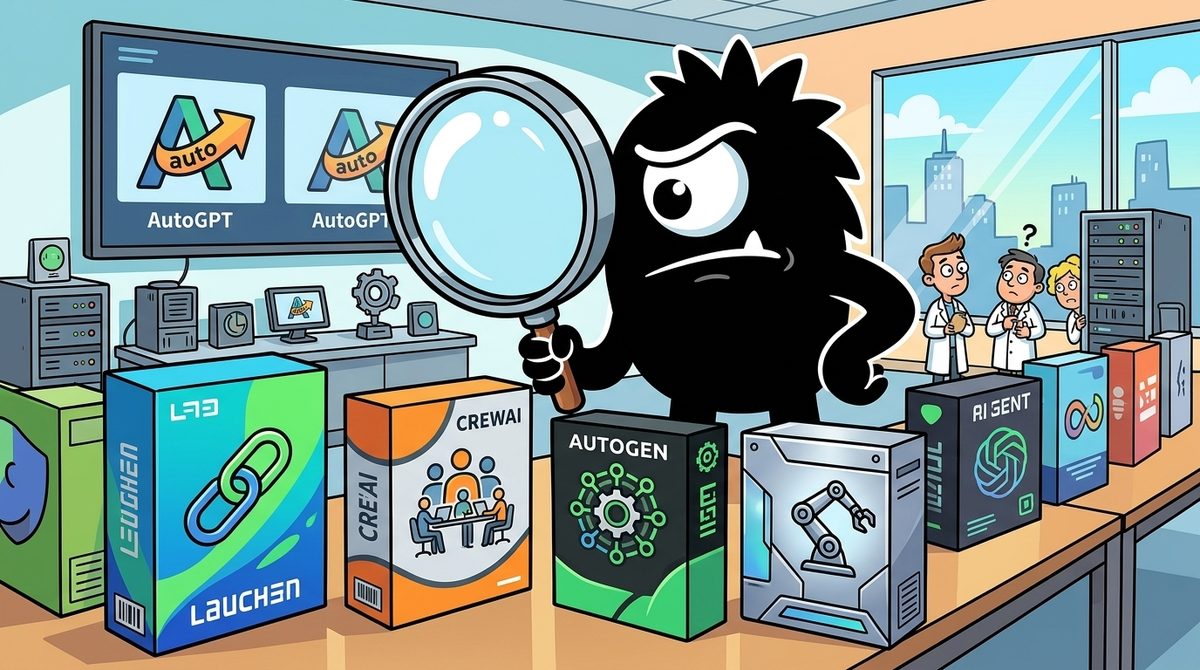
How Should You Choose Between LangChain, CrewAI, AutoGPT, and AutoGen?
Feature checklists and GitHub stars are weak selection methods. The better starting point is the job: How quickly can your team delegate real work, and how safely can it keep that work running?
The debate about which multi-agent harness is best misses the actual question.
The question is: how quickly can you go from zero to five agents working in parallel without spending a week wiring things together?
One ranking: 1) Hermes, 2) OpenClaw, 3) OpenCode, 4) Pi. The criterion was not benchmark performance. It was time-to-delegation.
AutoGen has 32K GitHub stars. LangGraph has 8.2K. Star counts tell you nothing about how long it takes to put multiple agents to work on different parts of a problem simultaneously.
The frameworks with the most documentation are often the hardest to use for multi-agent work. They were designed for single-agent workflows and bolt on multi-agent as a feature. The ones ranked highest make multi-agent the default assumption.
If you are evaluating frameworks and running benchmarks before you have five agents working in parallel doing real work, you are optimizing for the wrong thing.
Start with: can I get five agents running in parallel in under an hour, on a real problem, without reading a tutorial? That filters the list faster than any benchmark.
“Time-to-delegation” is especially useful for multi-agent systems. Measure how long it takes to assign independent subtasks, isolate context, collect results, handle one failed worker, and inspect the combined trace. A framework that looks elegant in a tutorial may still impose substantial coordination work.
LangChain and LangGraph: best for controlled production systems
Choose this ecosystem when engineering control and operational visibility are priorities. LangGraph models workflows as stateful graphs, making branching, checkpoints, human intervention, and explicit transitions easier to represent. LangSmith adds tracing and evaluation around those runs.
Best fit: platform teams, regulated workflows, long-running processes, and organizations willing to operate agents as software.
Tradeoff: the ecosystem’s breadth can create conceptual and implementation overhead. Teams still need to design state, tool contracts, evaluations, and failure policies.
CrewAI: best for fast role-based delegation
CrewAI organizes systems around agents with roles, goals, and tasks. That mental model maps naturally to workflows such as researcher–writer–reviewer or planner–executor–auditor.
Best fit: solo developers, small teams, internal prototypes, and use cases where parallel role delegation is the primary requirement.
Tradeoff: role descriptions do not remove the need for deterministic state and verification. As workflows become deeply conditional or transactional, teams may need lower-level orchestration. Current framework comparisons generally position CrewAI as the faster entry point and LangGraph as the more controllable architecture.[8][9]
AutoGen: best for conversational multi-agent experimentation
AutoGen centers on interactions among agents, models, tools, and potentially humans. It is a sensible option for research-style systems in which iterative conversation is itself the coordination mechanism.
Best fit: experimentation, simulations, research teams, and complex collaborative reasoning.
Tradeoff: conversational flexibility can make execution paths, cost, and termination harder to predict. Production use requires strict boundaries around loops and tool permissions.
AutoGPT: best treated as an autonomy reference pattern
AutoGPT helped popularize the idea of an LLM planning and executing toward a broad goal. In 2026, its enduring value is conceptual: goals, task decomposition, memory, tools, and iterative execution.
Best fit: autonomous-task experiments and developers studying agent-loop architecture.
Tradeoff: broad autonomy is usually less valuable to enterprises than narrow, observable workflows. Comparative guides increasingly favor more structured frameworks for production applications.[11][12]
Tool-use evaluation remains essential across all four options:
⚙️ Agents are the “killer” LLM app, but building and evaluating agents is hard.
A huge part of agents is tool use, but there aren't enough open-source tool use benchmarks out there.
Today, we are excited to release four new test environments for benchmarking LLMs’ ability to effectively use tools.
📖 https://t.co/OIj3cZfzt5
🧵 Below are some of our preliminary results
Before committing, run the same private tasks through each candidate and record setup time, successful state changes, human interventions, retries, cost, latency, and failure diagnosability.
What Do Working Enterprise Agents Actually Look Like?
Successful deployments look less like free-roaming digital employees and more like well-instrumented internal applications with bounded autonomy.
Coinbase’s reported approach is instructive. Its enterprise team created a “paved road”: standardized infrastructure through which other teams could build agents using code-first graphs, typed interfaces, unit-testable nodes, tracing, and immutable audit records.
⚡ Building enterprise agents at Coinbase with LangSmith ⚡
Coinbase went from zero to production AI agents in six weeks, then cut future build time from 12 weeks to under a week.
Their Enterprise AI Tiger Team built a "paved road" so any team could ship agents the same way they ship code.
What made this work:
→ Code-first graphs with LangGraph & LangChain over low-code tools. Typed interfaces and unit-testable nodes beat prompt engineering for the use cases they wanted to scale.
→ Observability as a requirement. Every tool call and decision gets traced using LangSmith, our agent engineering platform.
→ Auditability by design. Immutable records of data used, reasoning followed, and approvals given.
Result: Two agents in production saving 25+ hours per week. Four more completed. Half a dozen engineers now self-serve on the patterns.
Agents are a software discipline. When you host them properly, make them observable end-to-end, and test what's deterministic, you get speed where it helps and rigor where it matters.
Read more:
The important outcome is not merely that one agent shipped in six weeks. It is that subsequent build time reportedly fell from 12 weeks to under a week. That is a platform effect: reusable authentication, deployment, observability, approval, and evaluation patterns reduce the cost of every later agent.
LangChain’s paid media agent shows another production pattern: treat the agent like a knowledge worker, but give it a controlled workstation. According to the shared account, the system uses a sandboxed micro-VM, layered context, deterministic computation, a parent agent with platform-specific subagents, and Slack approvals.
TL;DR LangChain built an agent to run its own paid ad program, designed around "treat the agent like a knowledge worker." In 6 months it grew paid media's pipeline contribution from 0% to 20%.
Title: How We Built LangChain's Paid Media Agent
URL: https://www.langchain.com/blog/paid-media-agent
Points
🖥️ Deep Agents plus a sandboxed micro-VM give the agent the same equipment a human analyst would have
📚 Context is organized in 5 layers: system prompt, skills, internal wiki, 218 live tools, and deterministic code
🧮 Switching to "judgment stays with the model, computation moves to code" cut reporting token costs 40x
🔍 Instead of loading all 218 tool definitions upfront, dynamic search-then-read cut tokens to a quarter with no quality loss
🧩 Splitting into a parent agent plus per-platform subagents keeps failures cleanly isolated
✅ A Slack approval card built on Block Kit lets humans review, edit, and approve changes before they execute
📈 Cost-per-lead dropped 30% over 3 months while ad spend grew roughly 60%
I think these design principles for internal-ops agents transfer well to plenty of other domains.
#AIAgents #Marketing
The phrase “judgment stays with the model, computation moves to code” is particularly valuable. Models can interpret campaign performance and propose actions; ordinary code should calculate metrics, enforce budgets, and validate payloads.
The agent also serves as a collaborative interface rather than an invisible background process:
Excited to share more of the Paid Media Agent we built @LangChain
It runs our weekly campaign analysis and reporting, connects ad spend to leads and pipeline, and lets the team work through campaign questions and changes together in Slack
This is part of our GTM engineering series, where we’re sharing how we build and use agents internally.
We’re also doing a live webinar to walk through how our marketing team uses it, how we built it, and what we learned along the way.
Join us on September 23! 👇
LangChain’s broader survey found that agent builders consistently care about performance quality and observability, reflecting how difficult these systems are to debug after deployment.[1] A durable enterprise agent therefore needs traces, task-level evaluations, approval records, versioned prompts and tools, and a clear rollback mechanism.
What Happens When AI Agents Transact With Each Other?
The agentic economy extends autonomy from tool use to contracting and settlement. In this model, agents discover services, request quotes, complete tasks, evaluate results, and transfer payment with limited human involvement.
Recent updates from TermiX keep showing that we’re gradually moving toward the agentic economy.
The idea is simple:
AI agents can handle high volumes of small, verifiable transactions that humans usually wouldn’t bother with, creating a new market for autonomous agent-to-agent services.
@termix_ai is building this through its Agent Autonomous Commerce Protocol (AACP) on BNB Chain and Base.
Agents can create on-chain identities, quote for jobs, complete tasks and settle payments through programmable escrow, with staking, reputation and evaluator-based dispute resolution.
And the activity is already interesting.
https://t.co/V7fLMJk1Yf now shows:
> 409,751 jobs settled autonomously
> $21.4M moved between agents
> 440,071 registered agents
> $52 average transaction size
At this point, TermiX is starting to look less like an idea for the agentic economy and more like infrastructure already processing real activity.
Expecting those numbers to increase massively by the next update
The specific activity figures in that post should be treated as TermiX-related claims rather than independent market-wide evidence. The architectural direction, however, is important. Humans ignore many tiny transactions because coordination and payment overhead exceed their value. Software agents could make high-volume, low-value services economical.
That requires stronger infrastructure than ordinary chat agents:
- Identity: Who controls the agent and its credentials?
- Authorization: What may it buy, sell, disclose, or commit to?
- Settlement: When does payment become final?
- Verification: What proves that the requested work happened?
- Reputation: How are repeated performance and misconduct recorded?
- Disputes: Who—or what—handles ambiguous outcomes?
This returns to CommerceAgentBench’s central insight: trust must rest on verifiable state, not generated explanations. An agent claiming “task complete” is insufficient when money moves. The protocol or evaluator must inspect the artifact, transaction, delivery, or system change.
McKinsey’s analysis of the agentic opportunity similarly places governance and organizational redesign alongside technology adoption.[3] Agent-to-agent commerce will depend as much on permissions, liability, and auditability as on model intelligence.
Who Should Use What? A Practical 2026 Playbook
The right choice depends on risk, team maturity, and workflow shape—not which framework dominates social media.
AI agents are getting deeper
LangChain created DeepAgents, an open-source framework for building AI agents that can plan tasks, spawn sub-agents, manage files & maintain context
Basically turning LLMs into autonomous systems for complex workflows
GitHub: https://t.co/znBjhDpPi1
Docs:
Solo developers and small prototype teams
Start with CrewAI when the task naturally decomposes into roles and you want several agents operating quickly. Start with Deep Agents when you need a ready-made coding or research harness with filesystem access, planning, and subagents.
Keep the first workflow narrow. Require approval before external communication, purchases, deployment, or destructive writes.
Product teams moving beyond a prototype
Choose LangGraph or another code-first orchestrator when the flow needs durable state, checkpoints, branching, tests, and human intervention. Define typed tool contracts and separate model judgment from deterministic calculations.
A low-code prototype can remain useful as a process specification, but export or rebuild in code before operational complexity outruns the visual environment.
Enterprises and regulated organizations
Invest in a paved road rather than letting each team build an isolated agent stack. Standardize:
- Model and tool access
- Identity and least-privilege permissions
- Sandboxed execution
- Trace collection and cost monitoring
- Private evaluation datasets
- Human-approval components
- Deployment, rollback, and incident response
- Audit retention and data-governance rules
Agent case studies across enterprise sectors consistently emphasize process integration and governance, not just model selection.[13][14][15]
Research teams exploring multi-agent behavior
Use AutoGen when agent conversation, negotiation, or emergent collaboration is the object of study. Track loop length, token consumption, termination conditions, and information leakage between agents.
The rule that applies to everyone
Build two harnesses: an execution harness and an evaluation harness.
The execution harness helps the agent act. The evaluation harness tests whether those actions were correct, safe, efficient, and recoverable on your private data. Public benchmarks can indicate capability, but only private evaluations expose your undocumented rules and failure costs.
Finally, do not add autonomy where ordinary software is clearer. Use deterministic workflows for known rules and agents for ambiguity. In 2026, the best agent architecture is rarely the one with the most independent decision-making. It is the one that gives the model enough freedom to be useful—and enough constraints to be trusted.
Sources
[1] LangChain State of AI Agents Report: 2024 Trends
[2] New autonomous agents scale your team like never before
[3] Seizing the agentic AI advantage
[4] Autonomous generative AI agents
[5] What are agentic workflows that work with AI agents and models in Azure Logic Apps?
[6] The state of the AI Agents ecosystem: The tech, use cases, and economics
[7] AI Agent Frameworks 2026 — LangChain, CrewAI, AutoGPT, AutoGen
[8] Best AI Agent Frameworks: LangChain, CrewAI, AutoGPT Compared
[9] Best AI Agent Frameworks 2026: LangChain, CrewAI, AutoGPT
[10] LangChain vs CrewAI: AI Agent Framework Comparison
[11] AI Agent Framework Comparison: LangChain vs AutoGPT vs CrewAI
[12] AI Agent Frameworks in 2026: CrewAI vs LangGraph vs AutoGPT — Which Should You Use?
[13] 5 agentic AI case studies for CIOs
[14] Agentic AI in the manufacturing industry
[15] The Rise of AI Agents in Enterprise Workflows — Global Case Studies
References (15 sources)
- LangChain State of AI Agents Report: 2024 Trends - langchain.com
- New autonomous agents scale your team like never before - blogs.microsoft.com
- Seizing the agentic AI advantage - mckinsey.com
- Autonomous generative AI agents - deloitte.com
- What are agentic workflows that work with AI agents and models in Azure Logic Apps? - github.com
- The state of the AI Agents ecosystem: The tech, use cases, and economics - insightpartners.com
- AI Agent Frameworks 2026 — LangChain, CrewAI, AutoGPT, AutoGen - softperceptron.com
- Best AI Agent Frameworks: LangChain, CrewAI, AutoGPT Compared - aitoolboxcourses.com
- Best AI Agent Frameworks 2026: LangChain, CrewAI, AutoGPT - claudemarket.ai
- LangChain vs CrewAI: AI Agent Framework Comparison - zarifautomates.com
- AI Agent Framework Comparison: LangChain vs AutoGPT vs CrewAI - fast.io
- AI Agent Frameworks in 2026: CrewAI vs LangGraph vs AutoGPT — Which Should You Use? - aegisai.in
- 5 agentic AI case studies for CIOs - techtarget.com
- Agentic AI in the manufacturing industry - deloitte.com
- The Rise of AI Agents in Enterprise Workflows — Global Case Studies - community.nasscom.in
Related Guides
The Best AI Model Tools in 2026: An Expert Comparison Through Prediction Market Odds
20 min read
Is PlanetScale Worth It in 2026? An Honest Review of Performance, Pricing, and Alternatives
17 min read
Priced at 13%: What Polymarket's AI Bubble Odds Reveal About Where AI and SaaS Are Really Heading in 2026
19 min read
The Best AI Model Strategy in 2026: Open vs Closed, An Expert Comparison
25 min read