n8n vs Dify vs AutoGPT: Which Is Best for AI-Assisted Development in 2026?Updated: September 27, 2026
n8n vs Dify vs AutoGPT compared for AI pair programming: architecture, integrations, cost, and self-hosting. Find out which tool fits your workflow in 2026.
The Real Argument: These Three Tools Aren’t Even Competing for the Same Job
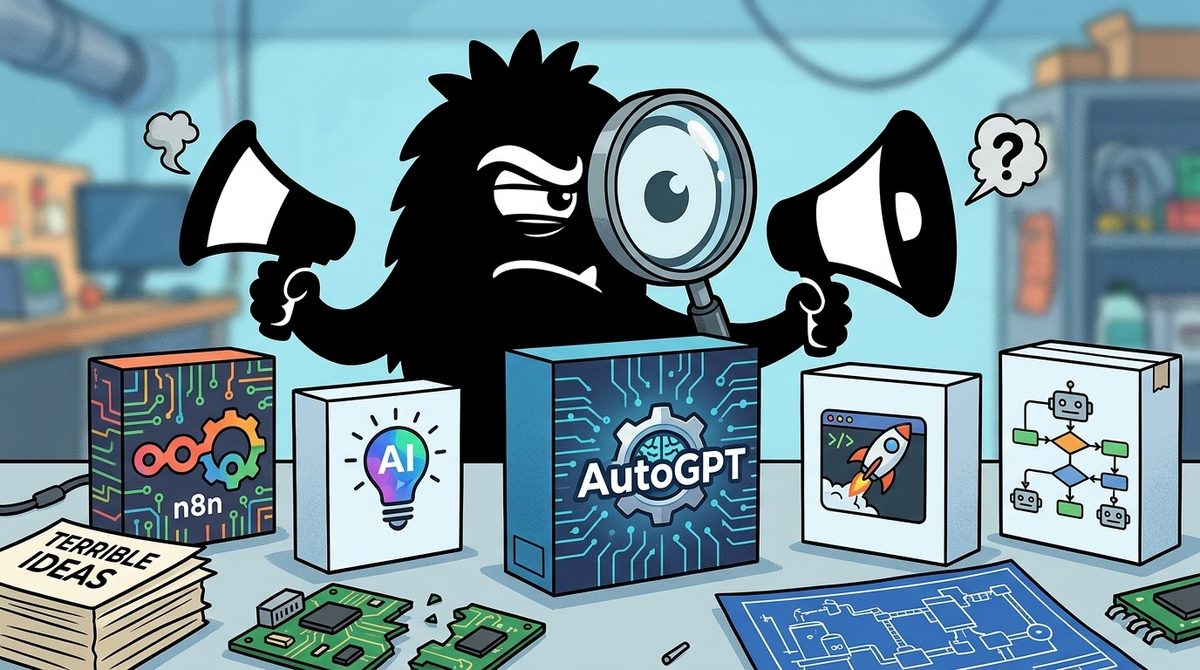
The real question behind “n8n vs Dify vs AutoGPT for AI pair programming” is not which product has the longest feature list. It is how you want AI to participate in software development: automatically around your developers, conversationally alongside them, or autonomously on their behalf.
As of early 2026, n8n is the strongest default for production development workflows, such as reviewing pull requests, classifying issues, updating tickets, generating release notes, and connecting coding agents to GitHub, Slack, CI, and internal systems. Dify is the better fit for building a developer-facing chat assistant grounded in private documentation or source material. AutoGPT is best treated as an experimental or bounded autonomous worker, not the control plane for a predictable engineering process.
Bottom line
>
- Choose n8n for trigger-based, repeatable AI automation across the software-development lifecycle.
- Choose Dify for a conversational coding assistant, especially one requiring retrieval-augmented generation, or RAG.
- Choose AutoGPT when the task genuinely requires the agent to plan its own multi-step route—and the additional cost and unpredictability are acceptable.
- For a serious production system, the strongest architecture may combine them rather than force one tool to do everything.
n8n vs Dify for AI workflows?
-n8n = complex, scalable backend orchestration across many systems.
-Dify = fast prototyping and user-facing AI apps.
Pick n8n for enterprise-grade, data-silo-free automation; Dify for quick conversational AI.
Read more:
https://n8nlab.io/blog/n8n-vs-dify-ai-workflow-automation
That distinction matters because “AI pair programming” now covers several very different jobs. It can mean asking questions about an unfamiliar codebase, automatically reviewing every pull request, turning an issue into an implementation plan, or giving an agent an objective and allowing it to modify files independently.
The products encode different answers. n8n is an orchestration platform with hundreds of integrations and AI-capable nodes. Dify is a low-code platform for building LLM applications, including chat interfaces and knowledge-backed assistants. AutoGPT is organized around goal-driven agents that plan and execute tasks with less predefined structure.[1][2]
The fading excitement around agent buzzwords does not mean AI-assisted development has disappeared. It suggests that attention is moving from demonstrations of autonomy toward systems that reliably connect models to real work.
Why nobody talking much about LangChain, RAG, prompt engineering, vector DBs, agents, n8n, Zapier, AutoGPT, BabyAGI, Custom GPTs anymore… what happened to all that hype?
View on XAutomation vs Conversation vs Autonomy: What Is Each Tool Designed to Do?
A useful mental model is to place the three products on a spectrum:
- n8n: define the process, then let AI handle selected decisions.
- Dify: define the application and knowledge context, then let a human converse with it.
- AutoGPT: define the objective, then let the agent determine more of the process.
n8n turns AI into one component of a controlled workflow
An n8n development workflow might begin when a pull request is opened. It can collect the diff and linked issue, call an LLM to identify risky changes, route high-risk findings to a senior reviewer, post a summary to GitHub, and log token usage elsewhere.
The model does not need to decide that this workflow exists. It operates inside explicit branches, permissions, retries, and integration steps. n8n’s AI Agent node can use tools and work through multi-step tasks, but it remains embedded in a broader workflow designed by the team.[7][9]
That makes n8n suitable for scripted assistance: the process is mostly known, while the model handles interpretation, summarization, classification, or generation.
Dify makes the AI application itself the center
Dify’s natural unit is an LLM-powered application. For pair programming, that could be an internal assistant that answers:
- How does the authentication service work?
- Which internal API should this feature call?
- What conventions apply to database migrations?
- Which architecture decision explains this unusual dependency?
This is conversational assistance. A developer initiates the interaction, adds context, challenges an answer, and refines the request. Dify’s appeal is that prompt management, model selection, retrieval, workflows, APIs, and application monitoring can live in one application-oriented layer.[6]
Difyに怒られちゃうかもしれないけど、中小企業はDifyよりn8nを導入した方がいいと思う派。理由を解説していきます。
①n8nのが「完全自動化」に近い
Difyとn8nはそもそもプロダクトの思想が違う。Difyは人が介在する前提かつ対話型アプリに強いが、n8nはトリガーベースのワークフロー自動化に特化している。
例えばn8nならGoogleドライブへのファイルアップロードを検知→LLMで文字起こし、要約→Notion保存までを全自動化できる。Difyでもできなくないが、Difyはトリガー機能が弱い。
他にも毎週月曜日の朝8時に財務諸表を分析して、経営陣にメールでレポートを送付する、とかもできる。DifyもCronプラグインとか出たけど、不安定だし、使いにくい。
②n8nなら「作ったけど使われない」問題を回避する
Salesforceを導入しても営業が入力しないのと同じ構図で、便利なAIツールを作って社内展開しても、人間は基本的に面倒くさがりな生き物なので使わない。
例えばDifyで議事録ツールを作っても、Difyにアクセスして、議事録を生成するという一手間がボトルネックになり、結局使われなくなる。
人が介在しない、依存しないワークフローをいかに設計できるかがAI推進の重要な論点だと思う。
③厳格性が必要ないタスクこそn8nが向いている
厳格性、正確性が求められるエンプラと違い、中小企業はクオリティを許容できる。
AIは70~80点の精度で業務効率化するのは得意だけど、100点の精度にもっていくには相当ハードルが高い。
「雑でも効率化できればいい」というタスクはn8nがめちゃくちゃ向いていると思う。
逆に人の承認を得たいとか、対話しながら出力精度を上げたい、みたいな場合はDifyの方がいいでしょう。(例えば記事制作とかそういう類のツール)
ただn8nはセルフホスト版の制約が強すぎるのよね…そこだけ難点。セキュリティリスクが許容できる、クラウド版でもいいよって人はn8n一択だと思う。
詳しく知りたい人は8月にDifyとn8n、Opalのウェビナーをやるので参加してみて。
Human involvement is not inherently a weakness. It is valuable when specifications are ambiguous, trade-offs are architectural, or generated changes require judgment.
AutoGPT gives the agent more control over the route
AutoGPT represents autonomous execution. Instead of prescribing every step, the user gives an objective and allows the agent to plan, use tools, inspect results, and continue. The project’s positioning emphasizes delegating work to agents rather than manually constructing every workflow.[13][15]
This can fit exploratory tasks such as investigating a repository, proposing a migration strategy, or attempting a bounded refactor in an isolated environment. It becomes riskier when an agent can change production code, invoke costly services, or continue iterating without sufficiently strict limits.
The central trade-off is simple: the more freedom an agent receives, the less predictable its path, cost, and failure mode become.
How Do You Avoid Building an AI Coding Tool Nobody Uses?
Internal AI initiatives frequently fail for a mundane reason: they add another destination developers must remember to visit.
A standalone coding chatbot may be technically impressive but operationally invisible. If engineers must leave their editor or pull-request page, open a separate application, select a knowledge base, and paste context, usage depends on memory and motivation.
Trigger-based automation reverses the burden. The assistance appears where work already happens:
- A pull request automatically receives a risk summary.
- A failed CI job gets an explanation in the team’s existing chat channel.
- A newly filed issue is enriched with likely owners and related incidents.
- A merged change automatically drafts release notes.
- A dependency alert opens a remediation task with repository context.
n8n is particularly well aligned with this pattern because triggers, schedules, webhooks, API calls, and application integrations are its core abstraction. Its AI features add probabilistic reasoning without removing the surrounding workflow controls.[8][10]
The X discussion captures the adoption lesson clearly: n8n is most valuable as infrastructure around human activity, not necessarily as another user-facing destination.
Great Article! This is a useful comparison. One thing I've really learned from is treating n8n as part of a larger workflow instead of the entire workflow. Looking forward to exploring Dify too.
View on XDify still wins when interaction is the point. Architecture exploration, requirements refinement, debugging conversations, and codebase onboarding benefit from follow-up questions. In those cases, forcing a fire-and-forget workflow can remove necessary judgment.
A practical decision rule is:
- If the event should always receive the same kind of AI assistance, trigger it automatically with n8n.
- If the quality of the outcome depends on dialogue, make the interaction explicit with Dify.
- If neither the steps nor the required tools can be known in advance, consider a bounded autonomous agent.
Why Are Autonomous Coding Agents Usually More Expensive?
The token economics of agents are counterintuitive. Automation can reduce human labor while simultaneously increasing model consumption.
A deterministic workflow sends only the required context to the model and may make a small, fixed number of calls. An agentic workflow asks the model to choose tools, evaluate intermediate output, revise its plan, and decide whether to continue. A more autonomous system may repeatedly read files, reconstruct context, call external services, and critique its own answers.
One widely discussed n8n example compared three implementations of the same monitoring task: a predefined workflow used 5,000 tokens in 30–40 seconds; an agentic version used 12,000 tokens in 90 seconds; and a fully autonomous version used 90,000 tokens in roughly 90 seconds. The autonomous output was reportedly the best, but it consumed 18 times the tokens of the basic workflow.
I've been building with N8N for months and this tutorial finally clicked something for me.
The token economics of agents are backwards from what most people think.
Pawel walks through building the same competitor monitoring workflow three ways. A traditional workflow, an agentic workflow, and a fully autonomous agent.
The numbers are WILD.
Traditional workflow with manual steps... 5,000 tokens, 30-40 seconds. Everything is predefined. You control every step. The LLM just formats a report.
Agentic workflow where the model decides prompts... 12,000 tokens, 90 seconds. The agent chooses what to ask Perplexity. More expensive. More flexible.
Fully autonomous agent with just an objective... 90,000 tokens. Same 90 seconds but 8x the token cost.
And here's where it gets interesting.
The fully autonomous version produced the best output. Pawel's exact reaction was "this is like the best one yet."
So you're paying 18x more tokens than the basic workflow. You're giving up control. The agent makes sequential Perplexity calls instead of parallel ones.
But the quality jumps.
This is the tradeoff nobody talks about when they say "just use agents for everything."
n8n just raised $180M at a $2.5B valuation. ARR hit $40M. That's a 62x revenue multiple.
Investors are betting the orchestration layer becomes THE layer.
The logic goes like this. If you can't plug in a GPU because power infrastructure doesn't exist, compute isn't your bottleneck. If Claude and GPT-5 keep getting smarter but your workflows can't use them, model capability isn't your bottleneck.
The bottleneck is connecting intelligence to action.
n8n sits in that exact gap. Workflow automation meets AI orchestration. Self-hostable. Fair-code license. 400+ integrations.
Pawel's advice is counterintutive but correct. Use agents only when you have to.
For production systems at scale, every token matters. You want the workflow version when the process is predictable. Save agents for genuinely ambiguous problems where you can't predefine the steps.
The tutorial covers practical stuff too. Pin your data during development so you're not burning API calls on every test. Use fromAI() expressions to let agents fill parameters dynamically. Set max iterations to 30 so complex workflows don't terminate early.
For PMs trying to build AI intuition, this is the move. You don't need to code to understand context compression, token economics, and agent limitations.
You just need to build a few workflows and watch them fail.
Those figures should not be generalized into a universal benchmark. They do, however, illustrate why autonomy is an optimization target, not a free upgrade.
For development teams, repeated agent loops can become expensive when they ingest large repositories, test logs, generated patches, and previous reasoning on every iteration. They also complicate latency budgets and cost attribution.
Where n8n controls cost
n8n lets teams constrain expensive reasoning behind deterministic steps. Conventional code can filter files, remove generated artifacts, check labels, or retrieve only the relevant issue before an LLM is invoked. Branching rules can reserve a larger model for security-sensitive changes while routing routine summaries to a cheaper one.
The workflow can also cap retries and agent iterations. Guidance for n8n agent implementations emphasizes tool configuration, memory, and guardrails rather than assuming unlimited model freedom.[12]
Where AutoGPT becomes a liability
AutoGPT is least attractive when the desired route is already known. Letting an autonomous agent rediscover a standard build-test-review sequence wastes tokens and introduces more opportunities for loops or irrelevant actions.
Use it when the exploration itself creates value—for example, investigating an unfamiliar legacy repository where the necessary steps cannot be predefined. Even then, isolate the environment, limit tools, cap iterations, and require approval before consequential changes.
The production rule for 2026 is: choose the least autonomous design that can solve the task well.
Does Self-Hosting Really Make n8n or Dify Cheaper?
Self-hosting can sharply reduce the visible SaaS bill, especially at high workflow volumes. It does not eliminate operating cost; it converts subscription spending into infrastructure and engineering responsibility.
I’ve run Dify and n8n on prem and the SaaS bill drops dramatically.
The trade off is you must own the infra and monitor updates.
If you can automate ops, the cost win beats the overhead
Both n8n and Dify have self-hosted deployment paths. This can be compelling for development teams that need code, prompts, logs, or retrieved documents to remain inside controlled infrastructure. AutoGPT can also be run in local environments, although “local” does not necessarily mean that every model call or connected service stays local.[3][15]
Self-hosting means the team owns:
- deployment and upgrades;
- database backup and recovery;
- secret management;
- worker scaling and queue health;
- observability and incident response;
- security patches and access controls;
- model-provider and vector-store connectivity.
One X comparison estimates a small self-hosted n8n server at $5–15 per month. That is a practitioner’s reported infrastructure estimate, not a total-cost guarantee: engineering time, high availability, databases, storage, model tokens, and compliance controls can dwarf the base server.
2026年AI工作流自动化横评:n8n vs Make vs Zapier vs Coze vs Dify,5款工具到底选哪个?
最近花了两周时间,把市面上主流的5款AI自动化工具全部上手试了一遍。结论是:没有最好的,只有最适合你的。
🔌 Zapier — 上手最快
7000+应用集成,注册即用。适合"今天就想跑起来"的非技术用户。缺点是按步计费,一个4步流程每跑一次消耗4个Task,月跑1万次账单轻松上千刀。适合简单场景和小团队。
🎨 Make — 可视化最强
画布式设计,分支/循环/错误处理体验是所有工具里最好的。同样1万次5步流程,成本约为Zapier的1/3到1/5。适合需要复杂逻辑的独立开发者和SaaS团队。
🛠️ n8n — 自由度最高
开源自托管,数据完全在自己手里。2026年新增的AI Agent节点可以直接在工作流里调大模型、做RAG、跑多步推理。代码节点无超时限制,想跑什么就跑什么。月成本仅服务器费5-15刀。学习曲线最陡,但一旦搭好就是你的。
🇨🇳 Coze(扣子)— 国内首选
字节出品,飞书/微信/钉钉原生集成,直接发布到豆包。免费额度非常慷慨,插件市场上千个。适合对接国内生态的场景。
🧠 Dify — AI应用开发首选
Prompt管理+RAG管道+多模型编排一条龙。如果你在做AI应用开发,它的工作流编排是顺带的免费能力。
💰 成本对比(月跑1万次5步流程):
Zapier ≈ $250-300/月
Make ≈ $40-60/月
n8n ≈ $5-15/月(仅服务器)
Coze ≈ ¥0-30/月(免费额度内)
选型建议:
- 追求快速上手 → Zapier
- 需要复杂逻辑 → Make
- 技术团队+数据隐私 → n8n
- 国内生态深度对接 → Coze
- AI应用开发 → Dify
个人建议:如果你有一点技术基础,直接上n8n。自托管零限制,AI Agent节点加上MCP协议支持,2026年的n8n已经不是两年前那个简单的自动化工具了。花一个周末搭好环境,后面无限用。
你目前在用哪款自动化工具?评论区聊聊
Enterprise quotes can move in the opposite direction. One practitioner reported receiving a Dify quote of ¥15 million, illustrating the sticker shock that can arise around support, governance, deployment scope, or enterprise requirements. It should be treated as an individual quote, not standard public pricing.
n8nはジョブスケジューラーとワークフローなんで、使い方はMCP経由かもしれませんがエンタープライズ含めて残ると思います。Vibe codingで全部お任せで作る方がコスト高いですし
Difyは見積もり取ったら1500万と言われたのであれは無くなって良いと思います。
For a two-person startup, self-hosting both platforms may be needless operational drag. Managed service can be cheaper once staff time is counted. For a platform team serving hundreds of engineers—or a regulated company with strict data-residency requirements—self-hosting may deliver both financial and governance advantages.
The right calculation is total cost per reliable workflow, not monthly license price alone.
Which Has the Better Ecosystem: n8n, Dify, or AutoGPT?
n8n has the broadest workflow integration surface
n8n’s strongest practical advantage is its catalog of 400-plus integrations, complemented by HTTP requests and code nodes for services without dedicated connectors.[4] In AI-assisted development, breadth matters because useful context is distributed across source control, issue trackers, CI systems, incident tools, documentation, chat, databases, and cloud platforms.
Dify vs n8n: which one for your AI app?
Dify (146K stars): LLM apps with RAG + an embeddable knowledge-base chatbot. n8n (194K stars): 400+ integrations. Plus connect Dify to OpenRouter: hundreds of models, one key.
https://pasqualepillitteri.it/en/news/6300/dify-vs-n8n-openrouter-guide
#AI #opensource #LLMOps
Its AI Agent node allows a model to select tools inside a workflow, while ordinary nodes can retain deterministic control over authentication, data transformation, routing, and side effects.[7] This combination is more production-friendly than making every integration decision part of an agent loop.
Dify has the stronger RAG-first application layer
RAG retrieves relevant material before asking a model to answer. For pair programming, that material might include architecture records, API documentation, runbooks, coding standards, or selected repository content.
Dify packages application-oriented capabilities such as hybrid retrieval, chunking, model routing, visual agent workflows, generated APIs, and tracing. The reported retrieval options include BM25 keyword search plus vector-based semantic search, with sources such as PDFs, Notion, and DOCX.
DROP EVERYTHING.
This GitHub repo just hit 136K stars and it’s the fastest way to ship an AI app:
Dify helps you go from prototype to production without writing 1,000+ lines of glue code and using 6 other tools.
Here’s what it handles for you:
1. RAG pipelines:
Built-in hybrid search (BM25 + vector), chunking, and support for PDFs, Notion, DOCX, web scraping.
2. Agent orchestration:
Visually build ReAct-style workflows using tools, API calls, and logic blocks - no manual loops in Python.
3. Model routing:
Easily switch between GPT, Claude, or local models like Llama via Ollama/vLLM.
4. Auto-generated APIs:
Every saved workflow gets an auto-generated REST endpoint, ready to integrate.
5. LLMOps & monitoring:
Full tracing, latency, token usage, and annotation support - ready for production.
No more stitching together LangChain, FastAPI, vector DBs, and monitoring tools. Think of Dify as the missing infrastructure layer between your AI logic and a real product.
You can self-host it or use their cloud. 100% free to start.
That makes Dify attractive when the deliverable is not merely an automated step but a developer product: an embeddable assistant or API that other engineering tools can call.
AutoGPT offers autonomy, not the deepest integration catalog
AutoGPT has significant open-source recognition, but popularity does not erase architectural differences.
**15 Open-Source AI GitHub Repos Every Developer Should Bookmark in 2026**
1. OpenClaw — Personal AI agent for cross-platform workflows (384,081★)
https://github.com/openclaw/openclaw
2. AutoGPT — Autonomous agents for real-world tasks (185,679★)
https://github.com/Significant-Gravitas/AutoGPT
3. n8n — Visual workflow automation platform, AI native (197,925★)
https://t.co/FJncY39s7l
4. ...
6. Dify — Low-code AI app builder, agent pipelines (150,202★)
https://t.co/DEHD5jXech
Its central value is giving agents goals and tools, not providing the richest prebuilt enterprise integration canvas or the most packaged knowledge-assistant experience. Compared with n8n, teams should expect more work around bounded tool access and operational integration. Compared with Dify, they should expect less emphasis on quickly shipping a polished RAG-backed chat application.[2][5]
Model flexibility is available across these ecosystems in different forms. The more important question is whether your team needs to switch models inside an application, route calls as part of a workflow, or let an autonomous agent choose actions.
Should You Combine n8n, Dify, and AutoGPT Instead of Picking One?
Yes. The most mature architecture is often compositional: each tool handles the layer its design favors.
Dify、n8nに次ぐ新たなワークフローツール「SimAI」。
使ってみましたが、想像以上でした。
✅自然言語でWF構築
✅テスト動作までAIが実行
✅豊富な外部ツール連携からMCP連携機能もあり
しかもオープンソースでセルフホストまで可能。詳細はリプに掲載しました👇
A practical AI pair-programming pipeline could work as follows:
- n8n receives an event when a pull request is opened.
- It gathers the diff, issue, ownership metadata, and CI status.
- Dify provides the knowledge layer, retrieving relevant architecture decisions, security policies, and internal coding standards through an application API.
- n8n sends a curated context package to a review model.
- If the change is unusually broad, a bounded AutoGPT-style agent investigates dependencies in an isolated repository clone.
- n8n collects the results, applies deterministic severity rules, and posts a structured review.
- A human approves any patch, deployment, or security-sensitive action.
Dify’s generated API orientation makes it suitable as a callable application, while n8n can invoke external services through HTTP and agent-tool integrations.[4][10] MCP—the Model Context Protocol—can provide another standard interface where supported, but plain HTTP APIs remain a straightforward composability mechanism.
The key architectural insight is that the user-facing assistant, orchestration layer, and autonomous worker do not have to be the same process.
AI agents are replacing manual workflows — automating research, content, and data pipelines in minutes. We tested n8n, Make, and AutoGPT head-to-head. Full comparison at https://goodbetterbestreviews.com/ 🚀
View on XThis separation also improves security. The RAG service can have read access to approved knowledge. The workflow layer can hold integration credentials and policy checks. The autonomous worker can operate in a disposable sandbox with narrowly scoped tools.
Verdict: Who Should Use n8n, Dify, or AutoGPT in 2026?
There is no universal winner, but there is a strong default for each workflow shape.
AIの力で業務を自動化したい人へ
「n8n」vs「Dify」2つのワークフローツールを徹底比較!
ブクマして自分の業務にはどちらが最適なのか確認しよう↓
Choose n8n for automated AI development operations
Best for: technical startups, platform teams, DevOps groups, and enterprises connecting AI to existing systems.
Pick n8n when:
- assistance should run automatically on commits, pull requests, incidents, or schedules;
- the process is mostly predictable;
- cost controls, branching, retries, and auditability matter;
- GitHub, ticketing, chat, CI, and internal APIs must be connected;
- the team can manage a steeper workflow and self-hosting learning curve.
For most teams asking broadly about AI-assisted development, n8n is the best production default.
Choose Dify for a conversational, knowledge-backed coding assistant
Best for: AI product teams, internal developer-experience groups, and small teams shipping an LLM application quickly.
Pick Dify when:
- developers need to ask follow-up questions;
- private documentation and RAG are central;
- you want a chat interface or application API;
- prompt management, model routing, and LLM observability should be packaged together;
- speed from prototype to internal product matters more than integration breadth.
Dify is the clearest choice when “pair programming” literally means a developer conversing with an assistant.
Choose AutoGPT for bounded autonomy and experimentation
Best for: research teams, advanced developers, and organizations exploring autonomous task execution.
Pick AutoGPT when:
- the task cannot be expressed as a stable workflow;
- discovering the plan is part of the problem;
- the environment can be sandboxed;
- higher token use and variable latency are acceptable;
- humans will approve consequential output.
Do not choose it merely because autonomy sounds more advanced. In predictable software-delivery pipelines, a less autonomous workflow will usually be cheaper and easier to govern.[3]
The final decision is therefore not “which AI tool is smartest?” It is where your team wants determinism, where it needs dialogue, and where autonomy is genuinely worth paying for.
Sources
[1] n8n vs. Dify: Choosing a Production AI Automation Platform
[2] The Best AI Agents in 2026: Tools and Frameworks Compared
[3] Best AutoGPT Alternatives in 2026: 10 Local AI Agents Compared
[4] N8N vs Dify: A Deep Comparison for Developers Who Actually Build Things
[5] The 9 best open-source AI agents in 2026
[6] Comparison of AI Agent Platforms: Tovie Platform, Dify, and n8n
[7] AI Agent | Nodes
[8] Build Custom AI Agents With Logic & Control
[10] AI Agent integrations | Workflow automation with n8n
[12] n8n AI Agent Guide: What You’re Still Missing in Existing Workflows
[13] AutoGPT — Stop building workflows. Start hiring agents.
References (15 sources)
- n8n vs. Dify: Choosing a Production AI Automation Platform - n8n.io
- The Best AI Agents in 2026: Tools and Frameworks Compared - datacamp.com
- Best AutoGPT Alternatives in 2026: 10 Local AI Agents Compared - blog.buildbetter.ai
- N8N vs Dify: A Deep Comparison for Developers Who Actually Build Things - levelup.gitconnected.com
- The 9 best open-source AI agents in 2026 - eesel.ai
- Comparison of AI Agent Platforms: Tovie Platform, Dify, and n8n - tovie.ai
- AI Agent | Nodes - docs.n8n.io
- Build Custom AI Agents With Logic & Control - n8n.io
- Integrate AI | Build - docs.n8n.io
- AI Agent integrations | Workflow automation with n8n - n8n.io
- How to Build an AI Agent Factory with n8n Workflow Automation Templates - medium.com
- n8n AI Agent Guide: What You're Still Missing in Existing Workflows - hatchworks.com
- AutoGPT — Stop building workflows. Start hiring agents. - agpt.co
- AutoGPT - en.wikipedia.org
- AutoGPT - github.com
Related Guides

Aider vs Cline: Which Is Best for AI Pair Programming in 2026?
15 min read
The Best AI Model Tools in 2026: An Expert Comparison Through a $4M Polymarket Bet
25 min read
What Is Replit? A Complete Guide for 2026
19 min read
Traders Are Betting on Anthropic: What Polymarket's 99% AI Model Odds Reveal for Developers in 2026
20 min read