Meta Buys AI Agent Firm Manus for $2B+ in Major DealUpdated: October 11, 2026
Meta announced the acquisition of Manus, a Singapore-based startup specializing in general-purpose autonomous AI agents capable of multi-step tasks like planning and tool use. The deal, reportedly valued at over $2 billion, aims to integrate Manus's agent execution technology into Meta's AI ecosystem to enhance scalability and real-world applications. This move follows Meta's push into advanced agentic systems for broader AI integration across its platforms.
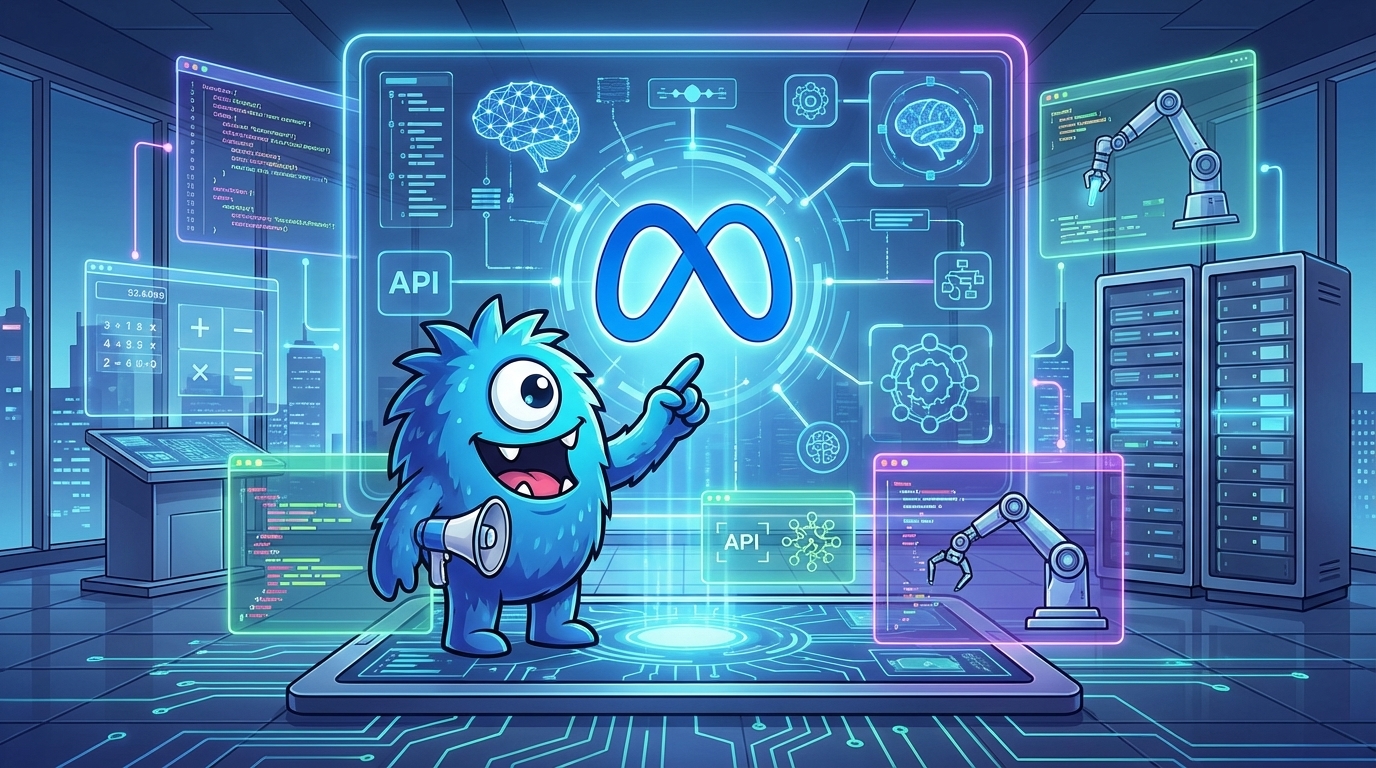
For developers and technical buyers building the next generation of AI applications, Meta's acquisition of Manus signals a pivotal shift toward scalable, autonomous AI agents that can execute complex, multi-step workflows independently. If you're integrating AI into enterprise systems or consumer platforms, this deal promises enhanced tool-use capabilities and planning algorithms that could redefine how agents interact with real-world data and APIs, potentially unlocking new efficiencies in automation and decision-making.
What Happened
Meta Platforms announced the acquisition of Manus, a Singapore-based startup founded by Chinese entrepreneurs, in a deal valued at more than $2 billion, according to reports from The Wall Street Journal[WSJ]. Manus specializes in general-purpose autonomous AI agents designed for multi-step tasks, including advanced planning, tool integration, and workflow automation, going beyond traditional chatbots to deliver actionable results[Manus Docs]. The official confirmation came via a Manus blog post stating the company will join Meta to accelerate innovations in AI agent technology while continuing current services[Manus Blog]. Press coverage from Reuters and CNBC highlights this as Meta's strategic move to bolster its AI ecosystem amid intensifying competition, with integration planned across platforms like Facebook, Instagram, and WhatsApp[Reuters][CNBC]. No detailed technical documentation on the integration has been released yet, but Manus's existing framework emphasizes context engineering for stable agent loops and file-system-based interactions[Manus Blog on Context Engineering].
Why This Matters
From a technical standpoint, developers stand to benefit from Manus's agent execution engine, which enhances Meta's Llama models with robust multi-agent orchestration for handling dynamic environments—critical for building reliable AI systems in production. Engineers can expect improved scalability in tool-calling and planning, reducing hallucinations in long-horizon tasks and enabling seamless API integrations for enterprise automation. For technical buyers, this acquisition intensifies the AI agent arms race, pressuring competitors like OpenAI and Google to accelerate agentic advancements, potentially leading to open-source tools or APIs that lower barriers for custom agent development. Business-wise, Meta's $2B+ investment underscores the monetization potential of agents in social and e-commerce platforms, offering developers new revenue streams through enhanced personalization and task automation, while raising questions on data privacy and cross-border tech transfers in global AI ecosystems.
Technical Deep-Dive
Meta's acquisition of Manus, a Singapore-based AI agent startup, for over $2 billion accelerates its push into autonomous AI agents. Manus specializes in multi-agent systems that execute complex, real-world tasks independently, addressing gaps in Meta's Llama ecosystem where models excel in generation but lag in reliable orchestration. This deal integrates Manus' proven agent OS into Meta's infrastructure, potentially powering agentic features across WhatsApp, Instagram, and Meta AI.
Key Features and Capabilities
Manus agents autonomously plan, execute, and deliver outcomes for tasks like full-stack web development, SEO audits, data visualization, and research reports. Core strengths include long-horizon reliability, failure recovery, and tool orchestration. For instance, Manus 1.5 builds production-ready apps with persistent databases, user authentication, embedded AI (e.g., multimodal LLMs), and custom domains—all via natural language prompts. It supports multi-tab browsing, code deployment to subdomains, and event-driven notifications without external setup. Two variants: Manus-1.5 (full architecture for complex tasks) and Manus-1.5-Lite (cost-optimized). [source](https://manus.im/blog/manus-1.5-release)
Technical Implementation Details
Manus employs a multi-agent architecture with specialized roles: a Planner decomposes tasks into steps (tracked in todo.md), an Executor handles actions in isolated Ubuntu sandboxes, and a Knowledge module injects RAG-retrieved facts. Powered primarily by Anthropic's Claude 3.5 Sonnet (with Qwen fine-tunes and dynamic model switching), it uses an iterative ReAct loop: analyze state, plan action, execute via tools, observe, repeat—one action per cycle to prevent collapse.
Tools include browser automation (Playwright-like for navigation/clicks), shell commands (safeguarded, e.g., non-interactive apt-get), Python/Node.js interpreters (pre-installed libs like NumPy, Pandas), file ops, and APIs (e.g., weather via requests). Memory uses event streams for short-term context, file-based scratchpads for persistence, and vector stores (FAISS) for RAG. Prompt engineering enforces rules like citing sources and error diagnosis after 3 failures.
Example agent loop in Python (replicable via open-source CodeActAgent):
def agent_loop(user_request):
 event_stream = [{"type": "user", "content": user_request}]
 plan = create_plan(user_request) # Decompose to steps
 event_stream.append({"type": "plan", "content": plan})
 workspace = {"files": {}, "todo": plan}
 while True:
 context = format_context(event_stream, workspace)
 response = model(context) # e.g., Claude via LangChain
 code = extract_code_from_response(response)
 if "TASK_COMPLETE" in code:
 return workspace["files"].get("output.md", "Task completed")
 result, error = safe_execute_code(code) # Sandboxed exec
 event_stream.append({"type": "action", "content": code})
 event_stream.append({"type": "observation", "content": result or error})
 update_workspace(workspace, code, result)
Tool example (web search):
def search_web(query):
 response = requests.get(f"https://serpapi.com/search?q={query}&api_key={API_KEY}")
 return response.json()
Manus 1.5 boosts speed 4x (tasks under 4 minutes vs. 15), expands context windows, and improves quality 15% via refined orchestration. [source](https://gist.github.com/renschni/4fbc70b31bad8dd57f3370239dccd58f)
Benchmark Performance Comparisons
On the GAIA benchmark (real-world problem-solving), Manus scores SOTA >65% across difficulty levels, outperforming OpenAI's Deep Research (58%) and Operator (fails on loops). In SEO audits, Manus delivers polished reports with visualizations faster than Deep Research, though less comprehensive than Perplexity AI. Strengths: 90%+ success on web dev/game creation (e.g., ThreeJS runners); weaknesses: occasional code bugs, slow for hours-long tasks. Internal metrics: 6% user satisfaction uplift post-1.5. [source](https://www.helicone.ai/blog/manus-benchmark-operator-comparison)
API Availability and Documentation
Pre-acquisition, Manus offered an API at open.manus.ai/docs for embedding agents, supporting task submission via JSON payloads (e.g., {"task": "Build app", "tools": ["browser", "code"]}) and streaming observations. Pricing: $79/mo Pro (unlimited Lite tasks); post-acquisition, expect Meta API integration with LlamaGuard for safety, potentially free tiers via Meta AI. Docs emphasize sandbox isolation and rate limits (1 action/cycle). No major changes announced yet.
Integration Considerations
For developers, Manus slots into Meta's stack via Llama 3.2 APIs, enabling hybrid agents (e.g., Llama reasoning + Manus execution). Challenges: Aligning sandboxes with Meta's privacy (e.g., end-to-end encryption); opportunities: Scaling to billions via Meta's infra. Enterprise options may include custom orchestration for workflows, with SLAs for reliability. Developers praise autonomy but warn of ecosystem lock-in: "Your prompts become Meta's IP." [source](https://x.com/bigpeelenergy/status/2005776146860761203) Timeline: Full integration by Q2 2026, per analyst speculation.
Overall, this acquisition shifts Meta from models to executable AI, empowering devs to build agent-native apps with robust, benchmark-leading orchestration.
Developer & Community Reactions
What Developers Are Saying
Technical users in the AI community view Meta's acquisition of Manus as a strategic grab for advanced agent orchestration, praising its focus on production-ready systems over raw models. Developer Based Gladstone highlighted Manus's edge in "long-horizon task reliability, memory scaffolding that does not rot, tool-orchestrated workflows that do not collapse," arguing it represents an "agent operating system" that Meta lacked. [source](https://x.com/bigpeelenergy/status/2005776146860761203) AI Agent Systems Manager Muratcan Koylan lauded Manus's context engineering, noting its use of "parallel sub-agents with fresh context" to avoid "context pollution" and enable deep research without fabrication, calling it "the best computer use agent." [source](https://x.com/koylanai/status/2001682523370250630) Steve Ike emphasized practical innovations like "append only logs and deterministic serialization" for cache preservation and treating "the file system as external memory," which Meta acquired for scalable agent deployment. [source](https://x.com/steve_ike_/status/2006056285645521018)
Early Adopter Experiences
Developers testing Manus pre-acquisition reported strong results in research and automation but noted limitations in speed and context handling. Ashutosh Shrivastava, after three days of use, praised its "incredible" internet research, script execution, and structured planning for tasks like coding, though it lagged behind Claude 3.5 Sonnet in coding depth. He appreciated the beta-stage potential: "they can improve and solve a few issues, and it’ll be a heck of a product." [source](https://x.com/ai_for_success/status/1898790353291121082) Y Combinator's analysis echoed this, spotlighting Manus's "chain-of-thought injection" for dynamic plan updates, which excelled in UI-driven tasks like outreach and coding, outperforming basic wrappers. [source](https://x.com/ycombinator/status/1909608224921456874) Users compared it favorably to OpenAI's DeepResearch for autonomous execution but highlighted its edge in multi-entity analysis.
Concerns & Criticisms
While excited about integration, the community raised worries over innovation stifling and technical misalignment. Teortaxes critiqued Manus as "a product devilishly optimized for influencers," underperforming in STEM and coding—"worse than googling"—due to its LLM-heavy approach over true agency. [source](https://x.com/teortaxesTex/status/1898712333544812626) Victor Shaw warned that agents require aligned compute and data layers, predicting Manus's app-layer focus might "collapse into features" within Meta's ecosystem, exacerbating "misalignment" issues. [source](https://x.com/VShawHQ/status/2006031360889167993) Mustafa Al Marzooq lamented the deal as the "worst news of 2025," fearing Manus's superior agents would "vanish into Zuckerberg’s empire" without independent evolution. [source](https://x.com/mus_almarzooq/status/2006023758801141944) Comparisons to alternatives like Anthropic's reasoning or Perplexity's retrieval underscored risks of commoditization in enterprise workflows.
Strengths
- Manus provides autonomous AI agents capable of executing complex tasks like market research, coding, and data analysis, enhancing Meta's productization of AI for practical applications in apps like WhatsApp and Instagram [VentureBeat](https://venturebeat.com/orchestration/why-meta-bought-manus-and-what-it-means-for-your-enterprise-ai-agent).
- The acquisition adds millions of paying users from Manus, enabling immediate revenue streams and monetization opportunities for technical buyers integrating these agents into enterprise workflows [WSJ](https://www.wsj.com/tech/ai/meta-buys-ai-startup-manus-adding-millions-of-paying-users-f1dc7ef8).
- Meta gains a competitive edge in AI agents, allowing technical teams to leverage scalable, action-oriented tools that bridge intelligence and execution, accelerating development cycles [Business Insider](https://www.businessinsider.com/meta-manus-acquisition-ai-boost-agents-2025-12).
Weaknesses & Limitations
- Manus relies on third-party AI models rather than proprietary frontier tech, potentially limiting customization and increasing dependency on external providers for technical buyers [VentureBeat](https://venturebeat.com/orchestration/why-meta-bought-manus-and-what-it-means-for-your-enterprise-ai-agent).
- Privacy and security risks arise from the firm's Chinese founders, raising concerns for data handling in sensitive enterprise integrations, especially under U.S. regulations [BBC](https://www.bbc.com/news/articles/ce3k11q9qe1o).
- Instability in handling creative or highly nuanced tasks, as Manus agents can falter in unpredictable scenarios, requiring additional oversight for reliable adoption [Deeper Insights](https://deeperinsights.com/ai-review/manus-ai-review-detailed-analysis-of-benefits-drawbacks/).
Opportunities for Technical Buyers
How technical teams can leverage this development:
- Integrate Manus agents into enterprise systems for automated task execution, such as HR screening or financial analysis, reducing manual labor via Meta's developer APIs.
- Build custom AI-driven features for Meta platforms, enabling seamless user interactions like personalized content automation in social commerce apps.
- Accelerate prototyping of multi-step workflows by combining Manus' agent loop with Meta's Llama models, fostering innovation in sectors like e-commerce and customer service.
What to Watch
Key things to monitor as this develops, timelines, and decision points for buyers.
Monitor regulatory reviews, particularly U.S. scrutiny over Chinese ties, which could delay integration by 6-12 months YouTube/CNBC. Track Meta's Q1 2026 announcements for agent rollout in developer tools, as early access could inform adoption pilots. Watch for API stability updates, with potential beta releases in March 2026, to assess compatibility before committing resources. If privacy enhancements are addressed, it signals lower risk for enterprise buyers; otherwise, explore alternatives like OpenAI agents.
Key Takeaways
- Meta's $2B+ acquisition of Manus bolsters its AI agent portfolio, integrating advanced autonomous agents for tasks like customer service and content moderation into platforms like WhatsApp and Instagram.
- Manus brings a massive user base of millions of paying customers, primarily in Asia, accelerating Meta's monetization of AI features amid slowing ad revenue growth.
- The deal highlights Meta's aggressive push in the AI arms race, countering rivals like OpenAI and Google by acquiring specialized agent tech rather than building from scratch.
- Geopolitical risks loom due to Manus's Chinese founders and Singapore base, potentially inviting U.S. regulatory scrutiny under CFIUS amid U.S.-China tech tensions.
- Technical synergies include Manus's multi-modal AI models, enabling seamless integration with Meta's Llama ecosystem for more efficient, scalable agent deployments.
Bottom Line
For technical decision-makers in AI development, this acquisition signals Meta's intent to dominate agent-based automation—act now if you're building complementary tools or integrations, as API access and partnerships could expand rapidly. CTOs at enterprises should evaluate Manus-derived agents for internal workflows to stay competitive. Ignore if your focus is non-agent AI like generative models. Investors and AI engineers at competing firms should care most, as this could reshape market dynamics and talent flows.
Next Steps
- Review Meta's developer docs for upcoming Llama-Agent integrations (meta.com/developers).
- Assess your stack against Manus tech via their archived whitepapers on GitHub for potential migration planning.
- Monitor CFIUS filings and Meta's Q1 2026 earnings for deal closure details and rollout timelines.
References (50 sources)
- https://x.com/i/status/2006376445933670403
- https://techcrunch.com/2025/12/26/these-are-the-cybersecurity-stories-we-were-jealous-of-in-2025/
- https://x.com/i/status/2006015121441661055
- https://x.com/i/status/2006328442514805239
- https://x.com/i/status/2005515400365457502
- https://x.com/i/status/2004478246663098512
- https://techcrunch.com/2025/12/22/chatgpt-everything-to-know-about-the-ai-chatbot/
- https://x.com/i/status/2004000417181741097
- https://x.com/i/status/2005119278262222885
- https://x.com/i/status/2004775163796357526
- https://techcrunch.com/category/artificial-intelligence/
- https://x.com/i/status/2006179493187080226
- https://x.com/i/status/2006400914563666088
- https://x.com/i/status/2005824945474134207
- https://x.com/i/status/2004556329768399058
- https://techcrunch.com/2025/12/31/the-dumbest-things-that-happened-in-tech-this-year/
- https://x.com/i/status/2004103597982994840
- https://x.com/i/status/2005974272691286164
- https://x.com/i/status/2006110822272008623
- https://x.com/i/status/2005519189545779684
- https://x.com/i/status/2005766053813707003
- https://x.com/i/status/2006552830677782725
- https://x.com/i/status/2006503629470183610
- https://x.com/i/status/2006121652124315975
- https://www.theverge.com/ai-artificial-intelligence/848988/nvidia-chip-loans-coreweave-gpu-debt-ai-n
- https://x.com/i/status/2006594428887249021
- https://x.com/i/status/2006015028546134363
- https://x.com/i/status/2004512580568858779
- https://x.com/i/status/2005945744830894318
- https://x.com/i/status/2006289245187551476
- https://www.theverge.com/archives/news/2025/12/26
- https://x.com/i/status/2006287471618011640
- https://x.com/i/status/2005527166621257895
- https://x.com/i/status/2005432786619080974
- https://x.com/i/status/2006057141954625619
- https://techcrunch.com/2025/12/31/every-fusion-startup-that-has-raised-over-100m/
- https://x.com/i/status/2004650659162001517
- https://x.com/i/status/2004983939275128856
- https://techcrunch.com/2025/12/24/waymo-explains-why-its-robotaxis-got-stuck-during-the-sf-blackout/
- https://x.com/i/status/2005787172675231927
- https://x.com/i/status/2005611003850174655
- https://x.com/i/status/2004744864500777298
- https://x.com/i/status/2004552819378991172
- https://x.com/i/status/2004298880314163241
- https://x.com/i/status/2006617752463614357
- https://x.com/i/status/2004555642355274050
- https://x.com/i/status/2006536194193240223
- https://x.com/i/status/2004295990447095880
- https://x.com/i/status/2004583319648739836
- https://x.com/i/status/2005941974847873254
Related Guides
Perplexity Launches Computer: Unified AI for End-to-End Projects
9 min read
OpenAI Raises Record $110B from Amazon, Nvidia, SoftBank
9 min read
OpenAI Secures $110B Funding at $840B Valuation
9 min read
Anthropic Unveils Claude Cowork for Enterprise AI Collaboration
10 min read