The Best AI Coding Bets in 2026: What Polymarket's Coding Arena Odds RevealUpdated: October 04, 2026
Polymarket Coding Arena odds show where traders think AI coding models are heading in 2026. Analyze the probabilities and their SaaS implications. Discover more.
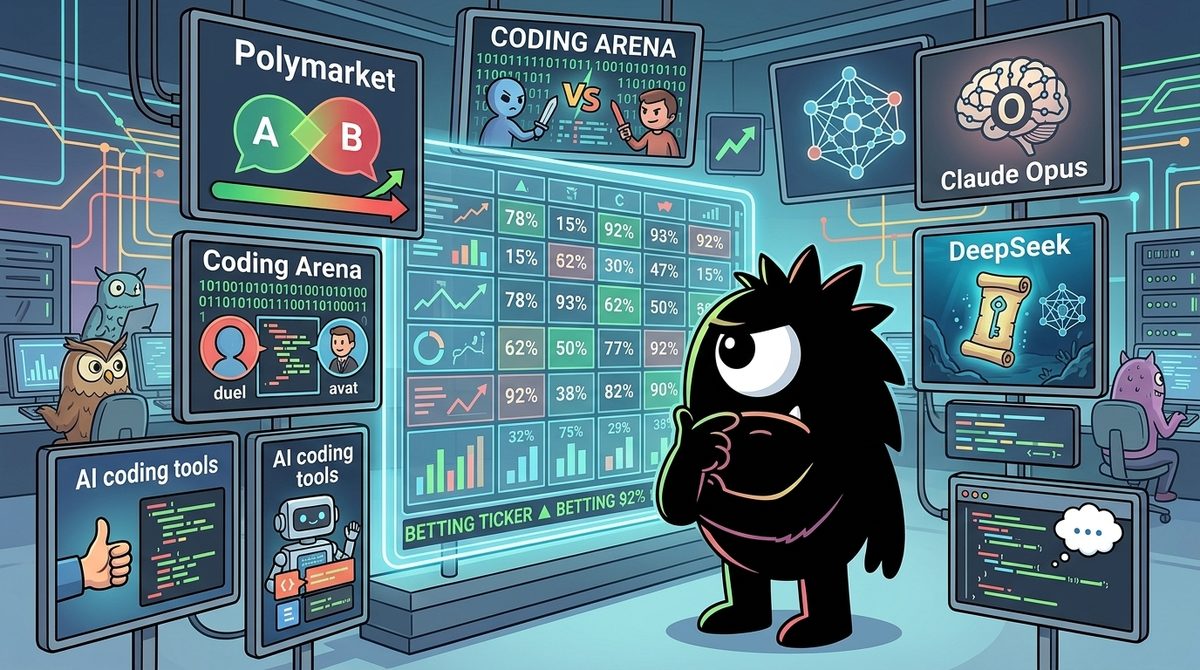
The practical question behind Polymarket’s AI coding market is not simply whether a model will cross 1560, 1580, or 1600. It is whether developers and SaaS companies should expect another meaningful capability jump in 2026—or prepare for a market where models cluster together and economics, agents, and workflow integration matter more than leaderboard rank.
As of August 24, 2026, traders price the first scenario cautiously. Roughly $187,695 has traded across Polymarket’s “Will any AI model reach ___ Coding Arena Score by December 31?” market, which resolves around the end of 2026. The market implies a 40% probability for 1560, an 18% probability for 1580, and a 13% probability for 1600.[1]
The bottom line: traders currently price further progress as plausible but not probable, with confidence falling sharply at each higher threshold. For practitioners, that points toward a fragmented AI coding market in which model quality keeps improving, but the largest commercial gains come from reliability, orchestration, specialization, and lower inference costs—not from waiting for one universally dominant model.
Market-watch summary
>
- 1560: 40% implied probability, with $90,069 traded
- 1580: 18% implied probability, with $64,120 traded
- 1600: 13% implied probability, with $33,506 traded
- The probability curve suggests traders expect incremental frontier gains, not an assured breakthrough.
- Founders should build around customer workflows and model portability, while buyers should benchmark several model tiers rather than paying automatically for the leaderboard leader.
What are traders actually pricing in the 2026 Coding Arena market?
Each threshold is a separate proposition about whether any qualifying AI model will attain the specified Coding Arena score by the market’s deadline. A 40% price does not mean that a 1560 result is objectively 40% likely. It means the marginal trade currently values the “yes” position as though the probability were about 40%, subject to liquidity, market rules, participant knowledge, and trading behavior.
The distribution is more informative than any individual number:
| Coding Arena threshold | Market-implied probability | Trading volume |
|---|---|---|
| 1560 | 40% | $90,069 |
| 1580 | 18% | $64,120 |
| 1600 | 13% | $33,506 |
The 22-percentage-point drop between 1560 and 1580 is the central signal. Traders appear to see a lower-threshold result as credible, while pricing the next 20 points as substantially harder. The additional decline to 13% at 1600 suggests the market assigns some chance to a late-2026 release producing a jump, but does not treat that result as the base case.[1]
The odds are also moving targets. One prediction account previously described the 1580 contract at 31%, while its own AI forecaster assigned 72%:
🚀 AI's coding prowess is climbing fast! The market gives a 31% chance of any AI hitting a 1580 Coding Arena Score by year-end, but our AI says a confident 72%! With frontier scores clustering near the threshold, it’s looking more than achievable. Who's ready for the breakthrou
View on XThat is not evidence that the AI estimate is better. It illustrates how quickly market prices and external forecasts can diverge. Similarly, an arbitrage account identified a cross-venue spread involving a 1600 contract:
ARBITRAGE ALERT | Polymarket × Kalshi | TECH
At least 1600 score — any AI model have a score of at least 1600 before Jan 1, 2027?
YES Kalshi @ 0.06
NO Polymarket @ 0.82
Spread: 12%
Join @Predictbook Telegram channel for more. Link in bio.
Such posts show that the market is being watched, but also that a displayed probability must be read with its timestamp, exact contract language, and venue attached. A Polymarket contract about Coding Arena is not interchangeable with another venue’s contract unless the threshold, deadline, resolution source, and qualifying conditions match.
What does a “Coding Arena Score” measure—and what does it leave out?
Code Arena’s WebDev leaderboard evaluates coding outputs through preference comparisons. Models are asked to produce websites or applications, and outputs are ranked using votes associated with real tasks and workflows. Those comparisons are converted into Elo-style ratings, where relative performance matters more than an absolute percentage score.[3]
For beginners, the crucial point is that an Elo score is not the percentage of tasks a model completed correctly. It estimates how likely one model is to be preferred over another in the evaluated environment. A score can therefore move as opponents change, more votes arrive, or the evaluation methodology is updated.
Arena has also used AutoEval, where a reward model trained on human preference data casts automated votes before enough live human votes accumulate. Arena explicitly described DeepSeek-V4-Pro’s reported 1607 as an early AutoEval result that would be watched as human votes arrived:
Big news: DeepSeek-V4-Pro (Max) by @deepseek_ai is coming in around ~#8 overall (#2 among open models) in the Code Arena: WebDev!
At 1607 pts, this places it after GPT-5.6 Sol (xHigh)(1622 pts), and makes it the second best open model after Kimi K3 (Max) (1674 pts).
Note: this is an early AutoEval score, in which a Reward Model trained on Arena's human preference data casts automatic votes in place of live votes. We’ll continue to see how scores converge as more live human votes come in.
See thread for Text Arena scores and more on AutoEval's methodology.
Congrats to the @deepseek_ai team on this release!
That distinction matters enormously for a prediction market. An early automated estimate can cross a threshold without necessarily becoming the final qualifying live score. Conversely, a model initially below a line could move above it as the sample grows.
The wider leaderboard conversation makes the same point from another direction:
🚨 AI model rankings are getting ridiculous.
The latest Text Arena leaderboard has nearly 7.8 MILLION human votes — and the top models are separated by just a few points.
Current Top 20 👇
1. Claude Fable 5 — 1506
2. Claude Opus 4.6 High — 1505
3. Claude Opus 4.7 High — 1502
4. Muse Spark 1.2 xHigh — 1498
5. Claude Opus 4.6 — 1497
6. Claude Opus 4.7 — 1494
7. Claude Opus 5 High — 1493
8. Qwen 3.8 Max — 1491
9. Gemini 3.7 Flash High — 1490
10. Claude Opus 5 Max — 1489
11. Muse Spark 1.1 — 1489
12. Kimi K3 Max — 1489
13. Muse Spark — 1488
14. Gemini 3.1 Pro Preview — 1486
15. Gemini 3 Pro — 1485
16. Gemini 3.6 Flash High — 1484
17. GPT-5.5 High — 1482
18. Claude Opus 4.8 High — 1481
19. GPT-5.6 Sol xHigh — 1481
20. Gemini 3.5 Flash High — 1477
And yes...
GPT-5.6 Sol is #19 here. 😭
Before we get another wave of “OpenAI is finished” posts, there’s one small detail:
Text Arena ≠ absolute intelligence.
It measures human preference in text conversations.
Change the benchmark, and the ranking changes.
On Artificial Analysis Intelligence Index:
Claude Opus 5 Max — 63
Claude Fable 5 — 62
GPT-5.6 Sol Max — 61
Grok 4.6 — 61
Kimi K3 Max — 60
Qwen 3.8 Max — 58
Muse Spark 1.2 — 57
Gemini 3.7 Flash High — 56
So apparently the scientific method for finding the smartest AI in 2026 is:
“Which benchmark are we arguing about today?” 😏
But seriously:
There is no single AI model dominating everything anymore.
Anthropic, OpenAI, Google, Meta, Alibaba, Moonshot and xAI are all competing near the frontier.
The gap between the best models is shrinking fast.
And that may be the most important benchmark of all.
Different benchmarks measure different things. Code Arena emphasizes human preference on generated coding experiences. SWE-bench Verified focuses on resolving software issues in repositories. LiveBench uses contamination-resistant tasks that are refreshed over time,[6] while Scale publishes expert-oriented evaluations across model capabilities.[7]
A model can therefore be:
- Strong for front-end generation but weaker at repository maintenance.
- Preferred by users visually but less reliable in terminal-based workflows.
- Excellent at producing a first draft but poor at debugging over many iterations.
- Expensive enough that a slightly lower-scoring model offers better production economics.
For developers and buyers, the relevant question is not “Which model has the highest number?” It is “Which evaluation most closely resembles the work we need done?”
Why do the odds fall so sharply between 1560 and 1600?
The frontier is crowded, and that makes both small improvements and leaderboard volatility more consequential. Arena announced Claude Opus 4.7 as the Code Arena leader, reporting a 37-point improvement over Opus 4.6 and a 46-point advantage over the next non-Anthropic model at that time:
Exciting news - Claude Opus 4.7 from @AnthropicAI takes #1 in Code Arena!
+37 points over Opus-4.6 and +46 over the next non-Anthropic model, GLM-5.1 (#4). Massive ~130 pts lead over GPT-5.4 and Gemini-3.1-Pro.
#1 on both React and HTML leaderboards. Code Arena evaluates agentic coding on real-world tasks - building live websites and apps, ranked by users on real workflows.
Huge congrats to @AnthropicAI on pushing the frontier forward again!
🧵More updates in the thread for Expert and Text Arena. Vision and Document Arena scores coming soon.
Other snapshots posted on X show models close to the thresholds under discussion. One August post placed GLM-5.3 Max at 1599 on Code Arena: WebDev:
Code Models
- GLM-5.3 (Max): #8 Code Arena: WebDev (1599 pts)
Agent Models
- DeepSeek-V4-Pro (High): #14 Agent Arena
- Muse Spark 1.2 (xHigh): #25 Agent Arena
- Inkling-Small: #40 Agent Arena
Image Models
- MAI-Image-2.6-Preview: #3 Single Image Edit Arena (1420 pts)
Video Models
- Dreamina Seedance-2.5: #1 Video Edit Arena (1411 pts) | #2 Image-to-Video Arena (1484 pts) | #4 Text-to-Video Arena (1477 pts)
Taken literally, posts showing 1599, 1607, or higher might appear inconsistent with a market assigning only 13% to 1600. But this apparent contradiction is precisely why the contract’s resolution criteria matter. A score may be an early AutoEval result, appear on a different leaderboard or configuration, lack sufficient votes, or fail another qualifying condition. Public leaderboard aggregators themselves cover different model versions, benchmark categories, and snapshots.[2][4]
The market’s shape can be interpreted in three ways.
First, traders may expect progress but doubt that it will appear in the exact qualifying measurement. Releasing a stronger model is not the same as obtaining a stable, eligible score before the deadline.
Second, Elo gains become harder to interpret at a tightly packed frontier. A 20-point improvement may require a genuine quality increase, but it can also depend on opponent composition, vote volume, style preferences, and evaluation conditions.
Third, the remaining calendar creates event risk. One major Anthropic, OpenAI, Google, DeepSeek, Kimi, or GLM release could move the contracts sharply. The market implies that possibility is meaningful, but its current prices do not make it the most likely outcome.
That is a more conservative position than much of AI social media. Traders appear to be pricing measurement-qualified progress, not merely the likelihood of an impressive launch announcement.
Why is benchmark trust suppressing the higher-threshold contracts?
AI model releases routinely arrive with extensive benchmark tables, but vendor-reported results are not equivalent to independent replication. LayerLens highlighted this gap around DeepSeek’s claimed improvement on an internal coding benchmark:
49.9 percentage points.
@deepseek_ai claims V4 Pro 0813 made that jump on DeepSWE, their internal coding benchmark. The model went GA August 12. No independent evaluator has replicated it.
Stratix ran 10 benchmarks in 48 hours. MATH-500 hit 98.20%, matching the April preview. AIME 2024 matched at 96.67%. Big Bench Hard dropped to 90.72% from the preview's 93.98%. AGIEval fell from 93.44% to 92.07%.
📊 The math held. Reasoning regressed by more than three points on two benchmarks. The 49.9-point coding gain driving procurement decisions exists nowhere outside the vendor's own reporting.
The key issue is not whether that specific model is good or bad. It is that procurement teams and traders face an evidence hierarchy:
- Internal vendor benchmark: useful as an initial claim, but controlled by the vendor.
- Third-party benchmark run: more independent, though still sensitive to harness and configuration.
- Public leaderboard with substantial live voting: broader evidence, but influenced by preference and sample composition.
- Organization-specific evaluation: the most relevant evidence for a buyer’s actual codebase.
Even apparently concrete claims such as “best for coding” mix incompatible measurements. One X comparison assigns different leaders to Arena WebDev, SWE-bench Verified, and front-end evaluation:
Which AI is best for coding?
Options:
1. Claude Opus 5 top 1 on the Arena WebDev leaderboard making Anthropic top coding model at $5/$25.
2. GPT-5.6 Sol tops the independent SWE bench Verified test with 96.2%, making a strong choice for terminal and agent workflows
3. Kimi K3 is the first open model to lead the Frontend Code Arena with a 93.4% score and you can also self host it for free.
4. DeepSeek V4 Pro scores 80.6% on SWE bench Verified while costing much less than top frontier models making it a great value for coding
This is why higher market thresholds can rationally remain discounted even when screenshots appear to show nearby or qualifying scores. Traders must price not just model capability, but benchmark eligibility and resolution risk.
Before interpreting the 13% price on 1600, a serious participant should ask:
- Which exact Arena leaderboard controls resolution?
- Does AutoEval count, or only live human voting?
- Is there a minimum vote requirement?
- Which model configurations and inference settings qualify?
- What happens if a score is revised after the deadline?
- Does the market use the displayed score at a specific snapshot or a later finalized result?
These are not legalistic side issues. They can determine the winning side when frontier models are separated by a few Elo points. Public Arena and benchmark pages help establish current rankings,[3][5] but the market’s own resolution language remains decisive.[1]
Are open-weight coding models destroying the closed-model price moat?
The Polymarket contract is strategically revealing because it is lab-agnostic. It does not matter whether Anthropic, OpenAI, DeepSeek, Kimi, Qwen, or GLM crosses the qualifying line. Every additional credible competitor increases the number of paths to a “yes” result.
That is important because open and open-weight models have become increasingly visible near the coding frontier. The debate on X is no longer whether such models can produce usable code. It is whether closed providers can sustain premium token prices as alternatives improve:
Direction of AI mid through late-2026:
1. Big labs are gonna push expensive bigger closed-source models directly to big tech. The moat will shift away from consumer markets coz OSS models are getting too good to compete at current price point. Plus big labs got more money to make directly going B2B.
2. Open source labs are making comparable coding models now. They lack marketing exposure, but it will be impossible to keep serving (example) Opus at the ridiculous token price Anthropic is. Qwen, Kimi, Minimax, GLM, etc... anybody got a clear shot here to deliver a Sonnet or a GPT5.2 at 1/10th pricing, completely agentic-pilled with coding and tool calls.
3. Local models are gonna go crazy because people will figure out speculative decoding + kv cache quantization to make models run fast on-device. If Qwen 3.6 27B is any indication, local coding models will be a thing soon enough.
4. Devs will realize that there is a lot of money to be made by making AI first local apps that use private local edge LMs (~0.5-4B models).
You can literally see indications of all 4 things above if you followed last 2 weeks of AI news. Mythos, Kimi K2.6, Qwen3.6-27B, DFlash, TurboQuant, Gemma-4... live examples of all the above at play.
I feel this is the next phase of evolution for LLMs.
The strongest version of that argument is not that closed models disappear. It is that raw model access becomes less differentiated. Closed laboratories can still defend premium pricing through higher reliability, larger context windows, managed infrastructure, security controls, support, and stronger performance on economically valuable tasks.
Open-weight models compete differently:
- Self-hosting and data control for regulated or security-sensitive organizations.
- Lower marginal inference costs at sufficiently high utilization.
- Fine-tuning and domain adaptation unavailable through closed APIs.
- Reduced platform dependency for coding-agent companies.
- Model routing, where cheaper models handle routine work and premium models receive difficult tasks.
The likely industry structure is therefore not one model winning every workload. It is a small number of major platforms surrounded by specialized models, hosting providers, and vertical agents. Ricky Ho’s X analysis frames that as vertical specialization within an oligopoly:
Yes, that is exactly part of the moat formation I am trying to visualize, and I actually think the mature AI market is more likely to look like vertical specialization within an oligopoly than one model winning everything.
I do not think Anthropic gets to $190–200 billion of 2028 revenue from coding alone, although coding could remain its first major wedge because the economics are unusually compelling: software engineers are expensive, productivity is measurable, the work is already digital, and agentic coding consumes far more tokens than a simple chatbot interaction because the agent continuously reads files, searches repositories, writes code, runs tests, identifies errors and iterates. Anthropic itself says Claude usage is increasingly shifting from conversational interactions toward long-running agentic tasks through Claude Code and Cowork, while coding remains its largest use category.
What changes my thinking is that Anthropic is already at a $65 billion revenue run rate, versus only about $9 billion at the end of 2025, so reaching roughly $200 billion no longer requires another 20x increase from here, it requires roughly another 3x over the next couple of years. At this point I think the additional revenue could come from coding agents, API consumption embedded inside third-party applications, enterprise knowledge-work agents through Cowork, and eventually vertical agents in finance, legal, cybersecurity, healthcare, research, customer service and other workflows.
The important thing is that enterprise AI economics are increasingly usage based rather than seat based. Anthropic’s Enterprise product charges for the seat, but actual Claude, Claude Code and Cowork usage is billed separately at API rates, so revenue can scale much faster than employee count as agents begin doing increasingly large amounts of work autonomously. One employee might use a traditional SaaS product for eight hours a day, but that same employee could eventually supervise ten AI agents that are each consuming tokens continuously. This is where I think the $200 billion number becomes less ridiculous than it initially sounds.
Coding is probably the clearest example of the moat forming already. Claude Code was already above a $2.5 billion annualized revenue run rate earlier this year, enterprise represented more than half of that revenue, business subscriptions had quadrupled since the beginning of 2026, and Anthropic said more than 500 customers were spending over $1 million annually across its products. The current company-wide revenue acceleration implies the opportunity has expanded far beyond that early Claude Code number.
Coding is an unusually powerful commercial wedge because its output is measurable and already digital. But the same economics that make coding attractive also encourage competition. If several models can perform routine repository work, the durable moat moves upward into proprietary context, integrations, evaluation data, orchestration, and customer distribution.
How much should developers trust prediction-market odds?
Prediction markets aggregate information through money-weighted positions, but they are not automatically efficient. A market with roughly $187,695 traded can contain useful information while still being moved by a few informed—or simply confident—participants.[1]
Cross-venue spreads reinforce that caution. Differences between Polymarket and Kalshi can reflect stale prices, fees, settlement constraints, access restrictions, or non-identical contract terms. They can also represent genuine disagreement. “Arbitrage” is only risk-free when the contracts resolve identically and positions can be executed at the displayed prices.
AI forecasters do not eliminate the problem. PolyBench evaluates language models on live prediction-market forecasting and trading rather than static question answering,[10] while PrediBench similarly tests models against prediction-market outcomes.[12] Foresight-32B’s developers report that a specialized forecasting model can outperform frontier general-purpose models in their live Polymarket setting.[11] These efforts are evidence that forecasting is becoming a technical discipline of its own—not proof that one bot’s probability should replace the market.
An AI prediction account, for example, argued that Claude’s reasoning and edge-case handling made it the likely winner of a separate Code Arena market:
Which company has the best Code Arena WebDev AI model end of July?
Claude leads developer preference for coding AI due to its superior reasoning and edge case handling, making it the likely winner for best Code Arena
https://polyprediction.app/event/which-company-has-the-best-code-arena-webdev-ai-model-end-of-july-20260715140712903
#AI #Tech #Coding #Polymarket
That may be a reasonable thesis, but it is still a model-generated judgment layered on benchmark assumptions and current product positioning.
The best use of these odds is therefore directional:
- Watch probability changes around major releases.
- Compare movement across related coding markets.
- Separate price changes from volume changes.
- Read the resolution rules before treating thresholds as capability milestones.
- Do not use one market as the sole basis for procurement or product strategy.
Do the 2026 odds imply that agents matter more than leaderboard scores?
Yes—in the limited sense that the market’s cautious probability curve strengthens the case for focusing on systems rather than waiting for an obvious model breakthrough.
If traders considered a qualifying 1600 score nearly inevitable, buyers might rationally delay commitments in anticipation of a step-change model. At a 13% implied probability, the market instead suggests that teams should plan around uncertain, incremental frontier progress.[1] That makes engineering around current models more valuable.
The live practitioner conversation is already shifting toward longer-running agents and multi-agent systems:
My predictions for 2026:
Coding and Mathematics AGI
- METR 50% time horizons above 24 hours - my mean estimate is 30.8 hours, 2 day time horizons possible within frontier labs when accounting for 60 day lag
- if 2025 was the year of agents, then 2026 will be the year of multi-agent systems
- agents delegating work to subagents -> the start of the agent economy and the great unhobbling!
Most of our current math and coding benchmarks will get saturated!
- Epoch Capabilities Index ( > 175 )
- FrontierMath Levels 1-3 ( > 95% )
- ARC-AGI 1 and 2 ( > 95% )
- SimpleQA verified ( > 95% )
- Simple-Bench ( > 90% )
- SWE-Bench-verified ( > 90% )
- Terminal-Bench 2 ( > 90% )
- WeirdML v2 ( > 85% )
- Humanities Last Exam ( > 80% )
- FrontierMath Level 4 ( > 75% )
- Cybench ( > 70% )
- GDPval ( > 70 % win rate, no ties)
- GSO ( > 65% )
- ARC-AGI-3 ( > 60% and > 80% if they go for o3-preview comparable compute budgets or continual learning breakthrough happens)
- more evals like gdpval that capture economic value of models and systems
- big focus white collar work and large acceleration of science: specifically i see acceleration in medicine, biology, chemistry, finance, legal, administrative work
- automation of white collar work will be enabled by having reliable and fast computer use agents
- reliable computer use agents will also have implications for how you use the internet. this is OpenAI's big goal: become the hub to the internet and delegate shopping and whatever to agents!
Big models launches to get hyped for in 2026:
- Claude 5 - Claude 5.5
- Gemini 3.5 - Gemini-4
- GPT-5.3 - GPT-6
(everything in between possible, but Gemini 4 ~ 80%, Claude 5.5 ~ 70%, GPT-6 ~ 60% likely before 2027)
- DeepSeek-V4
- Grok-5
- Qwen-4
- Kimi-K3, GLM-5, MiniMax M3
- more korean models and a bunch of american open-source models :)
The gap between closed and open labs will narrow in H1 2026 due to DeepSeek-V4, then widen in the later half of the year, especially on economically valuable tasks.
Closed models will be much more reliable. But we will still have Opus 4.5+ level open models by the end of 2026.
A coding agent that operates for hours must do much more than generate an attractive page. It needs to preserve state, inspect repositories, choose tools, run tests, recover from errors, manage credentials, and know when to ask for human intervention. These capabilities may not be captured fully by one WebDev Elo score.
The next layer is orchestration. Eric Zakariasson’s 2026 predictions emphasize cloud execution, domain-specific models, headless agents, and SaaS becoming the interface:
what are people’s predictions for ai coding in 2026?
some off the top of the dome
- agents will run for months and occasionally ask humans for input
- computer use will see massive improvements, and will be able to QA all visual apps
- majority of agent work will happen in cloud
- agent orchestration will become significantly more important, and new tools will be built to manage this
- smaller*, domain specific, models will become popular
- sync work will have shorter iteration cycles https://t.co/GCrG4rbL3v
- mcp/integrations/custom tools will consolidate into something useful
- coding agents will be headless, and saas will have to be the interface (or a primitive) https://t.co/3FiivykYBP
- more abstractions will be removed, and file will be the ultimate primitive
That points toward a different unit of competition: not model versus model, but system versus system. A lower-scoring model with strong tools, repository indexing, deterministic test loops, and good escalation can outperform a nominal leaderboard leader inside a specific business process.
For buyers, the economically important metrics become:
- Accepted pull requests per engineering hour.
- Regression and rollback rates.
- Cost per completed issue, not cost per token.
- Human review time.
- Time to recover from failed tool calls.
- Security and data-retention behavior.
- Performance on the company’s own frameworks and repositories.
A 1600 Arena result would still be symbolically and technically meaningful if it qualified. But betting markets currently put the odds at 13%, while the commercial shift toward agents does not depend on that threshold being crossed.
What should developers, founders, and SaaS buyers do with these odds?
Developers should choose a model tier by workflow
Do not select a coding model solely from a general leaderboard. Use Arena-style results for interactive and WebDev preference, repository benchmarks for issue resolution, and terminal or agent evaluations for tool-heavy work. Independent leaderboard projects increasingly organize models across several benchmark families rather than pretending one score is definitive.[14][15]
A tiered approach better reflects real usage:
In my LLM coding leaderboard, I would group models into Tiers.
1. Frontiers: Sol, Opus, Luna Max - trust them with quality
2. Almost-great Tier 2: Terra, Grok 4.6, Kimi K3, GLM-5.3, Hy3
3. Then, Tier 3 are "also usable" LLMs
Agree?
Full leaderboard: https://aicodingdaily.com/leaderboard
Use premium frontier models when failure is expensive, requirements are ambiguous, or a task spans a large codebase. Use lower-cost open or second-tier models for tests, migrations, documentation, boilerplate, and well-specified changes. Evaluate both with your own acceptance tests.
Micro-SaaS founders should build around domain knowledge
Falling code-production costs weaken code itself as a moat. They strengthen founders who understand ignored workflows, possess distribution, or can assemble proprietary operational data.
Right now, every developer with Claude and an API key is trying to build a massive, world-changing generative tool.
And 99% of them are becoming OBSOLETE in six months.
The actual gold mine in 2026? Using AI to build hyper-niche, painfully boring software for industries that Silicon Valley forgot - Micro SaaS!
Here is why the math works for solo developers today:
1. The Execution Gap is Gone Two years ago, launching a SaaS required a frontend dev, a backend engineer, and a DBA. Today, a single developer using Claude or Codex can orchestrate the entire modern stack in a week. You no longer need a team; you just need a problem.
2. Riches are in the "Boring" Niches Don't build a "general productivity app." Build a hyper-specific solution for a physical-world problem. Think about a dedicated venue booking platform specifically designed for local schools to reserve sports grounds. It sounds completely unsexy. It won't get you on the front page of Hacker News. But it solves a massive logistical headache (handling timezones, double-bookings, and admin access) for a specific group of buyers who are thrilled to pay a monthly subscription to make their pain go away.
3. You Compete on Empathy, Not Code When the cost of writing code drops to zero, your only moat is your understanding of the customer. Because the AI is handling the boilerplate and the repetitive syntax, you can actually spend 80% of your time acting like a business partner—talking to users, refining the product, and closing sales.
The formula has never been clearer: Find a boring problem in a traditional, messy industry.
Use AI to build the solution in weeks, not months. Charge $99/month to 1,000 businesses.
That thesis fits the market signal. If no qualifying threshold is assured, founders should not build businesses that require a specific future model leap. Build products that work with today’s capable models and improve as inference gets cheaper.
The best fit is a narrow workflow with identifiable buyers, painful manual operations, and measurable return on investment. The weakest fit is a thin interface over one model API that the provider can reproduce easily.
Coding-agent companies should own the orchestration layer
Agent vendors need differentiation beyond access to the “best” model. That can come from repository context, evaluation harnesses, security controls, deployment infrastructure, or self-hosted open-weight models.
Model portability is especially important. If the market leader changes, an agent company should be able to route workloads without rebuilding its product. Owning the execution environment and outcome data may be more defensible than owning a default API relationship.
SaaS buyers should negotiate on outcomes and portability
Small teams without ML infrastructure should usually prefer managed closed models because operational simplicity can outweigh token savings. Large engineering organizations with steady utilization, privacy requirements, and platform expertise should evaluate open-weight hosting or hybrid routing.
In either case, buyers should demand:
- Model-switching provisions and exportable data.
- Usage and cost visibility at the workflow level.
- Organization-specific evaluation before expansion.
- Clear security boundaries for agent actions.
- Human approval gates for high-impact changes.
Polymarket’s 40%, 18%, and 13% implied probabilities are not a product roadmap. They are a compact representation of uncertainty. Their most useful message for the AI and SaaS industry is that capability progress remains credible, but waiting for one decisive leaderboard winner is a poor strategy.
As of August 24, 2026, the better bet for practitioners is not on a particular threshold or laboratory. It is on architectures and businesses that become more valuable whether the year ends below 1560, between 1560 and 1600, or beyond it.
Sources
[1] Polymarket — Will any AI model reach ___ Coding Arena Score by December 31?
[2] AI Leaderboard 2026 — LLM Stats
[3] Arena.ai — WebDev AI Leaderboard
[4] SWFTE — AI Model Leaderboard August 2026
[5] Arena Leaderboard — Hugging Face
[6] LiveBench.ai
[7] Scale Labs — AI Model Leaderboards and Benchmarks
[10] PolyBench: Benchmarking LLM Forecasting and Trading Capabilities on Live Prediction Market Data
[11] Foresight-32B Beats Frontier LLMs on Live Polymarket Predictions
[12] PrediBench: Testing AI Models on Prediction Markets
References (16 sources)
- Polymarket — Will any AI model reach ___ Coding Arena Score by December 31? - polymarket.com
- AI Leaderboard 2026: Compare & Rank 300+ Top AI Models ... - llm-stats.com
- WebDev AI Leaderboard - Best AI Models for Web ... - arena.ai
- AI Model Leaderboard August 2026 — LMSys Arena, LLM, ... - swfte.com
- Arena Leaderboard - a Hugging Face Space by lmarena-ai - huggingface.co
- LiveBench.ai - livebench.ai
- AI Model Leaderboards & Benchmarks - labs.scale.com
- Which company has the best AI model on LiveBench (Coding) end of September? Trading Odds & Predictions 2026 | Polymarket - polymarket.com
- Which company will have the best AI model for coding at the end of 2025? - polymarket.com
- [2604.14199] PolyBench: Benchmarking LLM Forecasting and Trading Capabilities on Live Prediction Market Data - arxiv.org
- Foresight-32B Beats Frontier LLMs on Live Polymarket Predictions - blog.lightningrod.ai
- PrediBench: Testing AI models on prediction markets - huggingface.co
- GitHub - Alchemist-X/predict-raven: The first autonomous, continuously-running trading agent for prediction markets. Live on Polymarket. - github.com
- LLM Leaderboard & AI Model Benchmarks — August 2026 | 399 Models Compared | BenchLM.ai - benchlm.ai
- SWE-bench Verified Leaderboard (August 2026): Top Scores | BenchLM.ai - benchlm.ai
- GitHub - leoncuhk/awesome-llm-bench: Daily-synced Top 10 LLM leaderboards (SWE-bench Verified, Terminal-Bench, OSWorld, ARC-AGI-2, HLE) from benchlm.ai, plus a curated AI coding tools landscape. - github.com
Related Guides
The 'AI Bubble Burst' Prediction Market in 2026: An Expert Analysis of What Traders Are Really Pricing
21 min read
OpenAI vs Azure OpenAI vs Replicate: Which Is Best for Building SaaS in 2026?
15 min read
The Odds on AI Supremacy: What a $2.3M Polymarket Bet Reveals About the Frontier Model Race in 2026
20 min read
What Is Framer? A Complete Guide for Developers in 2026
20 min read