The Best SaaS Database Tools in 2026: An Expert ComparisonUpdated: September 27, 2026
SaaS database tools compared for founders and developers: PostgreSQL, MySQL, MongoDB, Redis, Supabase, Firebase. Choose wisely, Learn
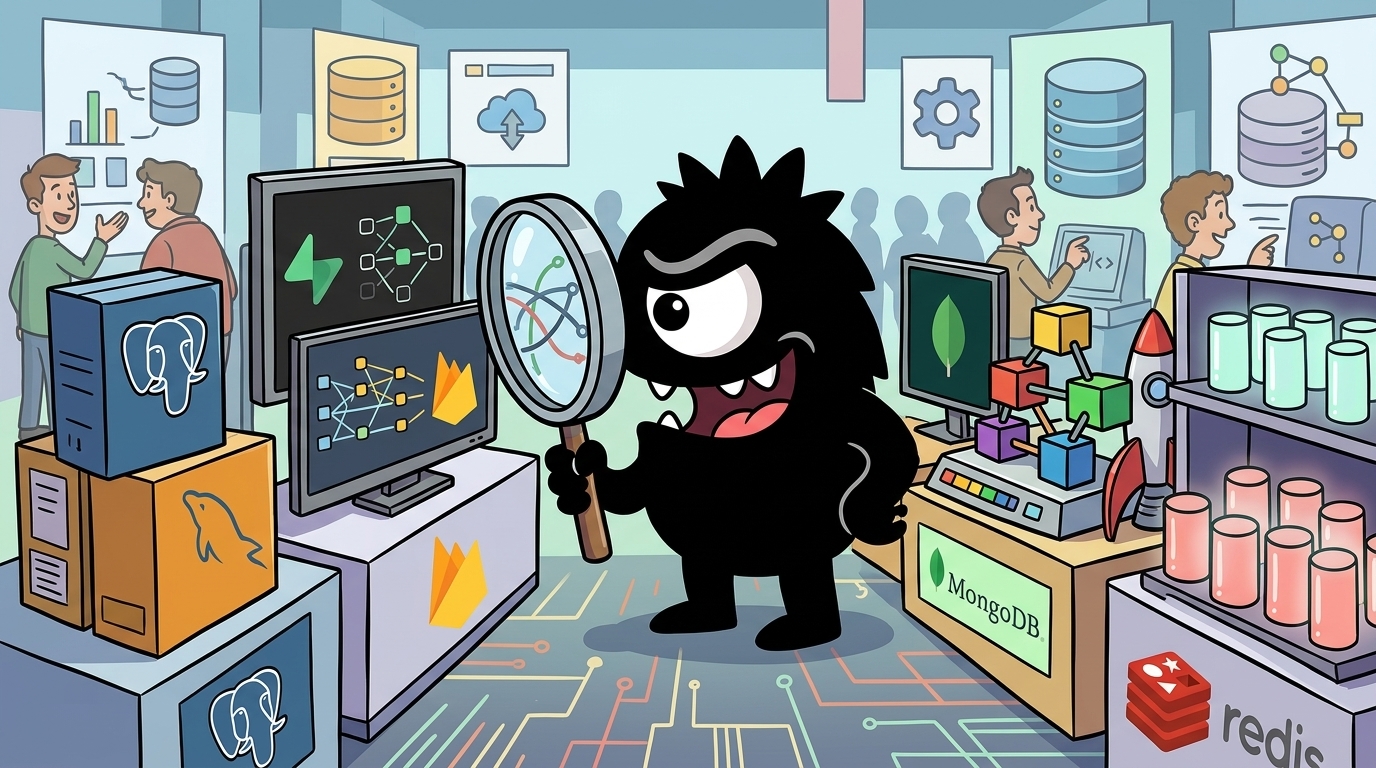
Why Choosing a SaaS Database Feels Harder Than It Should
Choosing a database used to sound like a narrow technical decision: SQL or NoSQL, managed or self-hosted, maybe one engine versus another. In 2026, that framing is outdated.
For many teams—especially founders, solo builders, and frontend-heavy product teams—picking a database now often means picking a backend posture. Are you also choosing auth, file storage, generated APIs, realtime sync, edge functions, and your scaling model? In many cases, yes. That’s why the decision feels overloaded.
You're a frontend dev. You just built a killer UI.
Now you're stuck.
You need a backend. You need a database. You need user auth. And that "weekend project" just became a 3-month infrastructure nightmare.
You think, "I need a server, an RDS instance, I need to write 50 Express routes for CRUD, I need to implement JWTs, bcrypt, password reset..."
This is the exact moment 90% of indie projects die.
For years, the answer was Firebase. But that meant getting locked into a NoSQL world (Firestore) that's not always the right fit.
Today, I really dove into Supabase, and I'm stunned. It’s the open-source alternative built on the one thing we all trust: Postgres.
That post captures the real anxiety well: the database is no longer isolated from the rest of the stack. Supabase, Firebase, Neon, PlanetScale, and similar products have compressed infrastructure decisions into a single starting point. That’s good for speed, but it also means early convenience can hide architectural constraints you’ll feel later.
You're building a SaaS product.
Are you using Supabase, Neon, MongoDB, Firebase or PlanetScale for Database?
Or are you using something else?
The wrong question is “What’s the best SaaS database?” The right question is: What combination of data model, backend primitives, and operational tradeoffs best fits my SaaS workload and team?
That distinction matters because the “best” answer changes depending on whether you’re building a multi-tenant B2B workflow app, a mobile chat product, an AI-native web app, or a content-heavy system with rapidly changing document shapes. Modern database selection guidance increasingly emphasizes use-case fit over generic rankings.[3][6]
First Principle: Stop Comparing Databases and Backend Platforms as If They’re the Same Thing
A lot of the X discourse gets muddled because people compare unlike things. PostgreSQL, MySQL, MongoDB, and Redis are database technologies. Supabase and Firebase are broader backend platforms.
Invalid comparison. each one has its own purpose and solves a different problem.
- PostgreSQL: Solid, battle-tested relational DB. Supports vectors too now.
- Supabase: Not really a DB, it's a product built on top of PostgreSQL. Gives you auth, storage, APIs, realtime subscriptions, dashboard, etc. Great for building fast and PoCs.
- MySQL: Another battle-tested relational DB that's been running production workloads for years.
- MongoDB: Great when your data is non-relational or the schema keeps changing.
There is no single winner here. They all shine in the use cases they were designed for.
That distinction is essential.
Databases are storage engines with query models
- PostgreSQL and MySQL are relational databases designed for structured data, transactions, and querying across related tables.
- MongoDB is a document database, optimized around flexible JSON-like records.
- Redis is an in-memory key-value store built for ultra-low-latency access patterns such as caching, sessions, and ephemeral state.
Platforms bundle storage with application services
- Supabase is built around PostgreSQL and adds authentication, object storage, auto-generated APIs, realtime features, developer tooling, and operational capabilities.[7]
- Firebase is a broader backend platform from Google, centered around services such as Firestore, Authentication, Cloud Functions, and deep integration with the Google Cloud ecosystem.[11]
Supabase offers:
Database (PostgreSQL)
Authentication (Auth)
Storage (S3-compatible object storage)
Realtime (websocket engine for live updates, broadcast, and presence)
Edge Functions (serverless functions)
Auto-generated APIs (REST and GraphQL)
Vector embeddings (AI & Vectors toolkit via the pgvector extension)
Supabase Studio (dashboard for managing services)
SQL Editor
Security & Performance Advisor
Point-in-Time Recovery
Automatic Backups
Custom Domains
Log Drains
Read Replicas
Command Line Interface (CLI)
Client Libraries (for JavaScript, TypeScript, Python, Flutter, Swift, etc.)
I wonder why developers are not using it 🤔
Why this matters in practice
If you compare PostgreSQL directly with Supabase, you’re really comparing a database engine to a developer platform. If you compare Redis to Firebase, you’re comparing a specialized in-memory data store to a full backend service suite. Those are not meaningful head-to-head matchups.
Database Types You Should Know 🗄️
1⃣ Relational
→ PostgreSQL • MySQL • RDS • Cloud SQL
→ Best for structured transactional data
2⃣ Key-Value
→ DynamoDB • etcd • Bigtable
→ Ultra-fast lookups with simple key-based access
3⃣ Document
→ MongoDB APIs • Firestore • CouchDB
→ Flexible JSON-style document storage
4⃣ Wide-Column
→ Cassandra • Bigtable • Keyspaces
→ Built for massive distributed workloads
5⃣ In-Memory
→ Redis • ElastiCache • Memorystore
→ High-speed caching and low latency access
6⃣ Time-Series
→ TimescaleDB • Timestream
→ Optimized for metrics, logs, and monitoring data
7⃣ Graph
→ Neo4j • Neptune
→ Best for relationships and connected data
8⃣ Blob/Object Storage
→ S3 • Azure Blob • Cloud Storage • MinIO
→ Store files, backups, media, and large objects
Choosing the right database matters more than choosing the most popular one.
The practical takeaway: first decide what layer of the problem you’re solving.
- Do you need a primary system of record?
- Do you need a backend platform that removes auth/API/storage toil?
- Do you need a complementary store for caching, queues, or low-latency state?
Most teams need more than one of these. Confusion starts when they try to force one tool into all three roles.
Start With Workload, Not Habit: The Real Decision Framework
The most useful shift in the current conversation is away from ideology and toward workload shape. “I always use Postgres” is better than “I always use Mongo,” but it’s still lazy architecture.
Picking a database by habit is how you end up with the wrong one.
SQL vs NoSQL is a distraction. The real question is: what does this workload demand?
ACCESS PATTERN
. Key lookups with very low latency → Redis
. Flexible document reads → MongoDB
. High-volume append-heavy workloads → Cassandra
. Joins and complex ad hoc queries → PostgreSQL
CONSISTENCY REQUIREMENTS
. Strong consistency needed? Financial loss/corruption risk → PostgreSQL
. Occasional stale reads are fine? Consider more scalable options
WRITE VOLUME
. Modest writes? One relational node could suffice
. High write throughput? Distributed databases become attractive
SCHEMA EVOLUTION
. Stable schema, well understood → Relational modeling for strong guarantees
. Frequent entity shape changes → Document model reduces friction
A good SaaS database decision usually starts with five questions.
1. What is your core data model?
Are you storing:
- Transactional business records: users, organizations, subscriptions, invoices, permissions
- Documents/content objects: evolving blobs of semi-structured data
- Session and ephemeral state: tokens, caches, rate limits
- Events and telemetry: append-heavy logs, analytics streams
- Realtime collaborative state: frequent concurrent updates, presence, feeds
If your product revolves around entities with relationships—companies, users, roles, plans, projects, tasks, invoices—you are already in relational territory. That doesn’t mean every field must be normalized. It means your business model benefits from integrity constraints and queryability.
2. How much consistency do you need?
This is where many SaaS teams should stop pretending all databases are interchangeable.
If you are handling:
- billing
- financial records
- entitlements
- audit trails
- permissions
- admin workflows
- multi-tenant isolation
then strong consistency and transactional guarantees are not “nice to have.” They are operational risk controls. Comparative database analyses consistently place relational systems at an advantage for ACID-sensitive workloads and complex transactional logic.[4][5]
3. What queries will matter in six months, not just week one?
Early-stage builders often optimize for writes and simple reads, then regret it once customers ask for:
- admin dashboards
- exports
- reporting
- joined views across entities
- ad hoc debugging queries
- internal analytics
The question isn’t whether your MVP can run on a flexible document model. It usually can. The question is whether the model will keep serving you once the product accumulates business rules.
4. How often will your schema really change?
Developers often overestimate the value of “schema flexibility” and underestimate the cost of moving data constraints into application code.
𝗨𝗻𝗱𝗲𝗿𝘀𝘁𝗮𝗻𝗱𝗶𝗻𝗴 𝗗𝗮𝘁𝗮𝗯𝗮𝘀𝗲 𝗧𝘆𝗽𝗲𝘀
Choosing storage is no longer about query syntax. It’s about matching the shape of your data and access pattern to the engine built for it.
Use the map below as a quick decision helper:
𝟭. 🧱 𝗥𝗲𝗹𝗮𝘁𝗶𝗼𝗻𝗮𝗹 — Row-oriented tables with ACID guarantees; best for OLTP, financial ledgers, and any workflow that demands multi-row transactions and strict foreign-key integrity. Databases: PostgreSQL, MySQL, SQL Server, Oracle, Amazon RDS, Azure SQL.
𝟮. 📄 𝗗𝗼𝗰𝘂𝗺𝗲𝗻𝘁 — JSON/BSON documents with schema enforced in code are ideal for rapidly evolving domain models in microservices and content platforms. Databases: MongoDB and Couchbase.
𝟯. 🔑 𝗞𝗲𝘆-𝗩𝗮𝗹𝘂𝗲 — Constant-time look-ups via distributed hash tables; perfect for session storage, feature flags, and low-latency caches. Databases: Redis, DynamoDB (KV mode), Aerospike.
... (and more types listed)
If your domain is genuinely evolving and each object varies meaningfully by type or tenant, a document model may reduce friction. But if “schema flexibility” mostly means “we haven’t thought through the model yet,” that flexibility can turn into silent inconsistency.
5. What can your team actually operate?
A solo founder with strong frontend skills but no appetite for backend plumbing has a different optimal choice than a startup with experienced backend engineers. Team capability is part of workload fit. A technically “perfect” architecture that your team can’t ship or maintain is not actually a better architecture.
Why PostgreSQL Keeps Emerging as the Default for SaaS
There’s a reason PostgreSQL keeps winning these conversations. Not because it’s fashionable, but because it aligns with the shape of most SaaS products.
PostgreSQL for most startups.
You get structure, reliability, joins, transactions, JSON support when needed, and fewer data headaches later.
MongoDB makes sense if the product is truly document-heavy, but I’d avoid choosing “flexibility” too early if the data model isn’t clear yet.
Most SaaS apps are not primarily feed engines, gaming backends, or unstructured content stores. They are systems of record for business processes. They track tenants, users, permissions, subscriptions, workflows, approvals, and history. PostgreSQL is unusually strong at exactly that mix.
Why it fits so many SaaS products
- Relational integrity for multi-entity business logic
- Transactions for correctness under concurrent writes
- Joins and ad hoc queries for reporting and internal tooling
- JSON/JSONB for moderate flexibility without abandoning SQL
- Mature ecosystem for ORMs, migrations, backups, observability, and managed hosting
For multi-tenant SaaS in particular, relational patterns remain a strong default because tenant boundaries, shared schemas, and access controls all benefit from explicit structure.[13][14][15]
Building a mobile app startup?
Use PostgreSQL as your backend foundation.
Rock-solid reliability, JSONB for flexible data, Row-Level Security for privacy, and scales from MVP to millions without huge bills. Pair with Supabase and ship faster.
Smart DB choice saves time.
PostgreSQL’s modern appeal is not that it’s rigid. It’s that it gives you structured correctness by default while still allowing pragmatism. JSONB lets you attach less-structured metadata where it makes sense. Extensions such as pgvector have also made Postgres more attractive for AI-adjacent workloads that need embeddings alongside transactional data.[3][5]
The biggest reason to choose PostgreSQL, though, is simple: it reduces future regret. A lot of teams don’t outgrow their day-one traffic assumptions. They outgrow their day-one data model assumptions.
MySQL vs MongoDB: Two Common Alternatives, Very Different Tradeoffs
PostgreSQL may be the default recommendation, but MySQL and MongoDB remain valid primary choices in the right context.
TurboStarter now supports SQLite + MySQL natively!
(+ PostgreSQL which is the default)
I just published a guides how to choose perfect database for your SaaS 🚀
Check at turbostarter(.)dev/docs 👇
When MySQL makes sense
MySQL is still a strong option for structured transactional SaaS systems, especially when:
- your team already knows it well
- your tooling stack is built around it
- you want a conservative, battle-tested relational foundation
- you don’t specifically need Postgres-oriented features
In practice, many teams can build excellent SaaS products on either MySQL or PostgreSQL. This is often less about abstract superiority and more about ecosystem familiarity, hosting preferences, and feature fit.[2]
When MongoDB makes sense
MongoDB is a good fit when the product is genuinely document-centric:
- content objects vary significantly in shape
- nested records are natural and frequently fetched together
- relationships are limited or deliberately denormalized
- rapid schema evolution is part of the product, not a temporary phase
Where teams get into trouble
The problem is not that MongoDB is bad. It’s that teams often choose it for the wrong reason: avoiding schema design. That trade pushes complexity upward into the application, where consistency, joins, and cross-entity rules become harder to reason about.[2][4]
Database choice for a new startup SaaS:
A) PostgreSQL
B) MySQL
C) Supabase / Neon
D) Something else
Why?
For classic B2B SaaS—accounts, memberships, roles, subscriptions, invoices, audit logs, reporting—document flexibility often becomes application-layer burden. For document-heavy products, MongoDB can be elegant. For business apps with dense relationships, it frequently becomes a workaround.
Where Redis Fits: Critical Accelerator, Rarely the Primary SaaS Database
Redis belongs in many SaaS stacks, but usually not as the main system of record.
It shines at:
- caching expensive queries
- session storage
- rate limiting
- queues
- pub/sub
- feature flags
- leaderboards
- ephemeral coordination state
Because Redis is in-memory, it delivers extremely low-latency access patterns that relational databases are not designed to optimize first.[1][4] That makes it a powerful accelerator.
What it usually should not be is the default home for your users, billing records, permissions, and core transactional workflows. Most SaaS teams use Redis alongside PostgreSQL or MySQL, not instead of them.
The easiest way to think about Redis is this: use it when speed of access to simple keyed state matters more than relational querying or durable transactional guarantees. If that is not your dominant workload, Redis is probably a supporting actor, not the star.
Supabase vs Firebase: Speed Now vs Complexity Later?
This is the hottest practical debate because it maps exactly to what indie builders and lean teams care about: how fast can I ship without painting myself into a corner?
Choosing Supabase vs Firebase decides when you deal with complexity.
Firebase feels incredible at the start.
Auth in minutes.
Realtime updates out of the box.
No schemas slowing you down.
You ship while others are still designing tables.
That speed is real.
But as apps grow, data stops being simple.
Records start depending on other records.
The same data gets updated from multiple places.
Business rules slowly move into application code.
Nothing breaks.
But reasoning about the system gets harder.
Supabase takes a different approach.
It’s built on PostgreSQL.
Structure is explicit.
Relationships are enforced.
Rules live close to the data.
It can feel heavier early,especially if you’re new to SQL.
But as features stack up, the system stays predictable.
The real difference isn’t SQL vs NoSQL.
It’s when you want to face complexity.
Firebase optimizes for speed and abstraction early.
Supabase optimizes for clarity and control over time.
Neither choice is wrong.
Just choose the pain
you’d rather handle first.
That framing is better than the usual “which is better?” discourse because it gets to the real tradeoff.
What Firebase optimizes for
Firebase still excels at:
- very fast initial setup
- mobile-friendly developer experience
- strong realtime workflows
- tightly integrated managed services
- low operational overhead for small teams
If your product is mobile-first, event-driven, and you care more about shipping than relational modeling, Firebase can feel magical early.[8][10]
What Supabase optimizes for
Supabase tries to preserve that speed while putting PostgreSQL underneath the application. That gives teams:
- SQL and relational modeling
- row-level security
- familiar querying for web/SaaS use cases
- open-source and self-hosting options
- less perceived long-term lock-in than Firebase[7][8]
Supabase vs Firebase in 2026.
Supabase: open source, Postgres, row-level security, self-hostable, generous free tier.
Firebase: fast setup, Google ecosystem, real-time is solid, vendor lock-in is real.
for new projects I've been defaulting to Supabase for 8 months now.
what are you using? 👇
The deeper tradeoff
Firebase often lets you postpone data modeling discipline. Supabase asks for more of it upfront. That can make Supabase feel heavier on day one, especially for developers newer to SQL. But the payoff is usually clearer data relationships, less duplicated business logic, and easier reporting later.
I prefer Supabase because I mostly build for the web, and being open-source means no vendor lock-in. Plus, having a real PostgreSQL database makes handling complex data much easier than NoSQL.
View on XThis is not really SQL versus NoSQL as an ideology war. It is about where complexity lives:
- In Firebase, more complexity tends to migrate into application code as relationships and business rules multiply.
- In Supabase, more complexity is surfaced earlier in the schema, policies, and queries.
For many web SaaS teams, that’s a worthwhile trade. For some mobile or realtime-first products, Firebase’s abstraction is still the more pragmatic choice.
Why Supabase Has So Much Momentum With Indie Hackers and Web SaaS Teams
Supabase’s momentum is not just hype. It’s responding to a real gap in the market.
Frontend-heavy teams wanted Firebase-level velocity without committing to a NoSQL-first mental model. Backend-lean startups wanted a way to ship product quickly without hand-assembling Postgres, auth, storage, APIs, and operational tooling. Supabase landed directly in that gap.
Removed MongoDB.
For vibe coding, Supabase delivers Firebase-like speed and DX on top of real PostgreSQL power (relations, queries, transactions). MongoDB's flexibility sounds nice until schemas get messy. PostgreSQL and Supabase keep the good vibes going long-term.
That appeal becomes obvious when you look at the bundled capabilities. Supabase provides PostgreSQL plus auth, storage, realtime, generated APIs, edge functions, backups, replicas, vector support, and management tooling in one platform.[9][12]
⚡ Supabase: The Open-Source Backend That Made Firebase Look Incomplete
For years, startups had two choices:
Build your backend from scratch.
Or use Firebase.
Then Supabase arrived.
Postgres
↓
Authentication
↓
Storage
↓
Realtime
↓
Edge Functions
↓
Vector Search
↓
AI Applications
All open source.
The strongest part of the value proposition is not any one feature. It’s the compression of backend setup time without giving up relational foundations. That’s especially compelling for:
- indie hackers
- small web teams
- internal tool builders
- AI app teams that still need normal SaaS entities underneath the prompt layer
- startups expecting permissions, billing, or reporting complexity to show up soon
It’s not universally superior. But it has changed the default stack decision for a large class of web products.
Who Should Use What: A Practical SaaS Database Recommendation Matrix
Here’s the straight answer.
Choose PostgreSQL if you are building:
- B2B SaaS
- internal tools
- admin-heavy applications
- billing and subscription systems
- products with reporting and exports
- multi-tenant systems with permissions and auditability
This remains the safest default for most startups because it aligns with the data complexity they usually grow into.[1][3]
Choose Supabase if you want:
- PostgreSQL as your foundation
- fast shipping without building backend basics from scratch
- auth, storage, APIs, and realtime in one place
- reduced lock-in risk compared with more vertically integrated platforms
- a strong default for web SaaS with a small team
Choose Firebase if you are building:
- mobile-first apps
- realtime-first consumer products
- prototypes where speed matters more than relational querying
- products deeply tied to the Google ecosystem
Just be honest that rapid early progress may mean more complexity in application code later.[7][8]
Choose MySQL if:
- your team already knows it best
- your workload is conventional and transactional
- you don’t need Postgres-specific features badly enough to justify switching
MySQL is not the “runner-up.” For many teams, it is a perfectly sound primary store.
Choose MongoDB if:
- your product is truly document-centric
- entity shapes vary substantially
- nested JSON-like retrieval is core to the product
- relational joins are not central to the business model
But don’t choose it just to avoid schema design.
Use Redis alongside your primary database if you need:
- caching
- sessions
- queues
- rate limiting
- ultra-fast key-value access
- pub/sub or ephemeral state coordination
Not as your default source of truth for a normal SaaS app.
PostgreSQL for most startups.
You get structure, reliability, joins, transactions, JSON support when needed, and fewer data headaches later.
MongoDB makes sense if the product is truly document-heavy, but I’d avoid choosing “flexibility” too early if the data model isn’t clear yet.
If you want the shortest practical rule: default to PostgreSQL, often via Supabase if you want platform speed, unless your workload clearly points elsewhere. That’s not dogma. It’s simply the option that causes the fewest architecture regrets for the broadest range of SaaS products.
Sources
[1] PostgreSQL vs MySQL vs Redis: Choose Your Database — https://blog.devgenius.io/postgresql-vs-mysql-vs-redis-choose-your-fighter-8f36ab233121
[2] MySQL vs MongoDB for SaaS: Which Database Should You Choose in 2025 — https://dev.to/swapnil-ahmmed-shishir/mysql-vs-mongodb-for-saas-which-database-should-you-choose-in-2025-k5o
[3] Best Database for a SaaS MVP — https://layerbase.com/blog/best-database-for-a-saas
[4] The Guide of Database Selection in 2025 — https://zeabur.com/blogs/database-choice
[5] Database Management Systems (DBMS) Comparison — https://www.altexsoft.com/blog/comparing-database-management-systems-mysql-postgresql-mssql-server-mongodb-elasticsearch-and-others/
[6] Which Modern Database Is Right for Your Use Case? — https://www.integrate.io/blog/which-database/
[7] Supabase vs Firebase — https://supabase.com/alternatives/supabase-vs-firebase
[8] Supabase vs Firebase 2026: Backend Comparison Guide — https://www.digitalapplied.com/blog/supabase-vs-firebase-2026-backend-comparison-guide
[9] Supabase vs Firebase: 8 Tests, 1 Winner [2026] — https://tech-insider.org/supabase-vs-firebase-2026/
[10] Supabase vs Firebase: Which Should You Choose? — https://www.dbpro.app/blog/supabase-vs-firebase
[11] Supabase vs. Firebase: a Complete Comparison in 2026 — https://www.bytebase.com/blog/supabase-vs-firebase/
[12] Supabase vs Firebase 2026: Full Comparison for Web Apps — https://www.weweb.io/blog/supabase-vs-firebase-comparison-for-web-apps
[13] Multitenant SaaS Patterns - Azure SQL Database — https://learn.microsoft.com/en-us/azure/azure-sql/database/saas-tenancy-app-design-patterns?view=azuresql
[14] Multi-Tenant SaaS Database Design Patterns on AWS — https://builder.aws.com/content/39R5wiQL0HWOdSmRrLppJ1Sb9kC/multi-tenant-saas-database-design-patterns-on-aws
[15] Designing Your Postgres Database for Multi-tenancy — https://www.crunchydata.com/blog/designing-your-postgres-database-for-multi-tenancy
References (15 sources)
- PostgreSQL vs MySQL vs Redis: Choose Your Database - blog.devgenius.io
- MySQL vs MongoDB for SaaS: Which Database Should You Choose in 2025 - dev.to
- Best Database for a SaaS MVP - layerbase.com
- The Guide of Database Selection in 2025 - zeabur.com
- Database Management Systems (DBMS) Comparison - altexsoft.com
- Which Modern Database Is Right for Your Use Case? - integrate.io
- Supabase vs Firebase - supabase.com
- Supabase vs Firebase 2026: Backend Comparison Guide - digitalapplied.com
- Supabase vs Firebase: 8 Tests, 1 Winner [2026] - tech-insider.org
- Supabase vs Firebase: Which Should You Choose? - dbpro.app
- Supabase vs. Firebase: a Complete Comparison in 2026 - bytebase.com
- Supabase vs Firebase 2026: Full Comparison for Web Apps - weweb.io
- Multitenant SaaS Patterns - Azure SQL Database - learn.microsoft.com
- Multi-Tenant SaaS Database Design Patterns on AWS - builder.aws.com
- Designing Your Postgres Database for Multi-tenancy - crunchydata.com
Related Guides

Aider vs Cline: Which Is Best for AI Pair Programming in 2026?
15 min read
The Best AI Model Tools in 2026: An Expert Comparison Through a $4M Polymarket Bet
25 min read
What Is Replit? A Complete Guide for 2026
19 min read
Traders Are Betting on Anthropic: What Polymarket's 99% AI Model Odds Reveal for Developers in 2026
20 min read