Deno Deploy vs Turso: Which Is Best for AI Pair Programming in 2026?Updated: September 27, 2026
Deno Deploy vs Turso compared for AI pair programming: pricing, edge performance, ORM support, and real-world stack tradeoffs developers face. Find out which wins.
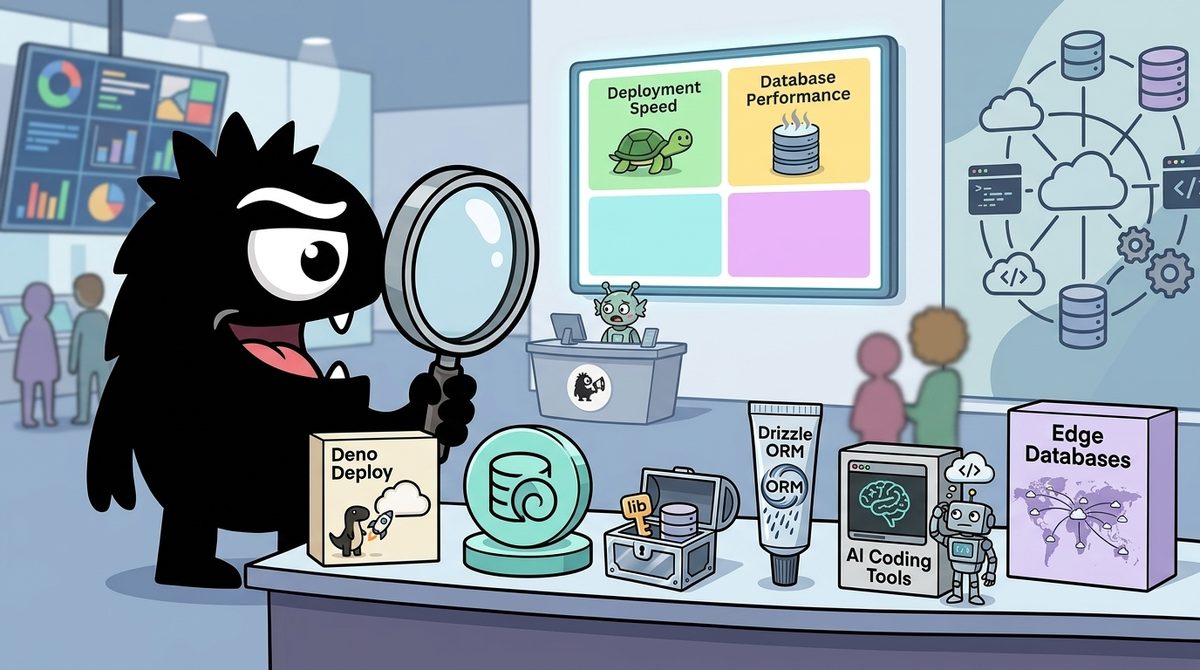
The real question behind “Deno Deploy vs Turso for AI pair programming” is not which product wins. Deno Deploy runs application code; Turso stores application data. For most AI-assisted TypeScript projects, the practical answer in 2026 is to use Deno Deploy for compute and Turso for relational data.
The important comparison is where each tool creates—or removes—friction when an AI agent generates the application, database schema, ORM configuration, and deployment files together. Deno’s standards-oriented TypeScript runtime gives agents a relatively clean execution target. Turso offers familiar SQLite semantics through a serverless driver designed for edge environments.[2]
Bottom line
>
- Best default for AI pair programming: Deno Deploy + Turso.
- Use Deno Deploy alone for stateless applications or simple built-in key-value requirements.
- Use Turso without Deno Deploy when your compute already runs on another supported platform.
- Treat ORM compatibility and plan-gated operational features as the real risks, not basic runtime-to-database connectivity.
Deno Deploy vs Turso: Why You’re Comparing Compute to Data
The confusion is understandable. AI coding tools encourage developers to select an entire stack in one prompt: runtime, framework, database, ORM, authentication, and hosting. Products from different layers consequently appear beside one another as if they were alternatives.
They are not direct competitors. Deno Deploy is a serverless application platform for running JavaScript and TypeScript applications.[3] Turso is a database platform built around SQLite-compatible technology, with remote and embedded deployment patterns.[12]
A useful architectural picture is:
```text
Browser or API client
↓
Deno Deploy: routing, validation, business logic, AI calls
↓
Turso: relational records, queries, transactions, vectors
```
The question developers are actually asking is closer to: Can my AI coding assistant generate a Deno application that connects to Turso, remains type-safe, works locally, and deploys without runtime surprises?
That question is visible in the community’s stack experiments:
The answer is yes, but the database access layer matters. Direct use of Turso’s TypeScript client is comparatively straightforward. Adding Prisma, Drizzle, or Kysely introduces another compatibility boundary involving generated code, adapters, migrations, and edge-runtime assumptions.
For a small team or solo developer, pairing the products is generally more useful than choosing between them. Larger teams should evaluate them separately: Deno Deploy against other compute platforms, and Turso against other relational database services.
What Does AI Pair Programming Actually Demand From a Stack?
AI pair programming changes the value of infrastructure features. A human can investigate an obscure runtime error, reconcile outdated documentation, or replace an incompatible driver. An agent can also attempt those jobs—but every exceptional configuration increases the chance that it produces plausible, outdated, or subtly incorrect code.
The best AI-assisted stacks therefore optimize for four qualities:
- Predictable APIs. Common, standards-based interfaces are more likely to appear correctly in generated code.
- Strong type feedback. TypeScript errors let both the developer and agent identify incorrect assumptions before deployment.
- Low configuration overhead. Every adapter, code-generation step, and platform-specific file is another failure point.
- Local-production parity. Code validated locally should use the same APIs and database behavior after deployment.
That desire is less about chasing a fashionable stack than removing interruptions:
my go-to stack when i'm trying to ship something quick without overthinking it
neovim when i'm hungry for power
zed for when neovim is in it's mood
deno because node_modules can stay in 2015
bun when I don't want deno's sass
turso for databases that don't make me want to cry
neon so I have postgres on demand
better-auth so i don't have to build auth for the 47th time
the rest is just whatever gets me from idea to deployment without friction
Deno is attractive here because web-platform APIs and TypeScript are central to its programming model. Turso is attractive because AI agents already understand SQL and SQLite conventions, while the official TypeScript quickstart exposes a small client surface: create a client, provide a URL and token, and execute queries.[1]
Type-safe database access can further tighten the feedback loop:
Thanks for the appreciation! Yes, We needed to build a dashboard super quick, so we decided to give Deno, Prisma ORM, and Turso DB a try.
The combination really speeds up development and deployment. Prisma's type safety with TypeScript in Deno is a game-changer, making database interactions much smoother and reducing the usual headaches associated with SQL queries.
However, type safety is not automatically equivalent to simplicity. An ORM may help an agent generate valid queries while simultaneously introducing engine binaries, code generation, migration state, or adapter-version constraints. The right question is not “Does this ORM support TypeScript?” It is “Does this exact ORM-driver-runtime combination work on Deno Deploy in the version I am installing?”
Why Is Deno Deploy a Strong Compute Layer for AI-Generated Apps?
Deno Deploy’s main advantage for AI-assisted development is a comparatively coherent runtime surface. Deno supports TypeScript directly and emphasizes web-standard APIs, reducing the need for a traditional transpilation pipeline or a large node_modules tree. Deno Deploy’s documentation positions the platform as a way to build and run applications using Deno’s runtime and cloud infrastructure.[3]
That coherence helps in three practical ways:
- An agent can generate
fetch,Request,Response, streams, and URL-handling code using familiar web APIs. - Type errors can be surfaced without first assembling a complicated build chain.
- Runtime-specific glue is easier to isolate when moving code between local Deno and deployment.
The community sees this standards-first approach as a portability benefit, even when mixing Deno with other edge platforms:
# サーバ必要
deno + remix3 で、 ssg からスムーズに移行できる。
deno deploy の KV を多用してたけど free plan だと1つしか作れないように nerf されたので turso メインに乗り換えた
cf worker も使うけど 独自ランタイムで Web標準寄りなので local は deno。 相性は悪くない。
Deno Deploy also offers platform capabilities beyond basic request handling, including application deployment and observability features. Its current product materials describe managed deployment, OpenTelemetry integration, cron functionality, and the ability to run applications across different environments.[7] Deno’s generally available deployment architecture is designed around fast, isolated application execution.[10]
That execution model affects database selection. Edge and isolate-oriented runtimes are not conventional, persistent Node.js servers. Libraries that expect native binaries, writable local disks, long-lived processes, or unrestricted TCP connections may fail even when their query API looks ordinary.
Turso’s serverless JavaScript driver was explicitly designed for environments including Deno Deploy, Cloudflare Workers, and Vercel Edge, using HTTP rather than depending on a conventional local SQLite process.[2] That makes it a more natural partner than a database driver built around assumptions from a long-running Node server.
Deno Deploy fits best when:
- The application is written primarily in TypeScript.
- The team wants minimal build and package-management machinery.
- Routes use web-standard APIs.
- Workloads are stateless or use remote, edge-compatible storage.
- Fast previews and deployment matter more than full Node.js compatibility.
It is a weaker fit when the generated application depends heavily on Node-native packages or database clients that require unsupported execution behavior.
Why Do Developers Keep Reaching for Turso as the Database?
Turso gives developers a familiar relational model without requiring them to operate a traditional database server. Its platform is based on SQLite-compatible technology and supports database access across distributed application environments.[12] Turso has also been developing a rewrite of SQLite in Rust, an effort distinct from simply placing an HTTP API in front of an unchanged local SQLite file.[14]
For AI-generated applications, the important benefit is familiarity. SQL tables, indexes, joins, and constraints are widely represented in training material and documentation. An agent generally has fewer concepts to invent than it would with a proprietary data model.
The migration path can also be small for applications already using SQLite:
So I tested @tursodatabase on a Deno server on @flydotio and it's a solid 10/10, I only had to replace the imports from "node:sqlite" to turso's, remove a few pragma statements, add some awaits to my code, and it's running flawlessly
View on XThat report should not be interpreted as a universal compatibility guarantee, but it illustrates why Turso appeals to fast prototyping: the conceptual database does not need to change. The code primarily needs an edge-compatible client and asynchronous remote operations.
Turso’s serverless driver was created to minimize bundle size and work in constrained JavaScript runtimes.[2] The platform also promotes capabilities for AI-oriented applications, including vector-related workloads, alongside its distributed database model.[12] That makes it relevant to retrieval-augmented generation, semantic search, agent memory, and applications storing both normal relational data and AI-related representations.
Its platform reach is part of the appeal:
#NextjsConf Sponsor 30/35: Turso
Turso calls itself "the fastest, easiest, cheapest database in the world." Turso integrates with https://t.co/y2kmvFCrJE, Cloudflare, Vercel, Digital Ocean, Netlify, Deno Deploy, AWS Lambda, and Koyeb.
A direct Turso client is often the lowest-friction choice for a small AI-generated application. It has fewer abstraction layers for an agent to misconfigure, and the official TypeScript quickstart provides a narrow reference implementation.[1]
Turso fits best when:
- The application needs relational SQL rather than only key-value storage.
- Developers want SQLite-compatible local concepts.
- Compute runs in an edge or serverless runtime.
- The project may need many small databases, replicas, or geographically distributed access.
- The team prefers an HTTP-capable client over a traditional database connection.
Which ORMs Actually Work With Deno Deploy and Turso?
The riskiest part of this stack is not the connection from Deno Deploy to Turso. It is the layer inserted between them.
A library can work with Deno, work with Turso, and still fail when combined on Deno Deploy. Generated clients, transitive dependencies, migration APIs, and runtime-specific adapters all influence the result.
Kysely: appealing design, but verify the complete path
Kysely’s typed query-builder approach is conceptually well suited to AI pair programming: generated queries remain close to SQL, while TypeScript checks table and result types. Earlier community reports described Kysely with Turso as promising for relational databases on Deno Deploy:
Kysely x Turso 良かった記事を書いた。
無料枠拡大したのもあるし、「Deno DeployでRDB使いたいなら、Trusoを使う」は結構有望そう。
[ブログ更新]: Deno で試すデータベースアクセス(Turso - Kysely 編)
#Deno #kysely #Turso
https://www.ccbaxy.xyz/blog/2023/10/08/js81/
But that same combination later produced a reported failure deep in the stack:
kysely x turso x Deno の環境が動かなくなった。
トレースを見るにかなり深いところエラー吐いていた。
deno deploy上でもエラー。
半ばあきらめながら調べていくと、turso は現在 スキーマ移行ステータスを最上位プランを使っていないと参照できなくなっているらしい。
https://docs.turso.tech/sdk/http/reference#schema-migration-status
This is not proof that every Kysely-Turso-Deno application is broken. It is evidence that compatibility can change outside your application code, including through service-plan behavior and migration tooling. Teams choosing Kysely should pin versions, test the deployed runtime in continuous integration, and separate runtime queries from schema-management operations.
Prisma: strong type feedback, more moving parts
The positive Prisma report above highlights its biggest advantage: a generated, type-safe client gives AI tools a precise schema-derived API. That can make CRUD code fast to produce and easy to correct.
The tradeoff is machinery. Prisma compatibility depends on the relevant Deno support, Turso adapter, client-generation workflow, and deployment environment all lining up. It is reasonable for teams already comfortable with Prisma, but it should not be selected merely because a coding agent recognizes its syntax.
Drizzle: the clearest documented starting point
A public Deno, Drizzle, and Turso starter provides a concrete integration reference rather than leaving the agent to assemble the stack from unrelated examples.[4] That matters: battle-tested scaffolding reduces the chance that generated configuration mixes Node, Deno, and edge-specific conventions.
For a new AI-assisted prototype, the practical order is:
- Direct Turso client for the smallest surface and easiest debugging.
- Drizzle when schema typing and a documented Deno-Turso starting point are important.
- Prisma when the team values its generated client and already understands its deployment workflow.
- Kysely when SQL-like control is valuable and the team is willing to validate versions and migrations carefully.
What Do the 2026 Free Tiers and Plan Gates Change?
Free tiers are product architecture, not merely marketing. AI pair programming makes it possible to create a prototype in hours, but generated code rarely accounts for account-level limits, observability retention, migration controls, or production pricing.
Deno Deploy’s documented free allowance includes 1 million requests, 100 GB of egress, and 15 CPU hours, subject to the platform’s current pricing and limits.[8][9] Those figures can accommodate prototypes and smaller applications, but request counts alone do not describe every constraint.
The X discussion shows how a narrower limit can determine architecture. One developer moved primary storage to Turso after reporting that the Deno Deploy free plan allowed only one KV instance, despite otherwise liking Deno’s runtime. Free-tier reductions can therefore push a project from a first-party integrated service toward an external database even when raw request capacity remains generous.
Turso’s free tier has attracted developers as its allowances expanded, but the opposite risk appears in operational features. The reported Kysely failure was eventually connected to schema migration status being unavailable without the highest plan. Whatever the exact application path, the lesson is broader: a database may allow free reads and writes while gating the operational API your migration system expects.
Before accepting an AI-generated architecture, check:
- Number of databases or KV instances allowed
- Storage and row-read/write limits
- Egress and replication costs
- Migration and branching features
- Backup and recovery options
- Observability and log retention
- Whether the ORM calls administrative APIs at runtime
- What happens when a limit is reached
Pricing pages should be rechecked immediately before launch. Deno maintains separate pricing and limitations documentation,[8][9] and third-party 2026 summaries should be treated as secondary interpretation rather than the contract.[11]
Can Deno and Turso Behave the Same Locally and in Production?
Local-to-production parity is the missing piece in many AI-assisted workflows. Agents typically write and test against a local environment. If deployment replaces the filesystem, runtime APIs, database protocol, or migration process, “works locally” says little about production.
The community’s request is explicit:
Same here, we use turso/libsql for prod/local dev, but would love a solution from the deno team that works locally and in deploy
View on XTurso and libSQL currently offer a practical answer because teams can preserve SQLite-compatible concepts across local and hosted environments. Turso’s architecture supports remote databases as well as embedded-replica patterns, helping applications keep data close while synchronizing with a primary database.[13]
That does not make every local and production topology identical. Authentication, network latency, replication behavior, and administrative operations still differ. But it is a smaller conceptual gap than developing against a local database that requires an entirely different driver after deployment.
The parity question also shapes hosting decisions:
I'm kind of inspired to create something simple and publish it both the Deno Deploy using Turso, as well as self-hosting in a far-away place, and comparing. I will write up my findings if I do it, I've been curious for some time. Thanks for the inspiration!
View on XA first-party Deno relational database that behaved identically during local development and on Deploy would materially change the comparison. It could consolidate authentication, emulator behavior, deployment configuration, and billing. Until then, Turso fills the relational-data gap, while Deno KV remains the simpler option for applications whose data naturally fits key-value operations.
Who Should Pick Deno Deploy, Turso, or Both in 2026?
For most developers asking which is better for AI pair programming, the answer is:
Choose Deno Deploy + Turso for the default full-stack path
This is the strongest fit for solo developers and small TypeScript teams building dashboards, APIs, SaaS prototypes, AI agents, or retrieval applications. Use Deno Deploy for request handling and business logic, and Turso for relational persistence.
The combination is established enough to have dedicated community walkthroughs:
Turso を Deno Deploy で触ってみる (虎の穴ラボ株式会社)
https://speakerdeck.com/toranoana/turso-wo-deno-deploy-dehong-tutemiru
Start with the direct Turso TypeScript client or the Deno-Drizzle-Turso starter.[1][4] Make the AI agent generate explicit environment-variable checks, typed schemas, and a deployment smoke test.
Choose Deno Deploy without Turso when data needs are minimal
Use stateless handlers or Deno KV when the application needs straightforward key-value storage and remains comfortably inside current limits. This reduces vendors and configuration. Do not force relational entities, reporting queries, or complex indexing into a key-value model merely to preserve first-party integration.
Choose Turso without Deno Deploy when compute is already settled
If the application runs on Cloudflare Workers, Vercel Edge, Fly.io, or another supported environment, Turso can remain the data layer. Its serverless driver was designed to span several edge runtimes.[2] There is no reason to move compute solely to adopt the database.
Use self-hosted or conventional infrastructure when runtime compatibility dominates
A long-running server may be the better choice when the application depends on native Node modules, persistent connections, unusual SQLite extensions, or operational tooling that does not support isolates. AI-generated code is not improved by deploying it to a theoretically elegant edge platform that its dependencies cannot reliably use.
The final verdict is therefore not Deno Deploy versus Turso. It is Deno Deploy with Turso, unless the application is stateless, purely key-value, or constrained by incompatible database tooling. In AI pair programming, the winning stack is the one with the fewest ambiguous boundaries—and today, the ORM and migration layer deserves more scrutiny than either core product.
Sources
[1] Turso Quickstart (TypeScript)
[2] Introducing the Turso Serverless JavaScript Driver
[4] Deno, Drizzle, and Turso Starter
[7] Deno Deploy
[10] Deno Deploy is Generally Available
[11] Deno Deploy Pricing 2026: Free Tier, Edge Runtime & More
[12] Turso — Databases Everywhere
[13] Welcome to Turso
[14] We are a year into rewriting SQLite. How is that going?
References (15 sources)
- Welcome to Turso - Turso - docs.turso.tech
- Turso Quickstart (TypeScript) - docs.turso.tech
- Introducing the Turso Serverless JavaScript Driver - turso.tech
- About Deno Deploy - docs.deno.com
- Deno, Drizzle, and Turso Starter - github.com
- Turso vs PlanetScale vs Neon for TypeScript Apps (2026) - pkgpulse.com
- Cloudflare Workers, Deno Deploy, and Vercel Edge - daily.dev
- Deno Deploy - deno.com
- Deno Deploy Pricing - deno.com
- Pricing and limitations - docs.deno.com
- Deno Deploy is Generally Available - deno.com
- Deno Deploy Pricing 2026: Free Tier, Edge Runtime & ... - srvrlss.io
- Turso - Databases Everywhere - turso.tech
- We are a year into rewriting SQLite. How is that going? - Turso - turso.tech
- Announcing the Turso Partner Program - Turso - turso.tech
Related Guides

Aider vs Cline: Which Is Best for AI Pair Programming in 2026?
15 min read
The Best AI Model Tools in 2026: An Expert Comparison Through a $4M Polymarket Bet
25 min read
What Is Replit? A Complete Guide for 2026
19 min read
Traders Are Betting on Anthropic: What Polymarket's 99% AI Model Odds Reveal for Developers in 2026
20 min read