The Best AI Bubble Signals in 2026: What Polymarket's $2.9M Bet Reveals About SaaSUpdated: September 27, 2026
AI bubble prediction markets price just a 12% burst chance by end of 2026. Discover what Polymarket odds reveal for developers, founders, and SaaS buyers. Learn more.
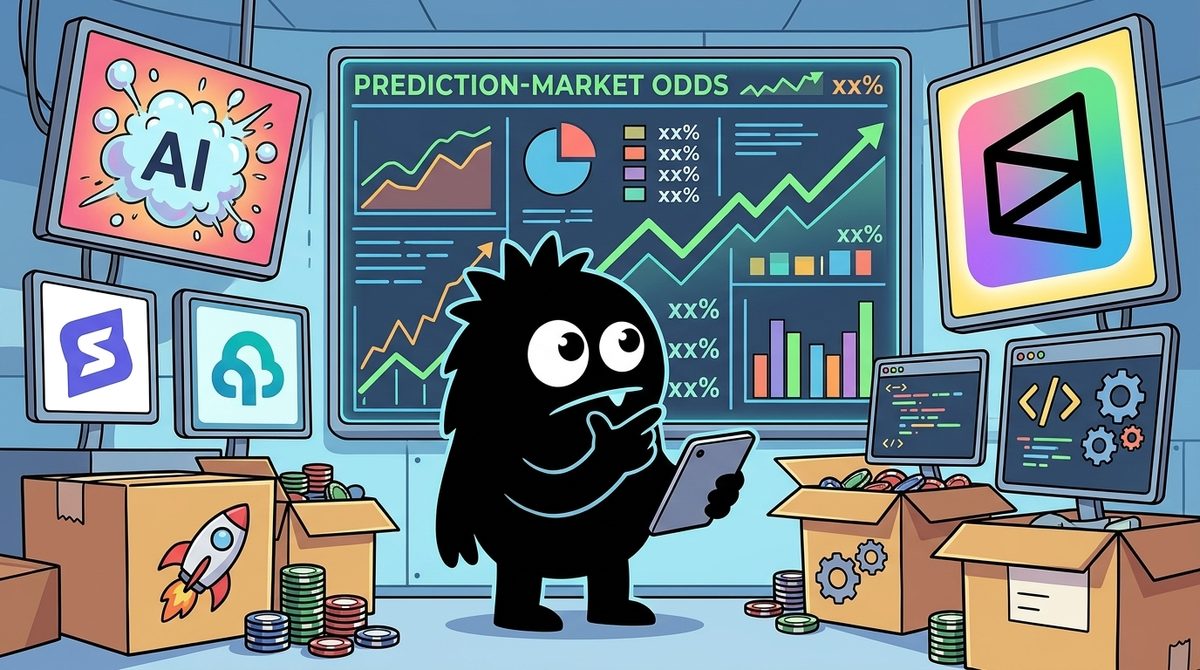
The question developers, founders, and SaaS buyers are really asking is not simply, “Is AI a bubble?” It is: How much should I change my hiring, funding, architecture, or procurement decisions because of the risk that AI valuations unwind in 2026?
As of August 18, 2026, Polymarket traders imply a 12% probability that the AI bubble will burst in 2026. The broader “AI bubble burst by...?” market has generated roughly $2,930,209 in trading volume, while approximately $2,342,214 has been traded on the 2026 contract, which resolves around December 31, 2026.[1] That is a meaningful tail risk, but it is not the market’s base case.
Bottom line: Betting markets currently put the odds of a qualifying 2026 AI-bubble burst at roughly one in eight. That price suggests traders expect the AI investment cycle to survive the year, but it does not imply that every AI startup, SaaS vendor, or infrastructure provider is safe. The more actionable signal is a widening split between durable infrastructure and cash-generating products on one side, and fragile app-layer valuations and legacy per-seat SaaS models on the other.
What does Polymarket’s 12% AI-bubble signal actually mean?
The central number is straightforward: the market currently implies a 12% chance of an AI bubble burst in 2026.[1] A separate tracker displayed the contract at 12.4%, while earlier coverage and aggregators have reported readings as high as roughly 16% as prices moved.[2][3][4][5]
Those differences are not contradictions. Prediction-market prices fluctuate as traders enter, exit, and respond to new information. They should be read as a changing range of money-weighted expectations, not as a fixed scientific estimate.
Nor does the roughly $2.93 million figure mean that traders have collectively placed exactly that amount of fresh capital at risk. Prediction-market “volume” measures trading activity and can include the same positions changing hands multiple times. It nevertheless indicates that this is more than a throwaway internet poll: participants have repeatedly bought and sold exposure to the outcome.
The sharp contrast is with the discourse on X, where bubble warnings are frequent and categorical. Fortuna captures the gap between dramatic narratives and the calmer market price:
🚨Guy who wrote the AI bible just got liquidated by AI stocks.📉🥀
Prediction markets: "bubble? what bubble?" (23%)
This is why you trade the odds and not the narrative.
The useful interpretation is not “bubble fears are wrong.” It is that traders currently demand much better than 12% odds before betting that the contract’s specific burst conditions will be met before the end of 2026.
That distinction matters. A startup funding slowdown, a 50% decline in one AI stock, or widespread app failures may not be enough to resolve the broader contract “Yes.” The market can therefore price low odds for a systemic burst while still expecting severe corrections inside particular AI segments.
Why are prediction markets becoming a risk gauge for AI and SaaS?
Prediction markets aggregate capital-weighted conviction. A survey asks what respondents believe; a market asks what price they will accept to be wrong.
That does not automatically make Polymarket more accurate than analysts, financial reporting, or industry research. It makes the signal different. Prices can react immediately to earnings, funding failures, regulatory changes, data-center delays, or shifts in public-market multiples. Traditional reports generally require collection, verification, analysis, and publication.
Rebeka Mordadi’s claim on X goes further, arguing that AI-risk order books have repriced institutional exposure before major headlines:
Seeing @Polymarket AI bubble risk contracts accurately re-price institutional fund exposure days before major news hits the headlines. Prediction order books are proving to be much sharper risk gauges for private tech valuations than traditional lagging reports.
View on XPractitioners should treat that as a market participant’s observation, not proof that prediction markets consistently lead the news. Still, it explains their appeal: a live order book can serve as a sentiment thermometer between quarterly reports.
What can distort the 12% price?
There are three important limitations.
- Resolution criteria control the bet. “Bubble burst” is not a self-evident economic state. Traders are pricing the contract’s formal rules and deadline, not every possible interpretation of an AI downturn.[1]
- Liquidity is not the same as certainty. Millions in volume can improve price discovery, but it does not eliminate concentrated positions, speculative trading, or temporary dislocations.
- The deadline creates event-window bias. A trader could believe AI valuations are unsustainable over three years while still betting that no qualifying burst occurs by December 31, 2026.
This makes the contract most useful as a short-horizon risk gauge. It is less useful as a verdict on whether current investment will generate adequate long-term returns.
Has the AI bubble already burst—or is there no broad bubble at all?
The X conversation has polarized into two camps.
The first argues that the unwind has already begun but has not been fully reflected in prices. In this view, large funds are distributing positions, AI infrastructure providers face deteriorating economics, and apparent resilience is merely a delay between underlying damage and public repricing.
The AI bubble has already burst. Prices just haven’t fully reflected it yet because large funds are still looking for the best levels to distribute and unload their positions.
I believe neocloud companies will take the biggest hit.
China has already crushed AI token prices, destroying pricing power across the ecosystem. Now SpaceX is entering the equation. If space-based data centers and structurally lower energy costs become commercially viable, the economics of today’s neocloud model could deteriorate very quickly.
At that point, 80% to 90% drawdowns would no longer look extreme.
The biggest risks, in my view:
$NBIS
$IREN
$CRWV
The bubble has burst.
The market just hasn’t priced it in yet.
A related bearish thesis interprets the rush toward public listings as insiders attempting to monetize private valuations before financing conditions, power constraints, delays, or missed forecasts become visible:
The AI bubble has already burst.
That is exactly why so many companies are racing toward IPOs now.
They want to sell at peak valuations before the financing problems, data center delays, power constraints, missed targets, and guidance cuts start hitting the market.
This is not sustainable growth.
This is insiders trying to cash out at the top before the crowd realizes the bubble is over.
$NVDA $AMD $MU $AVGO $SMCI $ARM $TSM $ASML $META $MSFT $GOOGL $AMZN $ORCL $PLTR
That concern is not confined to social media. The New York Times has framed AI hype as colliding with economic reality, while Ray Dalio has publicly discussed the conditions under which AI-related wealth could be converted into money and contribute to a bursting bubble.[6][8] Research comparing the current boom with the dot-com period likewise gives the caution camp a historical framework: transformative technologies can produce real productivity gains while investors still overpay for individual companies.[11]
The opposing camp argues that “bubble” is too broad a description because leading public AI companies do not resemble the most extreme dot-com valuations. Eric Jackson’s case rests on forward sales and earnings multiples rather than the scale of AI enthusiasm alone:
After reviewing forward P/S and EBITDA multiples across the MAG7, Palantir, CoreWeave, and the rest of the AI leaders, here’s the truth:
There is no AI bubble.
With one exception — Palantir — whose elevated multiple is earned because of the ontology architecture I’ve been talking about… the rest of the field is trading well below 2021 levels. Multiples have drifted up since the 2022 lows, yes — but nowhere near the dot-com moonshots where everything went vertical overnight.
Back then, everything bubbled.
This time, only Palantir is up — and that’s because retail understood the ontology-driven revenue ramp early.
The critics screaming “bubble!” are wrong.
If you disagree with me, show me any credible evidence.
Just because you say it, because you hope to be featured in “The Big Short 2” won’t make it so.
The market is rational. Retail sees it.
Rising Dynasty sees it.
Let’s keep riding. 🚀
Polymarket’s 12% price sits between these positions, but it leans strongly away from an imminent systemic rupture. The market implies that a qualifying burst before year-end is possible, not probable.
That does not validate every bullish valuation. It suggests traders distinguish among:
- an industry-wide collapse;
- a correction in private AI startups;
- falling multiples among public AI vendors;
- app-layer consolidation;
- and a repricing of SaaS companies threatened by automation.
Those events can occur independently. Indeed, localized damage may be the most probable path precisely because stronger companies can continue attracting capital after weaker ones fail.
Why can SaaS valuations collapse even if the AI bubble does not burst?
A low probability of an AI bust is not a bullish signal for conventional SaaS. It may imply the opposite.
Early-2026 SaaS analysis describes a market increasingly divided by growth quality, profitability, and exposure to AI-driven disruption.[12] Investors are questioning whether traditional per-seat pricing remains durable when automated agents can perform work previously assigned to human users. Research on agentic AI and SaaS valuations similarly emphasizes that automation can alter both product economics and the metrics investors use to value software companies.[13]
On X, JUMPERZ presents the maximalist version of that thesis:
I genuinely believe we're watching SaaS die in real time and most people still don't see it..
$1 trillion wiped from software stocks since January 2026 and its just getting started..
SaaS multiples collapsed from 18.5x at the covid peak to 4.8x today and in the same time the AI market went from $50B to $539B and it's heading to $3.5 trillion by 2033 if not sooner
the death cross hits around 2027.. that's when AI market trajectory fully overtakes SaaS valuations on the chart
the reason is simple.. the per-seat model dies when 10 agents replace 100 humans and no seats left to sell
every SaaS tool you're paying $50/seat a month for is about to get replaced by an agent that costs $0.003 per task..
chatgpt opened the door in 2022, claude opus 4 made agentic AI real in 2025 and now multiagent coordination systems like openclaw are making it deployable and accessible to everyone..
every step on that chart the tech gets more autonomous and the SaaS line drops further..
not saying every saas will die but the companies that were built entirely on per-seat pricing and no real data advantage are the ones exposed.
tbh I don't think most founders see it yet, not because the data isn't there, but accepting it means everything they built needs to be rethought..
The exact “death cross” forecast is an opinion, not an established outcome. But the underlying mechanism deserves attention. If a company charges for 100 employee seats and its customer automates enough work to need only 50, the vendor can deliver more technological value while collecting less revenue under the old pricing model.
That creates a structural challenge for:
- collaboration products priced exclusively per user;
- workflow tools with limited proprietary data;
- thin interfaces over functions that AI agents can reproduce;
- and vendors whose AI roadmap consists mainly of adding a chatbot to an existing product.
The likely beneficiaries are not simply “AI companies.” They are vendors able to move toward usage-, outcome-, transaction-, or workflow-based pricing, while retaining attractive gross margins.
What should SaaS buyers infer from the repricing?
Buyers should not assume a falling vendor valuation means a product is about to disappear. They should use the uncertainty to negotiate:
- shorter renewal periods;
- stronger data-export and termination rights;
- caps on AI usage charges;
- roadmap commitments tied to contract terms;
- and protections if an AI feature is withdrawn or moved into a higher-priced tier.
For mission-critical systems, financial durability matters more than headline innovation. A discounted three-year contract is not attractive if the supplier may need emergency financing or a forced acquisition before the term ends.
Which valuation mechanics are feeding AI-bubble concerns?
The most fragile valuations may be concentrated in private markets, where price discovery is less transparent than on public exchanges.
One mechanism drawing attention is the split- or two-tranche financing round. Different investors purchase shares at different prices, but the highest implied valuation becomes the number used in headlines, recruiting, and subsequent fundraising.
Hedgie describes an extreme version involving an early investment followed by a much larger tranche at a dramatically higher valuation:
🦔AI startups with no revenue have found a way to inflate their valuations. They raise funding in two tranches at wildly different prices. Ineffable Intelligence raised $11 million from Sequoia at a $55 million valuation, then raised $1.1 billion from other investors at a $4 billion valuation weeks later. The headlines reported the $5.1 billion number. Over 63 AI neolabs are collectively valued at $300 billion and have raised $48 billion.
My Take
Sequoia gets a 70x markup on paper before the company does anything. The founder pitched AI in toasters with no deck and no memo, and raised $1.1 billion. One VC on the call said he left with more questions than answers. Sequoia invested anyway.
This is how the bubble works. VCs inflate valuations with tranched rounds, startups use that headline number to recruit employees whose options price off the top, and those employees take on more risk for less upside without knowing the lead investor paid a fraction of the sticker price. One VC called it a "pump and dump" round. Another called it the "Sequoia Scam."
Meanwhile enterprise customers are capping AI spend, communities blocked $130 billion in data center projects, and 16% of the public thinks AI will be positive. The Nasdaq dropped 4% this week because the market is starting to ask the same question the investors on that Zoom call should have asked. Where does the revenue come from? 63 neolabs valued at $300 billion and not one of them has an answer yet.
Those specific allegations should not be generalized to the entire market without further disclosure. But the structural problem is real: a headline valuation does not reveal how much capital was invested at that price, what preferences investors received, or whether ordinary employee shares have equivalent economics.
For founders, accepting the highest possible paper valuation can create a trap. The next round must clear that benchmark, employees may anchor compensation expectations to it, and an eventual down round can damage retention. A lower valuation with clean terms and sufficient runway may be strategically superior.
The Financial Times has examined the bubble debate inside the 2026 AI buildout, while a multi-method academic evaluation published in May 2026 distinguishes between genuine infrastructure expansion and signs of speculative excess.[9][10] That distinction helps explain the low Polymarket probability: traders may see unsustainable pockets without expecting the entire AI complex to break by December.
Demis Hassabis’s reported position, relayed by Rohan Paul, draws essentially that boundary—extreme private startup valuations may be vulnerable even where big technology companies have real businesses behind their AI spending:
Google DeepMind CEO Demis Hassabis on AI bubble, from his new interview yesterday.
Says some AI startups with tens of billions of valuations are wildly overpriced — and a correction may come.
AI is overhyped in the short term, underappreciated in the medium to long term. An “AI bubble” exists in parts of the ecosystem, especially seed stage startups raising at tens of billions in valuation before proving anything, which he sees as unsustainable.
However, he differentiates that from big tech, where he thinks there is real business value behind the valuations, though outcomes still depend on execution. Booms and corrections are normal for transformative tech, similar to the internet and mobile cycles.
This is the market’s implicit barbell: profitable hyperscalers and strategically essential infrastructure can remain resilient while seed-stage labs and copycat applications undergo a severe correction.
Where does the “90% of AI apps go to zero” thesis bite hardest?
Aggregate bubble odds obscure company-level failure rates.
Mitchell Green’s argument, shared by TBPN, is that 90% to 95% of AI apps could go to zero because many have negative or inverted economics: customer revenue passes through to model and infrastructure providers, leaving the application with poor gross margins.
“90–95% of AI apps are going to zero,” says Mitchell Green (Founder, @LeadEdgeCapital) and here’s who wins.
Over the last year, he says the pattern is familiar: we overestimate the near term and underestimate the long term. Today’s AI hype mirrors the late-’90s dot-com era.
“What you’re seeing in the markets right now is so reminiscent of ’99 and 2000.”
Many AI app startups run on upside-down unit economics and negative gross margins, with spend flowing through to the hyperscalers and Nvidia.
In his view, models will commoditize; cost per query and infrastructure leverage will decide the winners.
“We’ve always thought that the models will commoditize and it will become a game of who’s got the best infrastructure and who can deliver the searches the cheapest.”
Polymarket’s 12% price does not contradict that thesis. A venture portfolio can experience mass failure without creating a market-wide event that satisfies the contract. The dot-com era produced many failed companies, but the internet remained transformative; current research similarly separates technological importance from the price paid for exposure.[10][11]
The app layer is particularly vulnerable because model APIs make impressive prototypes easier to build. Ease of development is good for users and developers, but dangerous for undifferentiated startups. If ten teams can reproduce a feature within months, technical novelty alone cannot support a durable valuation.
Jamie Quint identifies the competitive consequence:
Thoughts on investing in AI lately:
- If you can build a wildly impressive demo in 1-3 months so can 10+ other teams (and they are)
- The more broad (horizontal) your use case is, the more competition you'll face
- Late 2000's and early 2010's SaaS companies that did not have network effects and still turned into $5bn+ outcomes (e.g. Stripe, Palantir, Twilio, Okta) had relatively little competition near the time they were founded. Certainly there were not 10 other startups doing the same thing at the same time. Maybe 1-2.
- AI valuations are hilariously inflated, it's like we completely forgot about what we just learned from 2021.
- Outcome valuations will be compressed by the hyper-competitiveness of the space without more defensibility.
For founders, defensibility increasingly comes from some combination of:
- proprietary or permissioned data;
- distribution that competitors cannot cheaply replicate;
- workflow integration and high switching costs;
- network effects;
- regulatory or domain expertise;
- superior inference economics;
- and measurable ownership of a business outcome.
A horizontal AI assistant with no distribution advantage is therefore a poor fit for founders with limited runway. A narrow product can be more attractive when the team has privileged access to a regulated workflow, unique customer data, or an existing buyer channel.
Developers evaluating jobs should apply the same test. Ask whether the company owns customer relationships and differentiated data, or merely pays a model provider to generate outputs that competitors can reproduce.
What should developers, founders, and SaaS buyers do with the 12% odds?
The correct response to a 12% implied probability is neither panic nor complacency. It is contingency planning proportional to a meaningful but non-base-case risk.
Founders: prioritize runway and clean economics over valuation headlines
This approach fits early-stage teams that still control their burn rate and financing structure.
- Model a funding environment in which the next round takes longer or arrives at a lower valuation.
- Track gross margin after inference, data, human-review, and support costs.
- Avoid valuation structures that create misleading paper gains but make the next financing harder.
- Build around distribution, proprietary workflows, or data—not a demo that another team can reproduce quickly.
- Prepare an operating plan that does not depend on the bubble contract resolving “No.”
Developers: choose durable layers, not merely fashionable labels
For engineers choosing projects or employers, the strongest positions are likely to be tied to persistent demand: infrastructure efficiency, security, evaluation, data governance, observability, and products with demonstrated customer budgets.
That does not mean avoiding app startups. It means demanding evidence of retention, repeat usage, sustainable inference costs, and a credible reason customers cannot switch to a model provider’s native feature.
SaaS buyers: use repricing as leverage, but preserve exit options
Larger enterprises with procurement and integration resources can accept some startup risk in exchange for faster innovation. Small teams that cannot absorb vendor failure should prefer financially durable suppliers or architecture that makes replacement easy.
Buyers should:
- negotiate portability and deletion rights;
- avoid prepaying large sums to fragile vendors without protection;
- benchmark AI add-on pricing against measurable labor or workflow savings;
- require clarity about underlying model dependencies;
- maintain a migration path for critical data and automations.
The Polymarket contract should be monitored as December 31 approaches, particularly after earnings, major IPOs, financing failures, or changes in AI infrastructure spending.[1] A move from 12% to 25% would represent a substantial repricing of near-term risk even though “No” remained favored. A fall toward 5% would indicate greater confidence that the year ends without a qualifying event.
The most important conclusion is that systemic calm and localized destruction can coexist. Traders currently price a relatively low chance of a broad 2026 AI-bubble burst, while SaaS multiples, startup economics, and competitive intensity can still deteriorate sharply. Practitioners should trade neither the euphoric narrative nor the catastrophic one. They should use the odds as one live signal—and build businesses, careers, and vendor portfolios that survive either resolution.
Sources
[1] Polymarket — AI bubble burst by...? Predictions & Odds 2026
[2] CryptoSlate — AI bubble burst in 2026 Odds & Prediction Market Analysis
[3] Finbold — Traders set odds of AI bubble burst in 2026
[4] Phemex — Polymarket Traders: 16% Chance of AI Bubble Bursting by 2026
[5] Prediction Bubbles — AI bubble burst in 2026? — 12.4% on Polymarket
[6] The New York Times — Opinion: A.I. Hype Is Running Into Reality
[7] Stanford HAI — Stanford AI Experts Predict What Will Happen in 2026
[8] Bloomberg — Dalio Sees AI Bubble Bursting as Wealth Is Converted Into Money
[9] Financial Times — Tech in 2026: Inside the AI bubble
[10] arXiv — Boom, Bubble, or Buildout? A Multi-Method Evaluation of the AI Market as of May 2026
[11] Amundi Research Center — AI Boom or Bubble? Lessons from the Dot-Com Period
[12] SaaS Capital — Four early 2026 SaaS trends
[13] Oliver Wyman — How AI is reshaping SaaS valuations: a guide for investors
References (15 sources)
- AI bubble burst by...? Predictions & Odds 2026 - polymarket.com
- AI bubble burst in 2026 Odds & Prediction Market Analysis - cryptoslate.com
- Traders set odds of AI bubble burst in 2026 - finbold.com
- Polymarket Traders: 16% Chance of AI Bubble Bursting by 2026 - phemex.com
- AI bubble burst in 2026? — 12.4% on Polymarket - predictionbubbles.net
- Opinion | A.I. Hype Is Running Into Reality - nytimes.com
- Stanford AI Experts Predict What Will Happen in 2026 - hai.stanford.edu
- Dalio Sees AI Bubble Bursting as Wealth Is Converted Into Money - bloomberg.com
- Tech in 2026: Inside the AI bubble - ft.com
- Boom, Bubble, or Buildout? A Multi-Method Evaluation of the AI Market as of May 2026 - arxiv.org
- AI Boom or Bubble? Lessons from the Dot-Com Period - research-center.amundi.com
- Four early 2026 SaaS trends - saas-capital.com
- How AI is reshaping SaaS valuations: a guide for investors - oliverwyman.com
- How AI Impacts SaaS Valuations in 2026 - livmo.com
- AI and the SaaS industry in 2026 - bettercloud.com
Related Guides
The Best AI Model Odds in 2026: What Polymarket's $2M Bet Reveals
21 min read
The Best AI Model of 2026: What Polymarket's $1.9M Market Signals for Developers
20 min read
Make vs Vertex AI Agents vs OpenAI Assistants API: Which Is Best for Code Review and Debugging in 2026?
18 min read
The Best AI Model in 2026: An Expert Analysis of What a $4.2M Prediction Market Reveals
24 min read