LlamaIndex vs CrewAI vs Vertex AI Agents: Which Is Best for Full-Stack Web Apps in 2026?Updated: October 11, 2026
LlamaIndex vs CrewAI vs Vertex AI Agents compared for full-stack web apps: RAG, multi-agent orchestration, pricing, and production readiness. Find out which wins.
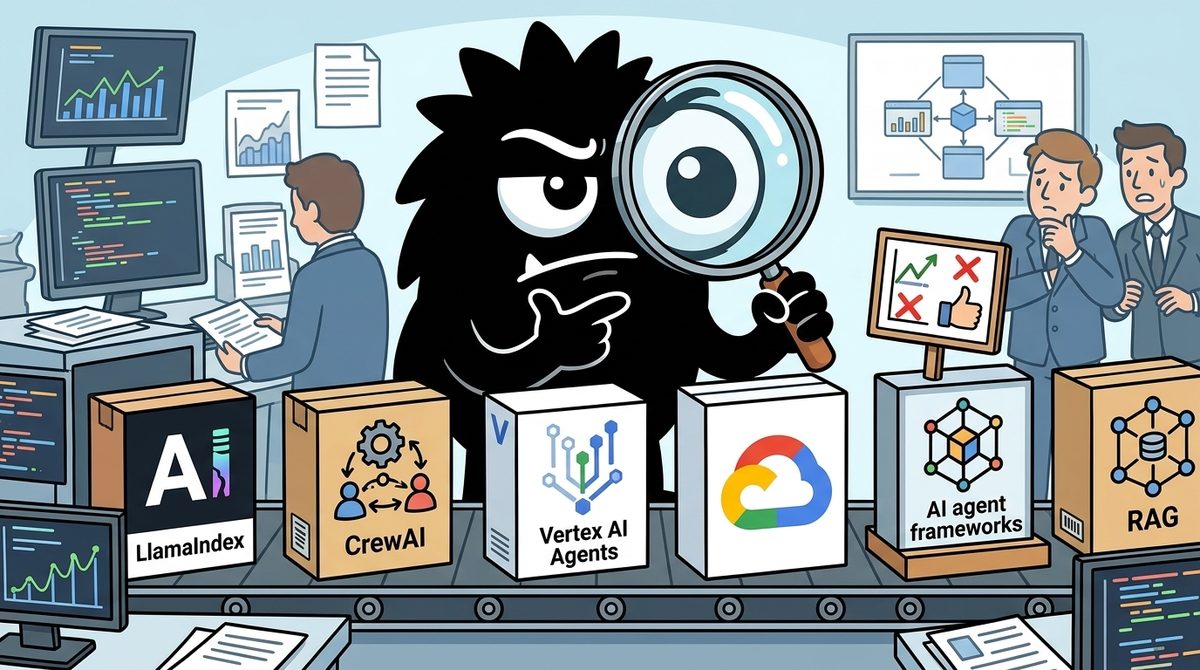
The real question is not “Which agent framework wins?” It is: Which layer of my full-stack web app is hardest—data retrieval, multi-agent coordination, or production operations? LlamaIndex is strongest when the application must answer from private or changing data. CrewAI fits workflows modeled as collaborating specialists. Vertex AI Agents is the better default when a Google Cloud team wants managed deployment, grounding, scaling, and governance.
None is a complete full-stack framework: you still need a frontend, authentication, application APIs, databases, and conventional business logic. These tools belong primarily in the AI backend.
Bottom line for 2026
>
- Choose LlamaIndex for RAG-heavy search, support, research, document, and enterprise-knowledge apps.
- Choose CrewAI for role-based workflows such as researcher–writer–reviewer or analyst–planner–executor.
- Choose Vertex AI Agents for managed, Google Cloud-native applications where operations and governance outweigh portability.
- Combine them when retrieval and orchestration are both first-class requirements—but avoid a three-framework stack unless each layer has a clear owner.
“Which Framework?” Is the Wrong First Question
The X debate is correctly moving away from framework rankings and toward workload patterns:
LangGraph vs CrewAI vs AutoGPT — everyone asking which framework, but that is the wrong question.
After building production agents on all three, here is the decision tree that actually matters:
**Choose LangGraph if:**
• You need explicit control over agent workflow (state machines, conditional branching)
• Your task has clear steps that can be graphed (DAG-style)
• You want to debug agent behavior (graph visualization is 🔥)
• Example: Code review pipeline (parse → analyze → suggest → verify → commit)
**Choose CrewAI if:**
• Your agents are role-based and collaborate like a team
• Task decomposition is dynamic (agents figure out subtasks)
• You want agents to have "personalities" and delegation patterns
• Example: Content creation team (researcher + writer + editor + SEO specialist)
For a full-stack application, begin with four architectural questions:
- Retrieval: Must responses be grounded in documents, databases, or other private sources?
- Coordination: Does the task require several autonomous roles, or would one agent with deterministic tools suffice?
- Control: Do you need persisted state, retries, approvals, and predictable branching?
- Operations: Who owns deployment, model quotas, traces, evaluation, security, and incident response?
LlamaIndex, CrewAI, and Vertex AI Agents optimize different parts of that problem. LlamaIndex starts from data and retrieval. CrewAI starts from roles and delegated tasks. Vertex AI Agent Builder and Google’s surrounding agent tooling start from managed infrastructure and integration with the Google Cloud platform. Current framework comparisons similarly distinguish data-centric systems from orchestration-centric ones rather than treating every product as a direct substitute.[1][9]
The most important omission in many comparisons is workflow durability. A production app may need cycles, persisted checkpoints, human approval, and recovery after partial failure—not merely a sequence of model calls.
Are you still building agentic workflows with linear, stateless scripts? I'm seeing a major split in production stacks right now between two patterns.
If your agents aren't using LangGraph for stateful cycles or CrewAI for role-based orchestration, you're building on a legacy foundation.
• LangGraph: This is for building durable, stateful agents. It introduces cycles and persistence. Essential for any real-world process that needs retries, human-in-the-loop validation, or complex conditional logic. Think of it as a state machine for your LLM.
• CrewAI: This is for high-level task delegation. You define a 'crew' of specialized agents-a researcher, a writer, a code reviewer-and they collaborate to execute a complex goal. It's about orchestrating roles, not just functions.
That distinction should shape the architecture before the team chooses a library.
What Are LlamaIndex, CrewAI, and Vertex AI Agents Actually For?
LlamaIndex is a data and retrieval layer
LlamaIndex is best understood as infrastructure for connecting language models to application data. Its center of gravity is retrieval-augmented generation, or RAG: ingesting data, indexing it, retrieving relevant context, and supplying that context to a model.
It can participate in agent workflows, but its distinctive value is the knowledge layer. That makes it a natural fit for document Q&A, enterprise search, support assistants, research applications, and any product whose correctness depends on finding the right evidence. Comparisons between LlamaIndex and CrewAI consistently frame the former as data-oriented and the latter as orchestration-oriented.[4][10]
CrewAI is a role-based orchestration layer
CrewAI models a process as a “crew” of agents with roles, goals, tools, and assigned tasks. A market-research workflow might contain a researcher, analyst, writer, and reviewer. Delegation and collaboration are part of the primary abstraction.
This is approachable because the software structure resembles an organizational chart. The tradeoff is that role-based autonomy can make routing and debugging less deterministic than an ordinary workflow engine. AWS’s comparison of agentic frameworks highlights the importance of evaluating orchestration, memory, observability, and deployment characteristics separately rather than assuming that a convenient agent abstraction solves all four.[3]
Vertex AI Agents is a managed platform
Vertex AI Agent Builder is Google Cloud’s managed route for building grounded generative AI experiences and connecting agents to enterprise systems.[11] The surrounding Google ecosystem—including Agent Development Kit patterns, Gemini, search and grounding services, and Cloud Run—covers more of the operational lifecycle than either open-source framework alone.
One practitioner summarized the appeal as combining familiar orchestration ideas with Vertex AI infrastructure:
ADK = LangChain + CrewAI + Vertex AI infra — but simpler, scalable & production-ready.
I tried it in Google Cloud Lab (GENAI104): created an agent using the Google Search tool, ran it via web UI, CLI, & Python.
Try it : https://cloud.google.com/
#AIagents #GenAI #GoogleADK
That is an interpretation from the X conversation, not a literal product equivalence. The useful point is that Google is packaging development interfaces and managed infrastructure together. For teams already operating on Google Cloud, that can remove integration work; for others, it creates a larger platform commitment.
Which Is Best for Grounding a Web App in Real Data?
For RAG-first applications, LlamaIndex is the clearest starting point. Its abstractions are built around data connectors, document transformation, indexes, retrievers, query engines, and response synthesis. Those components matter when a production app must handle multiple repositories, metadata filters, document permissions, or different retrieval strategies.
A widely discussed comparison amplified by LlamaIndex reported substantially better multi-document behavior and reliability than the OpenAI Assistants API in that particular setup, while also noting that the Assistants API performed well when material was consolidated into one document:
Head-to-head 🥊: LlamaIndex vs. OpenAI Assistants API
This is a fantastic in-depth analysis by @tonicfakedata comparing the RAG performance of the OpenAI Assistants API vs. LlamaIndex. tl;dr @llama_index is currently a lot faster (and better at multi-docs) 🔥
Some high-level takeaways:
📑 Multi-doc performance: The Assistants API does terribly over multiple documents. LlamaIndex is much better here.
📄 Single-doc performance: The Assistants API does much better when docs are consolidated into a *single* document. It edges out LlamaIndex here.
⚡️ Speed: “The run time was only seven minutes for the five documents compared with almost an hour for OpenAI’s system using the same setup.”
🛠️ Reliability: “The LlamaIndex system was dramatically less prone to crashing compared with OpenAI's system”
That result should not be universalized into a permanent benchmark. Models, APIs, chunking choices, and retrieval implementations change. Its enduring lesson is architectural: multi-document RAG is a retrieval-engineering problem, not a feature box labeled “file search.” Teams must evaluate their own corpus using answer quality, citation fidelity, latency, access control, and failure recovery.
CrewAI can use retrieved context, but retrieval is not its defining abstraction. If each crew member needs reliable access to private data, the team must supply a knowledge system or tool. CrewAI officially provides a LlamaIndex tool integration, making a LlamaIndex query engine callable from a crew.[8] That is often cleaner than forcing role-oriented code to become an indexing system.
Vertex AI offers the managed alternative. Google positions Agent Builder around grounded experiences and enterprise data connections.[11] LlamaIndex also announced an integrated RAG API hosted on Vertex, alongside open-source integrations with Gemini models and embeddings:
I’m thrilled to feature LlamaIndex on Vertex AI as part of the Google I/O announcements for Vertex 🦙
Developers can now take advantage of a fully integrated RAG API powered by @llama_index modules and is natively hosted by Vertex: allows for e2e indexing, retrieval, and generation.
If you want the full flexibility/customizability of @llama_index open-source, we also directly integrate with Gemini LLMs and embeddings with our library abstractions - see below for resources.
First, check out the LlamaIndex on Vertex docs and announcement:
https://t.co/B0sTnXL6Cg
https://t.co/JJAl35SNyX
Native LlamaIndex Gemini integrations:
https://t.co/kmexMOd35d
Decision: Pick LlamaIndex when retrieval behavior is part of the product’s differentiation. Pick Vertex when standard managed grounding is sufficient and reducing operational ownership is more valuable than deep portability. Use CrewAI above either one when multiple roles need the retrieved evidence.
Which Is Best for Coordinating Multiple Agents?
CrewAI has the strongest fit when the workflow genuinely maps to specialized collaborators. Examples include content production, due diligence, sales research, software-review crews, and report generation. It is particularly attractive to small Python teams that want to express task delegation quickly.
But “multiple agents” should not automatically mean “better system.” Every additional agent creates another prompt boundary, context handoff, model call, failure point, and source of nondeterminism. If one agent with three typed tools can perform the task, that design will usually be easier to test and operate.
LlamaIndex has also pursued multi-agent infrastructure. Its llama-agents announcement described an alpha framework based on distributed services, standard HTTP communication, explicit or agentic orchestration, deployment, scalability, and observability:
✨ Just announced on stage at @aiDotEngineer World's Fair! ✨ A brand new framework for getting multi-agent AI systems into production!
Currently an alpha release, llama-agents provides:
⭐️ Distributed, service-oriented architecture
⭐️ Communication via standard HTTP APIs
⭐️ Agentic and explicit orchestration of flows
⭐️ Easy deployment, scalability and observability
Check out the announcement blog post! https://t.co/sElHArdxkp
We want your feedback: check out the public roadmap!
That approach is conceptually different from a CrewAI crew. CrewAI emphasizes roles and tasks; the announced llama-agents design emphasized service boundaries and distributed communication. For a web app, the latter can align with independently deployed ingestion, retrieval, planning, and action services—but an alpha announcement is not the same as a mature production guarantee.
Vertex AI is the stronger option when coordination must live inside a managed cloud environment. Google’s official materials position Agent Builder as infrastructure for enterprise generative AI experiences rather than only a local orchestration library.[11] That brings platform integration, but the application team must still design agent contracts, tool permissions, state, and fallback behavior.
Model allocation also matters more than agent count:
Order and allocation matter more than agent count, agreed.
In my CrewAI SEO keyword crew I gave the planner its own dedicated LLM, had the tool calling agents share one, and used a higher quality model just for planning so the run never got rate limited.
Using a stronger model for planning and a cheaper or quota-separated model for tool execution can improve reliability and cost control. The exact allocation should be tested against the application’s latency, quota, and quality requirements.
Which Option Is Most Likely to Survive Production?
Production agents fail at the seams: a task is assigned to the wrong role, a tool returns malformed data, retrieval finds obsolete content, quotas interrupt a run, or a retry repeats a side effect.
Multi agent behavior in production is where the theory breaks.
I've debugged a real CrewAI bug myself, task misassignment from a role name mismatch in agent.yaml, and added per run caching afterward to cut redundant API calls.
The failure modes are rarely where you expect.
This CrewAI account captures a broader truth. Declarative role names and task configuration are application code, even when stored in YAML. They need schema validation, integration tests, version control, and deployment checks. Per-run caching can reduce redundant model calls, but cache keys must account for user identity, source revisions, tool arguments, and authorization boundaries.
A practical production checklist across all three options includes:
- Typed tool inputs and outputs, rather than unrestricted natural-language handoffs.
- Idempotency keys for actions such as sending messages or changing records.
- Per-step timeouts, retry limits, and budgets instead of retrying an entire run.
- Persisted execution state so a failed request can resume safely.
- Retrieval evaluations using representative documents and questions.
- Traces containing prompts, tool calls, retrieved sources, latency, and token usage.
- Human approval before high-impact or irreversible actions.
- Graceful degradation, such as conventional search when the agent is unavailable.
The production conversation around CrewAI now focuses explicitly on coordination, routing, memory, monitoring, and reliability rather than demo construction:
CrewAI in production: what changes beyond the demo?
Explore real-world lessons on agent coordination, task routing, memory, monitoring, and reliability in multi-agent AI systems.
https://www.agilesoftlabs.com/blog/2026/06/crewai-in-production-2026-real-lessons
With LlamaIndex and CrewAI, teams generally retain more control but must assemble more of the operational layer themselves. Vertex AI’s advantage is managed infrastructure and closer alignment with Google Cloud operations. Its disadvantage is that observability does not eliminate logical failures: managed scaling cannot fix a bad delegation prompt, an unsafe tool, or irrelevant retrieval.
How Do You Ship Each Option Inside a Full-Stack Web App?
The safest architecture is to treat the agent runtime as an asynchronous backend service, not as code embedded directly in a browser request.
A typical production flow is:
- React, Next.js, mobile, or another client sends a request to an application API.
- The API authenticates the user, checks authorization, and creates a job.
- A worker runs the LlamaIndex query, CrewAI crew, or Vertex agent.
- Events stream back through server-sent events, WebSockets, or polling.
- The application stores outputs, citations, traces, and approval state.
Shipping with LlamaIndex
Use LlamaIndex inside a Python API or worker when the key backend operation is retrieval. Keep ingestion separate from request-time querying so document processing cannot block users. The library can integrate with Gemini, while the hosted Vertex option provides a path to managed RAG.[12]
Shipping with CrewAI
Run CrewAI as a backend service behind a stable API contract. Do not expose crew configuration or unrestricted tools to the frontend. A small team can begin with one process, but longer tasks should move to a queue-backed worker with persistent run state.
CrewAI is most convincing when the UI exposes the workflow: users can inspect research, approve a draft, rerun one stage, or correct a specialist’s output. If the frontend only needs one concise answer, several collaborating agents may add cost without product value.
Shipping with Vertex AI Agents
Vertex is the most cohesive option for a Google Cloud-native stack. Google’s codelabs cover building applications in the AI era and constructing agents with Vertex AI Agent Builder, providing a guided route from agent development toward deployed applications.[12][13] Cloud Run can host the surrounding API or web service, while Agent Builder supplies the managed agent layer.
The result is still not “full stack” by itself. Authentication, tenancy, transactional data, frontend state, and product analytics remain application responsibilities.
How Do Pricing, Lock-In, and Learning Curve Compare?
LlamaIndex and CrewAI are open-source frameworks, but open-source does not mean zero-cost operation. The meaningful bill includes model tokens, embedding generation, vector storage, reranking, network traffic, observability, worker compute, and engineering time.
Today I’m excited to announce our Series A fundraise by @NorwestVP 🔥
Agents have the potential to automate the majority of knowledge work - whether it’s financial due diligence, support resolution, PRD generation, contract review. Building these agents requires both data and compute.
@llama_index is the best and only e2e platform for building agents over your enterprise data 🦙💫.
LlamaIndex usually has the steeper learning curve for teams that need to understand chunking, metadata, hybrid search, reranking, and evaluation. That depth is worthwhile when retrieval quality is the product.
CrewAI offers the fastest conceptual start for role-based demos. Its production curve arrives later, when the team must reason about delegation, memory, retries, caching, and tool side effects. Framework comparisons similarly describe CrewAI’s role abstraction as accessible while noting that production requirements extend beyond initial orchestration.[2][3]
Vertex shifts cost from framework assembly toward managed cloud consumption. It can reduce operational labor for Google Cloud teams, but creates greater lock-in around IAM, deployment, grounding services, monitoring, and platform-specific APIs. That trade is sensible for enterprises already standardized on Google Cloud; it is less attractive to early-stage teams deliberately maintaining cloud and model portability.
Should You Combine LlamaIndex, CrewAI, and Vertex AI?
Yes—but combine layers, not brand names.
A defensible hybrid architecture is:
- LlamaIndex for ingestion, indexing, retrieval, and evidence synthesis.
- CrewAI for role-based planning and delegation.
- Vertex AI for Gemini access, managed grounding, hosting, and cloud operations.
CrewAI’s documented LlamaIndex tool makes the first combination explicit.[8] The Vertex-hosted LlamaIndex RAG integration demonstrates the second. This convergence means the tools are increasingly complementary rather than exclusive.
The danger is compounded complexity. A CrewAI agent calling a LlamaIndex query engine hosted through Vertex may involve three configuration systems, three observability models, and several retry layers. Use that stack only if the boundaries are explicit:
- Retrieval failures belong to the knowledge service.
- Delegation failures belong to orchestration.
- quota, identity, and deployment failures belong to infrastructure.
- One trace ID follows the request across all layers.
Otherwise, standardize on one primary platform and use ordinary functions for the missing pieces. A hybrid is justified when each component removes more complexity than it introduces.
Who Should Pick What in 2026?
Choose LlamaIndex when data quality determines product quality
It is the best fit for:
- Enterprise search and knowledge assistants
- Document analysis and research products
- Customer support grounded in private documentation
- Applications requiring custom retrieval, metadata filters, or multiple indexes
- Teams willing to own retrieval evaluation and backend operations
Start with one retrieval-oriented agent. Add orchestration only after the workflow demonstrates a real need for separate roles.
Choose CrewAI when the workflow resembles a team
It is the best fit for:
- Researcher–writer–reviewer pipelines
- Marketing, analysis, and reporting automation
- Back-office workflows with distinct specialist responsibilities
- Python teams that want a quick route to role-based delegation
- Products where users benefit from inspecting or approving intermediate work
Do not choose it merely because “multi-agent” sounds more capable. Use it when roles improve decomposition, permissions, model allocation, or human oversight.
Choose Vertex AI Agents when operations are the deciding factor
It is the best fit for:
- Organizations standardized on Google Cloud
- Enterprise applications requiring managed identity and deployment integration
- Teams that prefer platform services over assembling open-source infrastructure
- Gemini-centric products using Google grounding or search capabilities
- Projects where cloud governance and operational consistency matter more than portability
Google’s Agent Builder materials emphasize creating grounded generative AI experiences within the Vertex ecosystem.[11] That is its clearest differentiator—not that it makes application architecture disappear.
Use a hybrid when retrieval and delegation are independently complex
Use LlamaIndex plus CrewAI when specialist agents need a shared, high-quality knowledge layer. Use LlamaIndex on Vertex when you want data-centric abstractions with managed Google infrastructure. Add CrewAI to that combination only when role-based delegation is central to the user experience.
The 2026 decision is therefore straightforward: choose the framework around the hardest production constraint. LlamaIndex wins on data-grounded depth, CrewAI on role-oriented coordination, and Vertex AI Agents on managed Google Cloud delivery. The best full-stack architecture may use more than one—but it should never require three agent frameworks to perform work that a conventional API and one reliable model call could handle.
Sources
[1] LlamaIndex vs CrewAI vs Vertex AI Agents: Which Is Best for Full-Stack Web Apps in 2026?
[3] Comparing agentic AI frameworks — AWS Prescriptive Guidance
[4] LlamaIndex vs CrewAI: Which Agentic AI Fits Your Python Agent Stack Better?
[9] LangChain vs LlamaIndex vs CrewAI: 2026 Framework Comparison
[10] LlamaIndex vs CrewAI: Data Framework vs Agent
[11] Build generative AI experiences with Vertex AI Agent Builder
References (15 sources)
- LlamaIndex vs CrewAI vs Vertex AI Agents: Which Is Best for Full-Stack Web Apps in 2026? - adtools.org
- Agent Frameworks Compared - rywalker.com
- Comparing agentic AI frameworks - docs.aws.amazon.com
- LlamaIndex vs CrewAI: Which Agentic AI Fits Your Python Agent Stack Better? - zenml.io
- AI Agent Frameworks Compared: LangChain vs CrewAI vs LlamaIndex - getaibook.com
- Open-source AI agent frameworks compared - stackpicks.dev
- CrewAI vs LlamaIndex — Agent Framework Comparison — A Tour of Agents - tinyagents.dev
- LlamaIndex Tool - CrewAI - docs.crewai.com
- LangChain vs LlamaIndex vs CrewAI: 2026 Framework Comparison - pecollective.com
- LlamaIndex vs CrewAI: Data Framework vs Agent - pecollective.com
- Build generative AI experiences with Vertex AI Agent Builder - cloud.google.com
- Building Applications in the AI Era - codelabs.developers.google.com
- Building AI Agents with Vertex AI Agent Builder - codelabs.developers.google.com
- Tutorial: Vertex AI Agent Builder for Developers - medium.com
- Build and deploy generative AI agents using natural language with Vertex AI Agent Builder - youtube.com
Related Guides
Windsurf vs Kiro vs GitHub Copilot: Which Is Best for Full-Stack Web Apps in 2026?
20 min read
The Best AI Model of 2026: What Polymarket's $2.4M Market Reveals for Developers
18 min read
Cohere vs Together AI vs xAI Grok: Which Is Best for AI Content Creation in 2026?
15 min read
The Best AI Bubble Signals in 2026: What Polymarket's Odds Reveal for 2027
24 min read