The Best AI Market Signals in 2026: An Expert Analysis of Polymarket's 12% Bubble OddsUpdated: October 04, 2026
Polymarket's AI bubble burst odds sit at 12%. Discover what these prediction market probabilities reveal about AI capex, the SaaS meltdown, and where the industry heads next. Learn more.
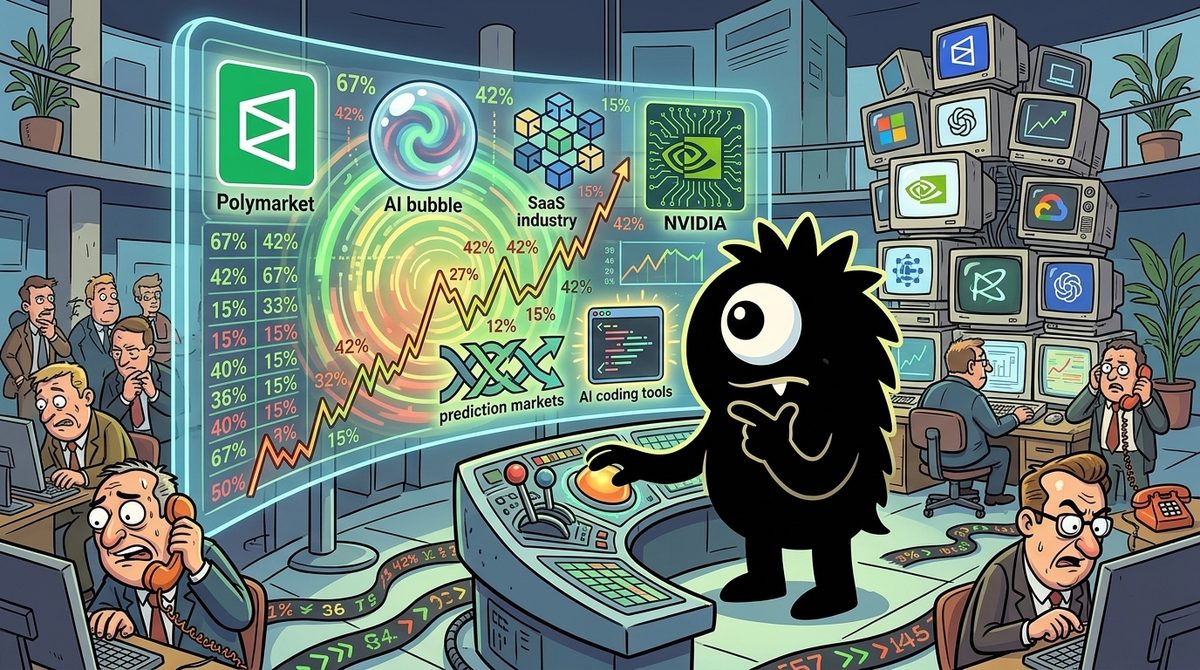
The real question for developers, founders, and technology buyers is not simply “Is AI a bubble?” It is: How much near-term collapse risk is the market pricing, what would count as a collapse, and should that probability change decisions being made today?
As of August 21, 2026, Polymarket traders imply only a 12% probability that the defined AI bubble will burst during 2026. Approximately $2,342,777 has traded on that contract, within roughly $2,930,772 of total volume across the broader “AI bubble burst by...?” market, which resolves around December 31, 2026.[1] That is not proof that the AI boom is sustainable. It is a market price for a narrowly defined, unusually severe scenario occurring within a short time window.
Bottom line
>
- Traders currently price roughly a one-in-eight chance of the contract’s severe bubble-burst conditions being met in 2026.
- The low probability reflects the contract’s strict resolution rules—not necessarily confidence in every AI company or SaaS valuation.
- SaaS can suffer a deep repricing while AI infrastructure demand remains durable, and neither outcome automatically makes the contract resolve “Yes.”
- Practitioners should treat inference economics, enterprise revenue, deployment reliability, and AI-driven pricing pressure as more useful operating signals than the headline 12% alone.
What does Polymarket’s 12% AI bubble probability actually say?
The live price says that traders currently assign a relatively low probability to a specific, compound crash scenario before the end of 2026. Independent market trackers have shown nearby readings, including approximately 12.4%, while reporting and X posts have captured snapshots between roughly 12% and 16% as prices moved.[2][4]
That narrow range is notable because the surrounding discourse is much more extreme. On X, “AI bubble” often describes any combination of enormous capital expenditure, unproven model economics, falling software valuations, circular commercial relationships, or speculative enthusiasm. Polymarket’s contract asks a different question: will enough objectively defined signs of systemic damage occur close together?
Worth pricing the other side of that demand story. Polymarket has an AI bubble bursting by the end of 2026 at 14%, on 3 million dollars of volume, and Nvidia still the largest company at year end at 68%.
View on XMarketCalled’s comparison with another prediction-market signal is instructive. At one snapshot, betting markets put Nvidia’s probability of remaining the world’s largest company at year-end at 68%, even while assigning a mid-teens probability to an AI bubble burst. Another snapshot cited 74%.
Every bar on that chart except the last one ended in a bust. An AI bubble burst by Dec 31 trades at 12% on Polymarket, $3M book, and NVIDIA as the largest company at year end is 74%. The railroad comparison is the one people make, and the market is not pricing the 1893 part yet.
View on XThose markets are not necessarily contradictory. Together, they imply that traders can recognize excess, volatility, and a possible software shakeout while still pricing continued strength in the company most closely associated with AI compute.
Volume also needs careful interpretation. Nearly $2.93 million traded makes this more informative than an idle online poll, but trading volume is not the same as $2.93 million of independent analytical conviction. Capital can turn over repeatedly, prices can be influenced by liquidity, and participants may be hedging other exposure. The 12% is best understood as a live consensus estimate with market incentives, not an oracle.
Why is “AI bubble burst” such a high bar to clear?
The contract’s resolution criteria explain much of the apparently calm pricing. It resolves “Yes” only if at least three listed triggers occur within a 90-day window by December 31, 2026. The triggers include:
- Nvidia falling 50% from its all-time high
- The SOXX semiconductor index falling 40% from its all-time high
- OpenAI or Anthropic entering bankruptcy
- OpenAI being acquired
- Nvidia H100 rental prices reaching $1 or less for five consecutive days
- TSMC, ASML, Broadcom, Arista Networks, or Super Micro Computer falling 50% from their respective all-time highs
Polymarket resolves the AI bubble burst Yes if at least 3 of these happen in any 90-day window by Dec 31 2026: NVDA down 50% from ATH, SOXX down 40% from ATH, OpenAI or Anthropic bankruptcy, OpenAI acquired, H100 rentals at $1 or less for 5 straight days, or TSM/ASML/AVGO/ANET/SMCI down 50% from ATH.
View on XThat is a compound systemic-stress test, not a generic measure of disappointment.[1][3] Several events that practitioners might reasonably call an AI downturn would still fail to resolve the market “Yes”:
- AI application startups could face a funding freeze.
- Public SaaS multiples could compress further.
- Hyperscalers could reduce forward capital-expenditure guidance.
- Model providers could cut prices aggressively and damage application margins.
- Nvidia could experience a substantial correction smaller than 50%.
- Enterprise AI projects could fail to produce expected returns.
A broad correction is therefore not enough. Even one spectacular corporate failure may not be enough. Three specified triggers must occur within the same 90-day period.
This is the key to interpreting the 12% rationally: the price reflects the stringency of the definition as much as confidence in AI fundamentals. A trader could believe AI equities are overvalued and still buy “No” because the required triggers appear unlikely to cluster before year-end.
For operators, that distinction matters. The complement—88%—does not mean traders assign an 88% probability to healthy margins, successful AI products, or rising SaaS valuations. It means they currently price an 88% probability that this particular resolution test will not be satisfied.
How can SaaS lose $1 trillion while AI crash odds remain low?
The emotionally dominant 2026 discussion is not about contract language. It is about what X users call the “Great SaaS Meltdown.”
One widely circulated estimate says approximately $1 trillion has been erased from software stocks since January 2026, while SaaS multiples have fallen from about 18.5 times at the pandemic-era peak to 4.8 times. The exact framing comes from the live market debate, but recent reporting likewise describes slower SaaS growth and mounting pressure from AI.[13]
I genuinely believe we're watching SaaS die in real time and most people still don't see it..
$1 trillion wiped from software stocks since January 2026 and its just getting started..
SaaS multiples collapsed from 18.5x at the covid peak to 4.8x today and in the same time the AI market went from $50B to $539B and it's heading to $3.5 trillion by 2033 if not sooner
the death cross hits around 2027.. that's when AI market trajectory fully overtakes SaaS valuations on the chart
the reason is simple.. the per-seat model dies when 10 agents replace 100 humans and no seats left to sell
every SaaS tool you're paying $50/seat a month for is about to get replaced by an agent that costs $0.003 per task..
chatgpt opened the door in 2022, claude opus 4 made agentic AI real in 2025 and now multiagent coordination systems like openclaw are making it deployable and accessible to everyone..
every step on that chart the tech gets more autonomous and the SaaS line drops further..
not saying every saas will die but the companies that were built entirely on per-seat pricing and no real data advantage are the ones exposed.
tbh I don't think most founders see it yet, not because the data isn't there, but accepting it means everything they built needs to be rethought..
The strongest part of that argument is not the dramatic claim that SaaS is “dying.” It is the critique of the sector’s economic contract with investors.
For years, many SaaS companies asked investors to accept low current profitability because recurring revenue, high retention, seat expansion, and low marginal distribution costs would eventually produce abundant cash. AI challenges several components of that model simultaneously:
- Seat counts may stop tracking customer value. If agents allow smaller teams to perform more work, vendors cannot assume that customer growth creates proportional license growth.
- Software creation may become cheaper. Customers and competitors can reproduce thin workflow layers more easily.
- Interfaces may shift from applications to agents. A user may interact with one orchestration layer rather than ten separate dashboards.
- Inference introduces a variable cost. AI-native products can have less attractive gross margins than conventional SaaS unless pricing and architecture compensate for model usage.
- Switching barriers may weaken. A product built mainly from CRUD operations, heuristics, and third-party APIs has limited protection if its proprietary data and workflow integration are weak.
We've talked a lot about this on the Pod, but the Great SaaS Meltdown has started and there's no going back.
What exactly is happening?
In short, hi growth, low/no profitability SaaS is no longer a winning strategy because the big question mark is the durability of that growth in the short term and, because of AI, the lack of profits in the long term. Every SaaS company has sold the dream (to investors and employees) that they will growth quickly now, and harvest lots of cash later. With AI, this assumption may be completely out the window.
Now the threshold question is whether their growth will be overtaken by a much cheaper AI-developed solution?
If you are a venture supported SaaS startup and are a legacy Heuristics+APIs+CRUD product, it is likely that a new AI oriented workflow is coming for you.
Investors in private markets can see this now and think that money to fund short term growth will not be rewarded. Investors in public markets no longer believe long term profitability is possible. They would rather pivot into something they think is more resilient.
This is a change in the risk calculus that has existed for the past 15 years and why the chart below is the chart below.
Good luck to all the players!
But a SaaS repricing is not synonymous with an AI bubble bursting. It may instead represent a transfer of expected value—from application seats toward models, chips, cloud infrastructure, data assets, or AI-native workflows. That transfer can be painful enough to destroy software market capitalization without satisfying three of Polymarket’s crash triggers.
The market’s implied view is therefore more nuanced than “everything is fine.” It is closer to: undifferentiated SaaS may be in structural trouble, but traders do not currently expect that trouble to become a synchronized AI-system collapse by December 31.
If AI is eating SaaS, why are both SaaS and AI stocks selling off?
This is the sharpest contradiction in the 2026 market narrative. If agents replace large portions of conventional software, they should consume substantial amounts of inference. That should benefit semiconductor manufacturers, cloud providers, networking companies, and data-center infrastructure.
Yet periods of the selloff have hit both software and AI-linked names.
The SaaS carnage is confusing for this simple premise:
If AI is going to commoditize all of SaaS, then why isn’t the market rotating heavily into Semis and Hyperscalers?
If Anthropic were to destroy $CRM and $NOW, I’d imagine we need tons of compute. More than we can fathom if agents take over hundreds of billions of marketcap for SaaS companies.
Yet, the market is selling off SaaS AND AI names which doesn’t seem to make sense if all the demand for the SaaS carnage will lead to AI growth.
Also, how is AI a bubble if we are talking about massive enterprise software companies being decimated by AI?
The entire logic behind the selloff feels more like forced, structural rotation without a pure reason for why the rotation is happening.
From Goldman: “The forward P/E multiple for software has declined from 35x in late 2025 to 20x currently, representing the lowest absolute level since 2014 and the smallest premium to the average S&P 500 stock since 2010.”
There are several possible explanations, none of which the 12% contract can resolve by itself.
The selloff may be a broad repricing of long-duration assets
Both SaaS and AI infrastructure valuations depend on profits expected far into the future. If investors demand a higher return for uncertainty, both groups can fall even when one is expected to disrupt the other. The movement may reflect valuation compression rather than a clean rotation between winners and losers.
Investors may doubt how efficiently SaaS value transfers to compute
A dollar lost from a SaaS company’s market value does not automatically become a dollar of chip revenue. AI agents could reduce total software spending, concentrate model demand among a few providers, or become more efficient faster than usage grows. Enterprises may also automate tasks without deploying enough inference to replace the profit pools they eliminate.
The market may expect a shakeout inside AI
Demand for compute can remain strong while individual model companies and AI applications struggle. Infrastructure vendors can prosper during an investment boom even when many customers never achieve durable economics. Recent analysis has consequently supported both bubble-risk and more optimistic interpretations of the same capital cycle.[9][11]
The related prediction-market snapshots putting Nvidia’s year-end leadership probability around 68% to 74% suggest traders still expect compute demand to be resilient. But this is a relative bet: Nvidia can remain the largest company even in a weaker market. It does not guarantee rising revenue, valuation, or share price.
Does the 12% probability assume inference costs will keep falling?
Underneath the bubble contract sits a more important economic wager: whether AI revenue and useful output can catch up with the capital required to supply them.
The bull case has a clear sequence:
- Providers spend heavily on chips, networking, energy, and data centers.
- Model and systems efficiency improve.
- Inference—the cost of running a trained model for users—gets cheaper.
- Lower prices unlock much greater usage.
- Revenue grows faster than unit costs and prior capital expenditure.
- Margins eventually justify today’s valuations.
The bearish case says one or more links will break. The most viral version on X argues that revenue remains small relative to spending and that rising memory and compute costs threaten the expected improvement in unit economics.
🚨 SOMETHING VERY BAD IS HAPPENING
The stock market keeps making new all-time highs.
OpenAI and Anthropic are now worth $2.1T.
That is 10% of the entire Nasdaq.
Look at the math:
– $450B burned per year
– $50B in actual revenue
The entire AI bull case depends on one assumption:
Inference gets cheaper.
That is how funds justify the math.
Spend massively today, scale later, margins explode when inference costs collapse.
But that assumption is breaking:
- Memory is getting expensive.
- Compute is not getting cheap fast enough.
- Inference is not falling the way everyone modeled.
And if inference does not get dramatically cheaper, the whole AI margin story starts to crack.
The loop is obvious:
– Big players fund each other
– Partnerships look perfect on paper
– Revenue moves around inside the same system
Everyone calls it growth.
I call it the final stage of mania.
In 2000, companies added “.com” to the name and valuations exploded:
– Small profits
– Massive valuations
– Perfect stories
Then reality hit.
Nasdaq collapsed 80%.
Now companies add “AI” to the name and reprice instantly:
– Small profits
– Massive valuations
– Perfect AI stories
This is the dot-com bubble with better AI branding.
And bubbles do not warn you before they break.
They break when everyone thinks the story is untouchable.
Turn notifications on.
The next move won’t wait for you.
The figures in that post are part of the social-market argument rather than the Polymarket resolution formula. But the underlying question is valid. An AI system’s economics depend on more than the headline price of a token. They include memory bandwidth, model size, utilization, latency requirements, energy, networking, redundancy, engineering, and the cost of serving peak demand. Reasoning models may also consume more compute to produce higher-quality answers.
Recent 2026 analysis has similarly focused on the gap between extraordinary investment and the revenue required to support it.[6] The vulnerability is not that inference must become cheaper every quarter. It is that quality-adjusted inference costs and application revenue must improve fast enough to support the installed capital base.
14% odds? That means Polymarket has priced in an 86% chance AI revenue will outpace capex before December. The bubble isn’t bursting; it’s just paying for itself
View on XCalling the inverse of 14% an “86% chance AI revenue will outpace capex” is rhetorically effective but mathematically too strong. The contract does not resolve on revenue exceeding capital expenditure. Its “No” side can win even if economics disappoint severely, provided three specified crash triggers do not occur together.
A better interpretation is that traders currently price only a 12% chance that economic disappointment becomes extreme and visible enough to produce the contract’s required market and corporate failures before the deadline.
Practitioners should therefore monitor:
- Inference cost per completed business task, not merely per token
- GPU and memory pricing
- Model utilization and idle capacity
- Hyperscaler capital-expenditure guidance
- AI revenue that comes from external customers rather than strategic cross-deals
- Gross margins after model, retrieval, observability, and human-review costs
- Renewal and expansion rates for deployed enterprise AI
Is trust at scale a bigger risk than stock prices?
Polymarket’s triggers are measurable, which makes settlement possible. But measurable price events are often lagging indicators. A slower loss of trust in AI judgment could weaken demand before any stock falls 50%.
>15%... AI bubble bursts by Dec 31, 2026
$2.9M vol from @polymarket
That 15% number isn't really about @nvidia stock or OpenAI going bankrupt.
► It's about TRUST.
The moment people stop believing AI judgment is reliable – at scale, in public, on things that matter to real people, the whole story starts to crack.
@reddit just handed AI moderation to a single model, for billions of users, across thousands of communities, making judgment calls that affect real speech every day.
They didn't know it, but they just launched the largest real-world test of single-model AI judgment ever run.
and @genLayer already knows how this ends.
The trust problem becomes more consequential as systems move from drafting text to making or recommending decisions. Content moderation, customer support, credit workflows, security response, medical administration, coding agents, and autonomous purchasing all expose different failure modes.
At production scale, “accuracy” is not one number. Buyers must evaluate:
- False-positive and false-negative rates
- Performance on rare or adversarial cases
- Model drift after updates
- Auditability and appeal mechanisms
- Data leakage and prompt injection
- Consistency across languages and user groups
- The cost and latency of human escalation
- Whether the system fails visibly or silently
Stanford experts have framed 2026 as a period when AI must confront real utility, institutional deployment, and practical limitations.[7] That reckoning does not need to produce a dramatic crash. Enterprise buyers can slow rollouts, narrow use cases, demand indemnification, or retain humans in the loop. Each response can reduce expected AI margins without activating Polymarket’s triggers.
This is why trust is a leading operating indicator. A public, high-impact failure may change procurement behavior long before it changes a semiconductor index enough to settle a prediction market.
Why might the 2026 AI boom differ from 2000—or 1893?
Historical analogies are useful only when their financing structures and infrastructure legacies are considered.
The dot-com analogy emphasizes valuations, persuasive narratives, and businesses whose revenue did not justify capital supplied. The railroad analogy emphasizes something different: investors can overfund infrastructure that later creates enormous economic value. The technology may transform society even if many of its financiers lose money.
AI also differs because much of the spending is being funded by highly profitable corporations with large balance sheets rather than predominantly by speculative retail capital. That can extend the investment cycle and delay the moment when external financing constraints force retrenchment. Analysis in The Atlantic describes why the AI cycle may not behave like an ordinary bubble, while the Financial Times has argued that some bubble fears are overblown.[10][9]
Neither argument rules out misallocation. Rich corporations can overspend. Durable infrastructure can be built at prices that generate poor investor returns. A technology can be revolutionary while its vendors and adopters destroy capital.
That produces the most coherent reading of the 12% odds: segment-level froth and a market-wide bubble burst are different propositions. Traders can price serious damage among SaaS vendors, AI applications, or model providers while remaining skeptical that three systemic triggers will cluster before year-end.
What should developers, founders, and SaaS buyers do with the 12% signal?
The contract is useful when treated as a scenario input rather than permission to ignore risk.
@Super_Powers_AI Hey Super, build a functional prediction market probability visualizer and scenario engine based on Polymarket's 14% year-end AI bubble burst contract odds.
https://app.getsupers.com/sites/ai-bubble-probability-matrix-90/?card=ae80e7b2f9bbe5b44475
The interface must enable users to inspect current contract market odds, manipulate milestone probability triggers, simulate order book depth and slippage, and trace implied probability time curves using D3.js.
The application must load with a fully complete default state featuring 14% year-end baseline odds alongside related tech milestone contracts such as hyperscaler revenue guidance and GPU capex shifts.
Developers: optimize for reliability and task economics
The low bubble-burst probability is most relevant to developers choosing whether AI capabilities are likely to remain strategically important. It is not a reason to lock an architecture to one provider.
Best fit: Teams building production AI features with enough engineering capacity to evaluate models, route workloads, and instrument failures.
Decision criteria:
- Measure cost per successful workflow, including retries and review.
- Keep model interfaces portable where switching is practical.
- Use smaller or specialized models when they satisfy reliability requirements.
- Build evaluations around real failure costs, not demonstration quality.
- Require human approval for high-consequence actions until evidence supports greater autonomy.
Founders: plan for lower software pricing power
Founders should assume AI compresses the value of generic features whether or not the bubble contract resolves “Yes.” Durable growth plus credible margins is likely to command more confidence than growth funded by the promise of distant profitability.
Best fit: AI-native or SaaS companies with proprietary data, deep workflow integration, measurable customer outcomes, or meaningful distribution advantages.
Higher-risk profile: Per-seat products built around reproducible interfaces, basic CRUD workflows, heuristics, and commodity APIs.
Founders should stress-test revenue under fewer customer seats, higher inference costs, slower fundraising, and aggressive bundling by platforms. If the business fails under any one of those conditions, a 12% systemic-crash probability offers little comfort.
SaaS buyers: negotiate for substitution and concentration risk
Buyers should not interpret low crash odds as a reason to accept long, inflexible commitments.
Best fit for longer contracts: Systems of record with costly migrations, strong governance, proprietary workflow data, and proven service reliability.
Best fit for short contracts or pilots: Rapidly changing AI assistants, thin workflow applications, and products whose differentiation depends mainly on access to a third-party model.
Seek usage transparency, data-portability rights, model-change notice, security commitments, exit clauses, and pricing that reflects potential seat reduction. Evaluate whether “AI included” means a dependable workflow improvement or simply a feature attached to an existing contract.
The market’s 12% should ultimately be read with precision. It implies a low probability of a narrowly defined, compound AI crash by December 31, 2026—not a high probability that every AI investment succeeds. For practitioners, the decisive signals remain less theatrical: improving task-level economics, external revenue catching up with infrastructure spending, durable enterprise adoption, and systems earning trust under real-world load.
Sources
[1] AI bubble burst by...? Predictions & Odds 2026 | Polymarket
[2] AI bubble burst in 2026 Odds & Prediction Market Analysis | CryptoSlate
[3] Traders set odds of AI bubble burst in 2026 | Finbold
[4] AI bubble burst in 2026? — 12.4% on Polymarket | Prediction Bubbles
[6] The State Of The $2.52 Trillion AI Bubble, January 2026 | Forbes
[7] Stanford AI Experts Predict What Will Happen in 2026 | Stanford HAI
[9] AI bubble trouble talk is overblown | Financial Times
[10] The AI Bubble Is No Ordinary Bubble | The Atlantic
[11] AI Investment Bubble 2026: Is the Tech Rally About to Burst? | Intellectia
[13] SaaS Bubble Gets a Reality Check as Growth Slows and AI Turns Up the Heat | Thomson Reuters
References (15 sources)
- AI bubble burst by...? Predictions & Odds 2026 | Polymarket - polymarket.com
- AI bubble burst in 2026 Odds & Prediction Market Analysis | CryptoSlate - cryptoslate.com
- Traders set odds of AI bubble burst in 2026 - Finbold - finbold.com
- AI bubble burst in 2026? — 12.4% on Polymarket - predictionbubbles.net
- Polymarket Traders See Low Risk of AI Bubble Bursting by 2026 - Phemex News - phemex.com
- The State Of The $2.52 Trillion AI Bubble, January 2026 - forbes.com
- Stanford AI Experts Predict What Will Happen in 2026 - hai.stanford.edu
- AI Is the Bubble to Burst Them All - wired.com
- AI bubble trouble talk is overblown - ft.com
- The AI Bubble Is No Ordinary Bubble - theatlantic.com
- AI Investment Bubble 2026: Is the Tech Rally About to Burst? - intellectia.ai
- The State Of The $1.7 Trillion AI Bubble: The End Of Thinking - forbes.com
- SaaS Bubble Gets a Reality Check as Growth Slows and AI Turns Up the Heat - tax.thomsonreuters.com
- AI Investment Boom and Bubble Risk: 2026 Market Analysis - intellectia.ai
- SaaS Is In Even More Trouble Than The Hype Would Have You Believe - startupceo.com
Related Guides
The Best AI Market Signals in 2026: What Polymarket's Bubble-Burst Odds Reveal
18 min read
JetBrains AI Assistant vs Zed vs Cline: Which Is Best for Developers in 2026?
21 min read
The Best AI Model in 2026: What Polymarket's $2.1M Market Reveals About the Frontier
22 min read
DALL-E 3 vs Ideogram vs Later: Which Is Best for AI Content Creation in 2026?
14 min read